Guide & AI Training for Leaders
Leading ISFP Personalities
This guide assists leaders in effectively managing ISFP employees and unlocking their potential.
What distinguishes ISFP?
Myers-Briggs Personality Type
Scientifically grounded personality analysis
Characteristics of ISFP Types
Communication with ISFP Personalities
Dos & Don'ts for different leadership situations with ISFP personalities
Select a leadership situation to see the appropriate strategies and cautions for ISFP personalities.
Recommended Strategies
Proven approaches for Leading ISFP Employees: Assertiveness & Self-Confidence
Encourage self-expression and individuality.
Tell your ISFP employee: "Your unique perspective is valuable to our team. Please feel free to share your thoughts and ideas openly with us."
ISFPs value authenticity and individuality. They feel validated and more secure when their uniqueness is recognized and appreciated.
Provide support in conflictual situations.
If your ISFP employee is avoiding conflict, offer support by saying, "I see that this situation is challenging for you. Let's work together to find a solution."
ISFPs often avoid conflicts and need support to defend their viewpoints. Your encouragement can help them feel more secure and express their opinions.
Pitfalls to Avoid
Common pitfalls in Leading ISFP Employees: Assertiveness & Self-Confidence
Avoid pressure and tight deadlines.
Avoid imposing harsh pressure or unrealistic deadlines, such as "This must be done by tomorrow, no matter what."
ISFPs thrive in stress-free environments and feel overwhelmed by high pressure or unattainable deadlines. This can undermine their confidence and stifle their creativity.
Don't overwhelm them with too many details.
Avoid statements like: "I need a detailed analysis of all possible scenarios."
ISFPs prefer a global, creative approach and can feel overwhelmed by excessive details or rigid structures. This may affect their sense of self-efficacy.
AI role-plays with ISFP personalities
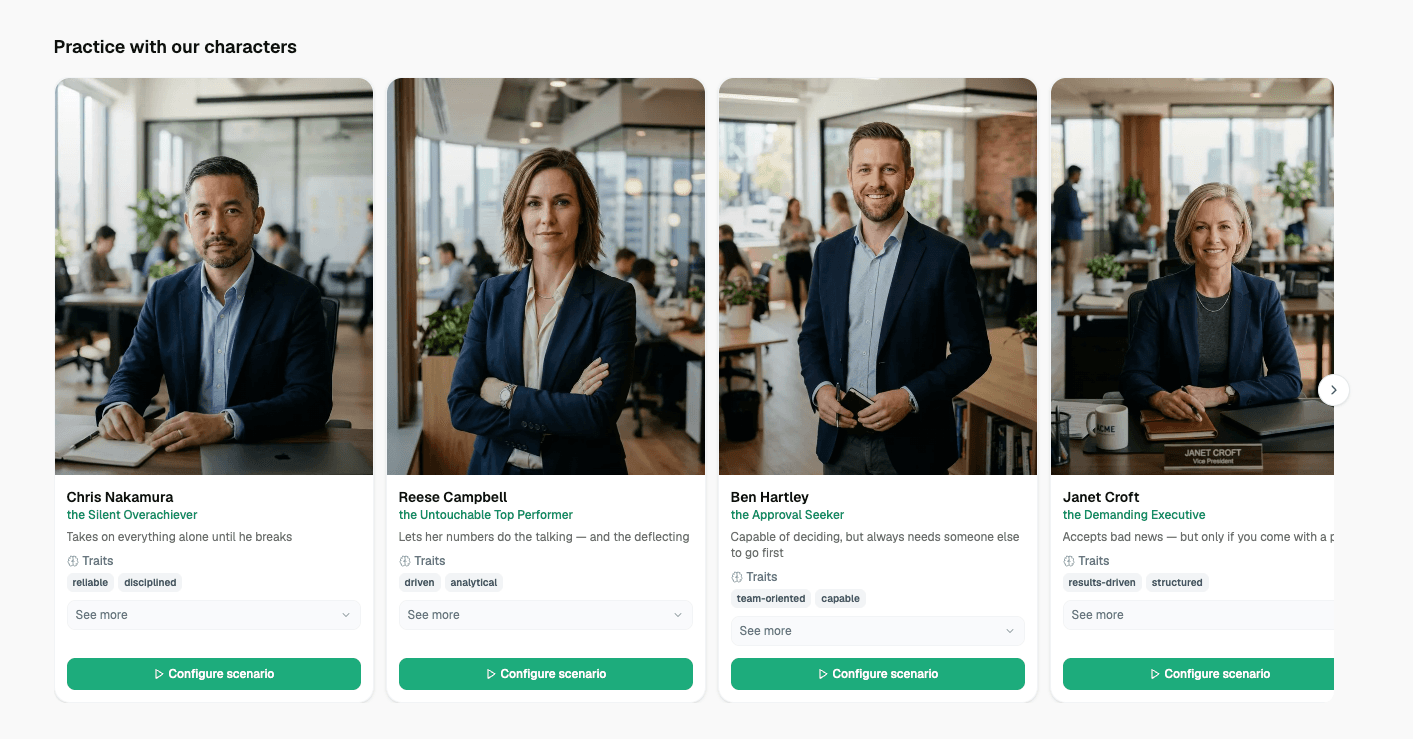
Train leadership skills with ISFP characters

Break the pattern of sick leave notifications.
mit Petra Hoffmann
Petra has been a reliable employee at the company for 14 years. However, a pattern has emerged over the past 12 months: 19 days of absence across 11 sick leaves, 8 of which were on Mondays or Fridays, and 6 occurred before important presentations or deadlines. Last Friday, she called in sick with a migraine—just one day before a critical client presentation she had prepared. Her colleague stepped in and reported incomplete documentation. Three weeks ago, she was absent on a Monday due to back pain, after discussing the stressful upcoming project the previous Thursday. Yesterday, a colleague approached you, saying, "Petra is great, but the team is constantly covering for her absences. We are exhausted." A year ago, Petra had only 4 days of absence. The medical certificates have always been accurate. You have scheduled a meeting with her today at 2:00 PM.
Goal as a Leader
Address the noticeable pattern of sick leave empathetically yet clearly. The goal is to encourage Petra to reflect on the connections between stress/overwhelm and physical symptoms. Together, we will find solutions for reducing stress instead of resorting to sick leave. Communicate clear expectations while also offering support.

Productively overcoming conflict avoidance.
mit Florian Beck
Florian nods in meetings to everything, remains silent during critical decisions, and only expresses concerns later in the hallway. Last week, he approved the new process change despite recognizing significant implementation issues. Three days later, those very problems surfaced—incurring additional costs and delays. "I didn't want to upset anyone," was his explanation. Yesterday, in the strategy meeting, he again nodded silently, while his expression clearly showed doubt. A colleague approached you afterward: "Florian has important objections but doesn't dare to voice them." You have scheduled a conversation with him today at 2:00 PM.
Goal as a Leader
Encourage Florian to express his professional concerns directly and to understand that constructive criticism is a sign of professionalism, not confrontation.
Frequently Asked Questions
How do I have a difficult conversation with an ISFP?
Start the conversation in a private and calm setting, making specific observations without accusations, and acknowledge their creativity and values. Ask for their perspective, offer concrete, flexible solutions, and agree on clear, small steps with set deadlines to ensure they feel secure.
How do I motivate an ISFP employee?
Give the ISFP space for creative independence and responsibility within clearly defined tasks to harness their creativity, harmony, and authenticity. Provide feedback privately and positively, avoid public confrontations, and offer simple structural aids such as clear deadlines and brief check-ins to support adjustments and implementation effectively.
How do I handle conflicts when an ISFP is involved?
Address the individual calmly and personally, specifically mention the observed behavior, and inquire about their feelings to ensure they feel heard and authentic. Allow them space to process, offer two concrete action options with clear next steps, and establish gentle, clear boundaries instead of applying pressure.
How do I conduct a coaching conversation with an ISFP?
Create a calm and appreciative atmosphere, listen actively, and inquire about their values and creative ideas instead of pressuring them. Allow the individual some decision-making freedom, provide a few clear steps with a flexible structure, and schedule brief, regular feedback sessions without pressure.