careertrainer.ai
LeadershipSalesInterview

Skill Gap Analysis for Leadership and Sales

Make competency gaps visible – based on real conversations, not gut feelings

Careertrainer.ai identifies skill gaps not through questionnaires, but by analyzing your actual conversational behavior during training. Each evaluated conversation contributes to a robust competency profile: per skill, per user, per team. This allows you to see which skills need improvement, where development has stalled, and which training sessions are most beneficial next. This is particularly relevant for teams: instead of providing uniform training for everyone, you can tailor coaching, learning paths, and training time to address the real gaps.

Live example · This is what training looks like

30 scenarios
Live audio

Your own scenario

Reese Campbell

Reese Campbell

Leadership
the Untouchable Top Performer

Senior · 37 · ENTJ

Cross-industry

Coaching: The High Performer Who Thinks Feedback Doesn't Apply to Them

Your top performer's behavior just triggered an HR escalation. Can you make her see that numbers aren't everything?

Reese Campbell is your top performer with the highest output and best client reviews. However, she consistently dismisses developmental feedback, claiming her numbers justify her methods. Now, two junior team members have filed complaints with HR regarding her dismissive communication style and lack of documentation. You must address this behavioral issue directly without minimizing her achievements or letting her deflect.

Goal: Deliver direct feedback about the HR complaints and secure her commitment to change her communication style.

Practice with Reese Campbell — it’s free

What Skill Gap Analysis & Competency Tracking offers

Discover the key capabilities and how they enhance your training.

Competence profile from real training conversations

Each completed session is automatically evaluated and incorporated into your skill profile. This creates a record based on actual conversational behavior rather than self-assessment.

Evaluation based on conversation rather than questionnaire

The foundation consists of evaluated training sessions.

Skills are continuously updated for each user.

70/30 Evaluation Model

The skill gap analysis combines scenario-specific goal achievement with universal baseline competencies, ensuring that the evaluation is both situational and comparable.

70% scenario performance

30% baseline competencies

Comparable development across various conversations

User Snapshots per Skill

For each skill, you can see the average score, the most recent score, the number of sessions, and development over time. This makes progress and stagnation immediately apparent.

Average Score and Last Score per Skill

Session Count per Competence

Trends over 7 and 30 days

Team Dashboard for HR and Leadership

At the team level, competency values can be aggregated, compared, and filtered. This allows you to identify patterns across departments, locations, or teams.

Team and Department Comparison

Filter by group, location, or area

Optional anonymized evaluation

Targeted Learning Recommendations

The system actively utilizes weaker competencies for the next training recommendations. This transforms analysis directly into concrete training management.

Recommended scenarios based on weakest skills

Continuous learning instead of one-time training

Meaningful prioritization of the next training steps

Separate categories for Leadership and Sales

Leadership and sales competencies are not mixed. This ensures that reports for each role remain professionally distinct and practically applicable in everyday situations.

Leadership skills managed separately

Sales skills managed separately

No mixing of different conversation logics

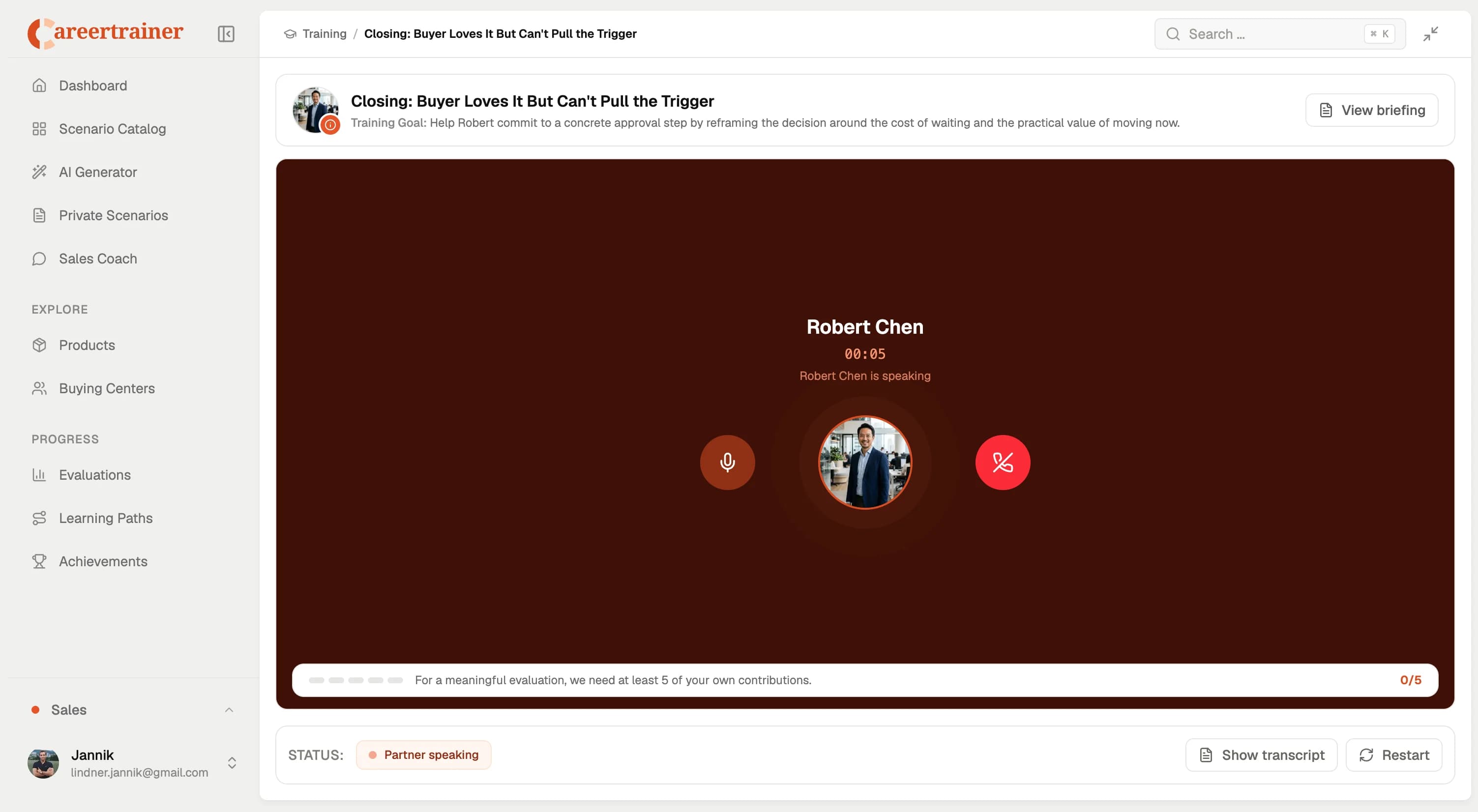
Inside the product

See how it works in practice

A look inside the platform — straight from real training sessions.

At a glance

Everything you need to know about the audience, use cases, and what makes Skill Gap Analysis & Competency Tracking special.

Who is this for?

For HR teams, sales enablement, team leaders, executives, and individual users who want to systematically measure and develop conversation skills.

Typical Use Cases

  • Skill Gap Analysis for a Sales Team Before a Quarter Start
  • Identify competency gaps in new leaders after onboarding
  • Derive training needs instead of relying on gut feelings for HR budget planning.
  • Make objection handling, empathy, or conversation management measurable over time.
  • Compare junior and senior teams by skill level
  • Before workshops, assess which topics are genuinely weak within the team.
  • Derive individual coaching focuses from real training data
  • See personally which communication skills have stagnated for you recently.

Right for you if...

  • Right for you if you want to identify training needs based on data rather than subjectively.
  • Right for you if you want to evaluate leadership and sales separately.
  • Especially for teams that want to distribute coaching strategically rather than uniformly.
  • Especially for companies that need to justify conversation training to management or HR.
  • Right for you if you want to track your personal development per skill over weeks.

What sets us apart

Unlike traditional training, e-learning, or self-assessments, the skill gaps here arise from real conversation simulations with AI evaluation. You measure not knowledge about communication, but observable behavior in conversations. Unlike isolated role plays without progression, Careertrainer.ai aggregates results over time, differentiates by training types, and makes individual as well as team-wide developments immediately usable.

Measurability instead of self-assessment

70/30

Evaluation Logic

We not only see who has trained, but also which skills have truly improved – and where we need to make targeted adjustments.

Team Lead Learning & Development · Careertrainer.ai Customer Team

AI Character Library

Practice with realistic personalities

Every employee is different – and reacts differently to feedback. Our characters are built on scientifically validated personality models and simulate realistic conversation dynamics: from the insecure junior employee to the critical senior developer.

Every character reacts differently

Thomas Weber

Thomas Weber

The skeptical IT decision-maker

IT & Cybersecurity

Analytical and slightly defensive – defends his team even though he knows NIS2 can't be managed alone.

references internal know-howblocks external solutionswants complement not replacement
Introverted
Extroverted
Detail-oriented
Conceptual
Analytical
Emotional
Structured
Flexible
Karin Weber

Karin Weber

The self-sacrificing helper

Healthcare

14 years in intensive care, on the verge of burnout. Can't say no and perceives exhaustion as failure.

always takes extra shiftsfeels guilty when setting boundariesdefines herself through helping
Introverted
Extroverted
Detail-oriented
Conceptual
Analytical
Emotional
Structured
Flexible
Dr. Anna Berger

Dr. Anna Berger

The ambitious part-time returner

Healthcare

Excellent senior doctor returning with a part-time request. Fears part-time will be seen as a career brake.

emphasizes capabilityimmediately sets perception boundariesseeks creative solutions when understood
Introverted
Extroverted
Detail-oriented
Conceptual
Analytical
Emotional
Structured
Flexible
Tobias Kern

Tobias Kern

The frustrated existing customer

After-Sales & Service

System hasn't worked for 3 weeks – threatens legal action. Doesn't want apologies, wants a solution with a date.

threatens legal actiondemands concrete deadlinerejects excuses
Introverted
Extroverted
Detail-oriented
Conceptual
Analytical
Emotional
Structured
Flexible
16+
Different Personality Types
50+
Realistic scenarios
24/7
Available for training anytime

Choose your plan

Transparent pricing for you alone or your whole team. Enterprise and White Label kept separate – clearly split, no jargon.

Still have questions? We're happy to advise you. Contact Us

FAQ

Frequently Asked Questions

What exactly is a skill gap analysis in Careertrainer.ai?

A skill gap analysis shows you which conversational skills are well developed and where gaps still exist. At Careertrainer.ai, this analysis is based not on self-assessments but on your actual training conversations.

Each evaluated session contributes to a competency profile. This allows you to see, for example, whether your objection handling is improving, your conversation management remains stable, or your empathy is declining in comparison. This is significantly more reliable than a questionnaire, as it measures your behavior in conversation rather than your feelings.

How is the competency profile created for me or my team?

The competency profile is built from all completed and evaluable training conversations. Requirements include a valid conversation, a duration of at least one minute, and sufficient personal contributions for the AI to evaluate meaningfully.

The evaluation follows a 70/30 model: 70 percent pertains to goal achievement in the specific scenario, while 30 percent covers universal baseline skills such as listening, conversation management, or needs analysis and objection handling in sales mode. Over multiple sessions, this results in a progression for each skill, per user, and upon request for entire teams.

What skills are measured in leadership and sales?

It depends on the training mode. In the leadership area, Careertrainer.ai evaluates aspects such as active listening, empathy, conversation management, solution orientation, and communication clarity.

In sales, a separate rubric is used, including needs analysis, value communication, objection handling, and sales conversation management. This is important because effective leadership conversations operate under different patterns than effective sales conversations. The skill gap analysis remains professionally sound and truly valuable for your coaching or reporting.

Is the skill gap analysis more beneficial for teams or also for individuals?

Both are beneficial, but the team advantage is particularly significant. For individuals, the analysis helps you track your own development over time and focus on improving weaker competencies.

For teams, it becomes strategically valuable: HR, Sales Enablement, or team leads can identify recurring gaps and determine where training is truly effective. This way, you don't have to send everyone to the same seminar; instead, you can target support for the teams or individuals who need assistance with specific communication skills.

How does this differ from traditional e-learning or a communication test?

Classic e-learning primarily tests knowledge: you read content, watch videos, or answer questions. Communication tests and self-assessments usually capture your self-perception. Both are useful, but they only provide limited insight into how you truly react under conversational pressure.

Careertrainer.ai, on the other hand, measures your behavior in simulated live conversations. This approach makes skill gaps more apparent in practice. You not only see if you theoretically know how to handle objections or give feedback, but also whether you actually implement it in conversation.

When are the skill gap data truly meaningful?

The more evaluated sessions are available, the more reliable the picture becomes. After a few conversations, you can identify initial trends, but no stable development is evident yet. A larger data set is significantly more useful for making informed statements.

Practically, this means: Three sessions can provide a hint, while twenty sessions clearly show whether a skill is genuinely weak or if it was just a snapshot. Careertrainer.ai is particularly effective when training is used regularly rather than sporadically. This way, trends, strengths, and real development gaps become visible.

Can I derive specific training measures from the skill gap analysis?

Yes, that’s exactly what it’s designed for. The analysis should not only display scores but also help you determine the next meaningful training steps.

If a team consistently performs poorly in price negotiations or feedback discussions, you can specifically plan suitable scenarios, learning paths, or coaching slots for that. Individual users can see which skill they should train next. This transforms reporting into actionable training management instead of a pretty but meaningless statistic.

What metrics do I see in the team dashboard for skill gap analysis?

In the team dashboard, you can view average competency levels per team or department, training activity over time, and developments in individual skill areas. Depending on the setup, comparisons between groups or locations are also possible.

This is particularly useful if you want to manage training investments rather than just coach individual employees. For instance, you can identify if a particular area is receiving a lot of training but is stagnating in a core skill. Such patterns will help you design workshops, coaching sessions, and leadership discussions more effectively.

Are there export or reporting options available for HR and management?

Yes, the skill gap analysis is not only intended for platform viewing. Team data can be exported for further analysis or management reporting, such as in CSV, Excel, or PDF formats. For larger setups, API integration is also relevant.

This makes Careertrainer.ai suitable not only as a training tool but also as a data foundation for personnel development and sales enablement. You can document developments, justify training needs, and make progress transparent without having to manually consolidate various sources.

Can a training provider use the skill gap analysis for leadership or sales training under their own brand?

Yes, this is a significant advantage of Careertrainer.ai. If you offer leadership or sales training for clients, you can use the platform in a partner or white-label context as your own solution, rather than working with a third-party tool.

Especially in skill gap analyses, this is powerful because you not only provide training to your clients but also deliver traceable development data. You maintain your own client relationship and use Careertrainer.ai as an enabler in the background – not as a direct competitor for the same end customer.

Related features

Other features from Careertrainer.ai

Discover more features that fit this topic.

AI Coach – Your sparring partner for the conversation scheduled for tomorrow
LeadershipSales

AI Coach – Your sparring partner for the conversation scheduled for tomorrow

No waiting time for coaching appointments. No hesitation about seemingly silly questions. Describe your situation—whether it's a challenging employee conversation, a stalled price negotiation, or an escalated customer case. The AI Coach knows your strengths and weaknesses from previous training and provides you with immediately actionable recommendations. And if you wish, you can practice the situation directly in a role-play.

AI Role-Play Generator for Leadership, Sales, and Customer Communication
LeadershipSales

AI Role-Play Generator for Leadership, Sales, and Customer Communication

Facing a challenging conversation and can't find a standard scenario that fits? With the Role-Play Generator from Careertrainer.ai, you can describe the situation just as you would to a colleague. This creates a complete training role-play featuring a realistically responding AI conversation partner, relevant actions, clear learning objectives, and automatic evaluation. Unlike generic AI tools, you’re not just building a prompt here; you’re creating a trainable scenario with psychological depth, MBTI-based personality insights, underlying conversation logic, and measurable assessment criteria. This is especially valuable for leaders preparing for sensitive employee discussions, sales teams dealing with product-specific customer situations, HR professionals focused on onboarding and leadership development, and training providers looking to offer customized role-plays under their own brand.

AI Role-plays – Practice the conversation before it happens
LeadershipSales

AI Role-plays – Practice the conversation before it happens

Difficult conversations often go awry because they can't be practiced in advance – until now. Our AI role-plays provide you with an interlocutor that behaves like a real person. It has its own personality, beliefs, and responds to what you say – not according to a script. In empathetic dialogue, it opens up; under pressure, it shuts down. Afterwards, you receive specific feedback: what went well, what didn't, and how a professional would have handled it. Ideal for leadership discussions, sales, customer communication, and job interviews.

Data Protection & GDPR Compliance
LeadershipSales

Data Protection & GDPR Compliance

Training conversations involving sensitive data requires the highest security standards—whether for sales discussions, customer service simulations, or leadership training. Careertrainer is designed from the ground up to meet German and European data protection requirements.

Evaluate conversations with AI – receive objective feedback after every training session.
LeadershipSales

Evaluate conversations with AI – receive objective feedback after every training session.

After each training conversation, a separate, independent AI system evaluates your conversational skills. Not your conversation partner, but a distinct system that objectively analyzes your performance. You receive immediate feedback on what you did well, where you can improve, and how an experienced coach would have approached the situation. This includes specific scores, direct text excerpts as evidence, and actionable professional tips to implement.

Leadership development with AI for HR teams
Leadership

Leadership development with AI for HR teams

Careertrainer.ai helps you make leadership development practical, planned, and measurable. Instead of one-off training sessions, your leaders practice real employee conversations through live audio role-plays: feedback discussions, conflict resolution, development conversations, separation situations, or remote leadership. HR receives reliable data on usage, skill gaps, and progress across teams, locations, and levels. This way, you complement seminars and coaching with a scalable practice space where leaders train the conversations that truly matter in everyday situations.