Feature · Corporate Management

Corporate Management for AI Training

Manage branding, scenarios, and evaluations centrally across teams, locations, and roles.

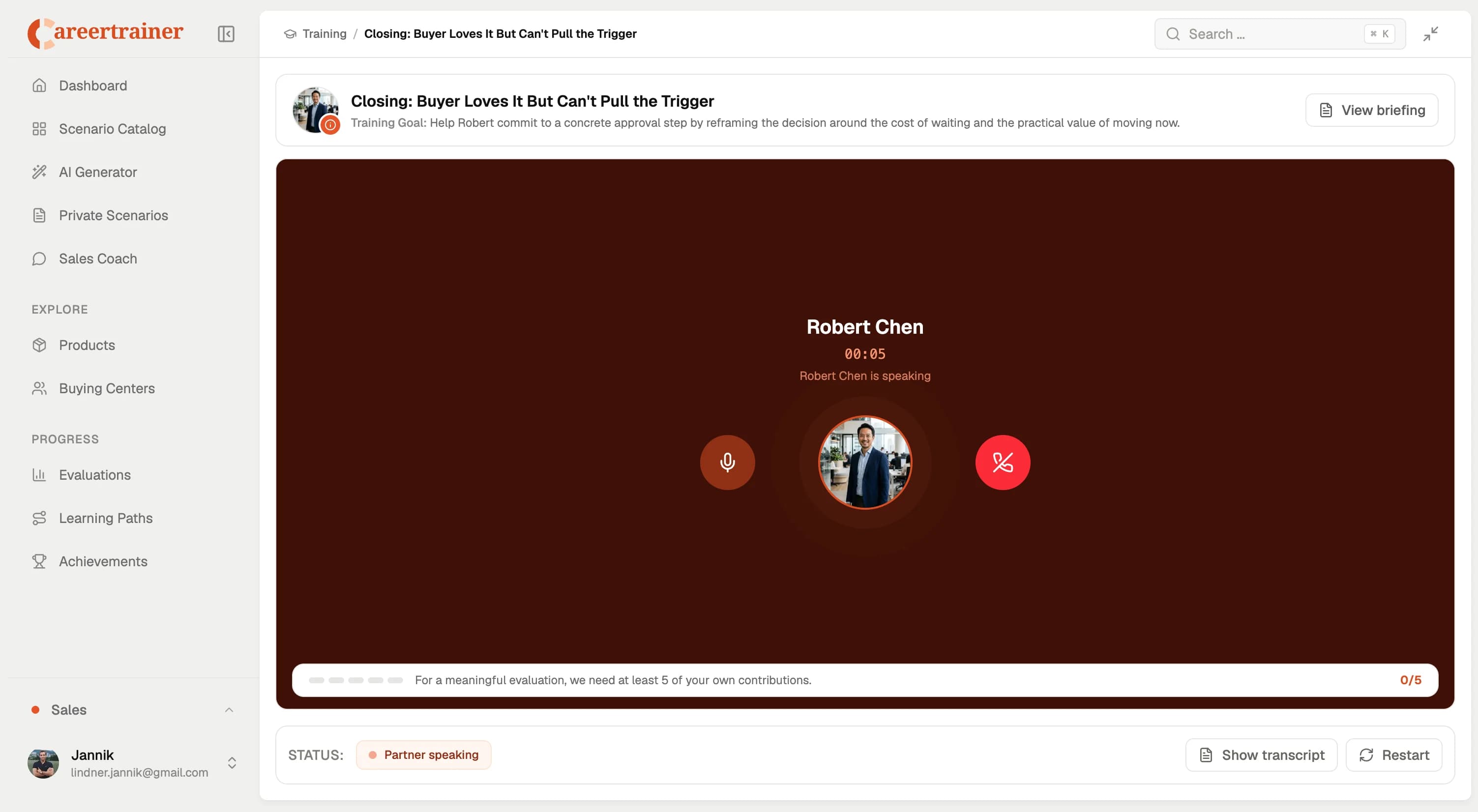
To make AI conversation training effective in your organization, you need more than individual access. With Careertrainer.ai's Enterprise Management, you can centrally control which scenarios are visible, which company-specific training cases are deployed, and how the experience appears to employees under your brand. At the same time, you can monitor training activities across your organization, identify skill gaps, and determine where additional enablement is needed. This way, you combine self-directed practice for individual employees with clear governance for HR, Sales Enablement, and leadership.

Start conversationLeadership · Coaching: The High Performer Who Thinks Feedback Doesn't Apply to Them
Reese Campbell

Reese Campbell

Senior

  • Cross-Industry

Your task

Deliver direct feedback about the HR complaints and secure her commitment to change her communication style.

Also available:+25 more

What's inside

What Corporate Management can do

Company Branding

You can customize the training experience to align with your corporate brand, allowing employees to perceive the platform as an integral part of your learning and enablement environment.

Logos and visual elements are centrally managed and consistently displayed for all members of the organization. This creates a seamless presentation without any media disruptions, which is especially beneficial for internal rollouts across multiple teams or locations.

  • Central storage of company logo and primary color
  • Consistent branding for all members of the organization
  • Stronger internal trust, as the training is an integral part of your learning ecosystem.

Catalog Curation

You control which standard scenarios are visible to your employees, rather than releasing the entire catalog unfiltered.

This allows you to create a curated access experience tailored to your target audience, rollout phase, or training focus. Employees can quickly find the relevant conversations, and you ensure that strategically important standards do not get lost in an overwhelming selection.

  • Release of a complete or selectively curated scenario catalog
  • Focus on relevant conversation types for specific roles or programs.
  • Less time spent searching and quicker orientation for employees

Corporate Scenarios

With company-specific scenarios, you can integrate your own products, conversation standards, values, and typical real-life situations directly into the training.

These scenarios are centrally created and provided, making them accessible across the organization for eligible teams. This way, employees not only practice general conversation patterns but also recurring situations from your actual work environment.

  • Showcase your own products, objections, guidelines, or leadership scenarios.
  • Company-wide approved scenarios for consistent training standards
  • Higher relevance through industry-specific and company-specific context

Company Analytics

Gain an organization-wide view of usage, activity, and potential areas for improvement, rather than just insights into individual training sessions.

This allows you to identify which teams are actively training, where adoption may be lagging, and in which areas additional enablement may be needed. This clarity simplifies prioritization, management, and tracking of rollouts across multiple units.

  • Overview of Usage and Activity at the Company Level
  • Visibility into which teams are actively engaging with the training
  • Early identification of skill gaps or stagnant areas

Who is Corporate Management for?

For users

For HR, L&D, and People teams looking to transform challenging leadership and employee conversations into repeatable training standards.

For Sales Enablement, sales leadership, and revenue teams that need to consistently enhance conversation quality across multiple AEs, regions, or business units.

For academies, internal enablement leads, and department heads aiming to scale from pilot groups to a structured rollout.

For growing mid-sized companies and enterprises with diverse role profiles that require tailored scenarios, governance, and organization-wide transparency.

Typical moments for Corporate Management

Other moments

You are implementing a new discovery standard in sales and want all Account Executives to practice the same conversation structure, core questions, and typical objections before engaging in real customer meetings.

Your People Team wants to standardize return, feedback, and conflict conversations, allowing leaders to practice sensitive situations under the same guidelines before the actual discussion.

After a reorganization, every new leader should train critical conversations such as performance decline, role clarification, or expectation alignment using a standardized approach.

You have your own products, values, or compliance requirements and want to create specific scenarios that are immediately available to authorized teams across the organization.

You want to see which locations or teams are consistently training, where closing rates, feedback, or questioning techniques are stagnating, and where additional enablement efforts are needed.

You begin with a pilot area and need a structure that can be seamlessly scaled to additional teams, functions, or countries later on.

When Corporate Management fits — and when it does not

Fits when …

Ideal if you want to manage conversation training for multiple teams, roles, or locations with consistent standards.

Ideal for translating your own products, conversation guidelines, or sensitive discussion scenarios into central training scenarios.

Less effective when there is no one internally responsible for releasing scenarios, assigning roles, or actively managing training focuses.

Does not fit when …

Less suitable for individuals who want to practice spontaneously on their own and do not require centralized curation, governance, or company-wide evaluation.

Not suitable if you're only looking for a static LMS with content to read, quizzes, or checklists, but no live conversation simulations.

How Careertrainer is built

Practice, not courses. Careertrainer.ai trains conversations. E-learning and courses are the better choice for transferring knowledge.

Simple, so people use it. Ready in minutes, in the browser, without an IT project. Sessions of 5–15 minutes fit into any working day.

Leading language models, not an in-house model. Careertrainer.ai integrates leading models from external providers and switches when a better one becomes available. The subprocessors list shows which providers are used.

Frequently asked questions about Corporate Management

What does corporate management mean at Careertrainer.ai?

<p>Managing your organization means not just enabling AI conversation training, but actively controlling it.

You determine how the platform appears for your employees, which standard scenarios are visible, which custom company scenarios are deployed, and how you track usage and skill development at the organizational level.</p><p>This is especially important when multiple teams, locations, or role profiles are involved in training. Instead of an open tool without guidelines, you create a manageable training system: employees practice live audio conversations independently, while HR, Enablement, or leadership provide centralized content direction.</p>

Which companies benefit most from centralized management of AI conversation training?

<p>It's especially beneficial for companies that want to ensure conversation quality rather than leaving it to chance.

Common triggers include expanding sales teams, multiple leadership levels, new standards for feedback or conflict discussions, reorganizations, or planned rollouts across various locations.</p><p>When different teams need to train on the same critical conversation types but require clear guidelines and their own terminology, centralized management becomes essential. For an individual or very small, informal setups, this may be excessive. However, for mid-sized and enterprise organizations with governance, scaling, or reporting needs, it is much more suitable.</p>

How does corporate management help me implement consistent conversation standards in sales or leadership?

<p>You can specifically highlight the scenarios that are strategically important for certain roles or teams.

In sales, this might include a new discovery approach, handling objections, or negotiation techniques. In leadership, it could involve return-to-work conversations, delivering critical feedback, or conflict resolution.</p><p>This way, employees are not just training on any scenario, but rather on the conversations that align with your current objectives. This reduces variability, accelerates the rollout of new standards, and ensures that teams practice using the same conversation guidelines, rather than diverging through multiple individual training sessions.</p>

How does the setup and rollout typically work?

<p>The journey begins with a clear vision: Which roles should be trained, what types of conversations are critical for your business, and which standard or company-specific scenarios should be prioritized?

After that, you can set up your branding, curate your catalog, and, if needed, create your own scenarios.</p><p>Many companies start with a pilot team before expanding to other areas. This approach is beneficial as it allows you to quickly assess usage, acceptance, and content relevance. It's less about launching a large IT project and more about making a strategic decision: Who will be responsible for training standards, approvals, and subsequent evaluations? Once this responsibility is clearly defined, the rollout can be structured more effectively.</p>

What internal prerequisites should I establish before implementing this company-wide?

<p>Clear responsibilities and a realistic focus at the outset are crucial.

You should determine who will select or approve scenarios, which target groups will train first, and how you will measure success—such as usage, completion of specific scenarios, or visible skill gaps.</p><p>It’s also beneficial if you can identify typical conversation situations, such as discovery calls in sales, delivering critical feedback in leadership, or handling sensitive return-to-work discussions in a people context. You don’t need a large technical project for this, but you do need a content owner. Without curation and accountability, even a great training tool can quickly fall short of its potential.</p>

What sets Careertrainer.ai apart from traditional seminars, e-learning, or manual role-playing?

<p>Traditional seminars can be sporadic, costly to repeat, and challenging to scale.

E-learning provides insights into conversation techniques, but it cannot replicate the experience of speaking under pressure. Manual role-playing with trainers or colleagues is valuable, yet it often involves significant organizational effort and inconsistent quality.</p><p>Careertrainer.ai fills this gap: you can practice authentic live audio conversations in just 5 to 15 minutes, as often as you like, without the need for scheduling. At the same time, your organization gains centralized control over scenarios, branding, and evaluations. Unlike generic chatbots, you won't just be training on text dialogues; you'll engage in realistic conversation situations with measurable responses, reactions, and competency feedback.</p>

Can we create custom scenarios for our products, values, or conversation guidelines with company management?

<p>Yes, this is where our platform truly excels.

If you have specific products, common objections, internal conversation standards, or sensitive leadership scenarios, we can create tailored company-specific scenarios that are centrally provided to your teams.</p><p>The advantage is that employees train not with abstract examples, but in your language and context. This significantly enhances relevance, especially for sales organizations with complex offerings or companies that align leadership and feedback conversations with their core values. This transforms general role-play into a trainable company standard.</p>

What types of analytics will I receive at the corporate level?

<p>At the organizational level, the focus is primarily on usage, activity, and the need for action.

You can identify which teams or departments are consistently training, where activity is declining, and in which competency areas additional support may be beneficial.</p><p>This insight is invaluable if you want to not only offer training but also manage it strategically. Instead of waiting for individual feedback or manual trainer reports, you gain a clearer understanding of where adoption is successful and where improvements are needed. For HR, Sales Enablement, and department leaders, this combination of decentralized practice and centralized visibility often makes all the difference.</p>

How should I evaluate the budget and selection for a centralized conversation training system?

<p>When evaluating a tool, it's not just about the price; it's also about the effort it saves or reduces.

If you're currently relying on seminars, shadowing, trainer alignments, or unstructured role-plays, you should consider scalability, repeatability, governance, and measurability.</p><p>Four key questions can guide your selection process: Can you create custom scenarios that reflect your context? Is the catalog for roles and teams easily manageable? Do you gain central transparency instead of just individual training sessions? And can employees practice immediately without significant organizational effort? If these factors are important, a centrally managed system is often more cost-effective than numerous isolated training initiatives.</p>

Can training providers or consultancies use Careertrainer.ai as a white-label solution for corporate management?

<p>Yes, this is possible and particularly relevant in the context of company-wide conversation training for sales, leadership, or internal academies.

If you are a training provider, consultancy, or enablement partner looking to offer standardized role-plays under your own brand, a white-label or partner model makes sense. This approach ensures you provide not only content but also a consistent user experience for your clients.</p><p>This is especially important when you assist companies in rolling out conversation standards and want to enable scalable practice between workshops, coaching sessions, or enablement programs. By doing so, you combine your expertise with a platform that supports live audio training, curation, and centralized management.</p>

Related features

Other features from Careertrainer.ai

Discover more features that fit this topic.

Account & Security with Real Control
LeadershipSales

Account & Security with Real Control

When you train with realistic AI role-plays, it's essential that not only the conversations are on point, but also the surrounding conditions. Careertrainer.ai gives you control over sensitive access through two-factor authentication, ensures linguistic compatibility in the DACH region with language and dialect options, and manages the entire lifecycle of your account, including complete deletion. This is particularly important for individuals looking to get started quickly, teams managing multiple roles, or companies and partners prioritizing robust security and self-management features before a rollout.

AI Coach
LeadershipSales

AI Coach

Before important conversations, there is often a lack of a clear next practice step, and after the role play, questions about the evaluation remain open. Four AI coaches accompany you via voice or text, clarify the situation, and build a suitable role play after your confirmation. Afterwards, you discuss the evaluation results, criteria, transcript, and professional tips, and track up to three focus competencies.

AI Role Plays for Difficult Conversations
LeadershipSales

AI Role Plays for Difficult Conversations

Before a difficult conversation, there is often no opportunity to practice your opening under realistic pressure. In a spoken role-play, an AI character responds to your arguments; a conversation lasts 5–15 minutes. Afterwards, a second AI evaluates the transcript with quotes, and you can repeat the same situation as many times as you like.

Company Profile: AI Role-Playing Games with the Knowledge of Your Company
LeadershipSales

Company Profile: AI Role-Playing Games with the Knowledge of Your Company

If practice cases miss the offer, customer types, and tone of conversation, the connection to your own company is lacking. The profile organizes confirmed company knowledge for all four training areas and feeds it into the scenario generator, conversation figure, and evaluation. Only after your confirmation do profile contents flow into the training and shape conversations with the context of your company.

Try Corporate Management now

Start your first AI role-play and practice the exact situation you need next.