Evaluation that measurably improves conversations

Feedback backed by quotes from your own conversation – scored by a second AI, not the one you just spoke with.

Careertrainer.ai deliberately separates role-play and evaluation into two systems: one AI runs the conversation, a second one scores it independently against your goals and your actual dialogue. Whoever just played resistance, emotion, or buying interest cannot judge your behavior neutrally. The result is not a blanket comment but a traceable evaluation on a 0–10 scale – with quote-backed evidence, competency scores, and concrete levers for the next run. This is especially strong in sensitive leadership, sales, and negotiation conversations, where tone, timing, questioning technique, and response to pushback decide the outcome.

Live trainingSales

Practice with your case

Cross-industry · Live audio

Coaching: The High Performer Who Thinks Feedback Doesn't Apply to Them

Reese Campbell

Reese Campbell

the Untouchable Top Performer

Reese Campbell is your top performer with the highest output and best client reviews. However, she consistently dismisses developmental feedback, claiming her numbers justify her methods. Now, two junior team members have filed complaints with HR regarding her dismissive communication style and lack of documentation. You must address this behavioral issue directly without minimizing her achievements or letting her deflect.

Practice now

3 free training conversations per month · no credit card · servers in Germany

What's inside

What Feedback & Evaluation includes

After every conversation you get specific, traceable feedback – backed by quotes from your own dialogue, not generic statements. Scored by a second, independent AI.

Dual-AI evaluation

Role-play and evaluation run deliberately separately: one AI takes the conversational role, a second one independently analyzes how you led the conversation. The reason is simple: whoever just played resistance, frustration, or buying interest cannot judge your behavior neutrally. Systems that blend both into one instance tend to produce friendly verdicts – and those don't help you.

Clean separation between conversation and evaluation

Independent scoring instead of self-assessment by the role-play AI

Traceable on delicate nuances like pressure, empathy, or objection handling

Comparable results across multiple people and runs
70/30 scoring

Scoring follows a clear 70/30 logic. 70% relates to the specific goals of the scenario, 30% to cross-cutting conversational competencies. This lets you see whether you failed at this one occasion or at a pattern that runs through all your conversations – two entirely different problems that most training programs blend together.

70% goal attainment in the specific scenario

30% recurring core competencies

Separates a situational problem from a competency problem

Enables targeted repetition with a single learning focus

Core competencies per training area

Different core competencies are scored depending on the training area, so the evaluation fits the conversation. Sales rewards different patterns than leadership or negotiation. Careertrainer.ai therefore doesn't score against one rigid template – you get feedback that sounds like your discipline, not like a generic communication grade.

Leadership: active listening, empathy, clarity, solution orientation

Sales: needs analysis, objection handling, closing strength

Negotiation: defending value, handling pushback, structure

Five core competencies per area, matched to the conversation context

Quote-backed feedback & pro tips

The evaluation doesn't just show scores; it backs every important point with a quote from your own conversation. That means you can verify each piece of feedback against a concrete moment – and disagree with it if you think it's wrong. This is complemented by concrete pro tips: not "be clearer", but an example sentence you can actually say in the next run.

Every score is backed by a passage from your conversation

You can verify the verdict instead of just accepting it

Pro tips give concrete example sentences, not platitudes

Especially valuable for phrasing, timing, and questioning technique

Only what you say is scored

An evaluation is only as good as its rules, so they are stated openly: only your own phrasing is scored – not that of your AI counterpart. If the AI persona is rude, unfair, or uncooperative, that does not count against your score; what counts is how you handle it. The AI's conversation opener is also never scored against you.

Only your own statements feed into the score

The AI counterpart's behavior does not count against you

The AI's conversation opener is never scored negatively

0–10 scale, with a clear interpretation instead of a bare number

A training instrument, not a monitoring one

As soon as conversations are scored, one question comes up immediately inside a company: who sees this? The answer is deliberately narrow. Managers, HR, and enablement see aggregated competency development at team level – not individual conversation logs. Your individual conversations and scores belong to you. That separation is what makes the tool workable in companies with works councils.

Managers see team-level aggregates, not individual logs

Not a basis for performance reviews or employment decisions

Works-council compatible: a training, not a monitoring instrument

Live audio is not stored; EU hosting

Share evaluations & reference conversations

Evaluations can be shared and discussed together, so learning doesn't stop at a single conversation. Teams can place a strong and a weak conversation side by side and build a shared quality standard from them – instead of arguing about what "a good conversation" even means. Sharing always originates with the learner, never with the manager.

Evaluations as a shared learning basis in the team

Reference conversations make the quality bar concrete

Supports coaching, debriefs, and team enablement

Sharing is initiated by the learner, not automatic

Who it's for

Who Feedback & Evaluation is for

For new and experienced leaders who want not just to practice feedback, conflict, return-to-work, or development conversations, but to improve them against clear evidence.

For sales reps, account executives, and presales teams who want to evaluate cold calls, discovery, demos, objection handling, or pricing conversations in a targeted way.

For procurement and purchasing teams who want to see, after a negotiation, exactly where they conceded too early or failed to defend their position.

For team leads, sales enablement, HR, and L&D in growing teams or larger rollouts who need consistent scoring logic without a live trainer in every session.

For consultancies, training providers, and partners who want to complement their methodology with traceable conversation evaluations or offer them under their own brand.

Typical use cases

Typical scenarios with Feedback & Evaluation

1

You are preparing a critical conversation with a defensive employee and want to check whether you stayed clear without creating unnecessary pressure or escalation.

2

You practice a B2B cold call and want to understand whether your opening was relevant enough or whether the prospect disengaged early due to unclear value.

3

You run a discovery conversation before an important client meeting and want to see whether you uncovered real needs or just worked through standard questions.

4

You simulate a price negotiation and want to pinpoint exactly where you conceded too early or failed to defend your value cleanly.

5

You conduct a return-to-work conversation in training and want feedback on whether your language was empathetic, structured, and solution-oriented enough.

6

You repeat the same conversation a second time with a different strategy and compare which phrasing actually held up better.

Inside the product

Feedback & Evaluation inside the platform

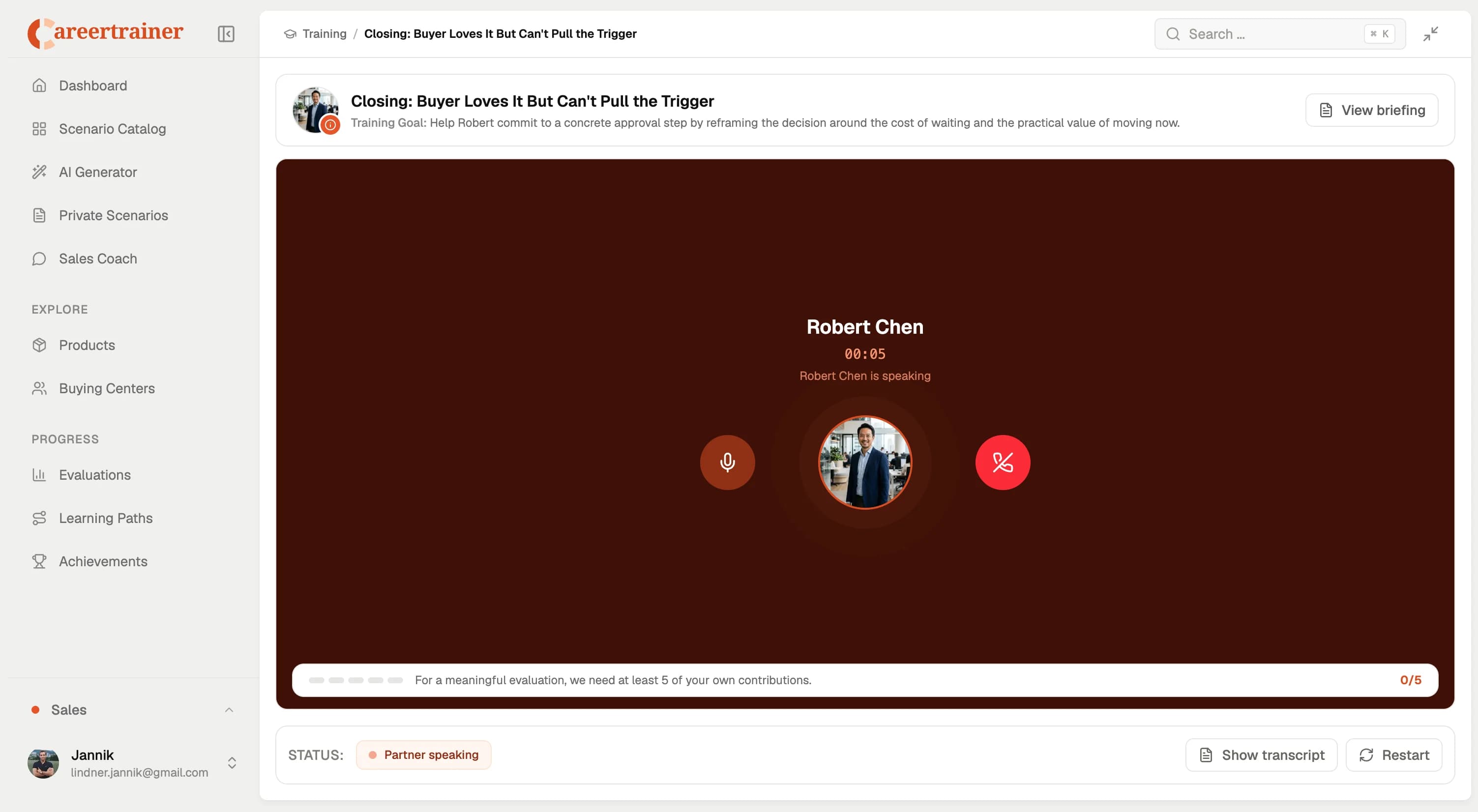
What Feedback & Evaluation looks like in real training — screenshots straight from the app.

What sets it apart

Why Feedback & Evaluation goes beyond standard training

01

One AI plays, another evaluates: the role-play AI is not simultaneously the judge of your performance. A chatbot grading its own conversation produces friendly but unreliable verdicts.

02

The 70/30 logic separates scenario success from core competencies: 70% measures whether you reached the specific conversation goal, 30% assesses cross-cutting skills like listening, structure, or objection handling.

03

Every piece of feedback is backed by quotes from your own conversation: you see not just the verdict but the phrasing that led to it – and you can disagree with it.

04

Only what you said is scored. The behavior of the AI counterpart and its conversation opener do not count against you.

05

Inside a company, the evaluation stays a training instrument, not a monitoring one: managers see aggregated competency development, not individual conversation logs.

In practice

Learning becomes tangible when feedback is verifiable

Scoring scale, backed by quotes

0–10

Honestly assessed

When Feedback & Evaluation fits — and when it doesn't

Feedback & Evaluation is right for you if …

  • Good fit if you need concrete evidence, scores, and next steps after a conversation rather than a vague gut feeling.
  • Good fit if you train sensitive leadership, sales, or negotiation situations repeatedly and want progress across runs to become visible.
  • Good fit if teams need consistent scoring logic without a trainer sitting in on every exercise.
  • Not a good fit if you only want theory, checklists, or knowledge tests and do not want to hold realistic live conversations.
  • Not a good fit if you want to replace a formal performance review for employment-law or compliance-critical decisions. The evaluation is training feedback, not a personnel assessment.
  • Not a good fit if your main focus is camera presence, body language, or facial expression – what is scored is the spoken conversation, not how you look on video.

Choose your plan

Transparent pricing for you alone or your whole team. Enterprise and White Label kept separate – clearly split, no jargon.

Feedback & Evaluation is included in all Team and Enterprise plans — from 2 seats, cancel anytime.

Still have questions? We're happy to advise you. Contact Us

FAQ

Common questions about Feedback & Evaluation

How does the AI conversation evaluation actually work?

After your role-play, the conversation isn't just summarized – it's evaluated against clear criteria. Careertrainer.ai deliberately separates conversation from evaluation: one AI runs the role-play, a second AI scores it independently against the scenario, your goals, and your actual dialogue.

You receive an overall score on a 0–10 scale, broken down into scenario goals (70%) and core competencies (30%), plus quotes from your own conversation and concrete pointers for the next run. So you see not just that something went well or poorly, but which phrasing, question, or reaction led there.

What happens if my score comes out low?

First: the scale is calibrated strictly. A 6 to 7 is a solid conversation, not a bad grade. Very high scores are deliberately hard to reach, because a scale on which everyone gets a 9 says nothing at all. If your first evaluation lands lower than expected, it usually doesn't mean you're bad at this – it means the bar is high.

In any case, what matters far more than the number is what sits underneath it. The score tells you nothing you could change. The quotes and pro tips do: they show you the one phrasing where the conversation tipped, and a concrete example sentence for the next attempt.

And the score stays with you. It doesn't land on your manager's desk and it is not a basis for personnel decisions.

Can my manager see my conversations and my scores?

No, not at an individual level. Managers, HR, and enablement see aggregated competency development at team level: where training is being used, which competency areas are developing, and where additional support would help. Individual conversation logs and individual scores belong to you.

This is a deliberate architectural decision, not a setting someone can flip by accident. Careertrainer.ai is built as a training instrument, not a monitoring one – and that separation is precisely what allows a works council to approve a rollout. If you want to discuss an evaluation with your manager or a coach, you can actively share it. The impulse comes from you.

In addition: live audio is processed in real time and voice recordings are not stored. Only the transcript remains for feedback – hosted in Germany or the EU.

What does the 70/30 scoring give me in practice?

The 70/30 logic separates two things most training programs blend together. 70% of the score relates to the specific goal of the scenario – whether you uncovered real needs in discovery, or led a critical conversation clearly and without escalation. 30% scores cross-cutting competencies like listening, structure, empathy, or objection handling.

The practical benefit: you immediately see whether your problem was with this one conversation type or with a pattern that follows you into every conversation. Those are two entirely different jobs. A weak pricing conversation alongside strong core competencies is a situational problem – weak core competencies across several conversation types is a competency problem and needs completely different training.

Is what the AI says also scored – or only what I say?

Only what you say. The evaluation refers exclusively to your own phrasing, questions, and reactions. The AI counterpart's behavior does not feed into your score.

This matters more than it sounds. If the AI persona argues unfairly, interrupts you, or stays uncooperative, that is not a flaw in the scenario – it is the task. What gets scored is how you handle it, not that it happened. The AI's conversation opener is never scored against you either.

The reverse is also true: a conversation that didn't reach your goal can still score well if you led it cleanly. And a conversation where you did reach your goal can lose points if you got there by applying pressure or burning trust.

Which conversations benefit most from feedback and evaluation?

The evaluation is most valuable in conversations where nuance decides the outcome: critical conversations, return-to-work discussions, cold calls, discovery, demos, objection handling, price negotiations, supplier conversations, or closing situations.

In those, a general "that was fine" or "be more empathetic" doesn't cut it. You need evidence-backed feedback on timing, questioning technique, clarity, response to resistance, and goal attainment – at the precise moment where it tipped.

The evaluation has less leverage when your conversation contains no real pushback. Where everything runs smoothly, there's little to score.

How is this different from seminars, e-learning, or generic chatbots?

Seminars and classic role-plays are one-off, expensive to repeat, and dependent on individual trainer capacity. E-learning conveys knowledge but not a conversation under pressure.

The most important difference, though, is with chatbots. A single AI system that first plays your counterpart and then grades you is essentially scoring its own interaction. That reliably produces friendly but unreliable verdicts – and the very moments where the AI itself caved too early go unnoticed.

Careertrainer.ai separates the two: live audio role-play with psychologically driven AI characters, then a separate evaluation AI with published rules, a fixed scale, and quote-backed evidence. That makes feedback verifiable rather than merely kind.

How long until I've had a first conversation with an evaluation?

Getting started is deliberately fast. Once your scenario is set, you're in your first live conversation within minutes. A typical training conversation runs 5 to 15 minutes, and the evaluation follows immediately.

For you that means: no long setup, no training center, no briefing with a role-play partner. This is especially strong right before a real client meeting or a difficult employee conversation, because you can practice at short notice and sharpen up against the evaluation immediately.

What do I need for a meaningful evaluation?

Above all, a clear conversational occasion. The more precisely the scenario matches your situation, the more precise the evaluation – because the 70% scenario goals can only be as good as the goals stored in the scenario. Helpful inputs: the goal of the conversation, the counterpart's role, typical objections, and the point where it usually gets critical.

Technically you need a device with a microphone, a quiet moment, and the willingness to actually speak out loud. Careertrainer.ai is built for live audio. If you only want a text evaluation, the benefit is much smaller – half the value of the evaluation sits in what happens when you speak and would never happen while typing.

Can I see progress across multiple runs with the evaluation?

Yes, that is exactly what it's built for. Instead of viewing a conversation in isolation, you can train the same occasion repeatedly and focus on exactly one lever – better needs questions, calmer reactions to pushback, clearer structure.

Because the feedback is anchored to scenario goals, fixed competencies, and concrete quotes, progress becomes comparable rather than anecdotal. You can see whether you actually got better – or whether you just felt better afterward. Those two are less often the same thing than people assume.

Is the evaluation only for individual training, or also for teams?

Both. Individuals use the evaluation to work on one concrete pattern before real conversations – objection handling, clarity, empathy. Teams use the same logic to make training comparable and to discuss strong and weak conversations properly.

For team leads, enablement, HR, or L&D, the shared standard is the real value. When everyone is scored against the same logic, a shared language emerges about what actually worked in a conversation – instead of a debate about whose style people prefer.

One caveat: at team level the data stays aggregated. A shared standard does not mean individual visibility.

Can training providers or consultancies use the evaluation under white label?

Yes. For training providers, consultancies, enablement partners, and platforms, the evaluation is often the more interesting part, because it delivers what a workshop alone cannot: evidence that something changed.

The leverage is in transfer. Between two live modules there is typically a gap in which nothing is practiced – and at the end of a program, often all that remains is an attendance list. With evidence-backed evaluation, you can instead show your client which competencies developed and where the next coaching phase should start.

What matters then is branding, embedding into the program, and rollout depth – not a generic off-the-shelf tool.

Related features

Other features from Careertrainer.ai

Discover more features that fit this topic.

Account & Security with Real Control
LeadershipSales

Account & Security with Real Control

When you train with realistic AI role-plays, it's essential that not only the conversations are on point, but also the surrounding conditions. Careertrainer.ai gives you control over sensitive access through two-factor authentication, ensures linguistic compatibility in the DACH region with language and dialect options, and manages the entire lifecycle of your account, including complete deletion. This is particularly important for individuals looking to get started quickly, teams managing multiple roles, or companies and partners prioritizing robust security and self-management features before a rollout.

AI Coach for Preparation and Reflection
LeadershipSales

AI Coach for Preparation and Reflection

The AI Coach is your text-based sparring partner before and after challenging conversations in leadership, sales, and negotiations. You bring a specific situation, outline your goals, risks, and challenging points, and receive not just general advice but precise follow-up questions, phrasing options, conversation structures, and actionable next steps. This transforms a vague scenario into a clear conversation plan. Unlike a standard chat, the Coach goes beyond text-based support; it helps you turn your preparation or follow-up into a trainable scenario and guides you directly into relevant voice role-plays, allowing you to practice critical passages aloud under pressure.

AI Role-Play Generator for Leadership, Sales & Negotiation
LeadershipSales

AI Role-Play Generator for Leadership, Sales & Negotiation

With Careertrainer.ai's role-play generator, you can create a tailored conversation training session in just minutes, designed specifically for your unique situation rather than relying on a generic template. Simply input the context, objectives, audience, product or company details, and typical objections, and our AI will generate a comprehensive scenario for leadership, sales, or negotiation. The result is not a static text block, but an interactive live conversation featuring a credible persona, appropriate difficulty level, and a clear focus on the dialogue. This allows you to practice the exact phrases, follow-up questions, and objections that are likely to arise in your real-life scenario.

AI Role-Play Training for Authentic Conversation Moments
LeadershipSales

AI Role-Play Training for Authentic Conversation Moments

Whether it's a termination conversation, handling price objections, delivering critical feedback, or navigating sensitive negotiations, you will train in real-life scenarios through realistic live audio role-plays with psychologically accurate AI characters. Instead of theory or text chat, you engage in real-time conversations, receive immediate, citation-backed feedback, and can revisit the specific moments where things often go awry in actual situations.

Corporate Management for AI Training
LeadershipSales

Corporate Management for AI Training

To make AI conversation training effective in your organization, you need more than individual access. With Careertrainer.ai's Enterprise Management, you can centrally control which scenarios are visible, which company-specific training cases are deployed, and how the experience appears to employees under your brand. At the same time, you can monitor training activities across your organization, identify skill gaps, and determine where additional enablement is needed. This way, you combine self-directed practice for individual employees with clear governance for HR, Sales Enablement, and leadership.

Flexible Plans for AI Conversation Training
LeadershipSales

Flexible Plans for AI Conversation Training

At Careertrainer.ai, our model adapts to your actual training needs rather than the other way around. You can first test a challenging conversation on your own, schedule regular practice through monthly quotas, manage training peaks with top-ups, and later roll out team-based training sessions. This way, your live audio conversation training grows alongside your usage, team size, and maturity level, without the need to commit to a rigid licensing model too early.