careertrainer.ai

Development conversations that truly foster growth – with AI-supported practical training.

Employee Development Software for Leaders

Your leaders train with realistic AI role-playing scenarios to recognize potential, outline career paths, and create individual development plans. From talent identification to targeted support – measurable and practical.

Live example · This is what training looks like

16 scenarios
Phone call

Practise with your situation

Casey Hayes

Casey Hayes

Leadership
The disengaged senior specialist

Long-tenured high performer · 43 · ISTJ

Cross-IndustryPriorisierungInnere KuendigungHigh Performer Langjaehrig

Calling out quiet disengagement in priority planning

Casey goes quiet on your development steps

Casey picks up your line during the lunch window and starts with, “So, what is this about?” You can hear they have checked out from recent priority changes.

Goal: Get Casey to describe what has been missing, using concrete examples rather than general complaints. Then agree on one small, binding change to reduce the mismatch and regain ownership of the next two

Learning goals

  • Name the withdrawal clearly
  • Ask causes without pressure

What to expect

  • Ask causes with neutral wording, no motivational pressure
  • Name the observable withdrawal pattern in one example
Practise with your situation
Practical training with AI role-playing for effective development conversations.

AI-driven employee development for sustainable talent promotion.

Your leaders will learn in realistic AI scenarios how to systematically identify potential, provide individual support, and collaboratively shape career paths – from development discussions to the implementation of concrete measures.

Realistic development conversations through Voice-First technology.

Your leaders engage with AI characters that embody various career ambitions, doubts, and developmental needs. The AI responds with emotional authenticity to development offers: with enthusiasm for suitable proposals, skepticism towards unrealistic goals, and uncertainty when guidance is lacking.

Echte Gesprächssimulationen mit Speech-to-Text statt künstlicher Chat-Interaktion

Emotionale Audio-Modulation: Begeisterung durch schnelleres, höheres Sprechen, Unsicherheit durch Pausen und Satzabbrüche

KI erkennt, ob Führungskraft aktiv zuhört, Potenziale wirklich erkennt oder Standard-Phrasen verwendet

15-25 Minuten pro Gespräch – realistisch wie echte Entwicklungsgespräche

Realistic development conversations through Voice-First technology.

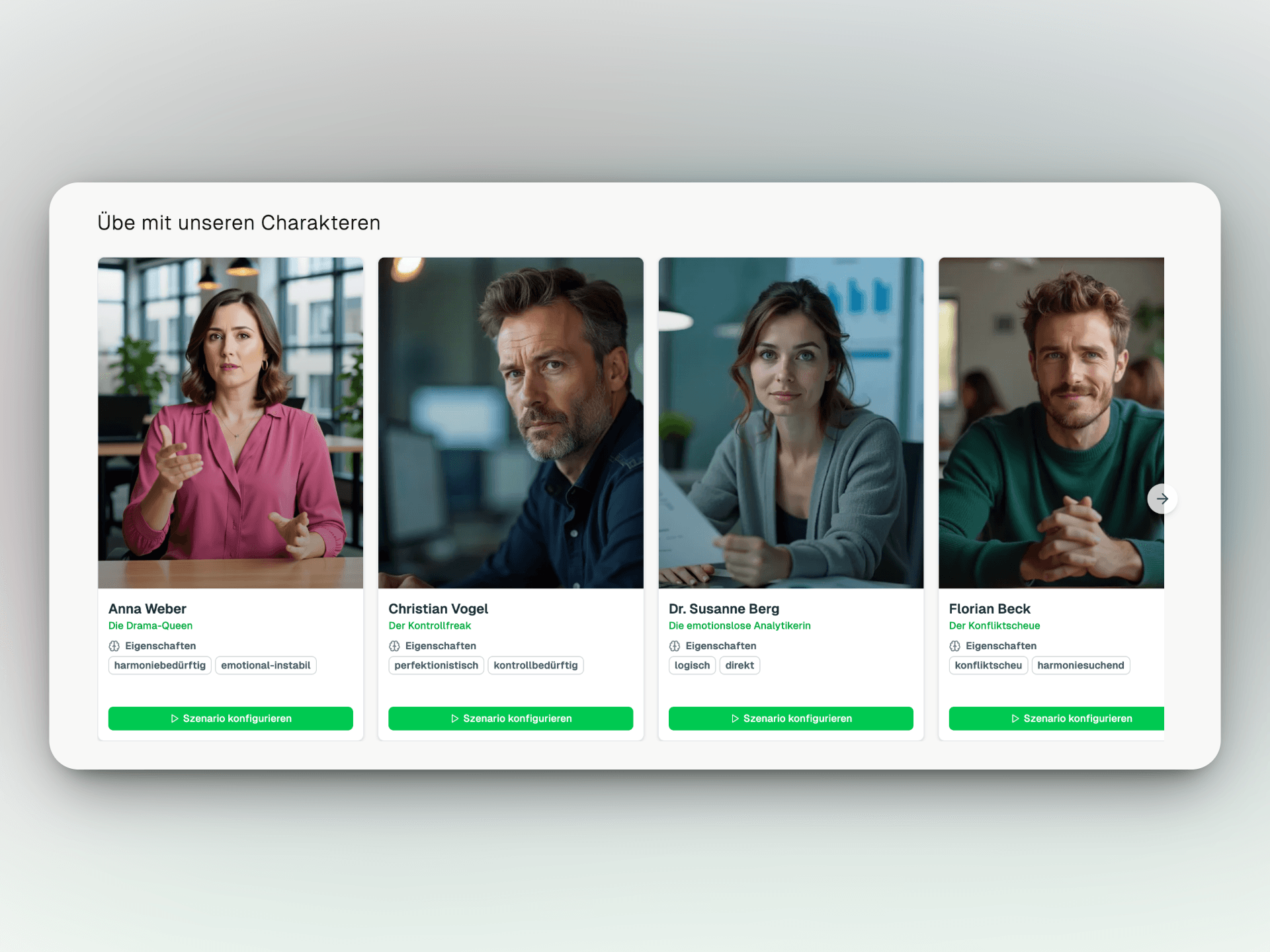
Over 50 AI characters with diverse career ambitions and developmental needs.

Your leaders train with diverse personalities: from the ambitious high performer with unrealistic expectations to the loyal employee who underestimates her potential, and the seasoned senior who fears losing significance. Each character has unique career goals, internal conflicts, and success factors.

16+ MBTI-Persönlichkeitstypen mit authentischen Karriereambitionen und Entwicklungshindernissen

Unterschiedliche Senioritätsstufen: Junior mit Orientierungslosigkeit, Mid-Level mit Work-Life-Balance-Konflikt, Senior mit Veränderungsangst

Diverse Motivationstypen: Aufstiegsorientiert vs. Fachexpertise-fokussiert, Sicherheitsbedürftig vs. Risikobereit

Interkulturelle Karrierevorstellungen: Hierarchie-sensibel vs. Egalitär, Individuell vs. Team-orientiert

Over 50 AI characters with diverse career ambitions and developmental needs.

Detailed performance analysis for effective employee development.

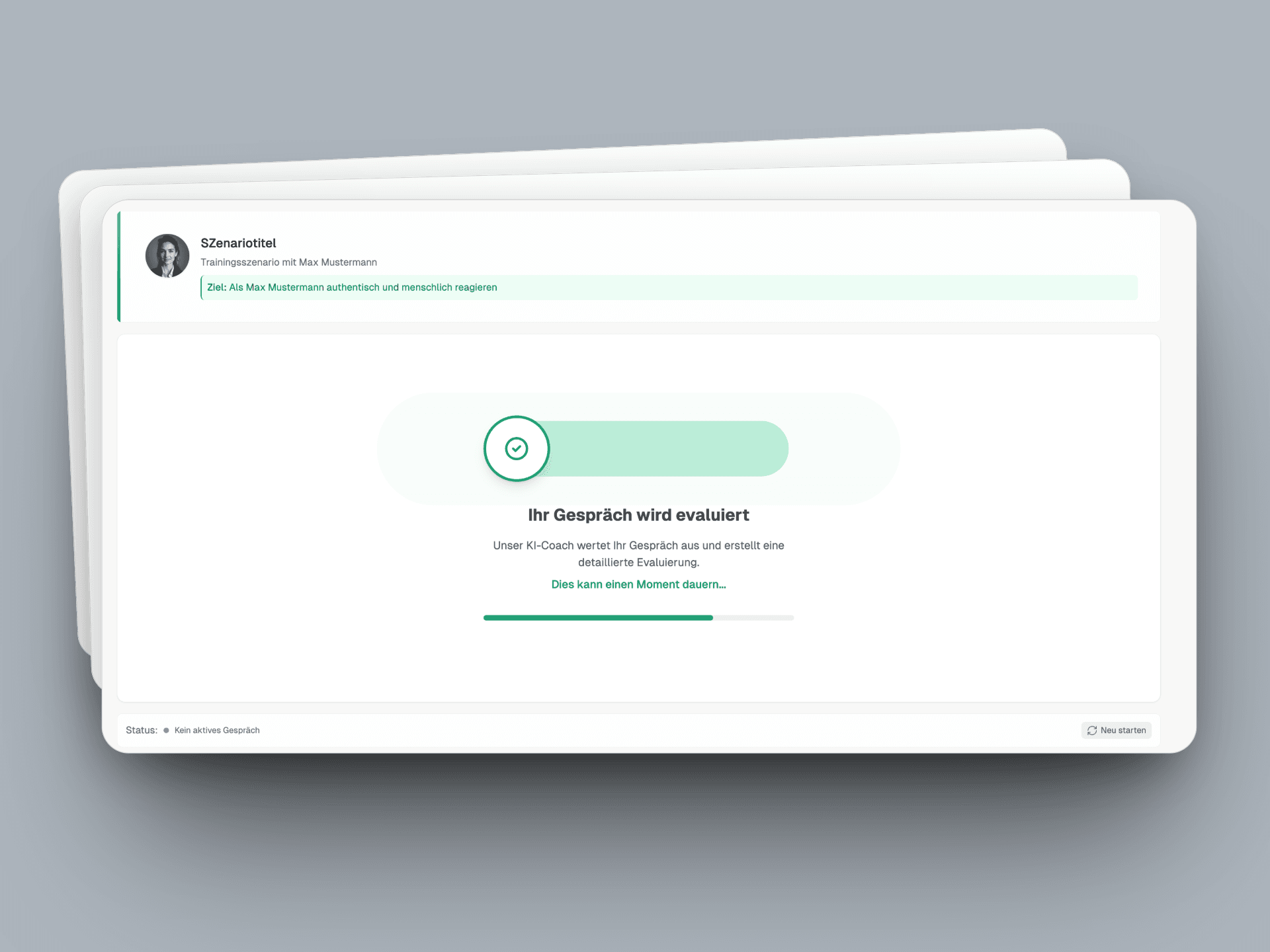
After each development conversation, you will receive a comprehensive analysis: Did the leader identify genuine potential? Were specific development steps agreed upon? Did the employee come up with their own ideas? The AI evaluates both the quality of the potential analysis and the specificity of the support measures.

Szenario-Performance (70%): Wurden Entwicklungsziele erreicht? Hat Mitarbeiter Klarheit über nächste Schritte?

Baseline-Skills (30%): Aktives Zuhören, Potenzialerkennung, Konkretisierung von Entwicklungsschritten, Empowerment

Anti-Pattern-Erkennung: Automatische Hinweise bei Standard-Phrasen, fehlender Konkretisierung oder Top-Down-Karrierevorgaben

Konkrete Verbesserungsvorschläge: 'Minute 4:20 – Du hast eine Lösung vorgeschlagen, statt zu fragen, was der Mitarbeiter selbst will'

Detailed performance analysis for effective employee development.

HR Analytics for Measurable Development Success

Your HR dashboard reveals which leaders are systematically developing talent and where there is a need for further training. You can view completion rates, average scores per development scenario, and effectively address skill gaps—ideal for reporting to management and demonstrating the effectiveness of training programs.

Übersichts-Metriken: Anzahl aktiver Manager, Sessions gesamt, Completion Rate, durchschnittlicher Score

Performance-Tracking über Zeit: Score-Entwicklung, Nutzungstrends, Verbesserung bei Wiederholungen

Detaillierte Analysen: Meistgespielte Szenarien, Abschlussraten pro Entwicklungs-Typ, Top-Herausforderungen

Individuelle Entwicklungspläne: Welche Manager brauchen Nachschulung in Potenzialerkennung, Gesprächsführung oder Konkretisierung?

HR Analytics for Measurable Development Success

Practice with realistic AI characters

Pick a scenario that matches your situation, then jump into the AI role-play.

Filter by company context, conversation type, challenge and employee persona. Every example leads directly into your own AI role-play.

16 of 16 scenarios

Company context

Conversation type

Challenge

Employee persona

Sophie Morgan

Sophie Morgan

Long-tenured high performer

Family-led midmarket companyFeedbackconversationAuthority challengeLong-tenured high performer

In the corridor after a busy handover, Sophie calls back to discuss a recurring pattern. You are seeing less follow-through after your last direction.

What you'll practise

  • Clarify your decision scope
  • Name one observable pattern
  • Agree one next behavior
It sounded fine, but then approvals changed it.
James Carter

James Carter

Junior with high expectations

Corporate matrix organisationKonfliktloesungFear of changeJunior with high expectations

Between two sprint planning blocks, James corners you at your desk before the team huddle. Since the new workflow and role expectations started, he doubts his competence will hold.

What you'll practise

  • Name the real concern
  • Provide concrete reassurance
  • Agree a small binding step
If I follow this new workflow, I will look slow.
Alex Taylor

Alex Taylor

Vocal critic

Tech scale-upPriorisierungDefensive response to feedbackVocal critic

Right before the store opens, Alex picks up your line and pushes back on your feedback. You are calling because the issue was only noted after customer complaints.

What you'll practise

  • Separate observation from judgement
  • Name the work impact
  • Ask for his perspective briefly
You wait until customers complain, then call it feedback.
Rachel Bennett

Rachel Bennett

Informal leader

Retail branch operationDelegation conversationFeeling micromanagedInformal leader

On site, moments after the quality bulletin prints, Rachel asks for a face-to-face talk across from you. The last deviation action plan was issued without her input, and the shift is now tense.

What you'll practise

  • Listen and mirror the core anger
  • Clarify ownership and autonomy
  • Agree a shift-handover checkpoint
I am the one who carries this shift. Nobody asked.
Daniel Walker

Daniel Walker

Return after overload

Remote and hybrid teamChange KommunikationLoyalty conflictReturn after overload

Daniel picks up quickly after you dial. Between shift handovers, he hints that the new rota rules collide with what the team expects from him.

What you'll practise

  • Clarify who decides what
  • Name the loyalty pressure
  • Agree a first stance
They changed the rota rules, and everyone looks at me.
Jordan Blake

Jordan Blake

New team member with leadership ambition

Tech scale-upTeam AlignmentFeeling micromanagedNew team member with leadership ambition

Across from you in the team area, Jordan leans forward before the meeting can settle. Right after a morning status call, he says the follow-up questions keep him from leading.

What you'll practise

  • Define outcome and ownership
  • Clarify decision scope
  • Set checkpoints the team can live with
I can deliver, but the updates feel like you do not trust me.
Laura Hughes

Laura Hughes

Experienced senior close to exit

Healthcare shift organisationFeedbackconversationOverload signalsExperienced senior close to exit

Laura answers on the third ring, sounding busy but controlled. Between two site calls at the family-run plant, you ask for a quick check-in on her motivation.

What you'll practise

  • Describe observable signs only
  • Split care from work priority
  • Agree relief with a date
I am not asking for sympathy. I just have to keep running.
Michael Brooks

Michael Brooks

Quiet talent

Skilled-trades businessKonfliktloesungDefensive response to feedbackQuiet talent

In the meeting room, Michael sits a bit back, like he is waiting for the next agenda item. After a recent cross-team clash, he keeps responding politely but his distance grows during the call.

What you'll practise

  • Name tension without blame
  • Clarify impact on team work
  • Agree one behaviour commitment
I do not want fireworks. But something feels off in how we work.
Casey Hayes

Casey Hayes

Long-tenured high performer

Tech scale-upPriorisierungQuiet quittingLong-tenured high performer

Casey picks up your line during the lunch window and starts with, “So, what is this about?” You can hear they have checked out from recent priority changes.

What you'll practise

  • Name the withdrawal clearly
  • Ask causes without pressure
  • Agree one small binding step
I’ll do my part, but this never pays off.
Maya Turner

Maya Turner

Informal leader

Family-led midmarket companyDelegation conversationFeeling micromanagedInformal leader

Between two shifts, you catch Maya across the store floor for a quick face-to-face check-in. She already planned how the team will respond to your new delegation approach, and she is not impressed.

What you'll practise

  • Clarify your decision scope
  • Reflect the workload risk
  • Agree checkpoints with minimal overhead
Don’t make me the messenger for a new promise.
Owen Foster

Owen Foster

Vocal critic

Corporate matrix organisationChange KommunikationAuthority challengeVocal critic

Owen answers your quick call and immediately starts talking about a different problem than the change update. You hear frustration about role confusion, and he wants you to address it now.

What you'll practise

  • Go with the urgent concern
  • Bridge to the shared agenda
  • Agree a limited next step
That change talk is missing the real risk.
Riley Stone

Riley Stone

Quiet talent

Public-sector organisationTeam AlignmentAuthority challengeQuiet talent

At your desk, Riley sits across from you after a cross-department check-in. You can see she is careful with every sentence, and she keeps the discussion away from ownership.

What you'll practise

  • Separate responsibility from outcome
  • Identify the real decision owner
  • Agree a next interface contact
I can help, but the outcome is not mine alone.
Hannah Reed

Hannah Reed

Return after overload

Healthcare shift organisationFeedbackconversationOverload signalsReturn after overload

In the corridor between shifts, Hannah asks for a quick call before the ward handover. Since her return, she says feedback discussions always turn into extra load.

What you'll practise

  • Confirm capacity, not motivation
  • Agree one measurable next step
  • Set follow-up without pressure
Hannah, I’m fine. Really. Just not this week.
Ethan Collins

Ethan Collins

Informal leader

Family-led midmarket companyKonfliktloesungDefensive response to feedbackInformal leader

At the office entrance after the morning planning meeting, Ethan steps toward his desk. He says, “Not again,” because you reached out right after an unplanned contact came in.

What you'll practise

  • Interrupt with a context hook
  • Ask for the smallest next action
  • Close the loop on conflict impact
You called again? People are already watching.
Olivia Bennett

Olivia Bennett

New team member with leadership ambition

Corporate matrix organisationPriorisierungAuthority challengeNew team member with leadership ambition

Mid-afternoon, Olivia picks up on a call between two remote standups. She says the “benchmark table” already decides it, and she wants you to stop changing criteria.

What you'll practise

  • Define decision scope clearly
  • Name the real risk behind comparisons
  • Confirm one next involvement step
We already scored the options. Why redo it?
Grace Cooper

Grace Cooper

Long-tenured high performer

Remote and hybrid teamDelegation conversationFeeling micromanagedLong-tenured high performer

Across the site meeting room, Grace arrives with last quarter’s sign-off notes. You planned a quick delegation discussion, but the committee cycle keeps inserting gatekeepers between you and the decision maker.

What you'll practise

  • Show decision chain steps
  • Clarify delegation boundaries
  • Lock a preparation timeline
If you change the chain again, I lose weeks.

How the AI evaluates your training conversation

After every role-play a separate AI analyses your full conversation transcript — with score, goal feedback and concrete quotes from your own dialogue.

Two layers feed the overall score: scenario-specific goals (70%) and five core competencies for your training type (30%).

SummaryRating: Solid

Sophie Morgan · Challenge to your mandate in a matrix feedback call

Mostly solid feedback structure, but decision scope and commitment need sharper

Name the concrete observation and its impact on the work. Make your decision scope visible, then agree one specific behavior for the next delivery cycle.

Overall result
6.7/ 10

70% scenario goals + 30% core competencies

Scale 0–10 · backed by quotes from your conversation

Scenario goals · 70%Core competencies · 30%

Scenario goals

Scenario goals · 70%

Clarify your decision scope

6.4 / 10

Make your mandate and boundaries explicit before you ask for agreement. This helps the employee separate your direction from approval politics.

Partially achieved

You referenced decision scope, but the boundary between your call vs committee approval stays slightly implicit.

As decision maker, you own the delivery schedule change, committee only approves scope.

Name one observable pattern

8.4 / 10

Describe the specific behavior you observed and where it shows up in delivery. This keeps the feedback from sounding like judgement.

Fully achieved

You named an observable pattern and its impact: less follow-through after the last direction.

follow-through dropped after your last change direction

Agree one next behavior

6.4 / 10

End with a single next action that changes daily follow-through. The employee should leave with a clear behavior to execute next.

Partially achieved

You did not lock a single measurable behavior for the next delivery cycle; no specific next action or timing.

follow-through dropped after your last change direction

Core competencies

Core competencies · 30%

Active listening

6.4

Follow-up questions, paraphrasing, targeted clarifiers

Empathy & understanding

6.9

Reading the counterpart's emotional state and perspective

Conversation control

6.7

Structured and goal-oriented without dominating

Solution focus

7.0

Developing constructive options together

Communication clarity

6.5

Clear, understandable, to the point

Details · Transcript excerpt

YouSophie, follow-through dropped after your last change direction; why?
Sophie MorganIt sounded fine, then approvals changed it. So whose call is this, really?
YouAs decision maker, you own the delivery schedule change, committee only approves scope.
Pro tip

In KONZERN_MATRIX calls, say the boundary first, then one measurable next step. Example: "You own X delivery by Friday; scope needs the committee."

Only your wording is evaluated — not the AI counterpart's. The AI's opening of the conversation is not penalised.

Practise with your situation
Use Cases

What do others use Careertrainer.ai for?

Concrete use cases for leaders, HR, and people development — from the first 100 days to measurable skill tracking

From peer to manager — without learning on the job

Newly promoted team leads often run their first employee conversations with zero training. With Careertrainer they practice the typical first conversations — expectation alignment, feedback, onboarding talks — before they happen for real.

  • Learning path "First 100 days as a manager"
  • Structured onboarding across 6–8 weeks
  • Skill tracking shows progress to HR and leadership
Thomas Weber
Frank Zimmermann
Karl-Friedrich Moser
Andreas Kaufmann
Olivia Bennett

Address quiet pushback on cross-team feedback

Cross-team feedback turns into sideways friction

LeadershipFeedbackConflict

Learning-path progress

Kick-off
Expectations
Feedback
Conflict
Discover the onboarding solution

Choose your plan

Transparent pricing for you alone or your whole team. Enterprise and White Label kept separate – clearly split, no jargon.

Still have questions? We're happy to advise you.

Contact Us

FAQs

Why is AI-powered training more effective than traditional development workshops?

Traditional workshops teach theory about competency models and development plans, but genuine development conversations are complex and require situational empathy. With AI role-playing, your leaders can practice: they engage in real conversations with diverse personalities, experience how differently individuals respond to development opportunities, and receive immediate feedback on their ability to recognize potential and conduct discussions. This significantly shortens the learning curve.

What types of development discussions can be trained?

We cover all classic development situations: annual reviews with goal setting and development planning, coaching conversations for skill enhancement, career discussions for those focused on advancement, potential assessments for high performers, motivation talks during performance plateaus, and challenging development conversations involving unrealistic expectations or a lack of self-reflection.

How does the AI respond to poor communication in development discussions?

The AI behaves like real employees: When a leader uses standard phrases, imposes career goals from above, or fails to listen actively, the AI character responds with disinterest, superficial answers, or resistance. However, when the leader demonstrates genuine interest, asks open-ended questions, and collaboratively explores development paths, the character becomes more engaged and generates its own ideas. The feedback clearly indicates what went well and what can be improved.

Can we create company-specific development scenarios?
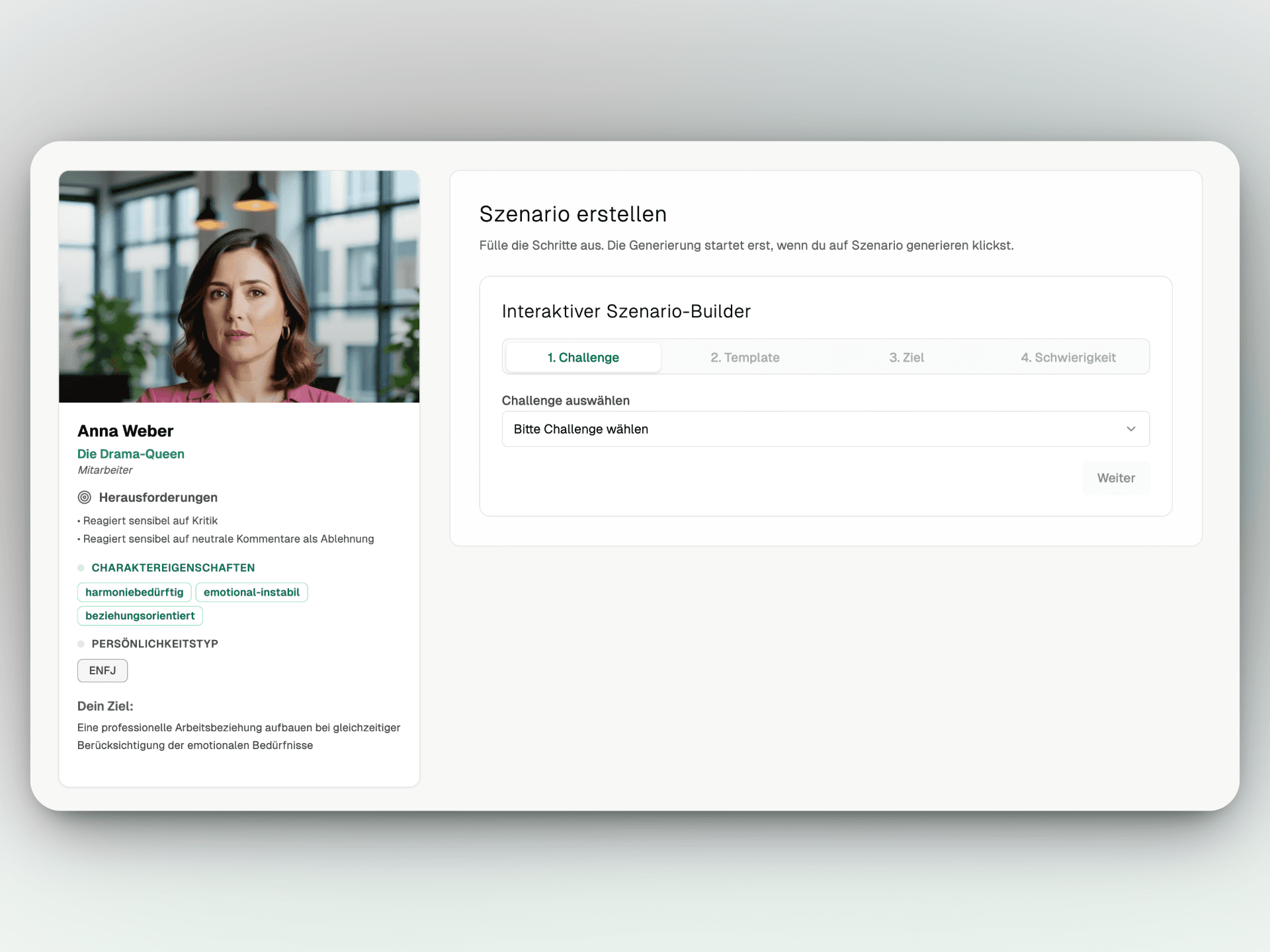
Yes, with the Scenario Builder, you can create custom development scenarios that reflect your competency models, career paths, and development programs. You can design your own characters based on typical employee profiles within your organization, ensuring that your leaders practice the exact conversations they need to have in their daily roles.
How long does an employee development training session last?

A single development conversation lasts 15-25 minutes and can easily fit between meetings or during lunch breaks. For sustainable success, we recommend a duration of 6-8 weeks with 2-3 scenarios per week. This allows your leaders to train with various personality types, career ambitions, and development situations, ensuring they can confidently engage in development conversations.

How does the training differ from traditional competency models?

We integrate established competency models like Google's Project Oxygen and the CCL Leadership Framework, making them practically applicable. While traditional training explains competency matrices, our approach enables your leaders to engage in genuine development conversations and learn how to identify, discuss, and promote competencies in real situations. The frameworks become evident in feedback, requiring no prior knowledge from leaders.

Does the training also work for industry-specific development paths?
Absolutely. Our character library is industry-agnostic (personality types and career ambitions exist everywhere), but you can customize the context: in IT, your managers can train for technical career paths versus leadership tracks; in healthcare, focus on professional development amid skill shortages; in retail, cultivate sales talent. The scenario builder automatically adapts to your industry and career structures.
How do we measure the effectiveness of the training?
Your HR dashboard displays quantitative metrics such as completion rates, average scores, and improvements over time, along with qualitative insights into which development situations are particularly challenging. The real business impact is reflected in increased employee satisfaction, reduced turnover (especially among high performers), improved internal filling of leadership positions, and measurable skill development. Additionally, we recommend implementing 360° feedback before and after training.
Can inexperienced leaders without an HR background also benefit?

This training is especially ideal for them, as many leaders perceive development discussions as abstract or time-consuming. In a secure AI environment, they learn through practical experience how to identify potential, agree on specific development steps, and truly empower employees—without prior HR training. The AI provides structured feedback and shares best practices for effective conversations.

How can we integrate the training into our existing development programs?

The software seamlessly integrates with your existing HR landscape via SSO/SAML (SAP SuccessFactors, Workday, Personio). You can centrally manage which scenarios are enabled for different hierarchy levels and set up automated reminders for annual reviews or development cycles. The analytics flow directly into your performance management systems.

What is the ROI of systematic employee development?

Companies with systematic employee development experience, on average, 15-25% lower turnover, a 40% higher internal fill rate for leadership positions, and significantly higher employee engagement scores. Our ROI calculator clearly demonstrates that with 100 leaders, you can save an average of €738,000 annually through reduced turnover, eliminated external recruiting costs, and increased productivity, resulting in an 800% ROI.

More Solutions

More Careertrainer.ai Solutions

Discover more professional solutions for your leadership development.