
Prepare for difficult conversations with AI
Whether it's a performance review, price negotiation, or an escalated customer issue – practice the conversation in advance.
Do you have a conversation tomorrow that’s making you anxious? Describe the situation – the AI will create a conversation partner that reacts just like your real counterpart likely would: defensively, emotionally, evasively, or confrontationally. You’ll practice the conversation, try out different strategies, and go into the real discussion with a concrete plan. In 15 minutes instead of sleepless nights.
Live example · This is what training looks like

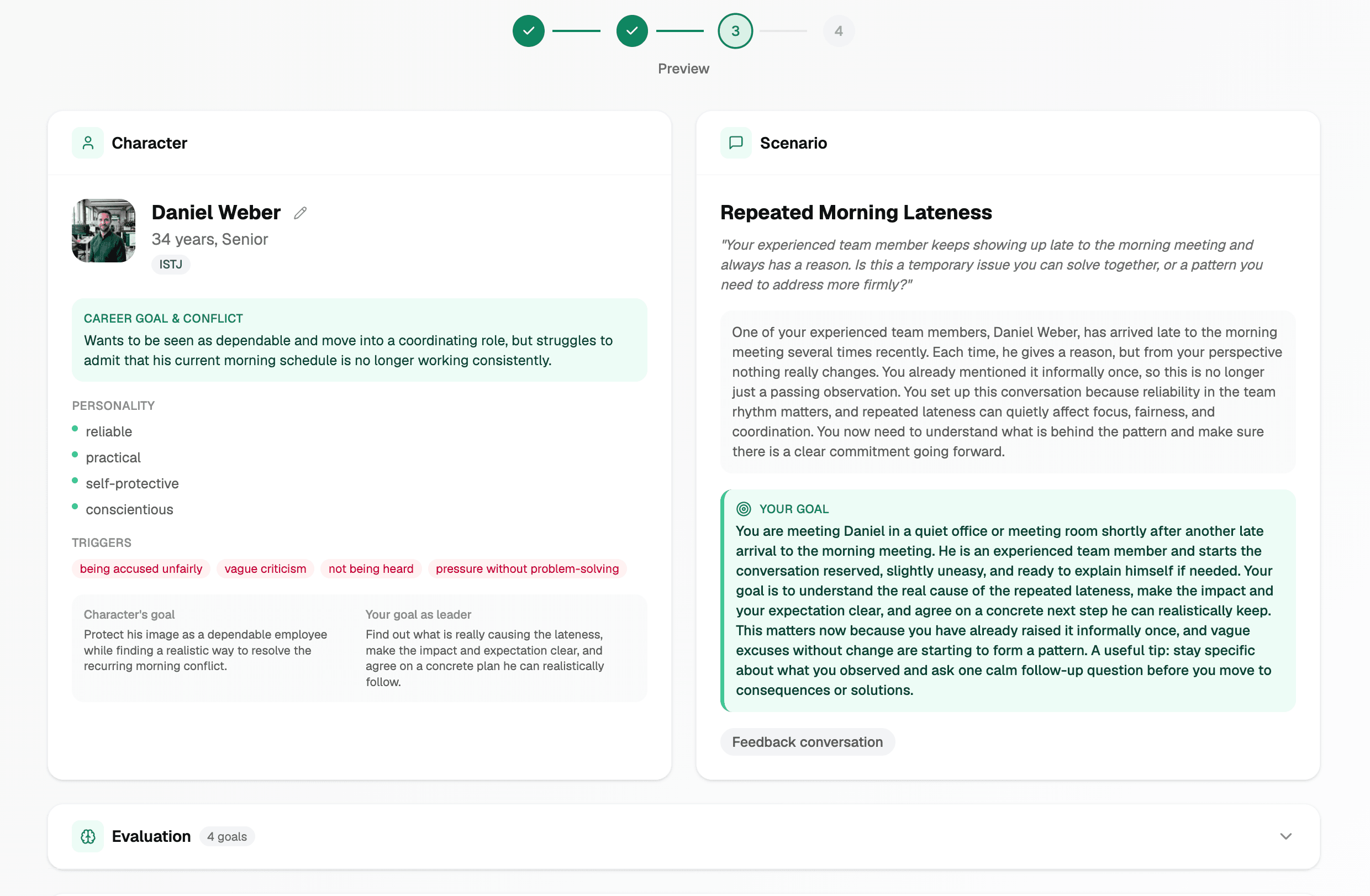
Reese Campbell
LeadershipSenior · 37 · ENTJ
Coaching: The High Performer Who Thinks Feedback Doesn't Apply to Them
Your top performer's behavior just triggered an HR escalation. Can you make her see that numbers aren't everything?
Goal: Deliver direct feedback about the HR complaints and secure her commitment to change her communication style.
Live audio · 5–15 min · GDPR-compliant
Talk with Reese Campbell as soon as you start
What Prepare for difficult conversations with AI offers
Discover the key capabilities and how they enhance your training.
Describe the situation – the AI simulates the response
You describe in your own words what is coming up tomorrow: which conversation, what type of person, and what the problem is. The AI creates a conversation partner who responds realistically – defensively, emotionally, evasively, or cooperatively. You role-play the conversation and try out different strategies.
Describe the situation as you would explain it to a colleague.
The AI creates a conversation partner tailored to the personality type.
Your behavior determines the response – just like in a real conversation
Try different strategies until you find the right one.
Preparing Leadership Conversations
Critique discussions, termination meetings, conflict mediation, salary rejection, return conversations – these are the discussions that require the most courage in everyday leadership. Often, just rehearsing once is enough to alleviate fear and enter with a clear plan.
Critique Conversations: Addressing Performance Issues Without Demotivating
Termination Conversations: Process, Phrasing, Professional Management of Emotions
Conflicts: De-escalating and moderating tensions within the team
Salary Negotiations: Declining Requests Without Damaging the Relationship
Preparing Sales Conversations
Annual negotiations with major clients, initial discussions with a skeptical decision-maker, pitches before the procurement committee – rehearse the conversation before it comes to the deal. The AI client is familiar with your products, prices, and typical objections.
Price Negotiations: Test Strategies Before You Sit at the Table
Initial consultations: Practicing the conversation opener and needs assessment
Objection Handling: Specific Responses to 'too expensive', 'no need', 'staying with the provider'
Also for B2C: Practice upselling, overcome price resistance
Prepare customer conversations and escalations
A customer has announced an escalation. A complaint case is becoming personal. A long-term customer is threatening to terminate their contract. Role-play the situation in advance so that you remain calm and composed during the actual conversation, rather than making mistakes under pressure.
Escalated Customer Conversations: Practicing De-escalation and Professional Response
Complaints: Stay solution-oriented without backing down
Customer Retention: Preparing for the Conversation with the Departing Customer
Complaints: Exploring different customer types and their response patterns
15 minutes instead of sleepless nights
Difficult conversations drain mental energy—often days in advance. A preparation session takes 10-15 minutes: describe the situation, role-play the conversation, receive feedback. Afterwards, you'll know what to expect and can sleep peacefully.
10-15 minutes per session – perfect the night before or in the morning before the appointment
Practice the conversation as often as you need until you feel confident.
Immediate feedback reveals what works and what doesn't
Also available on mobile – practice at home, not in front of colleagues at the office.
For teams, companies, and training providers
Not just for individuals: Team leaders can create typical conversation scenarios and share them with the team. Companies use it for executive onboarding. Training providers offer their participants targeted preparation exercises between seminar modules.
Small teams (2-10): Team leaders create scenarios, everyone practices independently.
Company: Typical conversation scenarios as standard training for all leaders
Training providers: Customers practice between in-person modules on your white-label platform.
New Leaders: Role-play typical challenging conversations from day one
See how it works in practice
A look inside the platform — straight from real training sessions.
At a glance
Everything you need to know about the audience, use cases, and what makes Prepare for difficult conversations with AI special.
Who is this for?
Managers in SMEs who have a feedback or termination conversation tomorrow and want to rehearse it beforehand. Sales representatives preparing for an important price negotiation or an initial meeting with a skeptical decision-maker. Service employees looking to prepare for challenging customer conversations. Training providers aiming to enable their participants to prepare for conversations between seminar modules.
Typical Use Cases
- Tomorrow, a feedback conversation is scheduled – how do I communicate it without losing the employee?
- I am conducting a termination meeting for the first time and have no idea how to do it.
- Next week is the annual negotiation with our largest client – how do I maintain the price?
- A customer has announced an escalation – how do I prepare for the call?
- Two employees have an ongoing conflict – how do I facilitate the conversation?
- I need to decline a salary increase without the employee resigning.
- My sales team should prepare for a specific tender presentation.
- New leaders should practice typical initial conversations with challenging employees.
Right for you if...
- Right for you if you have a conversation tomorrow that is weighing on your mind.
- Especially for leaders without formal training who need to conduct difficult conversations for the first time.
- Ideal for sales representatives before important client meetings, annual negotiations, or pitches.
- Useful for service teams that want to be prepared for escalations and challenging customer situations.
- Perfect for those who prefer to practice on their phones in the evening rather than replaying the conversation in their heads for days.
What sets us apart
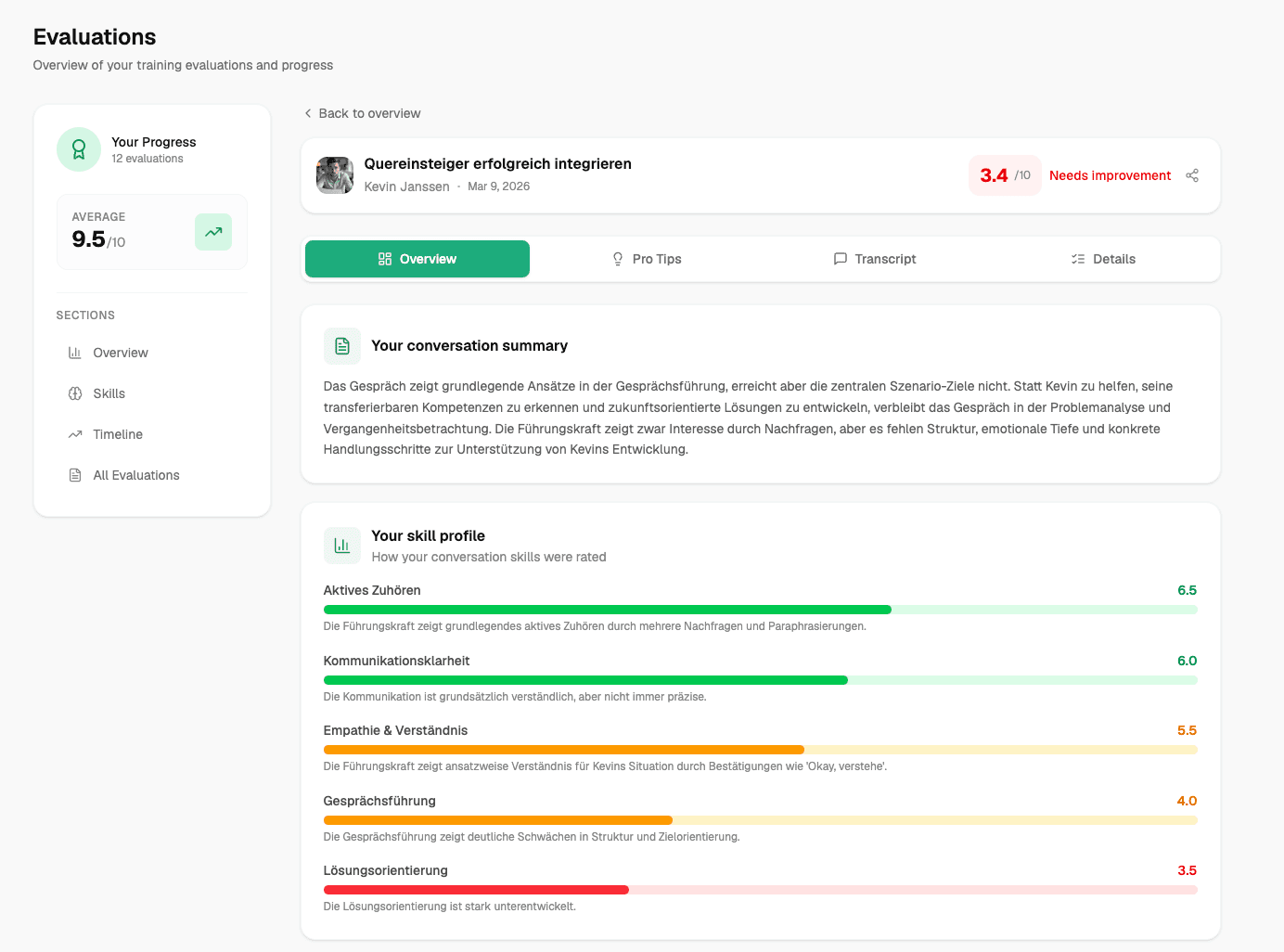
No theory, no textbook, no 'imagine how the employee would react.' Instead, you engage with an entity that truly responds – with its own personality profile, beliefs, and realistic reaction patterns. The AI characters are based on the MBTI model and respond proportionally to your conversational approach: they open up with empathy, and resist under pressure. Just like real people. After the conversation, a second AI system independently evaluates your discussion – providing concrete scores and improvement suggestions instead of vague gut feelings.
15 minutes of preparation instead of days of pondering
10–15 Min.
Preparation time per conversation
“I rehearsed the termination conversation three times. During the actual meeting, I knew exactly what to expect.”
— Managing Director, 40 employees
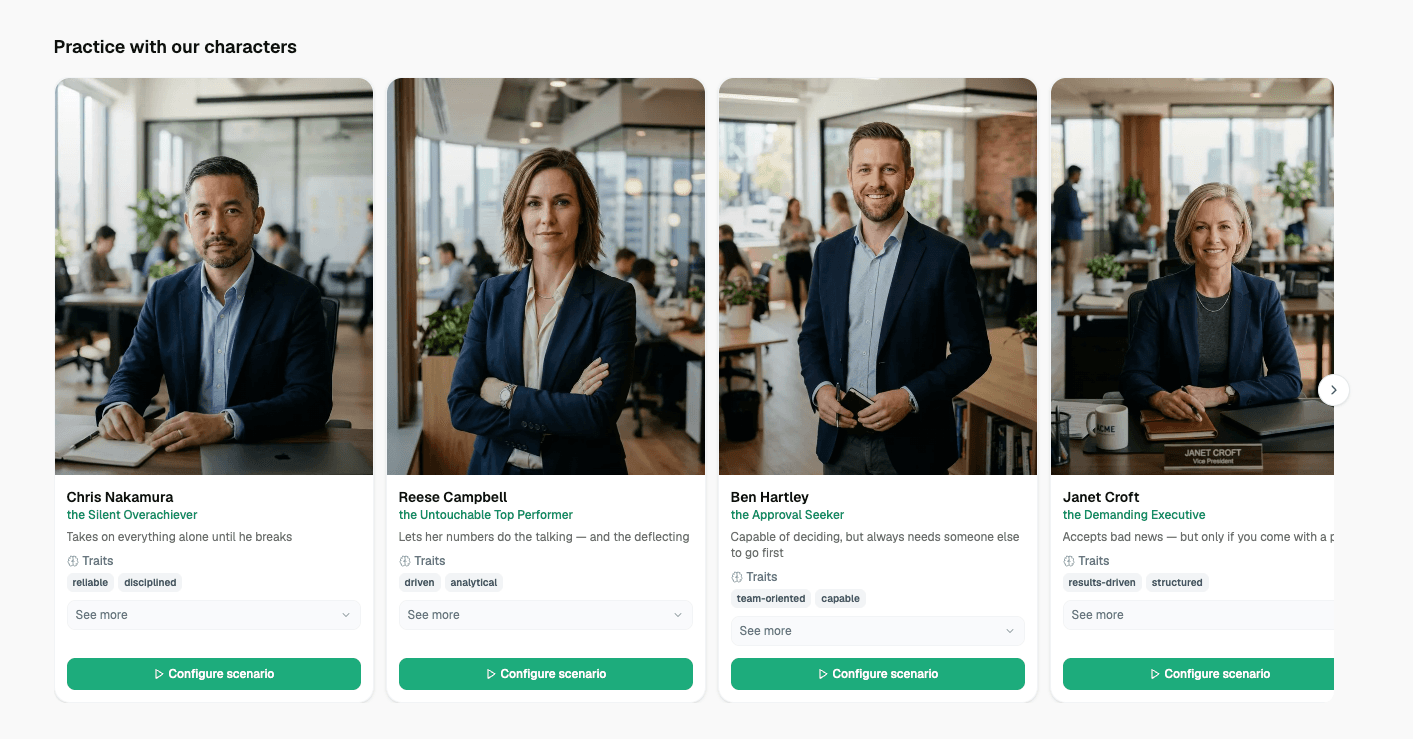
Practice with realistic personalities
Every employee is different – and reacts differently to feedback. Our characters are built on scientifically validated personality models and simulate realistic conversation dynamics: from the insecure junior employee to the critical senior developer.
Every character reacts differently

Dr. Anna Berger
The ambitious part-time returner
Healthcare
Excellent senior doctor returning with a part-time request. Fears part-time will be seen as a career brake.

Svenja Kramer
The over-motivated returner
Corporate Management
Returns after 4 months of burnout and wants to give 100% immediately. Sensitive to special treatment.

Kai Richter
The sarcastic tech expert
Software Development
Highly competent and introverted. Subtly undermines code reviews out of fear they might expose weaknesses.

Timo Lindner
The charming facade carrier
Corporate Management
Charming, clever, talks his way out of everything. Beneath the facade: growing exhaustion and inability to ask for help.
Choose your plan
Transparent pricing for you alone or your whole team. Enterprise and White Label kept separate – clearly split, no jargon.
Start free – grow with your team
Three free conversations every month. Transparent team pricing from 2 seats. Enterprise and White Label kept separate.
For you alone
Basic, Pro or Unlimited – depending on how much you train.
See all plans & detailsFor your team
Team Pro or Unlimited. Central admin, HR analytics, cancel monthly.
See all plans & detailsEnterprise & White Label
Tailored offers – including white-label with conversation-based licensing.
See all plans & detailsStill have questions? We're happy to advise you.
Contact UsFrequently Asked Questions
How do I prepare for a difficult conversation with Careertrainer.ai?
In three steps:
1. Describe the situation: You write in your own words what is at stake – 'I need to speak with an employee tomorrow who has been unreliable for weeks and misses appointments.' One sentence is enough; more context enhances the scenario.
2. Role-play the conversation: The AI creates a conversation partner who responds according to your description – defensively, emotionally, evasively, or cooperatively. You conduct the conversation via audio, like a real phone call or meeting. The conversation lasts 10-15 minutes.
3. Read feedback and practice again: After the conversation, a second AI system shows you what you did well and where you can improve – with specific text excerpts and alternative phrasing. If you wish, you can replay the conversation with a different strategy and compare the results.
The entire process takes 15-30 minutes – perfect the night before, in the morning before the appointment, or between two meetings. Afterwards, you enter the real conversation with a clear plan instead of uncertainty.
For which difficult conversations is preparation suitable?
For all conversations where you are unsure how the other party will react – and which therefore require courage:
Leadership: Conducting performance-related criticism discussions, termination conversations, de-escalating conflicts between team members, denying salary increases without damaging the relationship, providing feedback on difficult behaviors (tardiness, resistance, attitude), return-to-work discussions after illness or parental leave.
Sales: Price negotiations with tough buyers, initial conversations with skeptical decision-makers, annual negotiations with major clients, closing discussions when the client hesitates, cold calling conversations with various types of gatekeepers.
Customer Communication: De-escalating escalated customer conversations, handling complaints professionally, winning back customers who want to leave, responding to complaints without backing down.
In general: The more a conversation weighs on your mind, the more it helps to rehearse it beforehand.
Can AI truly simulate how the other person will respond?
The AI does not simulate individual people – it simulates personality types and typical response patterns. When you describe that your employee reacts sensitively to criticism, the AI character will respond defensively or emotionally. If you describe a dominant buyer, you will receive pressure and counter-questions.
The characters are based on the MBTI personality model and respond proportionally to your conversational approach: With an empathetic approach, they open up. Under pressure, they become resistant. With poor conversation management, they politely end the conversation. Just like real people.
The value lies not in predicting the exact reaction – but in playing through different conversation scenarios and being prepared for various responses. After two or three runs with different strategies, you will have a repertoire of response options – no matter how your real counterpart feels tomorrow.
What distinguishes this from mental rehearsal or note-taking?
In the mental rehearsal, you conduct both sides of the conversation yourself. You imagine what the other person says – but you always envision what you expect. The real challenge arises when someone reacts differently than you anticipated. This is precisely what the AI simulation trains: an interaction that you do not control.
Notes assist with structure – but not with execution under pressure. You can write down what you want to say as well as you like. When your counterpart becomes emotional or resistant, you need practice in handling the situation, not notes.
The AI simulation specifically trains this skill: saying the right thing in the moment, even when your counterpart reacts differently than expected. After the conversation, you receive concrete feedback – which phrasing triggered defensiveness, where you rushed too quickly, and how an experienced coach would have framed the situation.
Can I also use the conversation preparation for my team?
Yes – and there are various approaches depending on team size and situation:
Small Teams (2-10 people): The team leader creates a scenario for a typical conversation and makes it available to the team. Everyone practices independently, whenever and wherever they want. The team leader can see through the dashboard who has practiced and the results. No scheduling or coordination needed.
Companies: HR or management establishes typical conversation scenarios as standard templates – for example, the feedback conversation for performance issues, the onboarding discussion for new employees, or the typical price negotiation in your industry. All managers or salespeople train with these scenarios before an actual conversation takes place.
Training Providers: You create preparation scenarios for your clients that align with the seminar topic. Participants practice independently on your white-label platform between in-person modules – ensuring the training effect is maintained rather than fading after two weeks.
How long does a preparation session take?
A session lasts 10-15 minutes – describe the situation, role-play the conversation, read feedback. Perfect for a slot the evening before, in the morning before the appointment, or between two meetings.
If you want to practice the conversation multiple times with different strategies, allocate 30-45 minutes. Most users need 2-3 runs to feel confident. The first time to try it out, the second time to refine the strategy, and by the third time, it’s set.
In comparison: A difficult conversation can occupy your mind for days – sleepless nights, pondering in the shower, formulating and discarding sentences in your head. 15 minutes of structured preparation remove the unpredictability of the situation and provide you with a concrete plan.
Are real employee data transmitted to the AI?
No. You describe the situation and personality type – not your actual employee or customer. No real names, personal data, or sensitive information are processed. All training scenarios are based on fictional characters.
For example, you can write: 'Employee in their mid-40s, with 8 years of experience, reacts sensitively to criticism, has been unreliable in recent weeks.' This is sufficient for the AI to create a realistic conversation partner – without you having to mention a real name.
All training conversations are GDPR-compliant, stored on EU servers, and transmitted securely. The conversation content is only visible to you – not to HR, not to supervisors, not to colleagues. This allows you to safely train on sensitive topics such as terminations or performance issues.
Can I practice the same conversation with different personality types?
Yes – and that is exactly what we recommend. The same criticism can trigger withdrawal and insecurity in a sensitive employee and resistance and counterattack in a dominant employee. The same price negotiation proceeds very differently with an analytical buyer compared to a relationship-oriented decision-maker.
By role-playing the same situation with different personality types, you develop a repertoire of strategies. You learn when you can be more direct and when you need to show more empathy. When to argue with numbers and when to focus on relationship building.
In the evaluation, you can see for each run what worked and what didn’t – and you can directly compare the results. This way, you discover which strategy resonates best with which type.
Other features from Careertrainer.ai
Discover more features that fit this topic.
Leadership development with AI for HR teams
Careertrainer.ai helps you make leadership development practical, planned, and measurable. Instead of one-off training sessions, your leaders practice real employee conversations through live audio role-plays: feedback discussions, conflict resolution, development conversations, separation situations, or remote leadership. HR receives reliable data on usage, skill gaps, and progress across teams, locations, and levels. This way, you complement seminars and coaching with a scalable practice space where leaders train the conversations that truly matter in everyday situations.
AI Role-plays – Practice the conversation before it happens
Difficult conversations often go awry because they can't be practiced in advance – until now. Our AI role-plays provide you with an interlocutor that behaves like a real person. It has its own personality, beliefs, and responds to what you say – not according to a script. In empathetic dialogue, it opens up; under pressure, it shuts down. Afterwards, you receive specific feedback: what went well, what didn't, and how a professional would have handled it. Ideal for leadership discussions, sales, customer communication, and job interviews.
Train with realistic AI characters instead of generic bots.
The AI Character Library from Careertrainer.ai adds depth to your conversation training. Instead of interchangeable standard figures, you train with various personality types, decision-making styles, and internal tensions. In leadership training, these are employees with their own needs, uncertainties, or resistances. In sales, you encounter buyer personas, purchasers, and decision-makers with genuine buying motives, objections, and priorities. This way, you learn to tailor conversations to different types of people—not just an average case.
Role-playing for leaders – practice before it matters
Leadership is not learned in seminars. It is learned through conversation – ideally in an environment where mistakes have no consequences. With Careertrainer.ai, leaders practice criticism, feedback, and conflict conversations with AI characters that behave like real employees. Alone, on their phones or at their desks, as often as needed. Especially valuable for those who have not had formal leadership training – but were simply promoted.
Data Protection & GDPR Compliance
Training conversations involving sensitive data requires the highest security standards—whether for sales discussions, customer service simulations, or leadership training. Careertrainer is designed from the ground up to meet German and European data protection requirements.
Roleplay Generator – Your conversation, your scenario, ready in minutes
Do you have a difficult conversation tomorrow? Describe it in your own words – the generator will create a complete training role-play: with an AI conversation partner that behaves like a real person, a scenario tailored to your situation, and an evaluation that shows you what you did well and where you can improve. No technical knowledge required, no prompting, no AI expertise. Just describe it and get started.
Sales training with AI – practice real sales conversations instead of just theory
With Careertrainer.ai, you train sales conversations as they occur in real life: through live audio role-playing with challenging buyer personas, noticeable conversation dynamics, and clear evaluations after each session. You practice cold outreach, needs analysis, product presentation, objection handling, price negotiation, and closing in a safe environment without risking real deals. Instead of slides, lectures, or rigid scripts, you receive repeatable conversation practice, specific professional tips, and a platform that can be tailored to your product, industry, and team.
Buying Center Training for B2B Sales
In Enterprise Sales, deals are rarely lost due to a single poor call; rather, they fail because a stakeholder is overlooked, information is miscommunicated internally, or the deal collapses due to hidden interests. With the Buying Center from Careertrainer.ai, you train for this reality: complete buying committees with 4–6 personas, each with their own role, KPIs, objections, communication style, and decision-making logic. You practice not isolated conversation moments, but a cohesive virtual deal over multiple sessions – including persona memory, deal state management, milestones, next-best-action, and deal analytics. This prepares you for real multi-stakeholder sales situations before they become critical in the actual account.
Sales learning paths for systematic sales training
With the Sales Learning Paths, you train sales not as a loose collection of individual exercises, but as a clearly structured development pathway. Each phase of the sales funnel – from cold outreach to needs analysis, presentation, objection handling, negotiation, and closing – is trained with concrete scenarios. This is especially valuable for onboarding new salespeople, targeted team development, and for companies looking to establish uniform sales standards. Through progress tracking, you can see which phases are already mastered and where further practice is needed. In conjunction with the product library, the training becomes even more realistic: teams practice with their actual offerings rather than generic example products.
Buyer Personas in Sales Training – realistically simulate different buyer types
With Buyer Personas in sales training, you don't just practice any sales conversation; you specifically present your product to different buyer types. Careertrainer.ai simulates typical reactions from dominant, analytical, relationship-oriented, and expressive Buyer Personas, complete with relevant objections, priorities, and communication styles. This allows you to experiment with various sales tactics, vary terminology, refine value propositions, and directly experience what works for each persona type. This makes training significantly more realistic than rigid role plays or generic characters without a clear sales context.