careertrainer.ai

Leadership without physical presence – mastering the greatest challenge of the modern workplace.

Remote Leadership Training for Virtual Teams

Remote Leadership Training for leaders of hybrid and virtual teams: Your managers practice challenging remote conversations with realistic AI characters—covering motivation, distance, and conflict resolution in video calls. Practical, risk-free, and available anytime.

Live example · This is what training looks like

In-person

Your own scenario

Emma Thompson

Emma Thompson

Leadership

Team Lead, Customer Success · 38

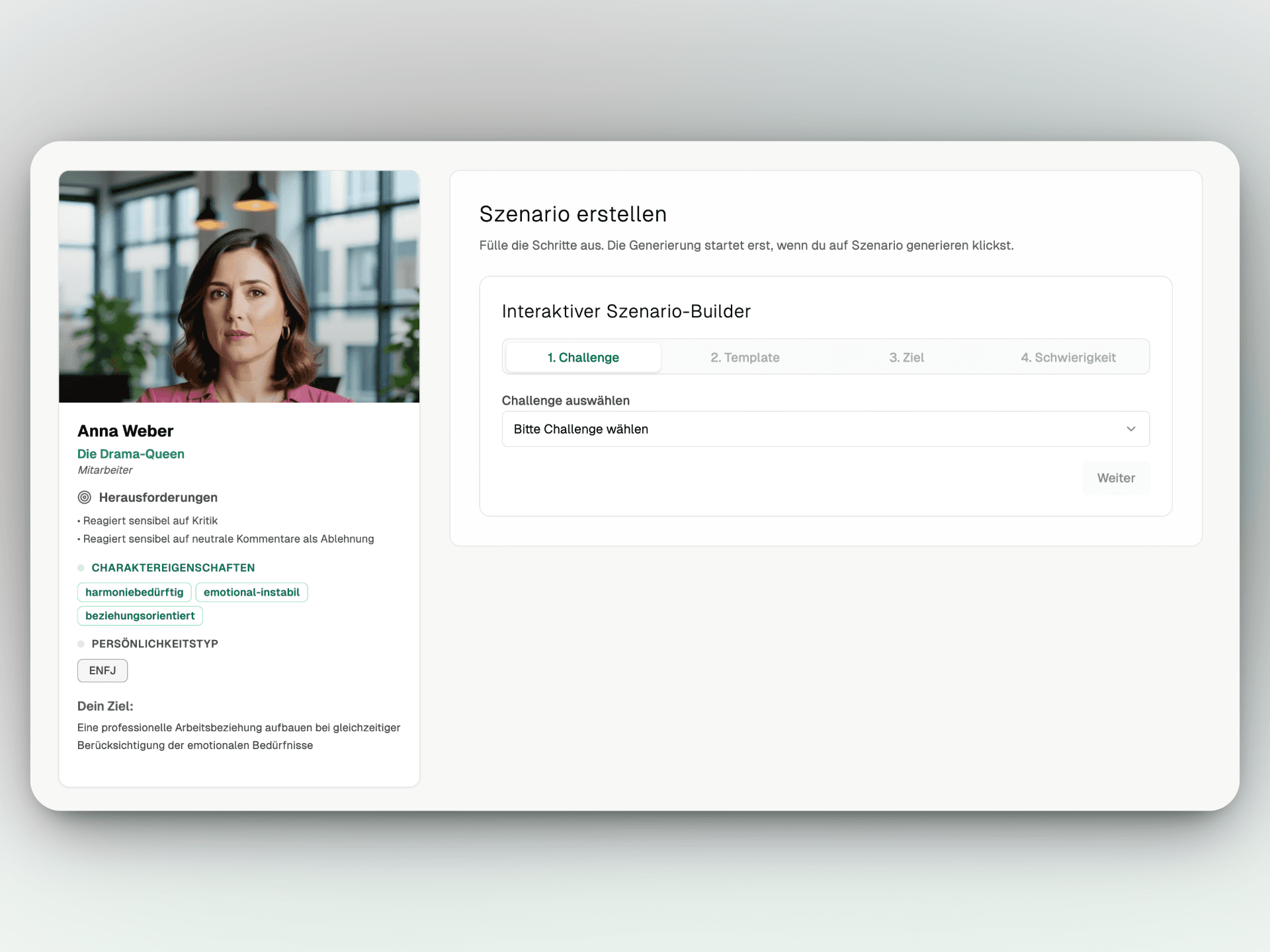
Motivation check-in: remote team member stops showing up

A missed video-call escalates into a motivation and performance discussion with muted concerns.

Goal: Practice leading a remote motivation conversation that creates clarity without sounding accusatory. Agree on concrete next steps and a follow-up rhythm.

Practice with Emma Thompson — it’s free
Targeted training for the specific challenges of remote leadership.

Remote Leadership Training for Successful Virtual Management

Our Remote Leadership Training equips leaders to tackle the unique challenges of virtual teams: motivating without physical proximity, de-escalating conflicts over video calls, managing performance without daily visibility, and building trust despite distance. Your managers will practice these scenarios through hands-on AI role-playing.

Remote Leadership Training with specialized scenarios for virtual leadership.

Our Remote Leadership Training focuses on the unique challenges of leading remotely: motivating employees you only see on screen, addressing performance issues without knowing if someone is truly working, and fostering team spirit without shared coffee breaks. The AI characters simulate typical remote scenarios: disengaged employees, overworked colleagues in home offices, and isolated team members.

Motivation über Distanz: Mitarbeiter begeistern, die ihr nur im Video-Call seht

Performance-Management remote: Leistungsprobleme ansprechen ohne tägliche Sichtbarkeit

Konfliktlösung in Video-Calls: Teamkonflikte moderieren, wenn alle in verschiedenen Räumen sitzen

Onboarding remote: Neue Mitarbeiter integrieren ohne physisches Büro

Remote Leadership Training with specialized scenarios for virtual leadership.

Remote Leadership Training for Asynchronous Communication and Trust Building

Remote leadership often involves asynchronous communication through Slack, email, and various tools. Our Remote Leadership Training prepares you for this challenge: How do you communicate expectations clearly without constant availability? How do you build trust when you can’t see if employees are working? The AI characters illustrate typical remote behaviors: withdrawn communication, misunderstandings due to lack of context, and feelings of isolation.

Vertrauen ohne Kontrolle: Loslassen lernen, wenn man Mitarbeiter nicht physisch sieht

Klare Remote-Erwartungen: Kommunizieren ohne als Mikro-Manager wahrgenommen zu werden

Psychologische Sicherheit remote: Offene Kultur schaffen trotz räumlicher Trennung

Work-Life-Balance remote: Überlastung erkennen, wenn Mitarbeiter rund um die Uhr online sind

Remote Leadership Training for Asynchronous Communication and Trust Building

Remote Leadership Training with Typical Challenges of Hybrid Teams

Hybrid teams present the greatest challenge: some members in the office, others remote. Our Remote Leadership Training simulates these dynamics: remote employees often feel excluded from office conversations, while in-office staff may receive preferential treatment. Information flows unevenly. The AI characters exhibit frustration, resignation, or passive-aggressiveness—common traits in hybrid team dynamics.

Hybride Meetings moderieren: Alle Stimmen hören – nicht nur die im Raum

Gleiche Sichtbarkeit: Remote-Mitarbeiter nicht vergessen bei Beförderungen und Projekten

Informationsfluss sicherstellen: Flurgespräche im Büro werden zur Benachteiligung für Remote-Kollegen

Team-Kohäsion hybrid: Zusammengehörigkeitsgefühl trotz verschiedener Arbeitsmodelle schaffen

Remote Leadership Training with Typical Challenges of Hybrid Teams

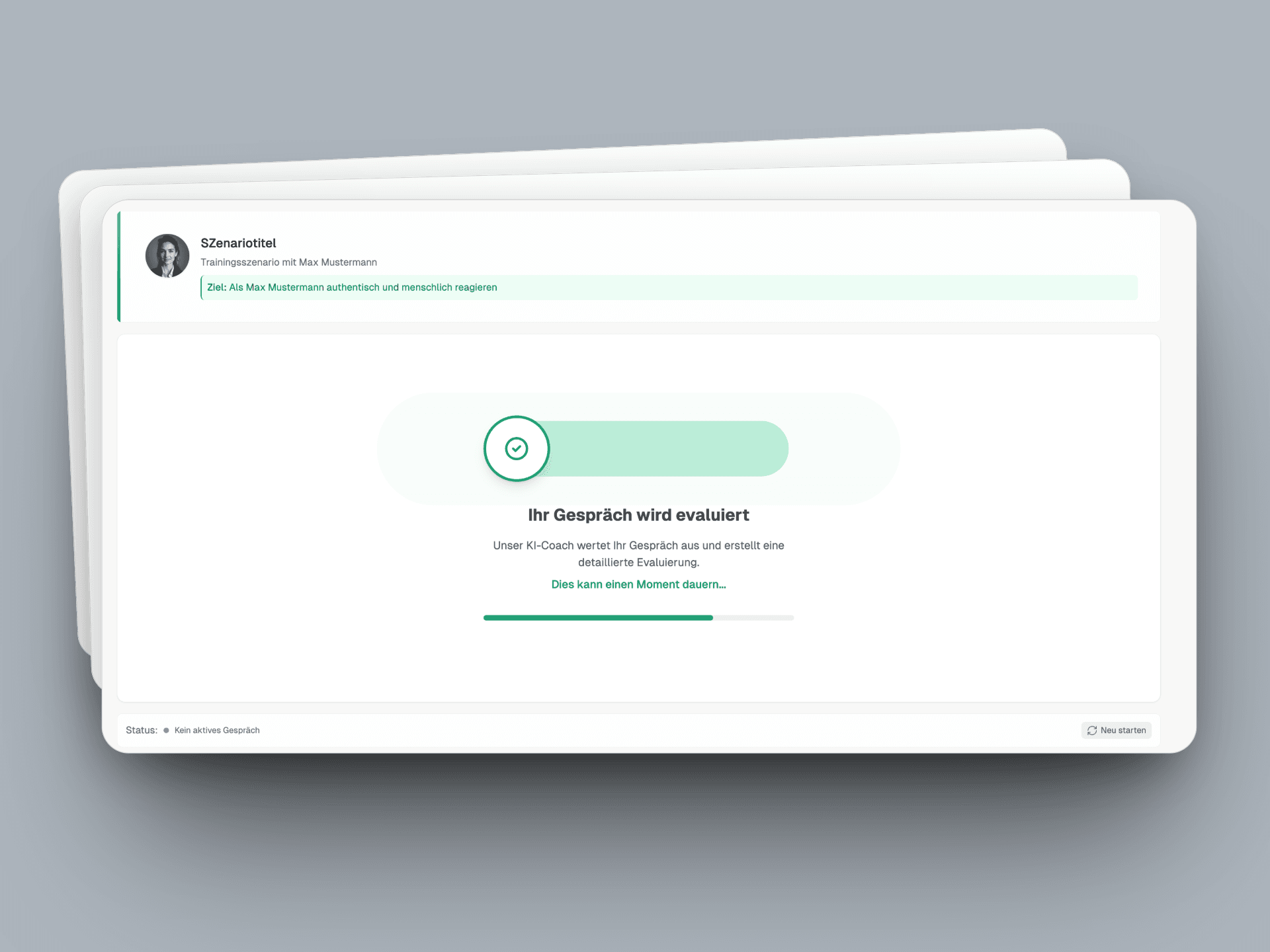
Remote Leadership Training with immediate feedback on virtual leadership skills.

After each Remote Leadership Training conversation, the AI analyzes your virtual leadership skills: Did you actively inquire about how your employee is doing while working from home? Were expectations clearly communicated despite the absence of physical meetings? Did you recognize and address feelings of isolation? The AI evaluates remote-specific leadership skills and highlights concrete areas for improvement.

Remote-Empathie: Wurde aktiv nach Wohlbefinden und Isolation gefragt?

Klare Kommunikation: Wurden Erwartungen eindeutig formuliert ohne Raum für Missverständnisse?

Vertrauensaufbau: Wurde Mikromanagement vermieden und Autonomie gegeben?

Inklusion: Wurden Remote-Mitarbeiter gleichwertig behandelt wie Büro-Kollegen?

Remote Leadership Training with immediate feedback on virtual leadership skills.

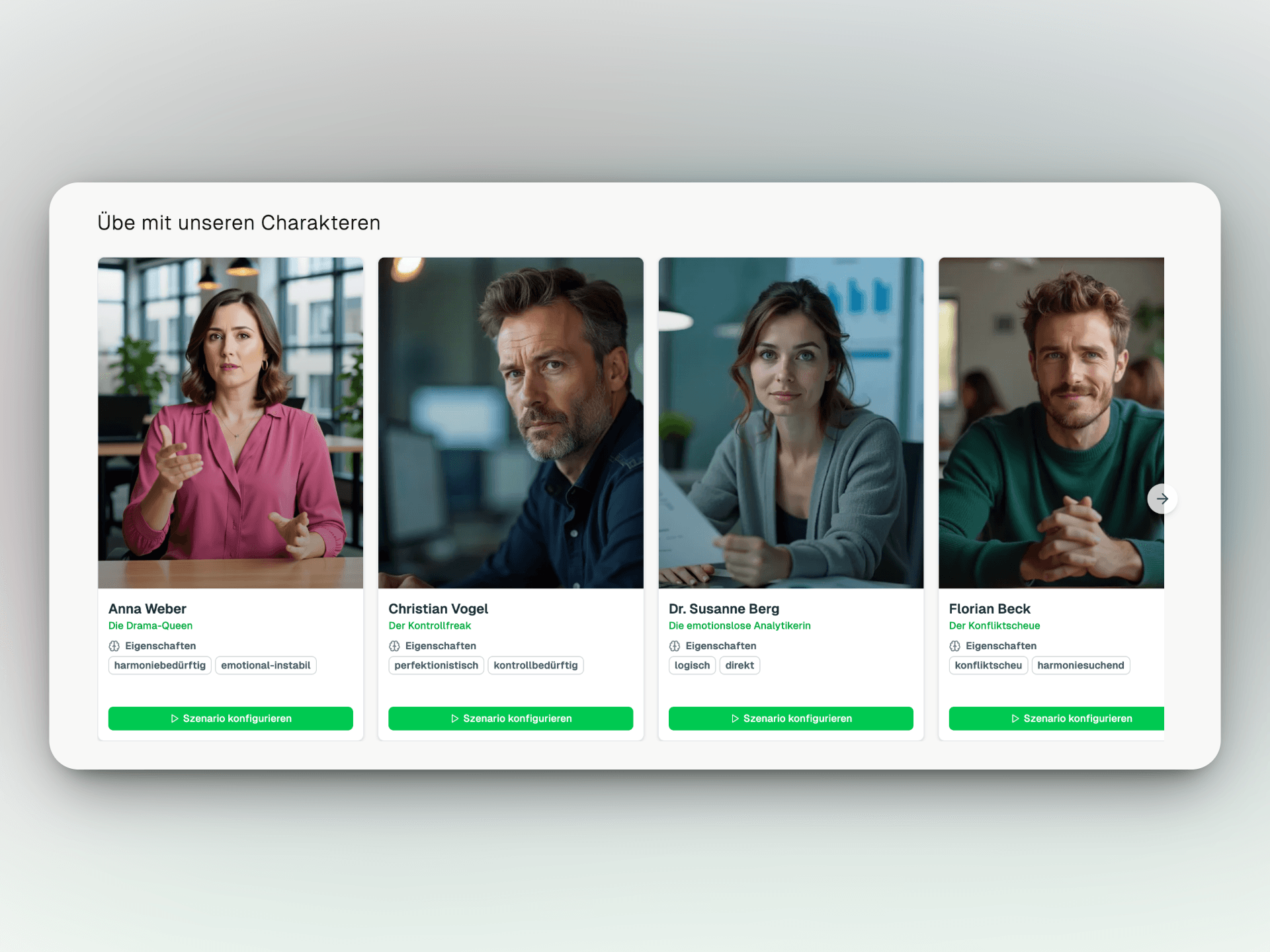
Practice with realistic AI characters

Characters, scenarios and example evaluation come from the central scenario mockups for this page.

Emma Thompson

Emma Thompson

Team Lead, Customer Success · HEALTHCARE_SERVICES

ESFJ

The empathetic remote coach

Emma is relationship-driven and quickly builds rapport. She hesitates when a short, tense video-call turns into a blame-focused conversation.

IntrovertExtrovert
DetailConcept
AnalyticalEmotional
StructuredFlexible
Michael Grant

Michael Grant

Director of Engineering · IT_TECH

INTJ

The rigorous systems director

Michael is strategic and prefers facts, metrics, and clear decision trees. He tends to over-structure under pressure, which can make remote conflicts feel cold or dismissive.

IntrovertExtrovert
DetailConcept
AnalyticalEmotional
StructuredFlexible
Sofia Martinez

Sofia Martinez

VP Operations · FINANCIAL_SERVICES

ISTP

The pragmatic crisis operator

Sofia is pragmatic, action-oriented, and calm under stress. When communication breaks down remotely, she may default to quick directives instead of rebuilding trust step-by-step.

IntrovertExtrovert
DetailConcept
AnalyticalEmotional
StructuredFlexible
Use Cases

What do others use Careertrainer.ai for?

Concrete use cases for leaders, HR, and people development — from the first 100 days to measurable skill tracking

From peer to manager — without learning on the job

Newly promoted team leads often run their first employee conversations with zero training. With Careertrainer they practice the typical first conversations — expectation alignment, feedback, onboarding talks — before they happen for real.

  • Learning path "First 100 days as a manager"
  • Structured onboarding across 6–8 weeks
  • Skill tracking shows progress to HR and leadership
Thomas Weber
Frank Zimmermann
Karl-Friedrich Moser
Andreas Kaufmann
Daniel Foster

Resetting expectations with a high-performing but disruptive developer

A strong individual contributor delivers results but damages team trust through blunt behavior and missed collaboration norms.

FührungMitarbeitergesprächFeedback

Learning-path progress

Kick-off
Expectations
Feedback
Conflict
Discover the onboarding solution

Choose your plan

Transparent pricing for you alone or your whole team. Enterprise and White Label kept separate – clearly split, no jargon.

Still have questions? We're happy to advise you.

Contact Us

FAQs

What distinguishes Remote Leadership Training from traditional leadership training?
Remote leadership presents unique challenges that traditional management training does not address: building trust without physical presence, motivating through a screen instead of in person, addressing performance issues without daily visibility, fostering team spirit when everyone is geographically separated, and recognizing burnout when employees are online 24/7. Our Remote Leadership Training specifically targets these situations, allowing leaders to practice virtual-specific communication skills.
What remote leadership situations can I practice with the training?
The Remote Leadership Training addresses all critical virtual leadership situations: motivating without physical presence (engaging employees via video), remote performance management (addressing performance issues without daily visibility), conflict resolution in video calls (facilitating team conflicts through screens), remote onboarding (integrating new employees without an office), remote work-life balance (recognizing and addressing overload), hybrid team dynamics (ensuring equal treatment of office and remote employees), and psychological safety in remote settings (fostering an open culture despite distance).
How realistic are the remote leadership scenarios?
Extremely realistic through remote-specific behavior patterns: AI characters exhibit typical remote challenges such as distant, brief responses in video calls (camera off, multitasking), feelings of isolation and loneliness in the home office (I feel excluded from the team), misunderstandings due to lack of context (asynchronous communication leads to conflicts), and overwork due to blurred boundaries (working until 11 PM because the laptop is in the bedroom). Leaders authentically experience the emotional realities of remote employees.
Is the Remote Leadership Training suitable for hybrid team configurations?
Perfect for hybrid teams – the greatest challenge of modern leadership. We have developed specific scenarios addressing common hybrid issues: remote employees feel disadvantaged when it comes to promotions (in-office staff are favored), information flow is uneven (important decisions are made in hallway conversations), meetings disadvantage remote participants (those present in the room dominate), and team events often exclude remote colleagues. The Remote Leadership Training helps avoid these pitfalls.
Can I also train international remote teams with the Remote Leadership Training?
Yes, the Remote Leadership Training combines remote-specific challenges with intercultural ones: leading across time zones (asynchronous communication with teams in India, the USA, and Europe), cultural differences amplified by remote work (direct German communication can seem harsher via email), and varying remote work cultures (US teams expect constant availability, while European teams prioritize work-life balance). The scenarios prepare participants for these complex dynamics.
How does remote leadership differ from traditional leadership?
Remote leadership requires fundamentally different skills: Traditional leadership relies on physical presence, informal conversations, non-verbal cues, and spontaneous exchanges. In contrast, remote leadership thrives on intentional communication, scheduled check-ins, written clarity, and trust rather than control. The Remote Leadership Training imparts these mindset shifts: from presence-based to outcome-based leadership, from informal to structured, from control to trust, and from spontaneous to intentional.
How can I identify if employees are overwhelmed during Remote Leadership Training?
The AI characters exhibit subtle signs of overload that are often overlooked in remote settings: responding to messages late at night or on weekends, appearing exhausted or irritable during video calls, delivering declining quality despite long online hours, and becoming withdrawn and terse. The Remote Leadership Training sharpens your awareness of these warning signs and teaches you how to proactively engage in conversations about work-life balance before burnout occurs.
Can the Remote Leadership Training also be utilized by new remote leaders?
Perfect for executives new to remote leadership—whether due to Covid-19 or new roles in remote-first companies. The Remote Leadership Training is systematically structured: Weeks 1-2: Foundations (building trust without physical presence, clear remote communication), Weeks 3-4: Challenges (performance management, conflict resolution via video), Weeks 5-6: Advanced (hybrid teams, psychological safety in remote settings). After 6-8 weeks, new remote leaders will be confident in virtual leadership.
How long does the Remote Leadership Training last?
A single Remote Leadership session lasts 15-25 minutes—perfectly suited for fitting between video calls or asynchronous work blocks. For systematic development of Remote Leadership skills, we recommend a duration of 6-8 weeks with 2-3 sessions per week, covering a total of 12-20 scenarios that address all critical remote situations. The training is designed to be remote-friendly: it is available anytime, integrates seamlessly into your home office routine, and requires no synchronous appointments.
Does the Remote Leadership Training also work for leaders who are fully remote?
Absolutely, the Remote Leadership Training is fully accessible online – designed for digital-first companies. Remote leaders can train from anywhere: home office, coworking spaces, or during workations. The software is available 24/7 across all time zones. It’s perfect for remote-first startups, distributed teams in tech companies, or digital nomads in leadership roles. You will train Remote Leadership remotely – with maximum practical relevance.
How do we measure the effectiveness of the Remote Leadership Training?
Measurable outcomes on multiple levels: Quantitative HR metrics (completion rates, training performance scores, improvement over time), employee feedback (higher engagement scores among remote employees, fewer complaints of isolation), business impact (reduced turnover in remote teams, increased productivity despite distance, successful hybrid team dynamics), and qualitative changes (leaders communicate more proactively, set clear remote expectations, and recognize burnout earlier). 360° feedback before and after training is recommended, particularly for remote leadership competencies.
More Solutions

More Careertrainer.ai Solutions

Discover more professional solutions for your leadership development.