careertrainer.ai

Train critical leadership conversations where objections are expressed openly—without escalation and without uncertainty.

If an employee refuses a task: lead calmly, act clearly

Practice realistic live audio role-plays with Careertrainer.ai for challenging leadership situations. Understand underlying motivations, set clear expectations, and address consequences professionally.

Live example · This is what training looks like

12 scenarios
Phone call

Your own scenario

Emily Parker

Emily Parker

Leadership
Senior matrix coordinator

Long-tenured high performer · 49 · ISTJ

Cross-IndustryKritikgespraechAutoritaetsanzweiflungHigh Performer Langjaehrig

Clarify your mandate when Emily stops taking direction

Emily questions your authority

In the middle of your phone call with Emily, she asks why you are involved now. She refuses to follow the next step for the joint process because approvals depend on several lines.

Goal: Name the exact behavior you observed and its impact on the handover. Clarify your mandate in a visible way and agree one specific next behavior she will do.

Learning goals

  • Clarify authority boundary
  • Describe impact on handover

What to expect

  • Reference concrete observations, not interpretations
  • Briefly state decision boundary and responsibility lane
Practice with Emily Parker — it’s free

Why leadership conversations often fail when there’s open resistance

If an employee refuses a task, pure logic usually isn’t enough. What matters is whether you can spot the root causes in the conversation, set clear boundaries, and stay action-ready—even when you meet resistance.

AI character for industry-focused solutions

AI role-play focus

Great leadership requires more than reflexes—it takes intentional direction.

With AI role-play training, you can practice sensitive leadership conversations realistically—before a rejected task turns into a team issue or an escalation case.

Stay calm under pressureIdentify the motivation behind resistance
Challenge 01

Open rejection puts you under instant pressure to justify yourself.

When an employee outright rejects a task, the conversation quickly shifts into justification, frustration, or a power struggle. Then the assignment, responsibility, and the next step become unclear—and the signal spreads across the whole team. With Careertrainer.ai, you can practice these leadership conversations as realistic live audio role-plays. So you stay calm, lead clearly, and handle resistance professionally.

Book a free demo
Challenge 02

Behind refusal, there’s often more than just a lack of will.

Not every rejection is just “defiance.” Overload, unclear roles, missing competence, or silent frustration often only become visible in the conversation. If you push too early, you miss the real root cause—and you can end up worsening performance dips, increasing sick days, or triggering “quiet quitting.” With Careertrainer.ai, you train with realistic role-plays to uncover underlying motives—while still staying clear on expectations and responsibilities.

Book a free demo
Challenge 03

Unclear messages turn a one-off incident into a pattern.

Many leaders address the problem, but they don’t clearly define expectations, accountability, or timelines. As a result, what starts as a one-off refusal quickly turns into an ongoing issue—creating friction in day-to-day operations and reducing leadership authority. Careertrainer.ai helps you train in AI role-play: a clear conversation structure, crisp expectations, and agreements you can actually rely on—even when there’s resistance.

Book a free demo
Challenge 04

Delayed action can intensify team dynamics and increase escalation risk.

When the consequences of uncertainty or a need for harmony are left unaddressed, colleagues pay close attention to what leadership actually enforces. This increases the cost of conflict, undermines reliability within the team, and makes later escalations significantly harder. Careertrainer.ai simulates difficult conversations with emotional resistance—so you can address consequences in a factual, fair way, with no unnecessary escalation.

Book a free demo

Train typical conversations with AI when an employee refuses a task

Four real-world practice scenarios on “What to do when an employee refuses a task”: Train realistic conversations with lifelike AI characters in Careertrainer.ai.

Filter by company context, conversation type, challenge and employee persona. Every example leads directly into your own AI role-play.

12 of 12 scenarios

Company context

Conversation type

Challenge

Employee persona

Emily Parker

Emily Parker

Long-tenured high performer

Corporate matrix organisationCritical feedback conversationAuthority challengeLong-tenured high performer

In the middle of your phone call with Emily, she asks why you are involved now. She refuses to follow the next step for the joint process because approvals depend on several lines.

What you'll practise

  • Clarify authority boundary
  • Describe impact on handover
  • Agree one next behavior
Well, in our matrix it is never just one line.
Noah Mitchell

Noah Mitchell

Junior with high expectations

Family-led midmarket companyDevelopment conversationFear of changeJunior with high expectations

Between two meetings, you pull Noah aside in the office corner where the new scheduling dashboard is pinned. Since the rollout, he has been avoiding the assigned report task for the shift planning.

What you'll practise

  • Name the hidden concern
  • Give concrete reassurance
  • Agree the next small step
Honestly, I do not trust the new dashboard yet.
Practise with Noah
Alex Taylor

Alex Taylor

Vocal critic

Tech scale-upCritical feedback conversationDefensive response to feedbackVocal critic

Alex picks up your phone call and immediately challenges the timing of your feedback. You notice he has stopped contributing to the deployment check for three releases, and he says you are judging the team.

What you'll practise

  • Anchor to observable facts
  • Name impact without escalation
  • Invite Alex’s perspective
You are bringing this up now. That is not fair.
Practise with Alex
Sophie Morgan

Sophie Morgan

Quiet talent

Public-sector organisationConflict conversationQuiet quittingQuiet talent

Across from you in the site office, Sophie starts talking before you open your notes. The same processing complaint has been raised twice this month, and she refuses the next assigned task because she says nobody listens to her concerns.

What you'll practise

  • Mirror the core frustration
  • Confirm the procedural expectation
  • Agree a concrete next step
I did not sign up to be brushed off.
Liam Edwards

Liam Edwards

Return after overload

Healthcare shift organisationMotivation conversationLoyalty conflictReturn after overload

Right after your morning handover call, Liam starts a quick callback about today’s coverage. He is back after weeks of strain, but the team rules and his own promise pull him in two directions.

What you'll practise

  • Clarify role boundary limits
  • Secure one shift action commitment
  • Follow up on expectations calmly
I will cover, okay. I just need you to understand the roster reality.
Practise with Liam
Jordan Blake

Jordan Blake

Informal leader

Skilled-trades businessDelegation conversationFeeling micromanagedInformal leader

Across from you in the workshop during a short site walkthrough, Jordan starts a hard stop. Since the last job plan update, his work feels micromanaged through constant approval rounds.

What you'll practise

  • State decision scope clearly
  • Reduce checkpoints to essentials
  • Agree escalation trigger and follow-up
I run the installation. If every step gets approval, you are not delegating.
Rachel Bennett

Rachel Bennett

New team member with leadership ambition

Retail branch operationMotivation conversationOverload signalsNew team member with leadership ambition

Between two shifts, you dial Rachel for a quick call about this week’s staffing. She answers fast, then steers away from the topic, because she does not want anyone to see she is reaching limits.

What you'll practise

  • Name overload signals neutrally
  • Agree one concrete workload relief
  • Plan a short follow-up on execution
I can still run the floor. I just do not want it to become a discussion.
Oliver Harris

Oliver Harris

Experienced senior close to exit

Remote and hybrid teamConflict conversationDefensive response to feedbackExperienced senior close to exit

At your desk in the hybrid team area, Oliver joins the meeting ten minutes earlier than planned. After the last conflict, he avoids open criticism but you can feel withdrawal in how he responds to requests.

What you'll practise

  • Name tension without assigning blame
  • Secure one behaviour commitment
  • Close with a follow-up check
I heard the comments. Then the next ask came through like nothing happened.
Casey Hayes

Casey Hayes

Long-tenured high performer

Production shift operationMotivation conversationQuiet quittingLong-tenured high performer

Casey answers your quick call before the shift handover and says they will not take the extra safety task today. You hear the same pattern since last quarter, when recognition dropped and workload kept growing.

What you'll practise

  • Name withdrawal, not excuses
  • Ask for causes without pressure
  • Agree one small binding step
I won’t be blamed for something you change every week.
Laura Hughes

Laura Hughes

Junior with high expectations

Corporate matrix organisationChange conversationFear of changeJunior with high expectations

In the conference corner near the production support desks, Laura meets you after the monthly steering update. She planned to stay quiet, but your face-to-face question pulls her into a direct refusal to join the new process pilot.

What you'll practise

  • Clarify the change impact on Laura
  • Mirror resistance without debating
  • Agree a safe, small involvement scope
If headquarters decides it anyway, why am I supposed to carry it?
Henry Clark

Henry Clark

Vocal critic

Family-led midmarket companyCritical feedback conversationQuiet quittingVocal critic

Henry picks up your call right after lunch and says he will not complete the additional documentation for the new rollout. He sounds irritated, because several parallel initiatives in the plant already consumed his time without visible outcomes.

What you'll practise

  • Define the observable refusal clearly
  • Surface trust criteria through questions
  • Secure a realistic expectation agreement
We’ve had plans before. Then the paperwork got dumped on us.
Riley Stone

Riley Stone

Quiet talent

Tech scale-upDelegation conversationGenerational conflictQuiet talent

On site at the coworking floor, Riley meets you after the stand-up and quietly refuses the requested task handover. Riley uses a broad comparison about how older colleagues work, and the refusal escalates your uncertainty about expectations.

What you'll practise

  • Translate labels into behaviors
  • Set shared standards for handover
  • Agree a safe feedback rhythm
I’m not refusing. I just don’t want that feedback rhythm.

How the AI evaluates your training conversation

After every role-play a separate AI analyses your full conversation transcript — with score, goal feedback and concrete quotes from your own dialogue.

Two layers feed the overall score: scenario-specific goals (70%) and five core competencies for your training type (30%).

SummaryRating: Solid

Emily Parker · Clarify your mandate when Emily stops taking direction

Good boundary and impact, but next step commitment needs more clarity

Name the exact behavior you observed and its impact on the handover. Clarify your mandate in a visible way and agree one specific next behavior she will do.

Overall result
6.8/ 10

70% scenario goals + 30% core competencies

Scale 0–10 · backed by quotes from your conversation

Scenario goals · 70%Core competencies · 30%

Scenario goals

Scenario goals · 70%

Clarify authority boundary

6.5 / 10

State what you can require immediately and what waits for other lines. This reduces Emily’s doubt and makes expectations documentable.

Partially achieved

You referenced the refusal, but the authority boundary between your immediate request and later approvals is slightly implied.

In our matrix it is never just one line.

Describe impact on handover

8.5 / 10

Name the specific impact of the missed step on the handover quality or timing. Link it to work outcomes, not personal judgement.

Fully achieved

You connected the refusal to a concrete handover impact: approvals route through three lines before handover.

approvals route through three lines before handover

Agree one next behavior

6.5 / 10

End with one concrete next action and a time reference the employee owns. Keep it small enough to secure without escalation.

Partially achieved

You did not secure one specific next behavior Emily will complete right away with an owner-level commitment.

So what exactly do you want me to do first?

Core competencies

Core competencies · 30%

Active listening

6.5

Follow-up questions, paraphrasing, targeted clarifiers

Empathy & understanding

7.0

Reading the counterpart's emotional state and perspective

Conversation control

6.8

Structured and goal-oriented without dominating

Solution focus

7.0

Developing constructive options together

Communication clarity

6.6

Clear, understandable, to the point

Details · Transcript excerpt

YouEmily, you said you cannot take the next step now.
Emily ParkerSo what exactly do you want me to do first? In our matrix it is never just one line.
YouOps signed it, but approvals route through three lines before handover.
Pro tip

For one clear commitment, say: “Please send the signed Ops note to the Workstream committee by 3pm today.”

Only your wording is evaluated — not the AI counterpart's. The AI's opening of the conversation is not penalised.

Start your own scenario for free
Roles & Responsibilities

Leadership roles benefit especially from realistic conversation simulations.

If you don’t want resistance in your team to be left to chance, Careertrainer.ai helps you train challenging leadership moments with AI role-play. You practice real conversations—like handling task refusals—get instant feedback, and build clearer expectations, boundaries, and next steps.

Team Lead for Operational Roles

You run a shift, service team, or back office—and you need to be able to respond when an employee clearly rejects a request. With Careertrainer.ai, you practice in AI role-play short, high-pressure conversation scenarios where emotions run high. That way, you train clear expectation-setting, de-escalation, and firm agreements you can rely on for the next workday.

Resolve everyday challenges clearly and effectively.

  • Order will be rejected outright.
  • You can address it calmly even when under pressure
  • Secure your commitment
  • State the consequences accurately

Department Manager & Regional Manager

When experienced employees refuse tasks, it’s often not just about the task itself—but about role expectations, priorities, or a hidden conflict. With Careertrainer.ai, you can train these leadership conversations through realistic conversation simulations, so you spot the underlying causes faster and lead with confidence—balancing understanding, clear expectations, and consistent consequences.

Recognize hidden motives behind rejections

  • Expose Priority Conflicts
  • Know Your Limits of Delegation
  • Lead through resistance—without turning it into a power struggle
  • Review call performance with a clear conversation timeline

HR Business Partner

You support leaders when a rejected task quickly turns into a legally sensitive workplace issue. With Careertrainer.ai, you use AI role-play training to test conversation guidelines in advance, soften critical wording, and prepare executives for escalation conversations. This reduces missteps and creates more consistency in how you handle these situations.

Prepare for sensitive conversations before they escalate

  • Discuss the refusal documentation
  • Mirror borderline cases professionally
  • Train leaders in advance
  • Feedback on your word choice and impact

Branch Manager & Store Manager

On the shop floor, in production, or in logistics, refusal to complete tasks meets a tight roster and ongoing operations. Careertrainer.ai offers live-audio practice for conversations under time pressure—where an employee says “no,” colleagues are watching, and you still have to find a solution. You’ll train to deliver clear statements without unnecessary escalation.

Stay effective under time pressure

  • Practice a short conversation before your shift starts
  • Consider team impact
  • Negotiate a clean replacement agreement
  • Define your next steps clearly
Perfect for getting started

New Leaders

If you’ve only just stepped into a leadership role, open rejection and resistance can often feel personal—and come as a surprise. Careertrainer.ai bridges the gap between theory and real conversation practice with AI role-play training, where you repeatedly practice your stance, questioning techniques, and clear consequences. This helps you show up with more confidence in real employee conversations.

Confidence for your first conflict conversations

  • Stay calm when you’re provoked
  • Ask relevant background information systematically
  • Set clear expectations
  • Progress you can track across multiple exercises

People Lead in Knowledge Work

In project teams, tech, or consulting, work usually isn’t outright refused—it’s blocked through priorities, workload, or a perceived lack of meaningful purpose. With Careertrainer.ai, you train conversation skills for exactly these nuances: an employee declines tasks indirectly, makes a strong, professional argument, and tests your leadership. That way, you build clarity without micromanaging.

Resolve subtle rejection in project teams

  • Handle conflicting priorities
  • Own your outcomes—stop making excuses and start taking responsibility
  • Separate technical objections clearly and systematically.
  • Secure your commitment at the end

So train you to handle critical leadership conversations when you face open rejection

With Careertrainer.ai, you practice the exact conversation where an employee does not accept a clear instruction. You’ll work in a structured way on staying calm, clarifying the root cause, setting clear expectations, and handling the consequences professionally.

1

Choose the right role-play for your specific leadership situation

Choose a scenario where an employee openly refuses a task, evades it, or links their cooperation to specific conditions. You decide whether it’s about conflicting priorities, being overwhelmed, a lack of acceptance of the instruction, or hidden resistance in everyday team life. This isn’t generic leadership training. You train exactly the conversation that can quickly derail in day-to-day operations.

Role-Play Generator in Careertrainer.ai
2

Run the conversation live—and stay clear and composed under pressure

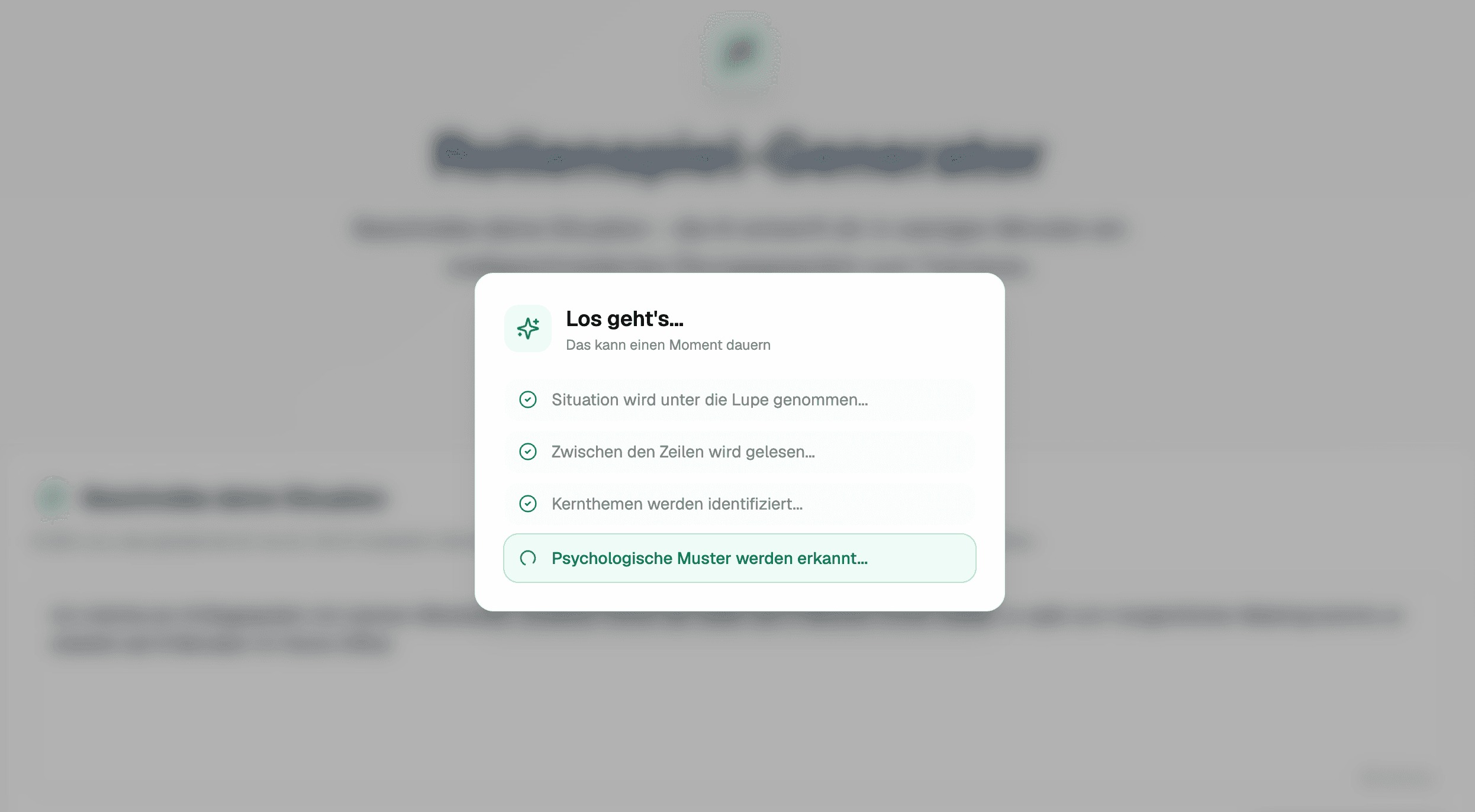
In our Voice AI simulation, you speak with a realistic, AI character that responds in real time—showing emotion, making justifications, or pushing back. You practice staying calm while asking follow-up questions, making context tangible, stating expectations clearly, and setting boundaries without escalating the situation. This helps you train your word choice, conversation structure, and mindset for the moment when resistance is openly on the table.

Voice AI Conversation Simulation in Careertrainer.ai
3

Analyze feedback and build leadership confidence—measurably

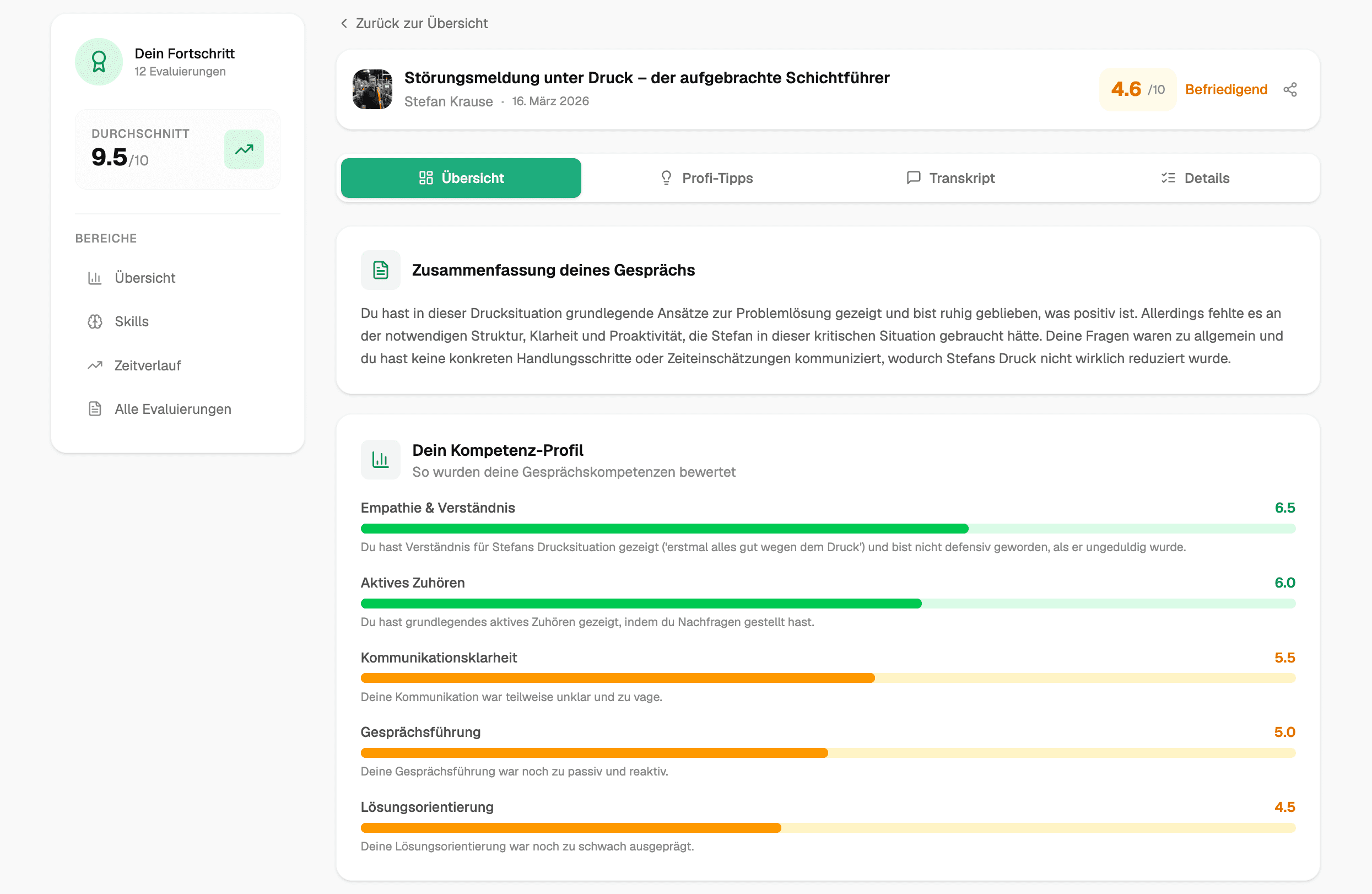
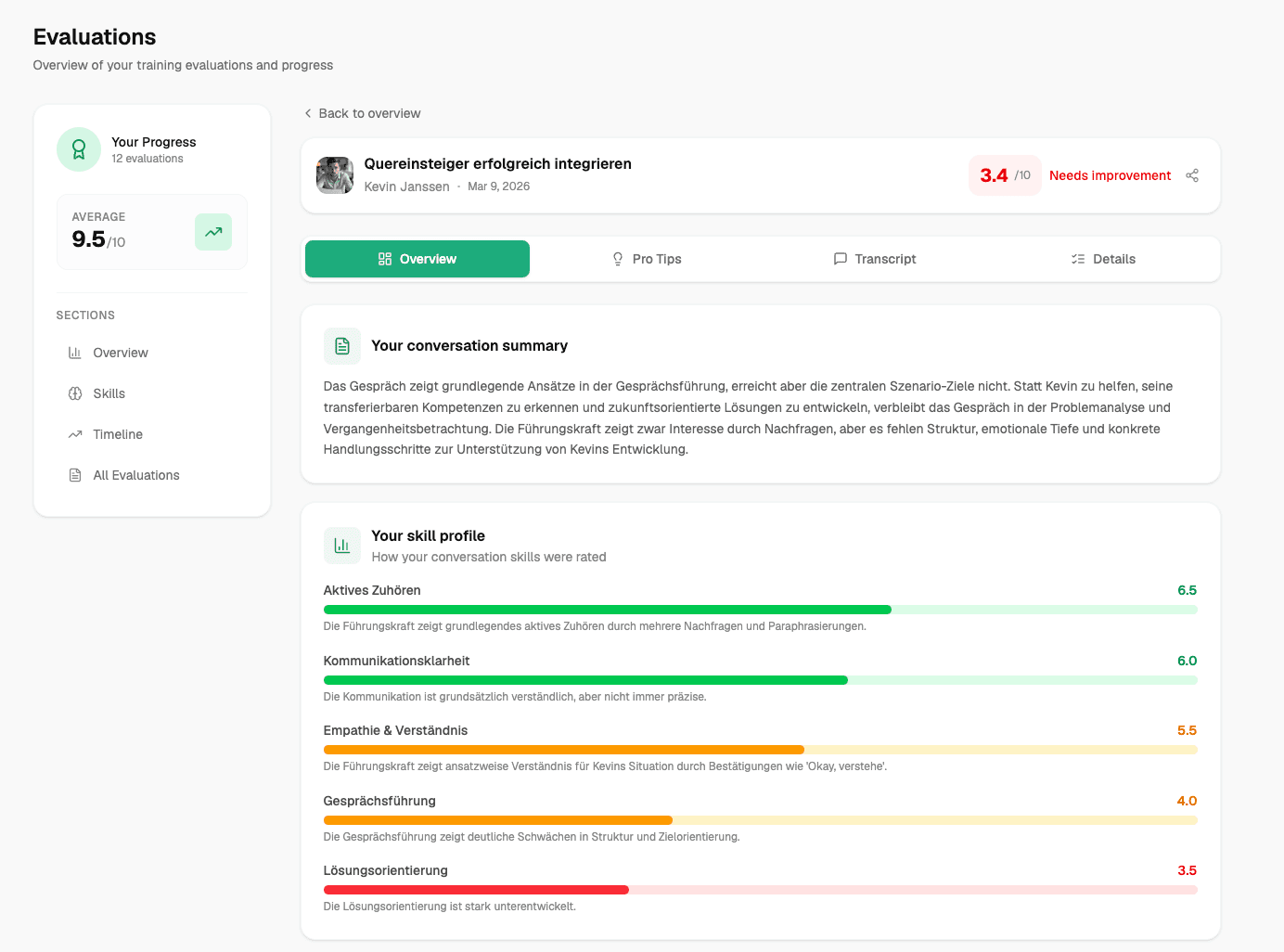
After the role-play, you’ll receive a clear evaluation of whether you identified the underlying causes, addressed responsibility appropriately, and agreed on next steps in a clear, actionable way. Careertrainer.ai shows you exactly where you were too vague, where you applied pressure too early, or where you didn’t name the consequences clearly enough. This way, you can target precisely this type of conversation again and make measurable progress in de-escalation, clarity, and follow-through.

Evaluation Dashboard in Careertrainer.ai

Typical conversations when requests are declined openly

Not every refusal has the same cause. Sometimes it’s overwhelm, sometimes defiance, and sometimes an open power struggle against your role as a leader. With Careertrainer.ai, you can train precisely these difficult live conversations as AI role-play—and practice staying calm, clarifying motives clearly, and setting solid next steps.

Conflict resolution

“I’m not doing that.” — when an employee rejects a request outright

In your day-to-day work you’re under time pressure, and one of your employees openly declines a clearly assigned task in front of others. The conversation can quickly spiral if you counter with authority immediately—or take the statement personally. A better approach is to clarify the trigger first, then confirm the assignment clearly and unmistakably, and set expectations for the expected behavior in a clean, unambiguous way. With the AI role-play training from Careertrainer.ai, you can practice exactly this first critical response multiple times.

Practice the conversation with Dennis
Performance review meeting

“I don’t have the capacity for that right now” — when priorities become a shield

A team member points to full capacity and repeatedly pushes an important task aside—even though it’s part of their role. Things get tricky when you talk only about speed and don’t clearly distinguish between genuine overload and quiet avoidance. In the conversation, you’ll practice asking concrete follow-up questions about priorities, obstacles, and ownership—without jumping to accusations. In the simulation, you train how to turn evasion into accountability and then receive clear feedback right after.

Practice the conversation with Mara
Constructive feedback conversation

If the task is refused because the instruction is allegedly “not making any sense”

An experienced employee questions your assignment on technical grounds and refuses to carry it out, claiming the approach is wrong or unnecessary. This quickly turns into a power struggle when it becomes more about who’s right than about the actual issue. The productive approach is to listen to the factual objections, while clearly separating decision-making, responsibility, and the expected behavior. With Careertrainer.ai, you can practice this conversation until you stay confident, clear, and composed—even when confronted with counterarguments.

Practice the conversation with Thomas
Disciplinary meeting

Repeated rejection despite clear communication—when consequences need to be on the table

An employee has already received feedback—and still refuses the task again, or only agrees under certain conditions. This is exactly where many conversations break down, because leaders either stay too soft or escalate too abruptly. The solution is a clear approach: name the behavior, document the previous course of events, make the consequences transparent, and clearly explain the final remaining scope for action. In KI role-play training, you practice this serious conversation phase without risk—and get immediate feedback on your communication and leadership style.

Practice your conversation with Selin
Why the training works

What helps you in day-to-day leadership when you face open rejection

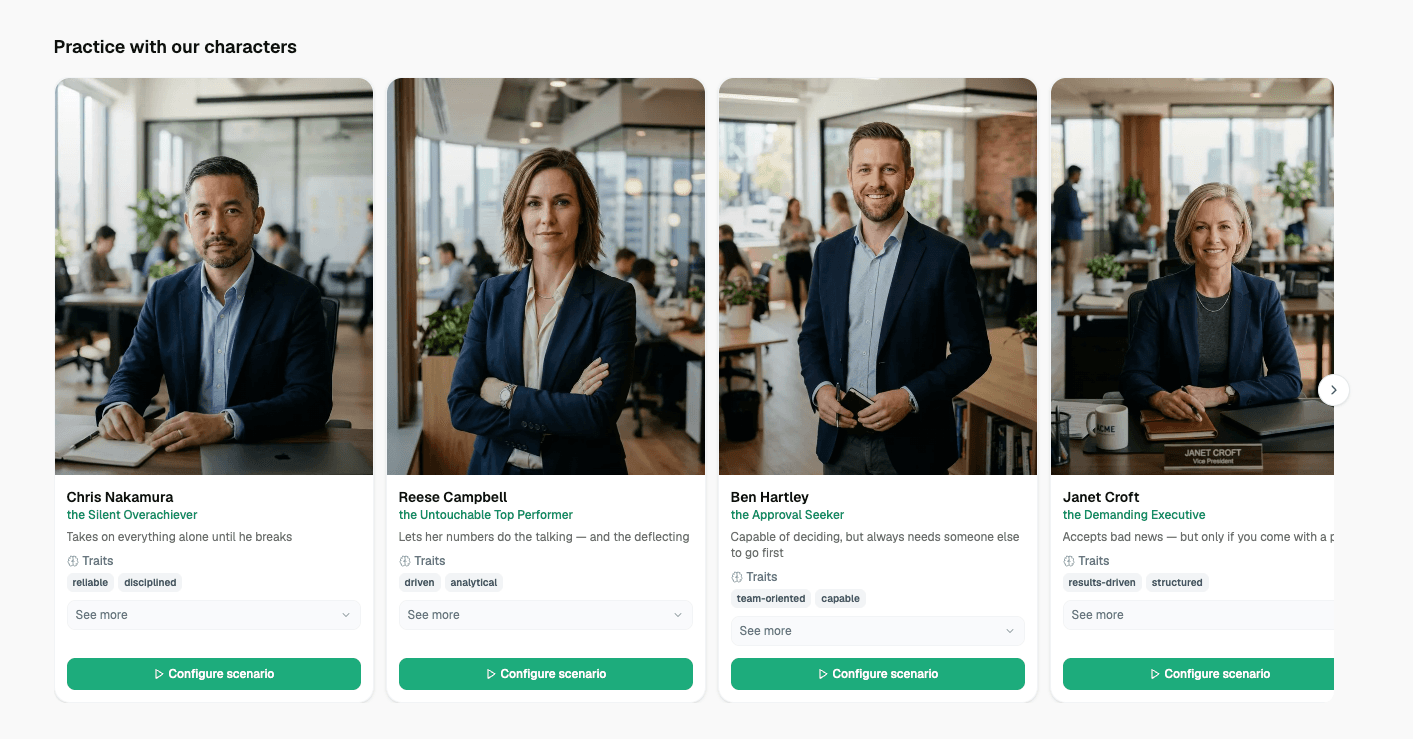
Careertrainer.ai doesn’t just give you generic communication tips—it trains you on leadership moments you can actually build skills from: from a tense 1:1 to a clear feedback and criticism conversation. You practice with realistic AI characters, spot the motives behind resistance, and after every run you see exactly where you get stronger in clarity, de-escalation, and follow-through.

Character selection screen with AI training personas and scenario configuration buttons

For Team Leads and New Managers

Practice sensitive one-to-one employee conversations before they escalate in real life

When a Direct Report pushes back on an assignment, you need more than theory. With Careertrainer.ai, you run the conversation as a live audio role-play, test different leadership approaches, and practice switching smoothly between understanding, clear expectations, and follow-through.

  • Train realistic 1:1 coaching for critical conversations, feedback, and escalations
  • Also ideal for probation feedback, delegation, and goal setting
  • Repeatable training—until your tone of voice and conversational structure feel right.
Learn more
Vertriebstraining mit KI-gestützten Szenarien zur Verbesserung von Verkaufs- und Beratungskompetenzen.

Realistic conversations instead of standard role-plays

Train against employees with real conviction—and noticeable, genuine pushback.

Requests are rarely refused for no reason. In Careertrainer.ai, the AI characters don’t respond from a script—they react with their own personality, hidden motives, and graduated emotional responses. This way, you can practice spotting what lies behind the “no”: overwhelm, a status conflict, or a quiet power struggle.

  • Direct Reports, Senior Engineers, or Project Leads with your own reasoning logic
  • Pressure increases resistance—good coaching opens the conversation.
  • Helps with conflict mediation and handling challenging feedback conversations
To functionality
Evaluation summary and competency profile for leadership communication under pressure.

Feedback right after the conversation

See right away whether you stayed calm, handled the conversation clearly, and brought it to a clean, decisive close.

After every role-play, you receive a structured evaluation of your conversation style. You’ll see whether you clearly identified the underlying causes, stated expectations in a straightforward way, and set next steps that are genuinely actionable—so you don’t rely on gut feeling after the conversation.

  • Scores for clarity, listening, empathy, and solution orientation
  • Evidence from the conversation instead of generic trainer feedback
  • Shows whether consequences were phrased professionally instead of in a threatening way
Learn more
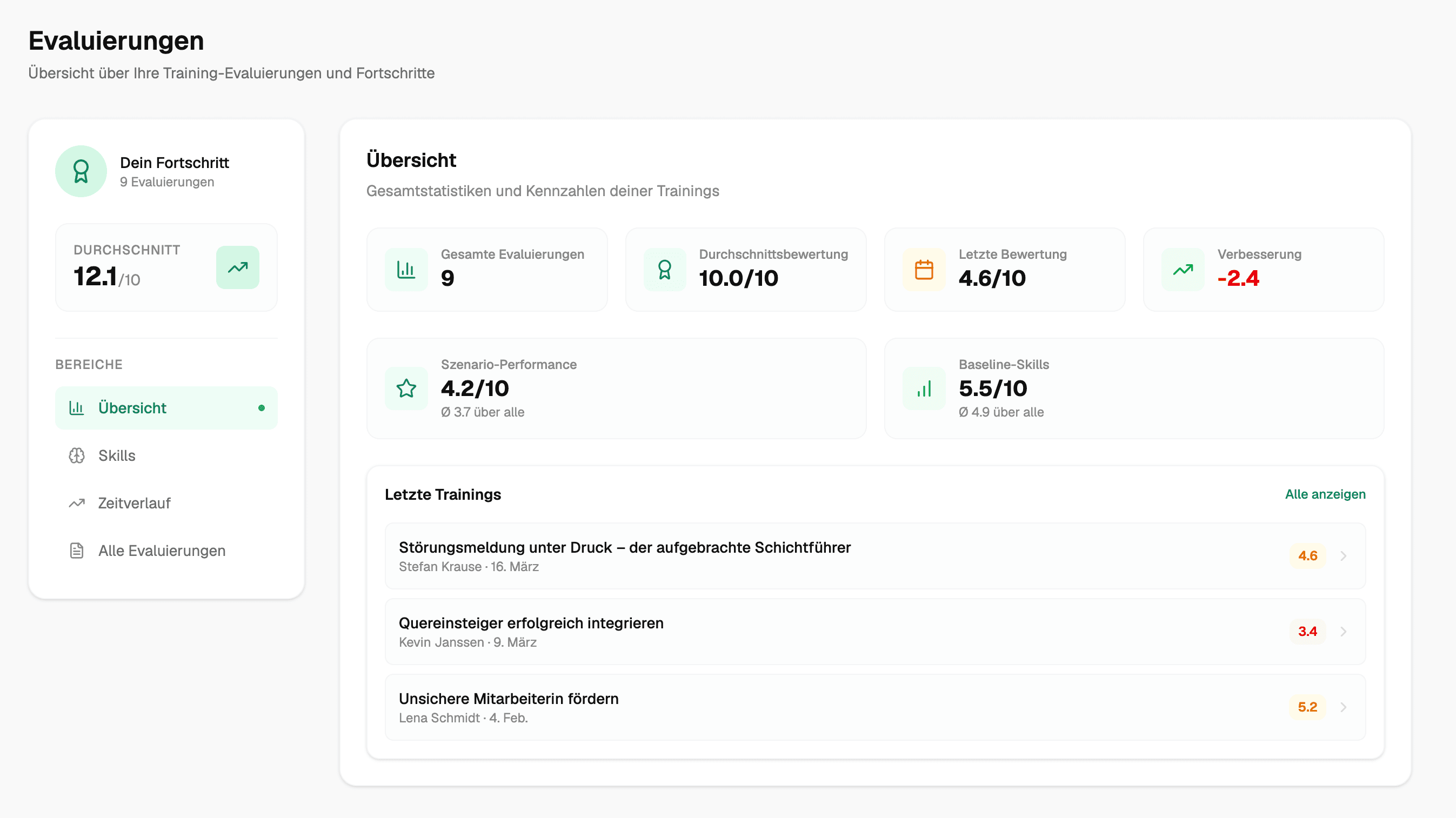
Training evaluation dashboard displaying progress, ratings, and performance metrics for leadership development.

Measurable progress for leadership

See exactly what you still need to improve in conflict and performance conversations

Recurring friction in teams is often not an isolated issue, but a skills gap in delegation, conversation management, or setting boundaries. Careertrainer.ai makes these patterns visible—so you can improve systematically, whether for yourself or for leadership teams through 1:1s, performance reviews, and difficult employee conversations.

  • Spot skill gaps in delegation, difficult feedback conversations, and escalation
  • Progress you can see over multiple sessions—powered by leadership KPIs.
  • Useful for team leads, HR, and leadership pipeline development
To the feature
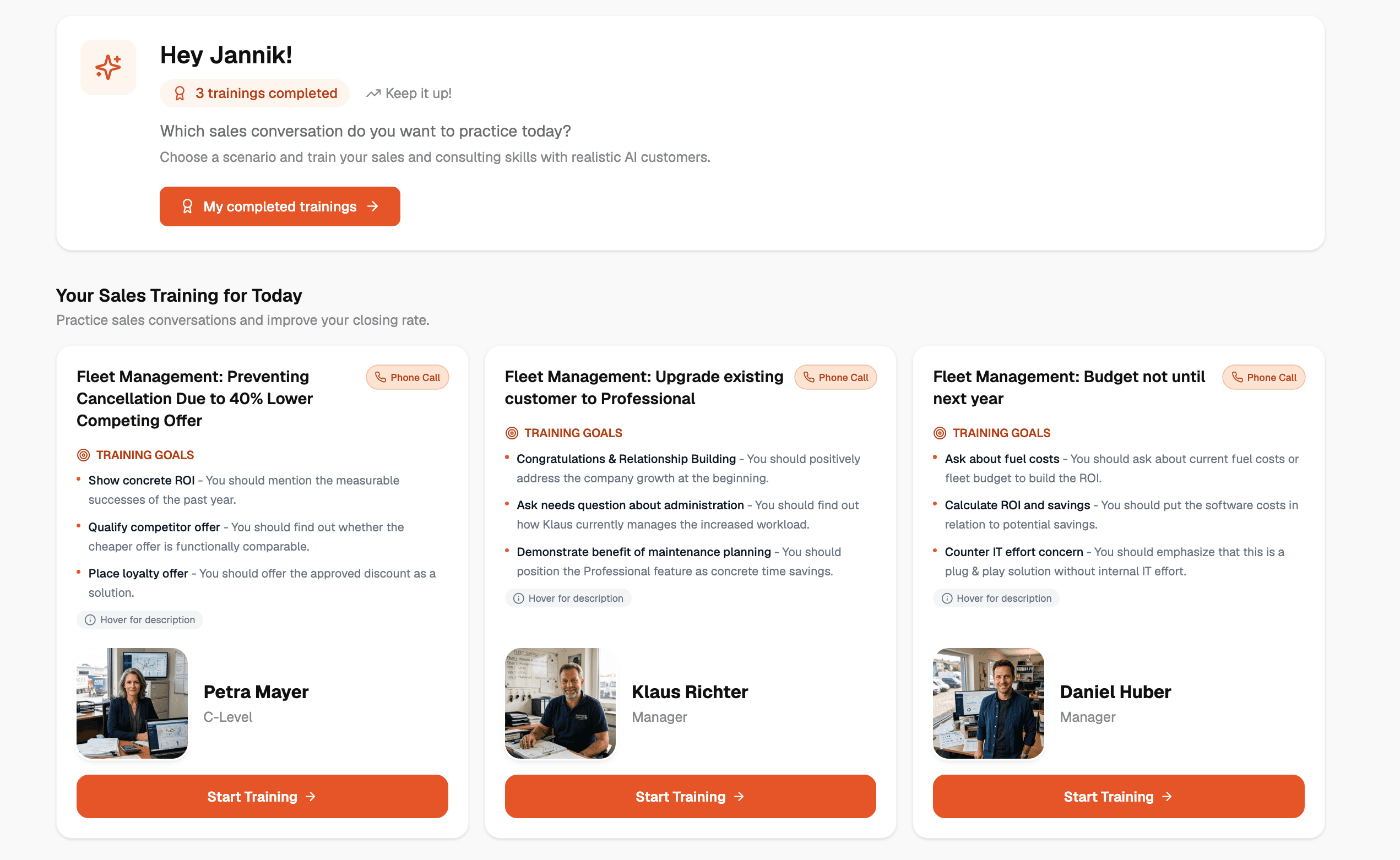
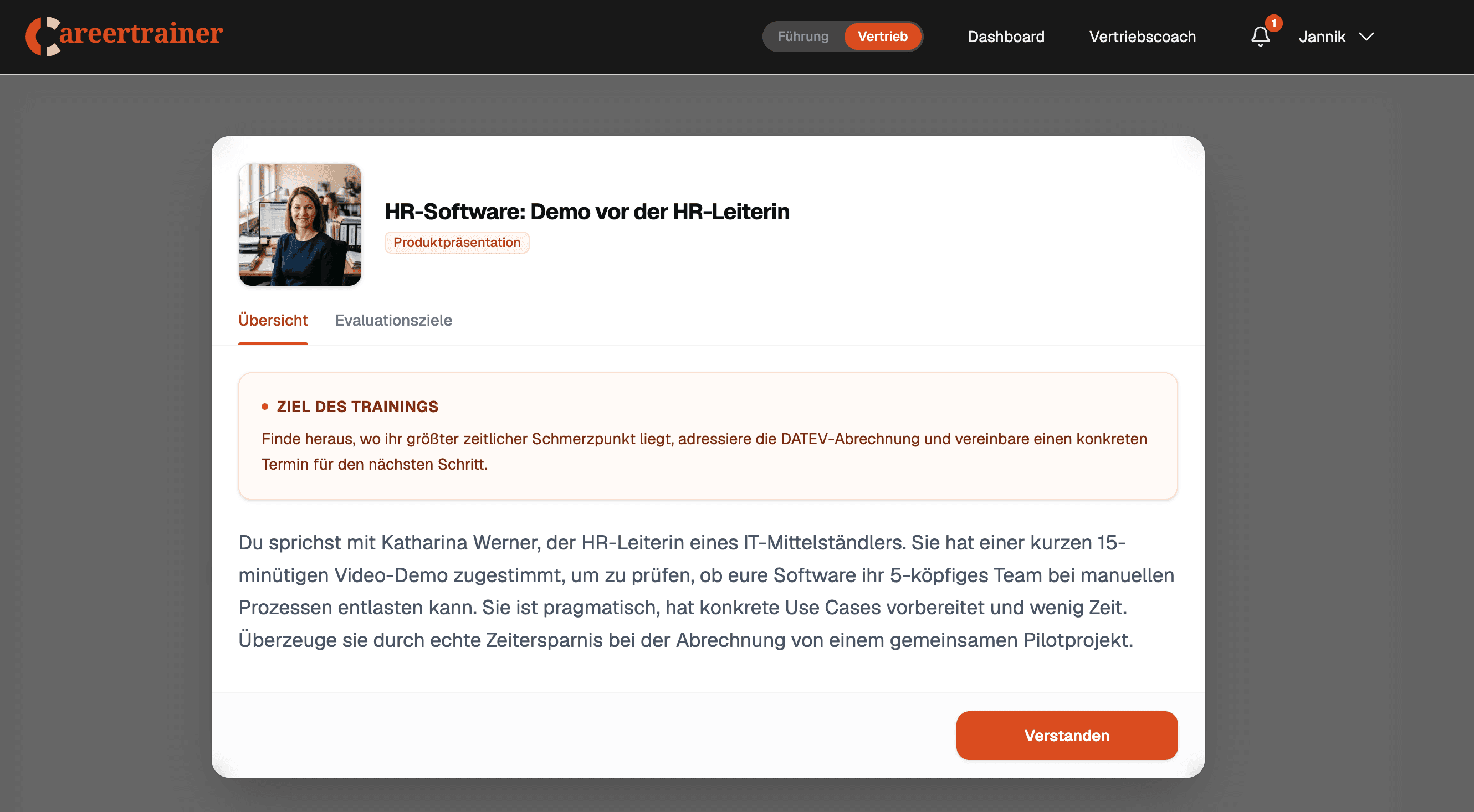
Sales training scenario overview for an HR software product demo with training goal and evaluation tabs

When your next conversation is just around the corner

Prepare the real conversation you can’t keep putting off any longer.

Tomorrow, you have a conversation with an employee who’s blocking a task, questioning priorities, or openly rejecting your instructions? Run through the situation beforehand. That way, you’ll go into the real meeting with a clearer conversation structure, better questions, and less internal uncertainty.

  • Simulate a real situation from your leadership day-to-day within minutes
  • Helps you prepare for a 1:1 meeting, a feedback conversation, or a short-notice escalation
  • Ideal as a warm-up before a challenging meeting
Learn more

Frequently Asked Questions about Task Refusal and Conversation Training

Here you’ll find practical answers on how to respond with confidence when faced with open rejection within your team—and how Careertrainer.ai supports you in practicing these leadership conversations.

How do you respond in a conversation when an employee openly refuses a task?

First things first: don’t respond reflexively with pressure, justification, or personal hurt. If an employee refuses a task openly, you need to stay calm, clarify what triggered the refusal, and make your leadership presence visible.

Start by clearly naming the situation: Which task was rejected, what was the original assignment, and what exactly is the refusal? Then ask for the reason—without immediately trying to legitimize the refusal. Behind open refusal, you often find overload, lack of clarity, professional uncertainty, conflicts over responsibilities, or deliberate resistance to a decision.

In the next step, separate understanding from agreement. You can acknowledge why someone has concerns and still clearly state what expectation applies. If the task is legitimate and reasonable, you spell out responsibility, the timeframe, and the consequences if the refusal continues. If the objections are valid, you adjust the assignment, priority, or provide additional support.

The goal is not a back-and-forth—it’s a clear leadership conversation that establishes the cause, the expectation, and the next step.


What often lies behind open task refusal?

Open refusal is rarely just defiance. In many cases, it’s the visible symptom of a deeper problem. If you don’t identify the root cause, you’ll often react quickly—while missing the real issue.

Common triggers include being overwhelmed, unclear priorities, lack of resources, insufficient competence for the task, a perceived unfair distribution of work, or an unresolved conflict with you or the team. Sometimes, there’s also a power play behind it: the employee tests whether the rules really apply—or whether they can push and move the boundaries. In other cases, refusal is a protective mechanism, because someone is afraid of making mistakes, being criticized, or taking on additional workload.

That’s why, as a leader, it’s crucial to distinguish between can’t, won’t, and doesn’t understand. These three scenarios require different responses. If it’s a capability issue, you support them with clarity and guidance. If expectations are unclear, you restructure the assignment. If there’s deliberate resistance, you need to address limits and consequences clearly and directly.

The more precisely you get to the underlying cause, the more effective—and fairer—your next step will be.

How can you tell whether “no” is coming from being overwhelmed—or from conscious resistance?

The difference usually isn’t visible in a single sentence, but over the course of the conversation. Feeling overwhelmed often shows up as uncertainty, time pressure, a lack of direction, or fear of not meeting expectations. Conscious resistance, on the other hand, tends to show up as dismissiveness, blanket rejection, shifting blame, or a clearly demonstrated boundary-setting.

Watch for specific signals: Can the employee name what’s missing? Do they talk about resources, priorities, or qualifications? If so, it’s more likely a solvable work-related problem. If they dodge the issue, challenge your authority, or refuse without a factual explanation, it’s more likely they’re resisting the task—or your role.

Open but precise questions help: What exactly is keeping you from doing it? What do you need to complete the assignment? In your view, what is the real problem? This way, you can tell whether there’s a genuine obstacle—or whether the refusal is mainly being used as a form of pressure.

What matters most: you don’t have to diagnose right away. The key is to run the conversation in a way that turns assumptions into reliable, actionable evidence.

Which mistakes should you avoid when an employee refuses a job or assignment?

The most common mistake is switching into “fight mode” or going into justification too early. If you respond right away with authority, morality, or anger, you often escalate the situation before it’s even clear what the real issue is.

Five patterns are especially problematic: first, taking rejection personally. Second, using vague language like “We’ll have to sort that out,” without setting expectations or a deadline. Third, giving in too quickly—even when the request is legitimate. Fourth, getting drawn into long debates about side issues instead of addressing the core of the refusal. Fifth, threatening consequences you later don’t follow through on.

It’s also critical not to confuse genuine overload with disobedience. When someone objectively has too much on their plate, applying pressure alone can feel unfair and undermine trust. Conversely, you shouldn’t downplay deliberate refusal as “just a misunderstanding” when it’s already putting the team or work capacity under strain.

In this context, good leadership means staying calm, being precise, assigning responsibility clearly, and only announcing what you can stand behind consistently.

When should you clearly address consequences in a conversation about refusing tasks?

You shouldn’t use consequences as an opening move—but you also shouldn’t delay them until your leadership role becomes implausible. The right moment is when the assignment is clear, reasonable, and understood, yet the employee still consciously refuses to take it on.

Before that, you need a thorough clarification: Is the task actually part of the role? Was it communicated clearly? Are there real obstacles? Have you offered support, prioritization, or an explanation? Only after these points have been addressed does a difficult situation turn into a genuine refusal with leadership relevance.

Then you should state consequences clearly and professionally. Not in a threatening way, but factually: what expectation applies, by when the implementation must happen, and what will occur if the refusal remains. Depending on the situation, this can range from closer guidance to formally documenting the conversation, up to next steps that are relevant under labor law.

Consequences only work if they are understandable, proportionate, and feasible. That’s exactly why they need to be tied to a clear conversation—not to an emotional back-and-forth.

How does Careertrainer.ai help me if I want to practice conversations when I’m receiving an open task rejection?

Careertrainer.ai is a DACH-focused AI platform for hands-on conversation training via live audio role-play. For leadership situations involving open resistance, that means: you’re not practicing a theoretical case study—you’re running a realistic conversation with an AI counterpart that behaves like a real employee.

This is especially valuable when tasks are refused, because these conversations can quickly turn emotionally. You train how to respond to defiance, avoidance, justifications, or silent obstruction—without losing your authority. The AI characters aren’t generic; they act with understandable motivations and show clear, believable reactions to your tone, your questions, and your clarity.

After each run, you get immediate feedback on whether you clarified the underlying causes properly, communicated expectations clearly, de-escalated effectively, and addressed consequences professionally. That way, you don’t just see whether the conversation felt good—you also understand where your leadership was truly strong or not quite solid in critical moments.

If you don’t want to improvise when it comes to sensitive employee conversations only when it really matters, practicing under realistic pressure is exactly the advantage you need.

What sets Careertrainer.ai apart for leadership challenges from seminars, e-learning, or basic chatbots?

The biggest difference is the training mode. In a seminar, you learn models and phrases; in e-learning, you consume content; and with simple chatbots, you typically communicate in a text-based way. Careertrainer.ai uses live audio role-plays where you actually run difficult leadership conversations.

Especially when dealing with task refusal, it’s not only about what you want to say—but whether you can deliver it calmly, clearly, and effectively under pressure. Role-play training closes the gap between knowing and being able to do much better than pure theory. You hear resistance, you have to respond on the spot, and you learn how to handle uncertainty, pressure, and emotional cues.

It also adds character depth. The AI counterpart doesn’t respond like a generic assistant, but like an employee with their own stance, hidden motives, and a conversation readiness that can change. After the session, you get structured feedback—not just a gut feeling.

If you lead a team and want to handle real, specific conversations with confidence, Careertrainer.ai is therefore closer to real life than classic learning formats or superficial roleplay tools.

Who is Careertrainer.ai particularly suitable for when team members refuse tasks?

Careertrainer.ai is especially well-suited for leaders who regularly have to conduct sensitive employee conversations—and don’t want to rely on chance or day-to-day mood. This includes team leaders, department heads, store managers, shift leads, project managers with people-management responsibility, and HR-adjacent leadership roles.

The training is particularly valuable in environments where tasks must be delivered under time pressure, in complex dependencies, or with operational impact—such as in production, logistics, service, sales, administration, or project-driven teams. In these settings, open refusal can quickly affect performance, morale, and reliability within the team.

The benefits are also significant for new managers: you need to set boundaries without coming across as unnecessarily harsh, while also learning to distinguish genuine overwhelm from deliberate refusal. Experienced leaders benefit too—especially if they want to test difficult conversations in advance, sharpen their phrasing, or develop a more consistent approach to consequences.

In short: if you carry responsibility and need to handle resistance professionally, this training fits naturally into your day-to-day work.

How quickly can I get started with Careertrainer.ai, and what does the process look like in practice?

The start is intentionally lightweight. You choose a suitable leadership scenario, start a live audio conversation, and train—within a few minutes—the exact situation you struggle with in everyday life. Typical sessions last around 5 to 15 minutes, so they fit between meetings or right before a real employee conversation.

For conversations involving direct but open rejection, you can use targeted scenarios where an employee deflects, declines the assignment, questions your responsibility, or only moves forward under certain conditions. This way, you’re not practicing communication in general—you’re drilling specific leadership moments with a clear rise in tension.

After the conversation, you’ll get immediate feedback: competency scores, key observations, and actionable improvement suggestions. This helps you spot patterns—Are you justifying too quickly? Are you staying too superficial on the underlying cause? Are your expectations clear enough? Every role-play becomes a short, measurable training unit.

For individuals, getting started is quick, and teams can work through several leadership scenarios in a structured way—without having to set up lengthy training logistics first.

Can training providers or consultants offer Careertrainer.ai for their employees under their own brand?

Yes. Careertrainer.ai can also be used as a White-Label or partner model if you want to offer leadership training under your own brand as a training provider, consultancy, or HR-adjacent platform. This also applies to formats around Refusal of Assigned Task—i.e., sensitive conversations involving open refusal, setting boundaries, and clarifying consequences.

The benefit for partners: you don’t need to develop your own AI infrastructure, but you can integrate realistic live role-play scenarios into your existing offering. Your brand remains front and center, and you can embed the training into your current programs for executives, academy offerings, or consulting formats.

This is particularly attractive for this topic because traditional training for task refusal often fails due to a lack of practice time. With Careertrainer.ai, you can train these conversations as often as needed—standardized and still realistic. At the same time, Careertrainer.ai positions itself as an enabler for partners, not as a model that takes over the customer relationship from you.

If you want to scale leadership training or add a digital layer, White Label is a smart option.

How can you measure training success for high-stakes leadership conversations with Careertrainer.ai?

Measurability is especially important in leadership conversations, because gut feeling often misleads. A conversation can feel confident and composed—and still fall short when it comes to clarity, consistency, or uncovering the underlying causes. Careertrainer.ai makes these points visible.

After every role-play, you receive a structured assessment with competency scores and concrete observations tied to the scenario’s goals. In conversations about tasks that were refused, for example, this includes de-escalation, precision in clarification, clear expectations, proper assignment of responsibility, and a professional approach to consequences. You’ll also see common failure patterns—for instance, evasion, unnecessary harshness, or a lack of follow-through.

For teams, the benefit is even greater: leaders don’t just train more often—they train against comparable standards. This helps you identify skill gaps, track progress over time, and plan training measures more precisely. That’s a clear difference from purely manual role-plays, where feedback is often subjective and difficult to compare.

If you want to develop leadership quality instead of just guessing, measurable training like this is a decisive advantage.

Leadership challenges

Overview of all leadership challenges

Each leadership problem requires specific solution approaches. Discover how to successfully master different challenges.

Authority Issues

Employees publicly question your instructions, go directly to your supervisor with complaints, or ignore deadlines with the excuse, "I see it differently." They endlessly debate every decision, speak disparagingly about you to colleagues, and act as if they are on the same level rather than in a leadership position. You notice your credibility diminishing, and other team members become uncertain about which rules still apply. The challenge: to regain authority without becoming a tyrant.

Learn solution

Your first employee conversation as a new manager

Train your first 1:1 as a new leader with AI role-play training in Careertrainer.ai: build trust, align expectations, clearly communicate your new role, and come across confidently—without sounding unsure or overly authoritative.

Learn solution

Learn to delegate

Train with Careertrainer.ai to delegate clearly, empower your team, and still stay in control. Practice challenging delegation conversations with employees in realistic, repeatable scenarios—without overwhelming your day-to-day workload.

Learn solution

Leading Demotivated Employees

Your team member has been going through the motions for weeks, showing no initiative and leaving the office promptly at 5 PM. This individual used to be your most dedicated performer. Meetings are now marked by awkward silence, with ideas and enthusiasm having vanished. This demotivation is slowly affecting the entire team.

Learn solution

Issue a warning

Practice the exact conversation with Careertrainer.ai where you issue a formal notice of misconduct: clearly state the reason, stay appropriately formal, set boundaries, and avoid escalation—through AI role-play with realistic reactions from employees.

Learn solution

Emotional Reactions to Criticism

As soon as you say, "This could be improved," a team member breaks down in tears or becomes defensive. Objective criticism is interpreted as a personal attack, and constructive feedback triggers emotional outbursts. You face the challenge of delivering important feedback without hurting your employees or poisoning the work atmosphere.

Learn solution