careertrainer.ai
|

Guide & AI Training for Leaders

Leading ISFJ Personalities

This guide assists leaders in effectively managing ISFJ employees and unlocking their potential.

Personality Type

What defines ISFJ?

Myers-Briggs Personality Type

Scientifically grounded personality analysis

MBTI Personalities
ISFJs are loyal and caring employees who utilize their practical skills to achieve tangible results within a team. However, they may struggle with sudden changes and conflicts, and often need encouragement to assert themselves.
Cognitive Functions
Conscious & unconscious processes
Strengths & Challenges
Individual development areas
Leadership Strategies
Optimal team leadership
Discover suitable leadership strategies below

Characteristics of ISFJ Types

You can identify ISFJ employees by their quiet support for colleagues, their diligent and timely completion of tasks, and their commitment to maintaining organized processes and documentation. In conflicts or rapid changes, they often withdraw, preferring one-on-one conversations, and may struggle to assert themselves vocally.

Communication with ISFJ Personalities

Acknowledge their care, loyalty, and practical support specifically (e.g., "Thank you for reliably supporting the team") to strengthen trust. Provide clear, structured information and timely warnings about changes, outlining specific steps, deadlines, and responsibilities to reduce uncertainty and resistance. Deliver critical feedback privately, factually, and with concrete suggestions for improvement, and encourage self-advocacy by asking questions like, "What do you need to implement this?"
Leadership Strategies

Dos & Don'ts for different leadership situations with ISFJ personalities

Select a leadership situation to see the appropriate strategies and cautions for ISFJ personalities.

Recommended Strategies

Proven approaches for Promote self-assertion and assertiveness among ISFJ employees.

Encourage your ISFJ employee to express their opinions.

Say to your ISFJ employee: "I value your perspective and would like to know what you think. Please share your thoughts with us."

ISFJs are often reserved and hesitant to express their opinions. They need encouragement and reassurance that their views are valued and heard.

Set clear expectations and goals for your ISFJ employee.

Set specific goals and milestones for your ISFJ employee to achieve. For example: "I would like you to complete this task by the end of the week."

ISFJs value clear instructions and structure. They are detail-oriented and work efficiently when they understand exactly what is expected of them.

Pitfalls to Avoid

Common pitfalls in Promote self-assertion and assertiveness among ISFJ employees.

Do not pressure your ISFJ employee into making quick decisions.

Avoid statements like: "We need to decide this right now."

ISFJs require time to process information and make thorough decisions. Pressure can cause them stress and negatively impact their performance.

Do not criticize your ISFJ employee in public.

If you need to provide feedback, do so in a private setting rather than in front of the entire team.

ISFJs are sensitive to criticism and may feel very uncomfortable with public feedback. It is better to provide feedback in a one-on-one setting.

AI role-plays with ISFJ personalities

Train leadership skills with ISFJ characters

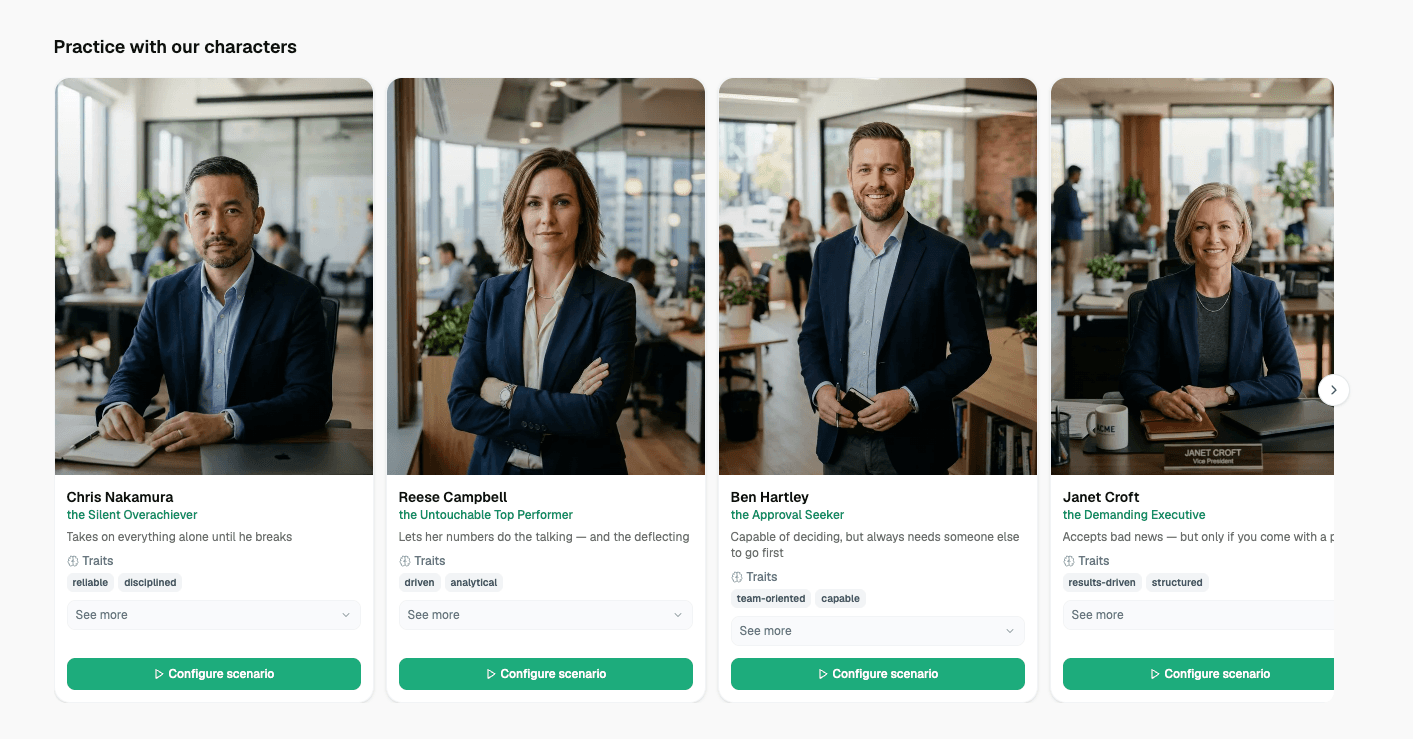
Discover realistic leadership situations with ISFJ personalities. Learn how to lead different characters successfully and leverage their strengths.
AI Role-play
ISFJ
Yuki Tanaka
Coaching Conversation

Kulturelle Kommunikationsbarrieren im Team

mit Yuki Tanaka

Character: Yuki Tanaka
Category: Coaching Conversation
Language:DE

Yuki arbeitet seit 10 Monaten im Team, fachlich exzellent aber kommunikativ zurückhaltend. In den letzten 3 Monaten häufen sich Missverständnisse. Letzte Woche fragte Kollege Max im Meeting: "Yuki, schaffst du das bis Freitag?" - Sie antwortete "Hmm, das ist vielleicht schwierig..." und lächelte. Max nahm das als Ja. Freitag: Aufgabe nicht fertig. Vor 2 Wochen in Projektbesprechung nickte Yuki durchgehend zu allen Vorschlägen - später stellte sich heraus sie hatte fundamentale Bedenken, traute sich aber nicht zu widersprechen. Gestern explodierte Teamleiter Thomas: "Sag doch einfach Nein wenn du Nein meinst!" Yuki verließ weinend den Raum. Vor 4 Monaten hattest du sie gefragt ob alles klar sei mit dem neuen Prozess - "Ja, vielen Dank" sagte sie höflich. Drei Wochen später: massive Fehler weil sie Kernpunkte nicht verstanden hatte aber nicht nachfragte. Team ist frustriert über ihre "Unzuverlässigkeit". Du hast sie heute um 14:00 Uhr zum Gespräch gebeten.

Goal as a Leader

Die kulturellen Kommunikations-Unterschiede zwischen Yukis indirektem ostasiatischem Stil und deutscher Direktkultur ansprechen. Ziel: Gemeinsam Brücken-Strategien entwickeln, Team für kulturelle Unterschiede sensibilisieren, Yuki helfen direkter zu kommunizieren ohne ihre kulturelle Identität aufgeben zu müssen.

AI Role-play
ISFJ
Lisa Hartmann
Criticism Conversation

Addressing gaps in product knowledge

mit Lisa Hartmann

Character: Lisa Hartmann
Category: Criticism Conversation
Language:DE

You are conducting a feedback conversation with Lisa regarding her lack of product knowledge, which has led to customer complaints. The goal is for Lisa to understand the seriousness of the situation without feeling so pressured that she considers resigning. You need to determine why she is not engaging in her training and collaboratively develop a realistic solution.

Goal as a Leader

You are conducting a feedback conversation with Lisa regarding her lack of product knowledge, which has led to customer complaints. The goal is for Lisa to understand the seriousness of the situation without feeling so pressured that she considers resigning. You need to determine why she is not engaging in her training and collaboratively develop a realistic solution.

AI Role-play
ISFJ
Sandra Bergmann
Employee Conversation

Burnout Prevention for Ward Management

mit Sandra Bergmann

Character: Sandra Bergmann
Category: Employee Conversation
Language:DE

Sandra has worked an average of 65 hours per week over the past eight weeks. She has covered for sick colleagues six times, even on her days off. Last week, she called a colleague at 11:15 PM to ask if she could take the morning shift the next day. Yesterday morning, Sandra collapsed during the handover due to circulatory issues from exhaustion. The on-duty doctor sent her home. Six weeks ago, during a personnel meeting, Sandra insisted, "I can handle it; the others need me." This afternoon, one day after the incident, she showed up for work despite being on sick leave. You have requested an immediate meeting with her in your office.

Goal as a Leader

Getting Sandra to: 1. Acknowledge her exhaustion and overload 2. Understand that her behavior is harming the team (rather than helping) 3. Set clear boundaries: say no to an upcoming extra shift

AI Role-play
ISFJ
Nadja Kowalski
Coaching Conversation

Liberating Victims of Micromanagement

mit Nadja Kowalski

Character: Nadja Kowalski
Category: Coaching Conversation
Language:DE

Nadja has been part of the team for three months and frequently seeks clarification on routine tasks, asking questions six times a day. Yesterday, she inquired three times whether she should really phrase a standard email that way. This morning, she waited ten minutes outside your office for confirmation on a decision she had already made three times two weeks ago. Colleague Lisa expressed her frustration: "Nadja can do all of this, but she just lacks confidence." Four weeks ago, you encouraged Nadja to make more independent decisions. Her response at that time was, "In my previous job, I had to ask about everything; otherwise, it was wrong." For the past three days, an important task has been pending because Nadja is waiting for your detailed instructions. You have scheduled a meeting with her today at 2:00 PM.

Goal as a Leader

Encourage Nadja to make the next routine decision on her own.

Myers-Briggs Personality Library

Each of the 16 MBTI types has unique strengths and leadership styles. Discover how to successfully lead different personality types.

Frequently Asked Questions

How do I conduct a difficult conversation with an ISFJ?

Conduct the conversation in a private and calm manner. Start by acknowledging their reliability and specific contributions. Then, present objectively observable facts and the practical impact of their behavior. Offer clear, supportive next steps, allow time for processing, and invite them to share their perspective and concrete suggestions for solutions.

How do I motivate an ISFJ employee?

Assign the person clear, stable tasks and regularly acknowledge their diligence and loyalty in person, so they feel valued. Prepare for changes in advance with concrete steps, and support them in conflicts and self-assertion, for example, through collaborative conversation preparation, to ensure they remain confident and motivated.

How do I handle conflicts when an ISFJ is involved?

Address the issue calmly and privately, acknowledge their care and loyalty, and ask specifically for their perspective and the concrete facts. Provide clear, practical steps for resolution, assist them in articulating their needs succinctly, and schedule a follow-up to ensure they feel supported and secure.

How do I conduct a coaching conversation with an ISFJ?

Provide clear, practical steps and acknowledge her efforts. Create a safe environment where she can openly express her concerns. Help her plan small, concrete steps for self-assertion, and offer to practice difficult conversations briefly or to stay by her side for support.