careertrainer.ai

Practice feedback, conflict, motivation, and development conversations—safely and concretely—with ENFP employees.

Train ENFPs for everyday leadership with AI role-play training

Careertrainer.ai helps you train difficult leadership conversations with ENFP direct reports through realistic live audio role-play. You practice risk-free and get instant feedback on clarity, impact, and how you prioritize.

Live example · This is what training looks like

12 scenarios
Phone call

Practise with your situation

Emily Parker

Emily Parker

Leadership
The skeptical matrix specialist

Long-tenured high performer · 38 · ENFP

Cross-IndustryKonfliktgespraechInnere KuendigungHigh Performer Langjaehrig

Address passive frustration across matrix teams

Indirect pushback after the last clash

In the corridor call before the Monday steering meeting, Emily stays unusually formal. She hints she is still unhappy about your direction, but never says it directly. If you miss it, the team will drift and deliver less than promised.

Goal: Focus on the observable pattern, not on blame or character. Get a clear commitment to one concrete behavior that will show up in the next two weeks.

Learning goals

  • Name the tension without blame
  • Agree on one next behaviour

What to expect

  • Points at process gaps without owning a view
  • Uses polite wording while delaying decisions
Practise with your situation

ENFP conversations don’t usually break down due to intent—they’re often derailed by leadership dynamics under pressure.

ENFP employees often respond strongly to tone, how much freedom they have, and the sense of purpose they perceive. That’s exactly why feedback, conflict, and development conversations can become tricky: if your guidance is too soft, it has no effect; if it’s too harsh, people may withdraw or resist. With Careertrainer.ai, you can make these leadership scenarios trainable in a practical way using live, audio-based AI role-play—backed by immediate feedback.

AI character for industry-focused solutions

AI role-play focus

Lead with clarity—without losing the ENFP energy.

With Careertrainer.ai, you practice critical leadership conversations with ENFP employees realistically, risk-free, and with instant feedback on clarity, impact, and priorities.

Feedback without discouragementAddress conflicts clearly
Challenge 01

Direct feedback often interrupts ENFP team members too abruptly.

When you bring up performance, accountability, or focus, ENFP employees may quickly hear feedback as a critique of who they are—not just of their behavior. That drains energy, reduces openness, and makes follow-through less likely even in the conversation itself. It then continues to affect motivation, ownership, and team dynamics. With Careertrainer.ai, you can practice these feedback conversations realistically through AI role-play—so you stay clear and direct without losing enthusiasm, the relationship, or approachability.

Book a free demo
Challenge 02

When ENFPs lack inspiration, it can quickly turn into an open point of friction.

Once tasks start to feel monotonous, priorities become narrowly constrained, or there’s no room for creative input, ENFP employees often respond with avoidance, counterarguments, or sudden topic shifts. For leaders, this quickly turns into a drawn-out conflict about attitude, pace, and taking responsibility—rather than the actual task at hand. With Careertrainer.ai, you can practice these conversations in AI role-play and stay clear, de-escalate calmly, and maintain leadership authority—especially under pressure.

Book a free demo
Challenge 03

ENFPs feel strongly motivated at first—but without structure, motivation quickly turns into uncertainty.

ENFP employees often come across as highly engaged: they say yes quickly and bring noticeable energy to the team. But when too many options compete—or when priorities aren’t clear—execution depth can suffer. That’s how you end up with missed commitments, shifting focus, and added leadership effort, even though the conversation atmosphere starts out positive. With Careertrainer.ai, you’ll train motivational conversations through AI role-play. You’ll pick up on that energy while also securing clear commitments, defining next steps, and agreeing on responsibilities.

Book a free demo
Challenge 04

Performance discussions with ENFPs can often be inspiring, but they don’t always feel sufficiently actionable.

Especially ENFP types—also known as The Activist—tend to think in possibilities rather than automatically in sequences, boundaries, and measurable intermediate steps. Without clear priorities, development plans can quickly become too big: inspiring, but also too broad. That makes it harder to manage progress, plan resources, and set expectations. Careertrainer.ai makes these conversations trainable through AI role-play, so you can unlock potential while still aligning on concrete goals, realistic timelines, and trackable development steps.

Book a free demo

Train ENFPs for everyday leadership: AI role-play training for difficult conversations — practice typical conversations with an AI trainer

Four real-world practice scenarios for training ENFP in everyday leadership: AI role-play training for difficult conversations. Practice typical conversations with realistic AI characters in Careertrainer.ai.

Filter by company context, conversation type, challenge and employee persona. Every example leads directly into your own AI role-play.

12 of 12 scenarios

Company context

Conversation type

Challenge

Employee persona

Emily Parker

Emily Parker

Long-tenured high performer

Corporate matrix organisationConflict conversationQuiet quittingLong-tenured high performer

In the corridor call before the Monday steering meeting, Emily stays unusually formal. She hints she is still unhappy about your direction, but never says it directly. If you miss it, the team will drift and deliver less than promised.

What you'll practise

  • Name the tension without blame
  • Agree on one next behaviour
  • Protect face for both sides
Well, the plan sounds good on paper.
James Carter

James Carter

Junior with high expectations

Family-led midmarket companyChange conversationLoyalty conflictJunior with high expectations

You only have 20 minutes in the office after lunch before James joins a customer call. He nods along to the new lead, yet his eyes keep drifting to the old team’s preferences. If the conflict stays blurred, he risks choosing the wrong side and losing trust with both.

What you'll practise

  • Define responsibility boundaries fast
  • Secure an initial position
  • Reduce relationship risk with empathy
Sure, I am on it, but let me double-check the context.
Alex Taylor

Alex Taylor

Vocal critic

Tech scale-upCritical feedback conversationDefensive response to feedbackVocal critic

Alex picks up your call mid-standup, then cuts straight to what he thinks is unfair. Last week’s feedback felt like judgement, because it arrived after the sprint review. If you argue immediately, he will escalate and the backlog priorities get derailed.

What you'll practise

  • Use only observable facts
  • Name the delivery impact clearly
  • Ask for his perspective briefly
I heard criticism, not what I actually did.
Sophie Morgan

Sophie Morgan

Quiet talent

Public-sector organisationDelegation conversationFeeling micromanagedQuiet talent

Between two desks on-site at the municipal office, your meeting with Sophie starts late. You need to clarify her next steps for a compliance report, but she looks visibly exhausted. If the scope stays fuzzy, her work quality will drop and she will stop volunteering improvements.

What you'll practise

  • Define the outcome owner goal
  • Clarify decision scope and autonomy
  • Set risk-based checkpoints
I can do it, but I need room to decide the steps.
Daniel Walker

Daniel Walker

Return after overload

Healthcare shift organisationMotivation conversationOverload signalsReturn after overload

Daniel picks up right after rounds, sounding busy but strangely flat today. He avoids any talk of workload by saying staffing is “just how it is.”

What you'll practise

  • Name observed strain plainly
  • Agree one relief step
  • Set a follow-up check
I can handle it. The next handover is all that matters, honestly.
Jordan Blake

Jordan Blake

Informal leader

Skilled-trades businessMotivation conversationQuiet quittingInformal leader

Jordan meets you at the workshop door between jobs, arms crossed and voice guarded. Since the last change, he keeps volunteering ideas but refuses to carry extra load.

What you'll practise

  • Name withdrawal in work terms
  • Ask causes without pushing
  • Create one binding next step
I’m not against the work. I’m against doing extra for nothing.
Rachel Bennett

Rachel Bennett

New team member with leadership ambition

Retail branch operationChange conversationFear of changeNew team member with leadership ambition

Rachel answers from the shop floor during a lull, but her tone stays skeptical. She already heard the new sales staffing concept, and she thinks another rollout will drain her team.

What you'll practise

  • Understand resistance behind the silence
  • Connect change to personal upside
  • Agree a controlled involvement step
I’m not being the messenger for another plan that drops on us.
Michael Brooks

Michael Brooks

Experienced senior close to exit

Remote and hybrid teamDelegation conversationAuthority challengeExperienced senior close to exit

You meet Michael at the shared desk area after a short standup, time running tight. He says he’ll follow the new handover rules, but his answers stay careful and noncommittal.

What you'll practise

  • State your mandate scope
  • Clarify the impact of non-follow
  • Agree one next behaviour
I’ll do my part, but the approval chain isn’t yours.
Casey Hayes

Casey Hayes

Long-tenured high performer

Production shift operationDelegation conversationFear of changeLong-tenured high performer

Casey stops you mid-call to challenge the new digital shift tool rollout. You’re inheriting a bigger role for the next quarter, and Casey is worried it will erode competence. If this stalls, shift handovers will lose momentum during peak weeks.

What you'll practise

  • Clarify real change concern
  • Reassure with decision boundaries
  • Agree a small next handover step
I have run handovers for ten years. This tool will change my call.
Laura Hughes

Laura Hughes

Junior with high expectations

Corporate matrix organisationCritical feedback conversationDefensive response to feedbackJunior with high expectations

Between meetings, you find Laura at her desk with raised voice and an open task board. She feels bypassed after the last service response missed its internal SLA by 6 hours. If she shuts down now, the cross-department release review will suffer next week.

What you'll practise

  • Let the vent finish and mirror core
  • Separate respect need from the SLA issue
  • Agree one next fix that restores visibility
I am not lazy. I keep hearing excuses from three departments.
Owen Foster

Owen Foster

Vocal critic

Family-led midmarket companyConflict conversationAuthority challengeVocal critic

Owen calls you first and cuts straight to the duplicated work in the warehouse checks. He suspects the new workflow gives another senior teammate more visibility than he gets. If you fail to clarify, the team will argue and mistakes will reach customers during audits.

What you'll practise

  • Clarify role ownership in one flow
  • Name the rivalry risk without attacking colleagues
  • Agree a shared audit outcome standard
Why does my checklist stop when someone else walks in with authority?
Riley Stone

Riley Stone

Quiet talent

Tech scale-upConflict conversationTeam splitQuiet talent

On site, Riley avoids eye contact and watches the room after a tense sprint update. They keep answers short when you ask about why messages stop getting shared between two groups. If the split continues, customer deployments will become inconsistent for two product lines.

What you'll practise

  • Name the info pattern, not the person
  • Create clear interfaces between camps
  • Set a minimum collaboration standard
We are not against each other. The updates just do not reach everyone.

How the AI evaluates your training conversation

After every role-play a separate AI analyses your full conversation transcript — with score, goal feedback and concrete quotes from your own dialogue.

Two layers feed the overall score: scenario-specific goals (70%) and five core competencies for your training type (30%).

SummaryRating: Solid

Emily Parker · Address passive frustration across matrix teams

State the tension factually, then lock one time bound action

Focus on the observable pattern, not on blame or character. Get a clear commitment to one concrete behavior that will show up in the next two weeks.

Overall result
6.8/ 10

70% scenario goals + 30% core competencies

Scale 0–10 · backed by quotes from your conversation

Scenario goals · 70%Core competencies · 30%

Scenario goals

Scenario goals · 70%

Name the tension without blame

6.5 / 10

Point to the specific behavior and its impact using concrete examples. This matters because indirect pushback usually hides the real risk to delivery.

Partially achieved

You named observable impact from the committee example, but you did not fully separate behavior from any underlying cause.

in last week's steering committee, the RACI updates slipped twice.

Agree on one next behaviour

6.5 / 10

Turn the discussion into one clear behavior commitment with timing. This matters because matrix teams need visible follow-through across interfaces.

Partially achieved

You asked for a time bound commitment, but the wording is slightly conditional and lacks a clear owner and confirmation step.

For two weeks, will you review one change log, then we reset?

Protect face for both sides

6.5 / 10

Keep the tone non-shaming and invite her view before pushing for alignment. This matters because high performers disengage when feedback feels like public correction.

Partially achieved

Your tone stayed respectful, but you did not explicitly invite her perspective before proposing the next behavior.

So: discovery drift.

Core competencies

Core competencies · 30%

Active listening

6.5

Follow-up questions, paraphrasing, targeted clarifiers

Empathy & understanding

7.0

Reading the counterpart's emotional state and perspective

Conversation control

6.8

Structured and goal-oriented without dominating

Solution focus

7.0

Developing constructive options together

Communication clarity

6.6

Clear, understandable, to the point

Details · Transcript excerpt

YouEmily, in last week's steering committee, the RACI updates slipped twice.
Emily ParkerOn paper it was fine. Then the handoffs kept changing, yes.
YouSo: discovery drift. For two weeks, will you review one change log, then we reset?
Pro tip

Use a concrete, observable commitment tied to a meeting cadence. Example: “Over the next two weeks, you’ll review the change log before Monday steering.”

Only your wording is evaluated — not the AI counterpart's. The AI's opening of the conversation is not penalised.

Practise with your situation
Roles & Responsibilities

Train ENFP leadership conversations with Careertrainer.ai—especially targeted and practice-ready.

If you lead ENFP team members, AI role-plays and conversation simulations help you practice sensitive situations without anyone losing face. With Careertrainer.ai, feedback, conflict, motivation, and development become measurable conversation training—built for the DACH context.

Team leads in day-to-day operations

You lead operational teams and need to give ENFP employees fast feedback when creativity pushes priorities aside or when commitments get left behind. With Careertrainer.ai, you practice these AI role-play scenarios in short live audio sessions—and get feedback on clarity, impact, and follow-through.

Give feedback without draining the energy.

  • Clarify your priorities instead of jumping from one idea to the next
  • Set clear, actionable next steps
  • Avoid feedback that comes too late
  • Evaluate the impact on motivation

Department Heads & Area Managers

When an ENFP direct report keeps pushing projects forward under changing impulses but doesn’t consistently follow through, leadership quickly becomes unclear. Careertrainer.ai turns that challenge into realistic conversation training—so you can practice focus, ownership, and clear expectations before misalignment shows up in the team.

Sharpen your focus and take clear ownership.

  • Address deviations early
  • Reflect responsibility in concrete terms
  • Create room to maneuver—within clear boundaries
  • Measure progress through repetition

People Lead in Growth Phases

In fast-growing teams, ENFP conversations often derail when enthusiasm is high—but structure is missing. With Careertrainer.ai’s AI training, you’ll practice development conversations where you align purpose, roles, and priorities—without pushing your employee into resistance or withdrawal.

Bring development together with meaning and structure

  • Sharpen your role profile
  • Lead with purpose—focused development instead of random guesswork.
  • Spot when you’re overwhelmed—even if you’re still motivated
  • Set clear goals for the quarter

HR Business Partner

You support leaders in tough conversations with ENFP employees—for example when motivation drops, conflicts become emotional, or expectations remain unclear. Careertrainer.ai provides realistic practice scenarios and measurable conversation training so leadership isn’t just well-intended, but consistently executed.

Practice sensitive leadership situations in advance—risk-free.

  • Address motivations clearly and effectively
  • Handle conflicts without escalation
  • Addressing meaning loss in your job role image
  • Identify skill gaps across your leadership team

Managing Director in a Small or Medium-Sized Business

As a Managing Director, you often lead ENFP employees yourself—especially when performance, culture, and pace are all on the line at once. Careertrainer.ai helps you with AI role-play training for feedback, conflict, and development conversations—so you stay clear and effective without unnecessarily slowing down initiative, loyalty, or creativity.

Clear leadership when culture and performance collide

  • Identify performance gaps immediately
  • Channel creativity
  • Build resistance to routine behavior
  • Standardize conversation quality across teams

L&D and HRD leaders

You build leadership skills systematically—and you’re looking for conversation training that goes beyond theory. Careertrainer.ai turns typical ENFP patterns like distractibility, a strong response to tone, and a drive for meaning into scalable AI role-play scenarios with evaluation—so you can make progress visible for every leader.

ENFP patterns, translated into scalable training

  • Consistent practice scenarios for your team
  • Competency scores per leader
  • Use repeatable AI role-play
  • Roll out training in the DACH market

Train challenging leadership conversations with an ENFP in Careertrainer.ai.

You prepare for real conversations with ENFP employees, train them through realistic live audio role-play, and then see just how clear, effective, and prioritized your conversation approach really was.

1

Choose the right ENFP conversation

Choose a leadership scenario that you’ll actually face in everyday life: delivering critical feedback, a motivation conversation, a development review, or addressing a conflict after communication has lost reliability. Careertrainer.ai tailors the role-play to typical ENFP patterns—for example, reacting strongly to tone, feeling a loss of freedom, sensing a lack of purpose, or experiencing frustration with overly rigid prioritization.

AI Role-Play Generator in Careertrainer.ai
2

Run the conversation as a Voice AI role-play

You’ll train live by audio in exactly the way the conversation could happen later with your Direct Report: with spontaneous follow-up questions, emotional reactions, and realistic pushback. This is how you build clarity with ENFP team members—without killing enthusiasm—and set clear boundaries without triggering unnecessary withdrawal.

Voice AI role-play conversation in Careertrainer.ai
3

Get feedback on your impact, structure, and progress

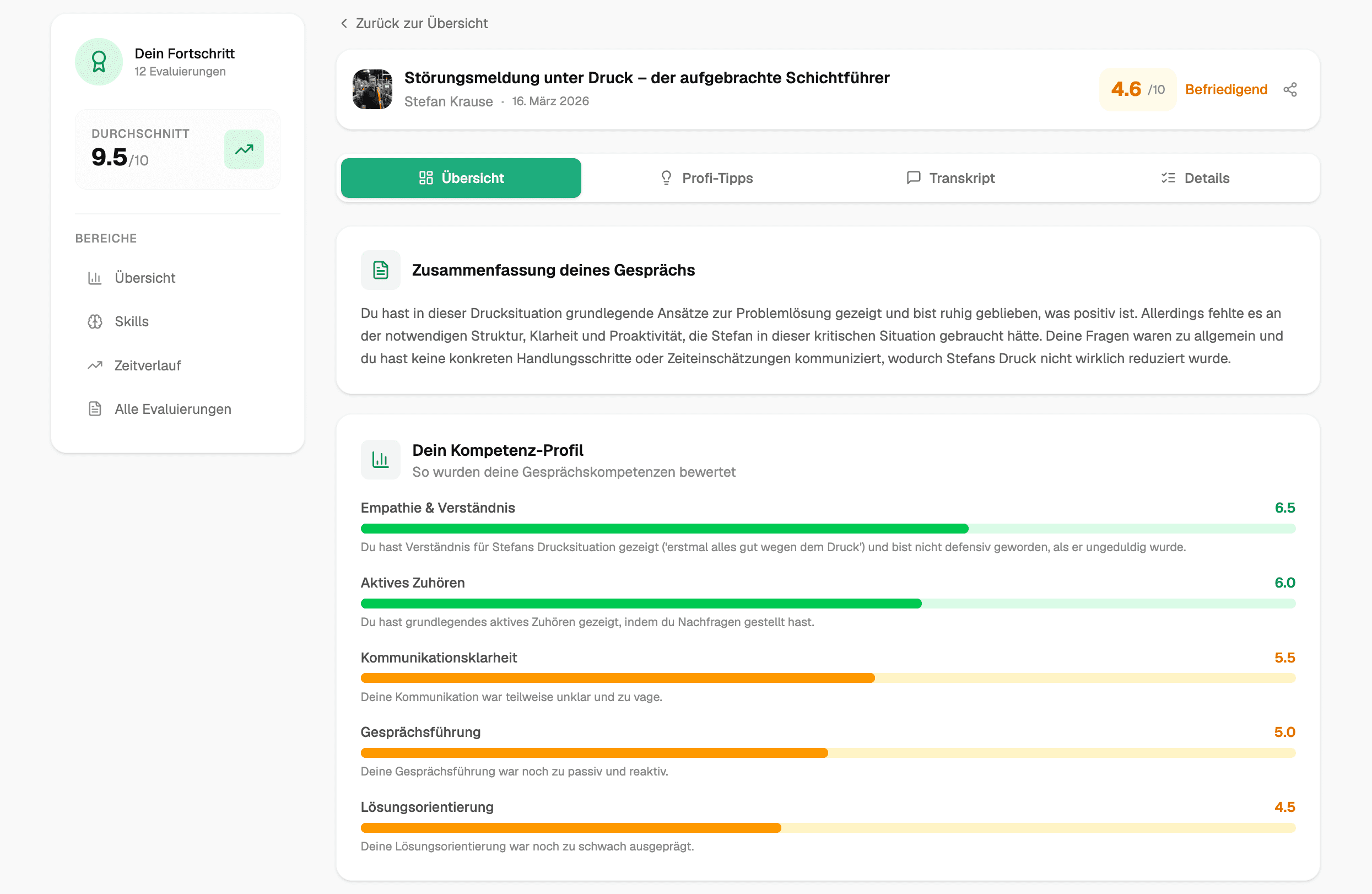
Right after the role-play, you’ll receive an evaluation tailored to exactly that leadership context—for example on clarity of expectations, prioritization, de-escalation, and motivating leadership. You’ll see whether, in conversations with ENFPs, you came across as too vague, too harsh, or too unstructured—and you can then train the same situation again in a targeted way.

Evaluation Dashboard in Careertrainer.ai

Typical leadership conversations with ENFP employees

ENFP employees often bring energy, ideas, and momentum to the team. Under pressure, they can respond quickly, but they’re also sensitive to tone, loss of freedom, and a lack of meaning. That’s exactly why feedback, conflict, motivation, and development conversations can quickly become tricky. With Careertrainer.ai, you practice these discussions as realistic live role-play and sharpen—step by step—your clarity, priority-setting, and impact.

Feedback session

“You’re holding back my best ideas”—Feedback on focus and follow-through

Your ENFP direct report delivers strong impulses, but they don’t follow through reliably—because new ideas constantly get in the way. The conversation quickly goes off track when your feedback focuses only on gaps, and the employee hears it as a restriction of their initiative. It helps to first acknowledge the impact and contribution, then set a few clear priorities and expectations that can be checked. In the KI role-play, you practice bringing clarity—without losing enthusiasm or unnecessarily damaging the relationship.

Practice the conversation with Lea
Conflict Resolution

Conflict right after the sentence: “I can’t keep working like this—it’s just mindless follow-up work from here.”

An ENFP employee shows open frustration because a project has become heavily formalized and they feel like they’ve lost all inspiration. If you push only on processes, deadlines, and strict compliance, resistance or an emotional retreat can happen quickly. What works better is to first reflect the frustration, clearly name the core conflict between freedom and reliability, and then negotiate a solid framework that everyone can stand behind. With Careertrainer.ai, you can train this conversation multiple times and immediately see whether you’re connecting de-escalation and leadership effectively.

Practice the conversation with Tobias
Motivational Interviewing

When an ENFP goes quiet all of a sudden: Energy drain after several weeks of routine

A normally reliable employee comes across as unusually quiet in meetings—delivering the minimum and barely engaging with new topics. Conversations often fall apart when you judge performance too quickly, without clarifying what’s behind their withdrawal. What helps is addressing concrete observations, clearly identifying the sources of energy and the points of frustration, and then deriving a realistic next focus from that. With role-play training, you don’t just “boost” motivation—you translate it into clear agreements.

Practice the conversation with Mara
Career development conversation

Plenty of potential, not enough structure: a development conversation with an ENFP talent

Your ENFP employee wants more responsibility—but gets scattered across projects, interests, and spontaneous commitments. Without a clear structure, the conversation either stays too vague or, from their perspective, feels like an attempt to push them into a rigid role. Effective development comes from combining growth opportunities with clear expectations, decision boundaries, and a small set of measurable priorities. With Careertrainer.ai, you practice this development conversation until support and leadership are able to work together in the same sentence.

Practice the conversation with Jonas
Practice features

What specifically helps you in ENFP leadership conversations

Careertrainer.ai helps you with ENFP conversations—not with theory, but with practice-ready 1:1 scenarios, feedback situations, conflict situations, and development situations. You train with realistic AI characters, learn to spot typical reactions to tone, degrees of freedom, and loss of meaning—and you make progress measurable through feedback and identified skill gaps.

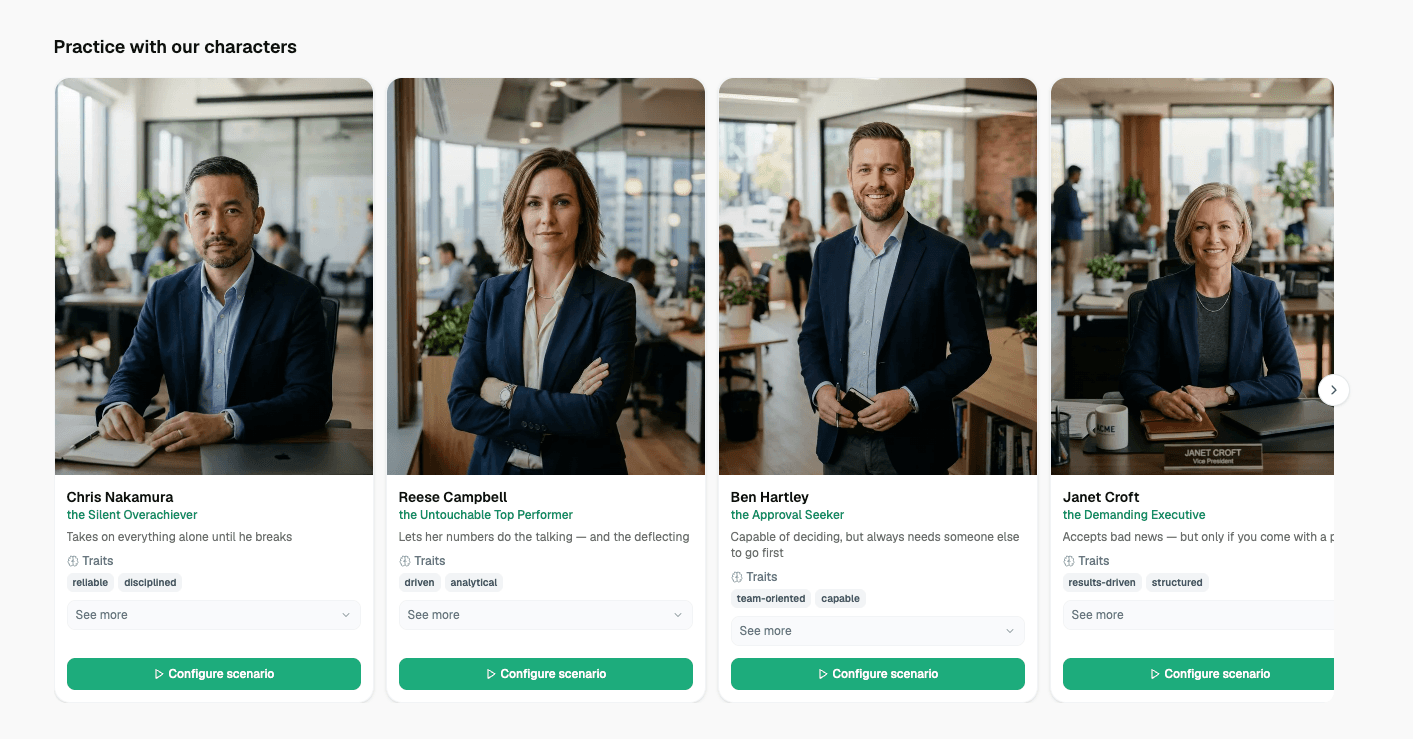
Character selection screen with AI training personas and scenario configuration buttons

For 1:1 coaching, critical feedback conversations, and escalations

Role-play realistic leadership conversations with ENFP direct reports

When ENFP employees react sensitively to rigid guidelines, a harsh tone, or a lack of meaning, your communication and leadership during the conversation determine whether they feel open and supported—or push back. With Careertrainer.ai, you practice these exact moments in realistic live-audio role-play training before the real employee conversation takes place.

  • Practice setting priorities—without losing enthusiasm.
  • Practice conflict mediation when someone withdraws or resists
  • Also for probation period feedback and goal setting in 1:1 sessions
Learn more
Vertriebstraining mit KI-gestützten Szenarien zur Verbesserung von Verkaufs- und Beratungskompetenzen.

Psychologically realistic conversations

AI characters that respond convincingly to ENFP-typical conversation dynamics

Instead of generic, off-the-shelf roles, you train with AI characters that respond consistently in leadership conversations—under pressure, with appreciation, with room to breathe, and with clarity. This matters especially for ENFP employees when creativity, spontaneous pivots, or emotional friction come up during the conversation.

  • Make reactions to criticism, recognition, and close leadership visible.
  • Accurately role-play a Direct Report, Project Lead, or Senior Engineer in realistic scenarios
  • More real-life realism than static roles from seminars
Learn more
Evaluation summary and competency profile for leadership communication under pressure.

See right away what works

After every ENFP conversation, get a clear evaluation instead of guesswork

After the role-play, you’ll receive a structured assessment of how clearly, empathetically, and effectively you led. This helps you see whether your feedback conversation provided clear direction, whether your conflict moderation helped de-escalate the situation, and where you’ll need to lead more precisely in the next round.

  • Scores for clarity, empathy, and conversation management
  • Evidence from real conversations instead of vague general statements
  • Expert tips for feedback conversations, coaching, and escalation
Learn more
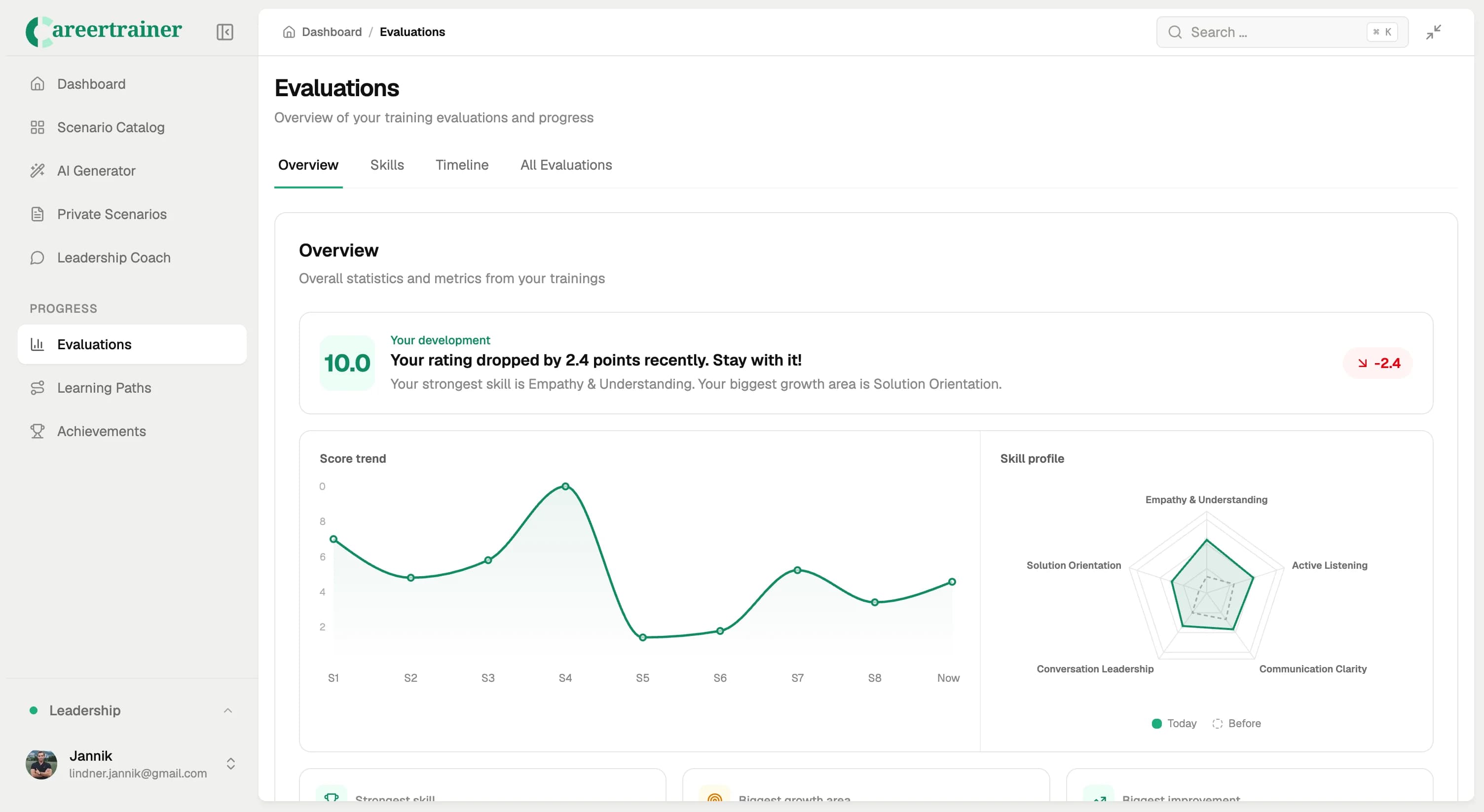
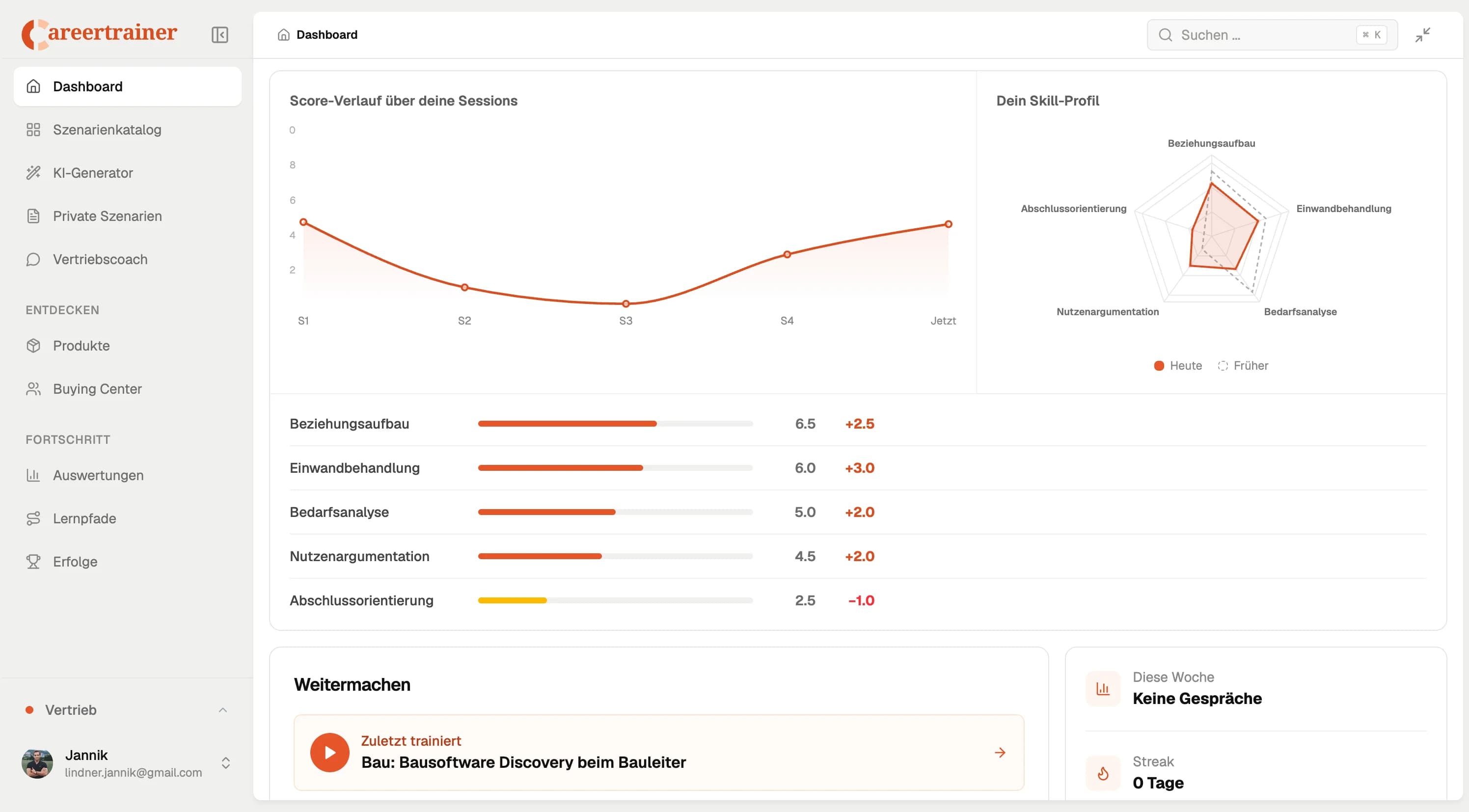
Training evaluation dashboard displaying progress, ratings, and performance metrics for leadership development.

Measurable Leadership KPIs

Measure ENFP leadership skill gaps—not just guess them by feel

If you lead ENFP team members more often, one great conversation isn’t enough. With Careertrainer.ai, you’ll see across multiple sessions whether you’re truly improving in prioritization, active leadership, de-escalation, and development-focused conversations. That’s how leadership training becomes practical, measurable, and easier to plan in everyday work.

  • Track progress in feedback, conflict, and development conversations
  • Identify Skill Gaps in Prioritization and Follow-Through
  • Ideal for your leadership pipeline, team leads, and HR teams
Learn more
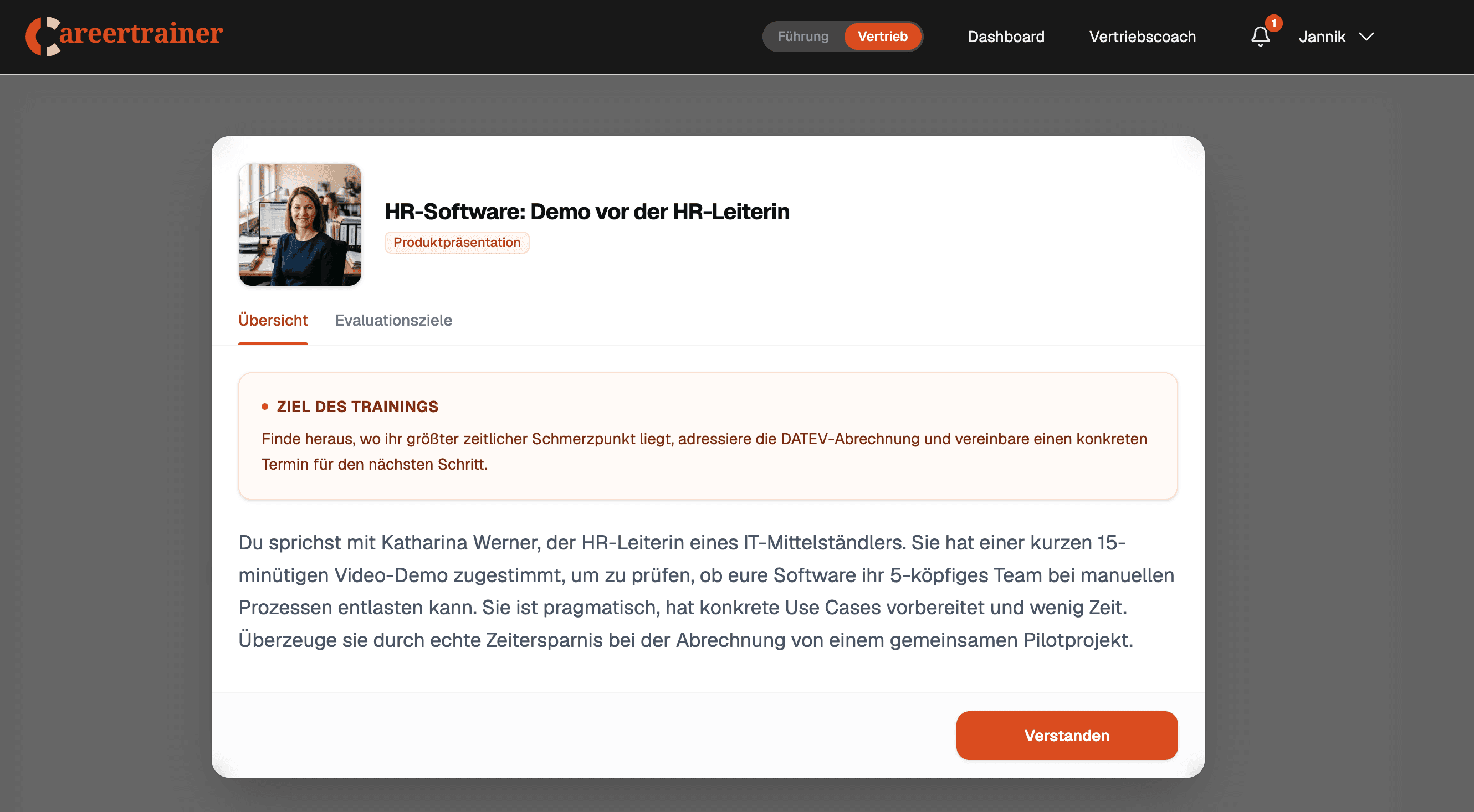
Sales training scenario overview for an HR software product demo with training goal and evaluation tabs

Practice before the real conversation

Prepare challenging ENFP conversations in advance—before you start overthinking them in your head

Whether it’s a performance review, a motivational conversation, or a sensitive delegation: you can rehearse the upcoming discussion in just a few minutes. Especially for ENFP setups, this helps you test your wording, build clarity, and find the right balance of structure, meaning, and relationship.

  • Train your challenging 1:1 conversation in advance the same day
  • Test alternative ways to express feedback and set goals
  • Practice live-audio conversations risk-free for the DACH region
Learn more

Frequently asked questions about ENFP leadership conversations and Careertrainer.ai

These FAQs help you better understand typical challenges with ENFP employees—and how to train difficult leadership conversations in a practical, hands-on way with Careertrainer.ai using realistic live audio role-play.

What should you pay special attention to during feedback conversations with ENFP employees?

When giving feedback to ENFP team members, it’s all about combining clarity with relationship confidence. If your feedback sounds only hard and purely factual, it’s quickly perceived as a personal put-down or as a loss of trust. On the other hand, if you stay too gentle, you often end up without the firmness needed for real change.

A clear structure helps: start with the observation (not a label), then explain the impact, and finally state a specific expectation. With ENFP profiles, wording works best when you don’t just point out what didn’t work—but also clarify why it matters for the team, the customer, or the goal. That way, the purpose stays visible without you getting pulled into long explanations.

Just as important: set tight priorities. Too many issues at once can overwhelm people and lead to avoidance rather than follow-through. That’s why a good feedback conversation should end with one or two clear behavior changes, a time frame, and a short check-in appointment.

Why do conflict conversations with ENFPs often escalate faster than you think?

Conflict conversations with ENFPs often don’t go off track because of the topic—but because of the experienced conversation atmosphere. When tone, pace, or phrasing sounds like control, devaluation, or loss of meaning, ENFP employees often respond emotionally, unpredictably, or defensively. At that point, the conversation shifts from the issue itself to relationships and motivation.

It’s also typical that ENFPs, in tense moments, first argue strongly—then deflect, or mentally switch off—when they no longer feel genuine room to connect. That doesn’t mean they can’t handle criticism. It means they respond noticeably to whether you treat them as a troublemaker or as someone who co-creates solutions.

That’s why conflict conversations work better when you name the friction clearly—without moralizing. Describe specific situations, keep the focus tight, and actively ask for their perspective before you push for solutions. This reduces escalation and increases the chance of real commitment.

How do you conduct a motivational conversation with an ENFP without just creating good vibes?

A good motivational conversation with an ENFP combines energy with direction. Pure encouragement rarely lasts when the real root cause is a lack of priority, unclear role expectations, or a sense of meaninglessness. In that case, motivation may look strong in the moment—but it won’t hold.

So start with an honest diagnosis: what exactly is the issue? Is inspiration missing, is there not enough orientation, do they lack decision-making freedom, or is progress not visible? ENFP employees often engage quickly when they can see purpose and shape outcomes. But their momentum drops fast when tasks are experienced as rigid “box-ticking.”

In the conversation, make sure you clarify three things: which goal truly matters right now, where there is room for meaningful autonomy, and how you will measure execution together. This helps you avoid a conversation that feels emotionally strong but leads nowhere. Motivation then becomes more than a mood boost—it turns into a clear work focus with realistic next steps.

How do you set clear priorities in development conversations with an ENFP—without damping their enthusiasm?

In development talks with ENFPs, the biggest risk isn’t too little potential—it’s too many directions at the same time. A lot of ideas, new interests, and quick follow-up thoughts can make the conversation lively, but they can also pull attention away from the truly relevant development areas.

Instead of going into every strength and every option in detail, focus on a few key levers: Which competence creates the biggest impact in your current area of responsibility? Which behavior change most strongly improves collaboration, reliability, or leadership in day-to-day work? This is where you should set priorities.

It’s important to frame development not only as a space of opportunities, but also as a space of expectations. ENFP employees often accept clear boundaries better when they understand why that boundary matters. A strong development conversation therefore brings together perspective and follow-through: a clear goal, observable behavior, a realistic timeframe, and a committed review date.

What common mistakes do leaders make in conversations with ENFP direct reports?

A common mistake is lack of clarity. Many leaders don’t want to demotivate ENFP employees, so they phrase things carefully—leaving it unclear what exactly needs to change. That may protect morale in the short term, but it doesn’t solve the leadership challenge.

The second typical mistake is the opposite: being too direct without the relational context. If feedback feels like a pure correction and it’s missing meaning, context, or any acknowledgement of existing strengths, the risk of resistance, justification, or internal withdrawal increases. Especially under stress, ENFP employees often react sensitively to tone and to how close or constraining the situation feels.

A third mistake is overload. Too many points, too many options, too many open ends may sound thorough—but they make implementation less likely. Instead, aim for a clear conversation with one core message, a few priorities, and a measurable follow-up. Great leadership with ENFP doesn’t mean being soft—it means being clear and still easy to engage with.

How does Careertrainer.ai help you handle difficult leadership conversations with ENFP employees?

Careertrainer.ai is a DACH-focused AI platform for hands-on conversation training through live audio role-play. For leadership conversations with ENFP employees, that means: you practice real situations—like critical feedback, motivation loss, conflicts, or development talks—not theoretically, but as a 5- to 15-minute conversation with a realistically responding AI counterpart.

The real value is in the dynamics. ENFP conversations often don’t fail because of what you know—they fail due to tone, timing, prioritization, and how you respond under pressure. That’s exactly what you train in a risk-free environment. You can test phrasing, set clearer boundaries, and experience how the conversation changes when you’re too harsh, too unclear, or too abstract.

After every conversation, you get immediate feedback with concrete competency scores, strengths, weaknesses, and improvement suggestions. So a vague gut feeling becomes a measurable learning process—especially valuable if you don’t want to test difficult conversations in the real team first.

What makes Careertrainer.ai different from seminars or e-learning for ENFP leadership training?

The biggest difference is the training mode. Seminars and e-learning teach you models, conversation frameworks, and MBTI knowledge. Careertrainer.ai, on the other hand, trains the actual delivery in the conversation. You have to respond in real time, refine your approach, set boundaries, and handle emotionally charged turns.

Especially in ENFP leadership, knowledge alone often isn’t enough. Many leaders understand in theory that meaning, tone, and the right level of freedom matter—but they lose that balance under pressure. In live audio role-play, you can instantly tell whether your conversation comes across as confident and engaging, or whether you unintentionally trigger withdrawal, defensiveness, or resistance.

Another advantage is repeatability. A seminar is one-time, and e-learning is usually static. With Careertrainer.ai, you can train the same challenging ENFP situation multiple times, test different approaches, and measure progress over time. If you want to build real capability—not just concept knowledge—that’s the key difference.

For which leadership roles is Careertrainer.ai especially useful for ENFP conversations?

Careertrainer.ai is especially useful for team leads, department heads, area managers, project owners, and people managers who regularly conduct challenging 1:1 conversations. This is particularly true when you manage ENFP employees who bring lots of energy and ideas—but who also react noticeably when there’s a lack of meaningful direction, unclear priorities, or a harsh tone. With targeted conversation training, you can generate practical value quickly.

The tool is most relevant in situations with high leadership risk: critical feedback, declining follow-through, tension within the team, stalled development, or loss of motivation. Instead of only mentally preparing these conversations, you can practice them in realistic scenarios before they happen in day-to-day work.

Careertrainer.ai is also a strong fit for HR, people development, and leadership enablement—especially when you want to scale conversation quality across teams. That means leadership training doesn’t depend on a single coach or calendar availability. It becomes measurable, repeatable, and cleanly deployable in the DACH context.

How quickly can you train ENFP leadership conversations with Careertrainer.ai—and measure your progress?

The start is intentionally quick: you choose a suitable scenario, hold a live audio conversation, and then receive your evaluation immediately afterward. A single training session typically takes just a few minutes—so it also fits between meetings, before a tough 1:1, or as short same-day preparation.

You don’t measure progress just by repetition, but through a clear evaluation logic. Careertrainer.ai shows you how clearly you set expectations, how well you handle resistance, and whether your way of leading in ENFP-typical high-tension situations creates alignment—or adds friction instead. That way, you can tell whether you’re truly improving or simply getting more familiar with the topic.

For individuals, this creates a fast learning loop. For companies, there’s more: skill gaps and development across teams become visible. That’s how conversation training turns into a transparent leadership process—not guesswork.

Can you use Careertrainer.ai as a partner for ENFP trainings under your own brand?

Yes. If you want to offer ENFP training as a consultant, training provider, HR platform, or enablement partner under your own brand, Careertrainer.ai is also suitable as a White-Label model. This is especially valuable if you don’t just coach leadership conversations with ENFP employees on an ad-hoc basis, but want to integrate it as a scalable offering into your own portfolio.

The advantage for partners: you use AI role-plays for real leadership scenarios such as feedback, conflict, motivation, or development—without having to build your own AI infrastructure. At the same time, your client relationship stays with you. Careertrainer.ai positions itself here as an enabler, not as a competitor to branded training providers with their own sales channels.

That’s particularly relevant in the DACH region—where German language, GDPR context, EU hosting, and realistic audio role-plays matter. If you want to deliver ENFP leadership training in a repeatable, measurable way under your own branding, this is a solid approach.