
careertrainer.ai

Station managers, nursing service leaders, and healthcare executives train for difficult conversations using AI role-play.

Leadership Training in Healthcare – AI-Powered Coaching for Nursing and Clinics

Leading in healthcare means managing shift work, emotional extremes, a shortage of skilled professionals, and teams under constant pressure. Ward managers, nursing service leaders, and hospital executives train with Careertrainer for the most challenging conversations they face daily—anytime, without a seminar day, and with immediate feedback.

Live example · This is what training looks like

In-person

Your own scenario

Rachel Thompson

Rachel Thompson

Leadership

Nurse Unit Manager (Stationsleitung) · 41

Handling a recurring care quality complaint in the morning shift

A team member challenges patient-care feedback; you must calm the room and align actions.

Goal: Lead a focused corrective conversation that acknowledges concerns, clarifies expectations, and agrees on measurable next steps for the next shift. Maintain team trust while preventing blame spirals.

Practice with Rachel Thompson — it’s free

Leadership in Healthcare by the Numbers

Why leadership skills in care and clinics determine quality of service and employee retention.

35 %
caregivers are actively considering leaving their profession.
According to the Care Report 2024, more than a third of caregivers are considering leaving the profession. Poor leadership, lack of appreciation, and absence of development discussions are among the most frequently cited reasons, alongside workload – all of which can be directly addressed through improved leadership skills.
307.000
open positions in the nursing sector in Germany (2025)
The shortage of skilled workers in healthcare makes every resignation costly. Leaders who retain employees not only safeguard the quality of care but also prevent the collapse of duty rosters and the increased burden on the remaining team.
72 %
The station managers were promoted to their roles without formal leadership training.
In healthcare, excellent caregivers are often appointed as unit leaders without systematic leadership training. The result: leadership based on gut feeling rather than proven communication techniques, leading to noticeable consequences for team dynamics and employee retention.
3-layer
Operations make traditional in-person training for nursing management difficult structurally.
Station managers and nursing service directors rarely have a whole day to dedicate to a seminar. Asynchronous AI training fits into breaks, between shifts, and during off-peak hours—without the need for schedule coordination.

The biggest leadership challenges in healthcare

AI character for industry-focused solutions

AI role-play focus

The biggest leadership challenges in healthcare

Train realistic leadership situations with AI characters

Conducting employee discussions when the team is consistently under high emotional stress?Resolving conflicts within the care team – often between long-standing employees with entrenched patterns?
Challenge 01

Conducting employee discussions when the team is consistently under high emotional stress?

AI role-playing exercises train conversations with emotionally exhausted, overburdened, and burned-out caregivers. Leaders learn to recognize signs of stress early, address them without confrontation, and conduct discussions that signal genuine relief rather than additional demands.

Book a free demo
Challenge 02

Resolving conflicts within the care team – often between long-standing employees with entrenched patterns?

Conflicts in care teams often arise from prolonged stress, unequal distribution of work, or tensions between experienced and new caregivers. AI scenarios train mediation conversations that address team conflicts without risking escalation—featuring realistic characters that demonstrate typical conflict patterns.

Book a free demo
Challenge 03

Leading in Shift Work: How do you keep a team together that rarely sees each other?

Station managers train leadership under shift conditions: How do I communicate with a team that I only partially experience directly? How do I provide feedback to someone I rarely see? How do I ensure that team agreements are upheld during the night shift? AI scenarios make these specific leadership situations trainable.

Book a free demo
Challenge 04

Conduct leadership conversations even when there is hardly any time left for discussions beyond patient care?

Leadership training must fit into the daily routine of nursing leaders—not the other way around. AI role plays last 10 to 25 minutes and are conducted asynchronously. Ward managers can train during breaks, before shifts, or from home—without the need for seminar dates, days off, or burdening the team.

Book a free demo

How AI Leadership Training Works for Healthcare

In four steps to measurable leadership competence for care and clinic teams.

1

Start immediately or create setup-specific scenarios.

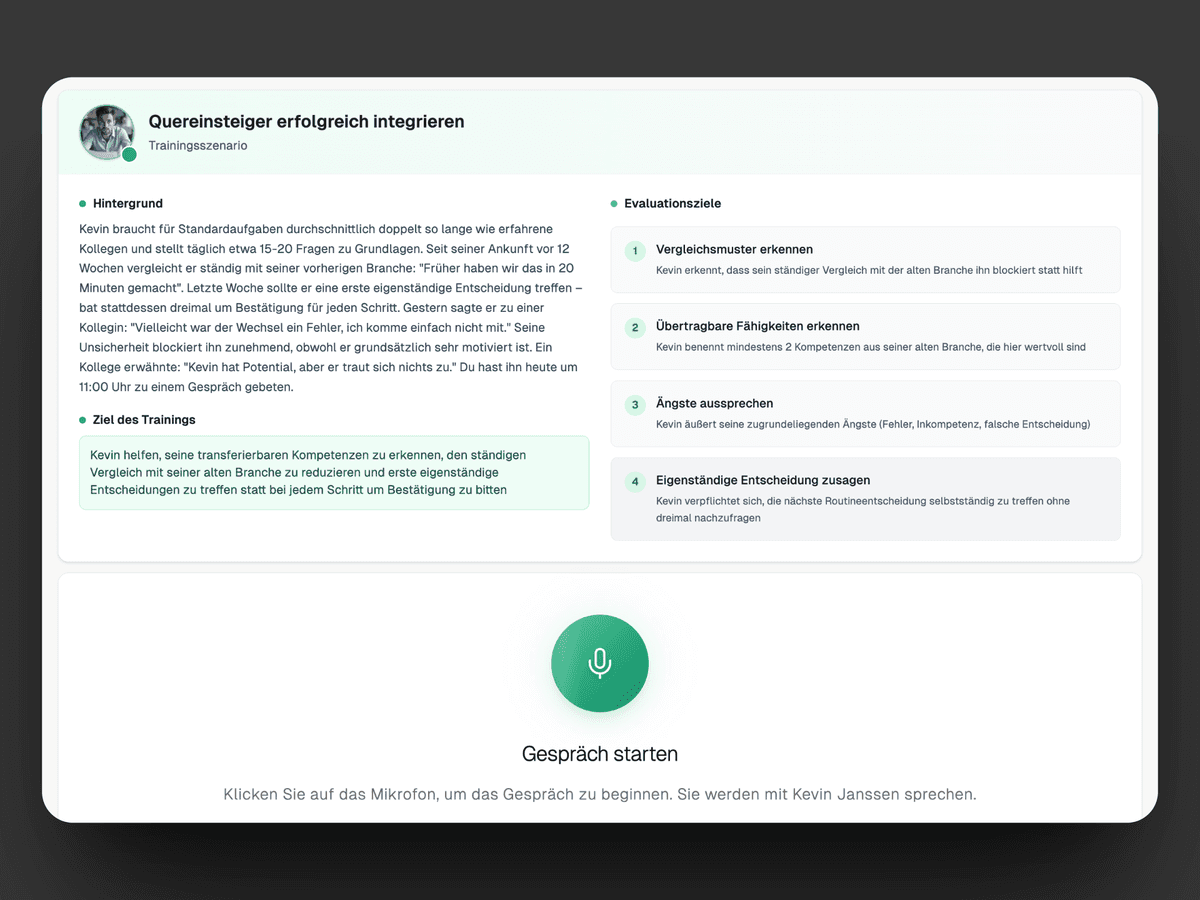
Standard scenarios for typical leadership conversations in nursing and clinics are immediately available: stress discussions, conflict mediation within teams, feedback conversations, and motivational talks after challenging shifts. For facility-specific training, the scenario generator creates scenarios based on your specific leadership situations.

2

Training realistic care team conversations

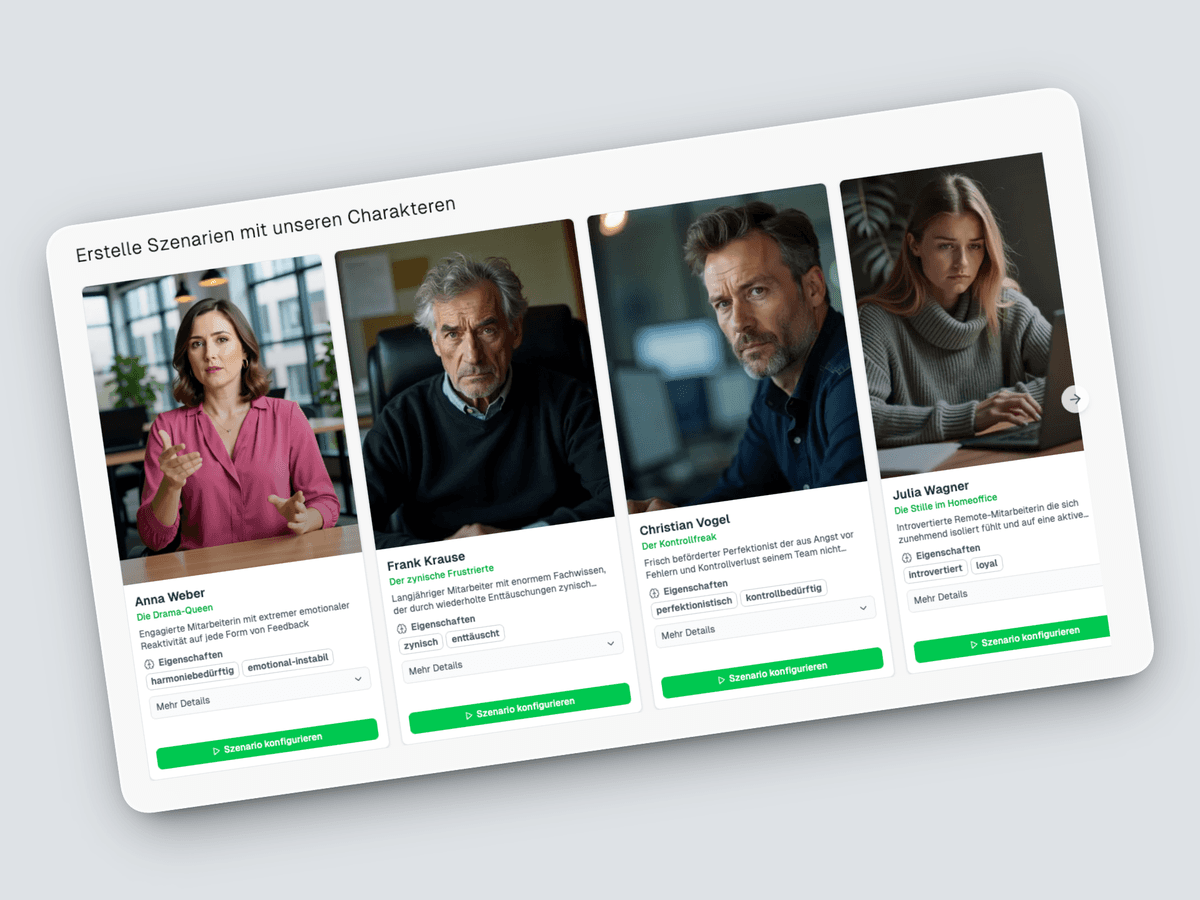
Executives engage in audio conversations with AI employee characters from the healthcare sector – the exhausted elderly caregiver, the frustrated nurse after a challenging shift, the long-term employee resisting change, and the new colleague struggling to integrate. The AI responds authentically to the dialogue.

3

Immediate feedback on leadership behavior and conversation quality.

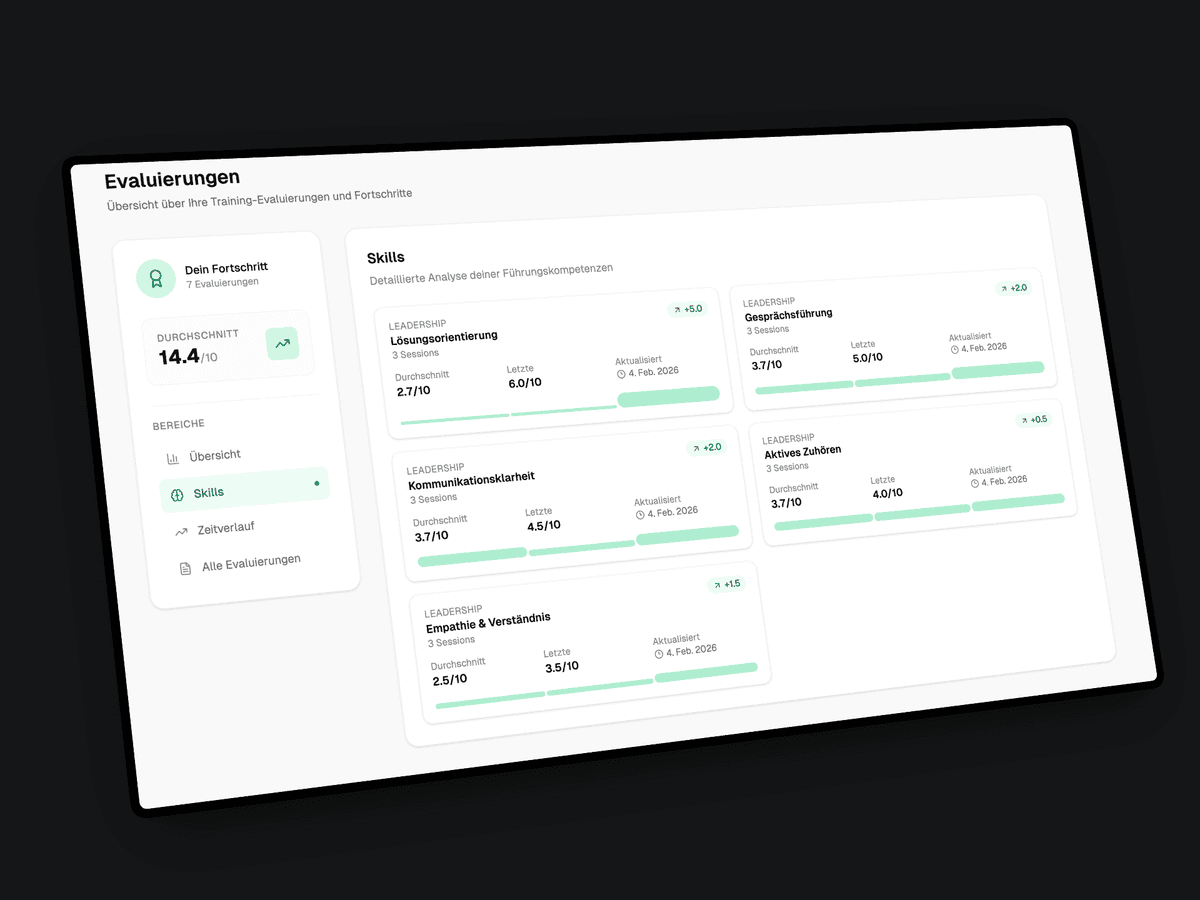
After each conversation, analysis of active listening, empathy, conversation management, solution orientation, and communication clarity. Specific formulation suggestions for more effective performance discussions, clearer feedback conversations, and de-escalating conflict moderation.

4

Measure and develop leadership skills over time.

The dashboard displays skill scores and development curves for each leader. Care service management and HR can identify who excels in empathy conversations and who needs support in conflict resolution or communication under pressure—based on data and without the need for extensive personal guidance.

Features for hospitals, nursing homes, and healthcare organizations

The essential tools for sustainable leadership competence in the healthcare sector.

Realistic nursing team conversation simulations

Realistic nursing team conversation simulations

Executives train audio conversations with AI caregivers—from the exhausted professional to the chronically overburdened shift leader. The AI responds to the quality of the conversation: genuine appreciation and empathy open the dialogue, while standard phrases lead to terse withdrawal.

Care and clinic-specific employee profiles

Care and clinic-specific employee profiles

Over 50 AI characters exhibiting typical behaviors from the healthcare sector: the experienced elderly caregiver on the brink of burnout, the new colleague from abroad struggling with integration, the nursing assistant refusing instructions, and the long-standing team member resisting change. Each character is psychologically consistent and realistic.

Skill Gap Analysis for Nursing Management and Hospital Leadership

Skill Gap Analysis for Nursing Management and Hospital Leadership

Automatic analysis of leadership quality based on five core competencies: active listening, empathy, conversation management, solution orientation, and communication clarity. The dashboard displays development areas and strengths for each leader—over time and in comparison across the organization.

Scenario generator for facility-specific leadership situations

Scenario generator for facility-specific leadership situations

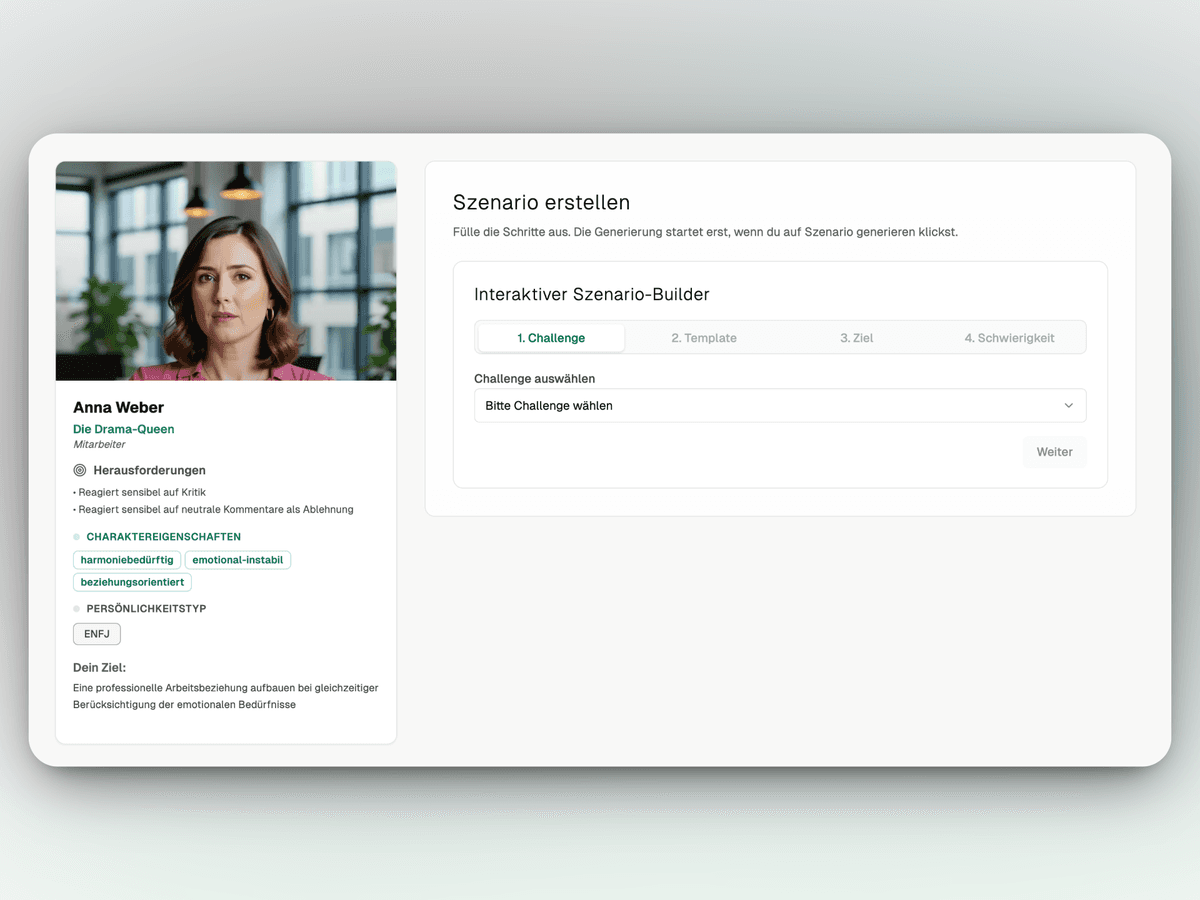
Care service managers and HR can create their own training scenarios in minutes based on real situations: a conversation with a caregiver who repeatedly arrives late, mediation between two conflicting team groups, or a discussion with someone who has mentally already resigned. No external trainer required.

Who is Careertrainer for?

Tailored for all leadership roles in healthcare.

Careertrainer supports station managers, nursing service leaders, medical executives, and HR teams.

Station management and residential area management

Conduct challenging care team conversations confidently and empathetically.

Leading through shifts, workload, and staff shortages

Station leaders engage in challenging conversations daily under difficult conditions: addressing criticism towards exhausted employees, resolving conflicts when there’s no time for lengthy discussions, and conveying appreciation even while the next emergency awaits. AI role-playing trains for these exact situations—precisely, repeatedly, and without burdening the real team.

Concrete benefits through AI role-play
  • Conducting stress and burnout discussions
  • Critique discussions under time pressure
  • Conflict mediation in the shift team

New Leaders in Care

Build leadership fundamentals – immediately and without waiting for a seminar.

From Care Expert to Confident Leader

Excellent nursing professionals promoted to leadership positions need leadership tools immediately – not at the next seminar in three months. Structured learning paths systematically guide new nursing leaders through their initial conversations in their roles: clarifying expectations, delegation discussions, first feedback conversations, and employee development.

Concrete benefits through AI role-play
  • Beginner Learning Path: First 90 Days as Station Manager
  • Train delegation, expectation management, and onboarding.
  • Visible progress through skill tracking

Nursing service management and departmental management

Measuring and developing leadership quality across the entire care sector.

Data-driven executive development for multiple stages.

Care service managers responsible for multiple stations or living areas gain an overview of the leadership status of all station managers through the dashboard. Skill gap analyses reveal who needs targeted support for specific types of conversations—without manual observation and without the need to coordinate seminar days during ongoing operations.

Concrete benefits through AI role-play
  • Setup dashboard with cross-station leadership comparison
  • Targeted learning path assignment based on skill gap analysis.
  • Proof of compliance for continuing education obligations

HR and personnel development in hospitals and care providers.

Scalable leadership development despite shift work and time pressure.

Leadership training that fits seamlessly into everyday care.

HR and personnel development in hospitals and care providers face the challenge of organizing leadership training for individuals who rarely have free time simultaneously. Careertrainer addresses this issue through asynchronous training: leaders can train whenever it suits them, while HR maintains an overview of progress and development needs in the dashboard.

Concrete benefits through AI role-play
  • Asynchronous training without schedule coordination.
  • Central learning path management for all leadership levels.
  • Documented training record for qualification reports.

Frequently Asked Questions about Leadership Training in Healthcare

Everything clinics, care facilities, and HR teams need to know.

How does AI leadership training specifically assist in managing care teams under constant pressure?
Care teams operate under structurally different conditions compared to teams in other industries: shift work, emotional extremes, chronic staff shortages, and a level of stress that is often underestimated from the outside. AI role-playing scenarios train leadership conversations under these exact conditions—with AI employees exhibiting exhaustion, frustration, and withdrawal. Leaders learn to recognize signs of stress early and engage in conversations that provide genuine relief rather than adding further demands.
Is Careertrainer equally suitable for leadership training in elderly care and hospitals?
Yes. The core competencies of good leadership – empathy, clear feedback, conflict resolution, motivation – are relevant across industries, but the specific situations vary. In hospitals, interfaces between nursing professions and medical hierarchy dominate, while in elderly care, long-term relationships with residents and their families take precedence. The scenario generator allows training to be tailored to the specific context.
How can training be integrated into the shift schedule of a care facility?
One of the key advantages of Careertrainer over traditional in-person seminars is that an AI role-play lasts between 10 to 25 minutes and can be started, paused, and repeated at any time—during breaks, before shifts, or from home. No need for schedule coordination, no disrupted workdays, and no replacements required. HR can monitor training progress through the dashboard without putting additional pressure on managers.
Can Careertrainer also be used for the leadership development of doctors?
Yes. Medical service executives face similar challenges as those in other highly skilled industries: they were selected for their professional excellence, not for their leadership skills. AI role-playing trains conversation scenarios that are particularly relevant for medical leaders: providing feedback to resident doctors, handling conflict discussions regarding responsibilities, motivating under high workloads, and communicating with nursing management.
How does Careertrainer support new station managers who lack formal leadership training?
Many station managers are promoted from within without systematic leadership training. Careertrainer offers structured entry-level learning paths that guide them from the initial expectation-setting conversation through delegation discussions and the first performance evaluation to conflict mediation. New leaders make mistakes in the AI role-play, not in front of the actual care team—this protects trust during the initial phase.
How does AI training help reduce turnover in care teams?
Fluctuation in healthcare rarely occurs due to a single event; it is the result of many small experiences: lack of feedback, unresolved conflicts, and the feeling of not being heard. Leaders who regularly conduct development discussions, address signs of stress early, and resolve conflicts before they escalate can retain employees for longer periods. AI training makes these conversations a routine practice rather than a rare exception.
Is the platform GDPR-compliant for use with sensitive employee data?
Yes. Careertrainer is fully GDPR-compliant, hosted in the EU, and developed in Germany. No training content or employee data is shared with third parties. Healthcare institutions can also train sensitive leadership situations—conversations about illnesses, mental stress, or personal difficulties—without privacy concerns.
Can Careertrainer be used as proof of continuing education requirements in the healthcare sector?
Completed training sessions are documented and can be tracked in the dashboard. HR and personnel development can generate training reports for qualification certificates, company agreements, or external audits using export functions. Whether the completed training can be credited towards formal continuing education requirements depends on the respective authority and applicable regulations – we recommend clarifying this in advance with the relevant body.
Use Cases

What do others use Careertrainer.ai for?

Concrete use cases for leaders, HR, and people development — from the first 100 days to measurable skill tracking

From peer to manager — without learning on the job

Newly promoted team leads often run their first employee conversations with zero training. With Careertrainer they practice the typical first conversations — expectation alignment, feedback, onboarding talks — before they happen for real.

  • Learning path "First 100 days as a manager"
  • Structured onboarding across 6–8 weeks
  • Skill tracking shows progress to HR and leadership
Thomas Weber
Frank Zimmermann
Karl-Friedrich Moser
Andreas Kaufmann
Daniel Foster

Resetting expectations with a high-performing but disruptive developer

A strong individual contributor delivers results but damages team trust through blunt behavior and missed collaboration norms.

FührungMitarbeitergesprächFeedback

Learning-path progress

Kick-off
Expectations
Feedback
Conflict
Discover the onboarding solution