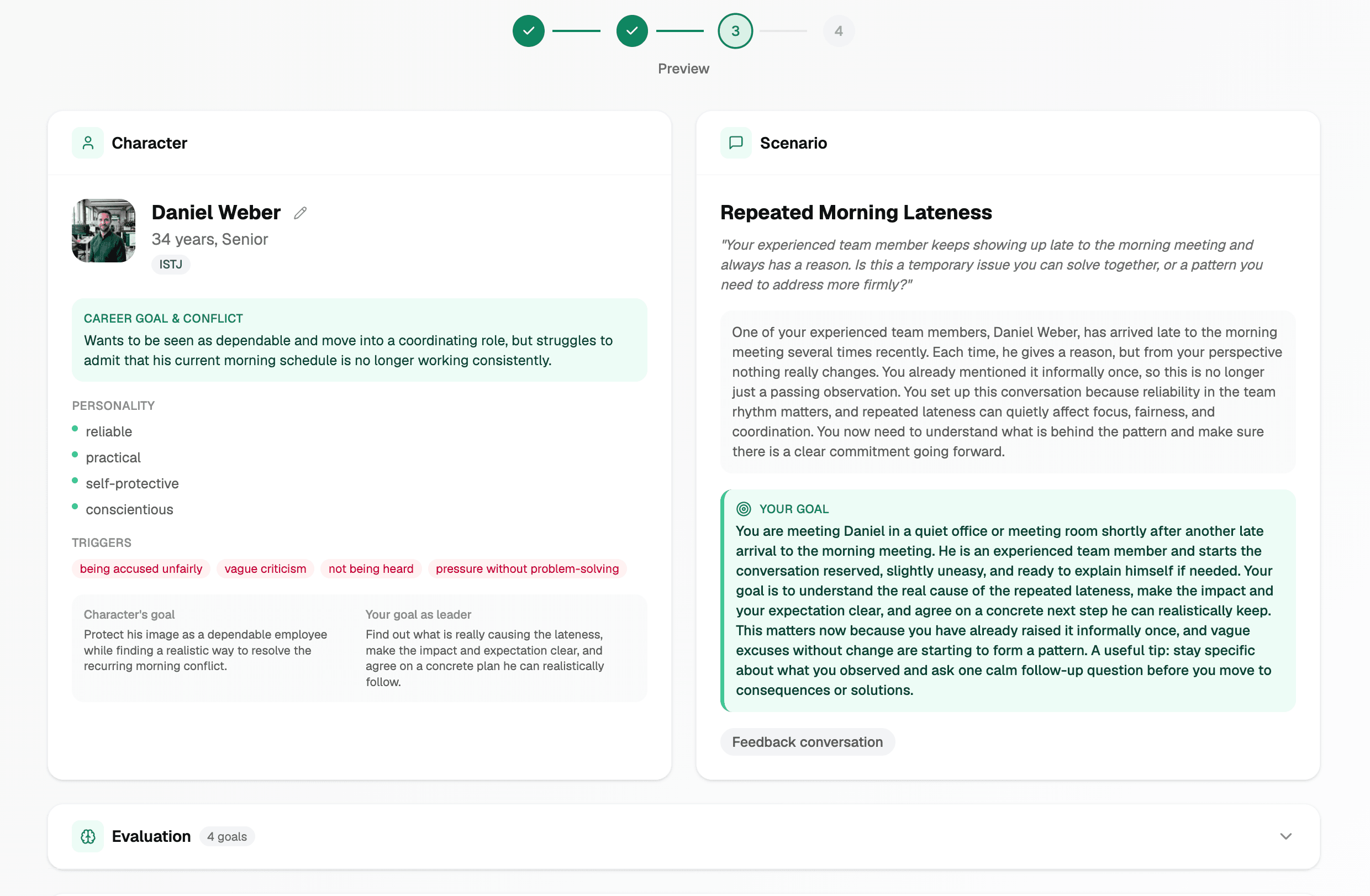
Realistic characters are important because conversational skills are never solely about what you want to say. They always develop through interaction with others. If your training partner is interchangeable, too polished, or predictable, you may learn a conversation structure, but not the essential core: how to effectively engage with different personalities, reactions, and resistance.
In everyday life, conversations rarely fail solely due to a lack of knowledge. They often derail because the other person reacts unexpectedly, emotions come into play, or interests are not openly expressed. A realistic character makes this trainable. You learn not only what you could say, but also how to respond appropriately to uncertainty, skepticism, time pressure, withdrawal, or resistance. This significantly enhances the transfer to real conversations.
For companies, this is relevant because training becomes closer to real customer and employee dynamics. For individuals, it is motivating because the practice feels more meaningful and less artificial. Especially in sensitive situations, this increases the willingness to truly train rather than just consume content theoretically.
If you are looking for conversation training that goes beyond merely repeating guidelines, realistic characters are not a nice extra, but a central quality factor.