



careertrainer.ai

Practice sensitive price negotiations, handle objections cleanly, and reduce unnecessary churn risk.

Communicate price increases to existing customers with confidence

Train with Careertrainer.ai using realistic live audio role-plays for price discussions with existing customers. Practice tough follow-up questions, sales pressure, and value-based argumentation in a recurring, real-world sales scenario.

Live example · This is what training looks like

Phone call

Your own scenario

Megan Carter

Megan Carter

Sales·Renewal

Procurement Manager · 38

Announcing a contract price increase to a loyal logistics customer

A dependable existing customer reacts cautiously when you call to communicate a price adjustment before renewal.

Goal: Communicate the price increase clearly and confidently without sounding defensive. Keep the account stable by acknowledging concerns, reinforcing value, and guiding the conversation toward continued合作

Practice with Megan Carter — it’s free

Why price negotiations in existing real estate so often go off track

With existing customers, it’s not just the number on the offer that matters—but how you justify the adjustment, handle objections, and guide the next step with confidence. Careertrainer.ai trains exactly these sensitive conversations as realistic live-audio role-play sessions with challenging AI customers—not with theoretical manuals.

AI character for industry-focused solutions

AI role-play focus

Make sensitive pricing conversations trainable

With realistic AI role-plays, you practice value-based arguments, handling pushback, and escalation scenarios—before a real customer conversation with an existing client is on the line.

Value, not discount pressureCatch resistance cleanly
Challenge 01

Discount pressure undermines your performance right in the first sentence.

Many existing customers respond to a price adjustment reflexively—by bringing up comparison prices, old terms, or by asking for an exception discount. If you give in too early, you risk losing your margins, your negotiation leverage, and often the credibility of your arguments. With Careertrainer.ai, you can live-train these price conversations with realistic AI customers, so you communicate value, timing, and your “red lines” with confidence—never defensively.

Book a free demo
Challenge 02

Existing customers quickly feel penalized instead of supported.

Especially loyal accounts ask right away why they suddenly have to pay more after years of collaboration—despite buying on time and creating little effort. If the conversation turns emotional, the risk of churn increases, as do the chances of a bid being stopped or an unnecessary re-tender. With Careertrainer.ai, you simulate critical live reactions within existing customer relationships—so you can communicate price increases clearly, value-driven, and in a relationship-stable way.

Book a free demo
Challenge 03

Procurement and the specialist department rarely see eye to eye.

In many B2B accounts, you’re not negotiating with a single person—you’re negotiating with procurement, end users, and budget owners, each with different goals and different pain thresholds. Even a well-run conversation can still fall apart if objections get passed internally or become politicized. Careertrainer.ai helps you practice real conversations with different AI decision-makers, so you can prepare specifically for stakeholder dynamics in pricing rounds.

Book a free demo
Challenge 04

Unclear or sloppy reasoning triggers escalations immediately.

Phrases like “rising costs” or “general market adjustment” are rarely enough in critical renewal and pricing conversations—especially with professional procurement teams. Without a solid, evidence-based rationale, the topic quickly ends up with your manager, in special approvals, or in tough renegotiations. With Careertrainer.ai, you’ll practice the exact phrasing, follow-up questions, and conversation structure that stay clear, credible, and resilient—even under pressure.

Book a free demo

AI role-play training to announce price increases to existing customers

Four practice scenarios for announcing a price increase to existing customers: Train in typical conversations with realistic AI characters in Careertrainer.ai.

Megan Carter

Megan Carter

Procurement Manager · RETAIL

ESTJ

The budget-focused operator

She is a long-standing account contact who values reliability and predictability. A price increase triggers immediate scrutiny because she is under pressure to protect margin and avoid setting a precedent internally.

IntrovertExtrovert
DetailConcept
AnalyticalEmotional
StructuredFlexible
Daniel Brooks

Daniel Brooks

Operations Director · MANUFACTURING

INTJ

The hard-nosed decision maker

He listens carefully, asks pointed commercial questions, and challenges weak arguments immediately. A price increase makes him compare alternatives and test whether your value story actually holds up under pressure.

IntrovertExtrovert
DetailConcept
AnalyticalEmotional
StructuredFlexible
Olivia Reed

Olivia Reed

Chief Financial Officer · HEALTHCARE

ISFJ

The escalated executive skeptic

She enters the conversation after prior pushback from her team and expects a crisp executive-level case. If the price increase sounds poorly prepared, she may threaten to freeze spend, reduce scope, or move the business elsewhere.

IntrovertExtrovert
DetailConcept
AnalyticalEmotional
StructuredFlexible

Typical conversation situations for price adjustments in existing contracts

When you notify existing customers about a price change, you often decide in just a few minutes about trust, margin, and whether the contract will be renewed. With Careertrainer.ai, you can train exactly these sensitive price conversations as a realistic AI role-play—complete with tough follow-up questions, negotiation pressure, and the ability to safely run through different conversation paths.

Announcement call

Why now?—the first reaction right after the pricing announcement

You’re letting a long-standing customer know about the new pricing structure—before their renewal is even up for discussion. At this moment, an overly technical explanation can quickly sound like an excuse, while a defensive opening immediately creates pressure for a discount. What works is a calm, confident start: a clear reason, visible customer benefit, and a smooth transition into questions. With Careertrainer.ai, you practice exactly this sensitive conversation opener with realistic AI “customers” and direct feedback on how clearly and effectively you communicate.

Train conversation openings
Handling Objections

“That’s way too much”—when the customer immediately goes on the defensive

The customer doesn’t engage with the offer—they jump straight to a higher amount and put you under justification pressure. If you give in too early or downplay the adjustment, you lose negotiation control and open the door to discounts. The better approach is to clarify the objection properly first, share the comparison criteria, and tie the added value directly to the customer’s specific use case. With AI role-play training on Careertrainer.ai, you can repeat these kinds of resistance situations multiple times—so your argument holds up even when you’re under pressure.

Handle objections with confidence
Churn risk

“Then we’ll look for alternatives”—a looming switch, even though you’re satisfied

It gets especially critical when a previously satisfied customer uses a price adjustment as an opportunity to openly raise the possibility of switching providers. In these conversations, you need to balance retention with firmness—without panicking into discounts or ignoring the threat. Instead of only defending the price, discuss change risks, operational consequences, and the specific value of the partnership in a structured way. With Careertrainer.ai, you can practice these escalation moments with challenging AI conversation partners before a real customer is on the phone.

Practice threat-of-resignation conversations
Negotiation

“When the price goes up, we need more performance”—more demand, not a backlash

Instead of outright rejecting, the customer links their approval to additional services, tighter SLAs, or individual special terms. At first glance, that may seem constructive—but it can quietly erode your margin if you add scope without checking it first. The sensible approach is to clearly isolate the demands, request corresponding concessions, and keep the commercial boundaries transparent. With Careertrainer.ai, you train exactly these negotiation moments in realistic live conversations—and you get feedback on whether you’re defending value effectively or giving in unnecessarily.

Run Negotiations Cleanly

So you can train for tricky price conversations with existing customers

With Careertrainer.ai, you practice exactly the conversation situation where price adjustments can quickly turn into discount pressure, frustration, or even cancellation threats. Instead of only reading scripts, you train live how to clearly justify the added value, pick up on resistance early, and

1

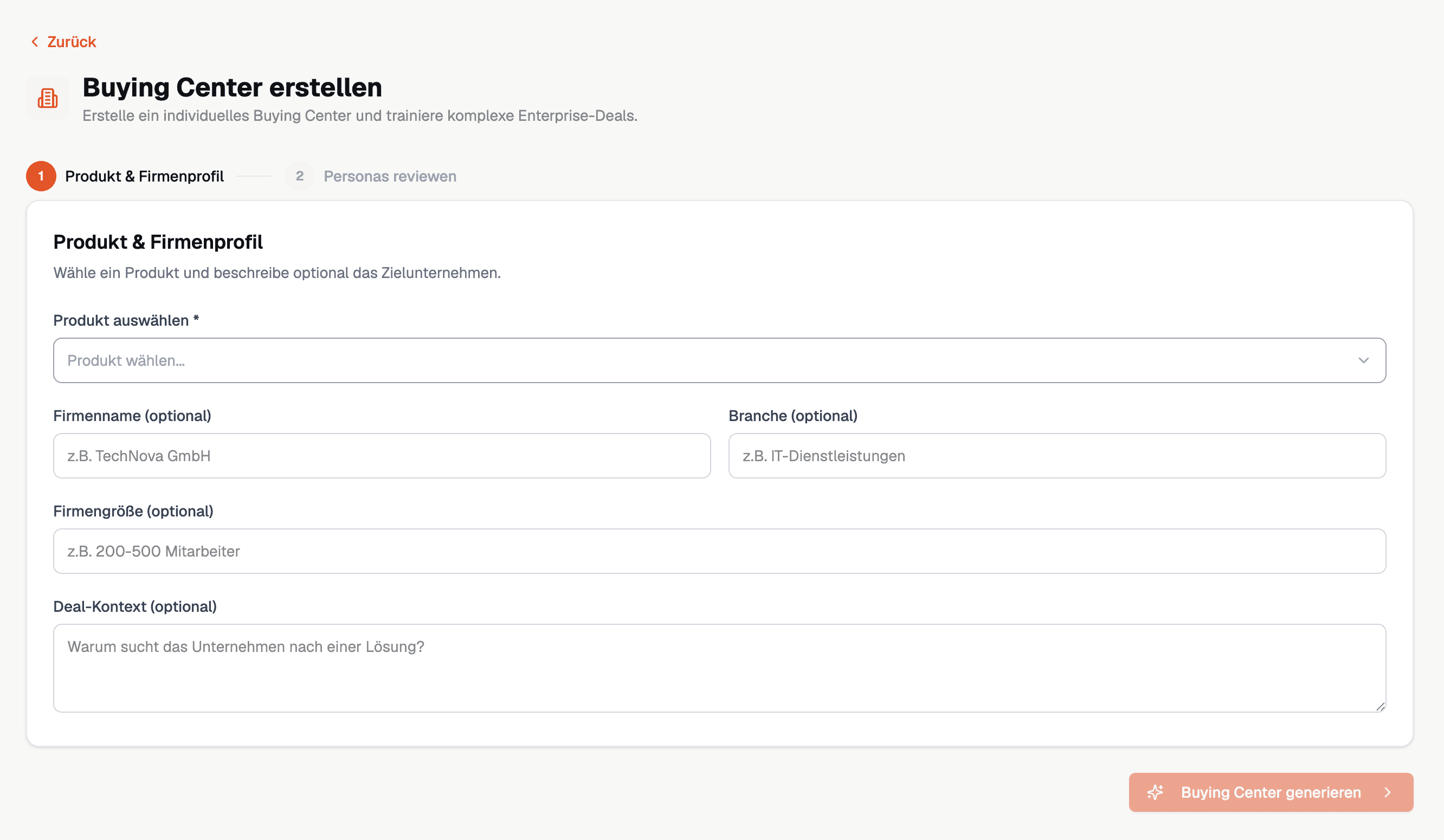
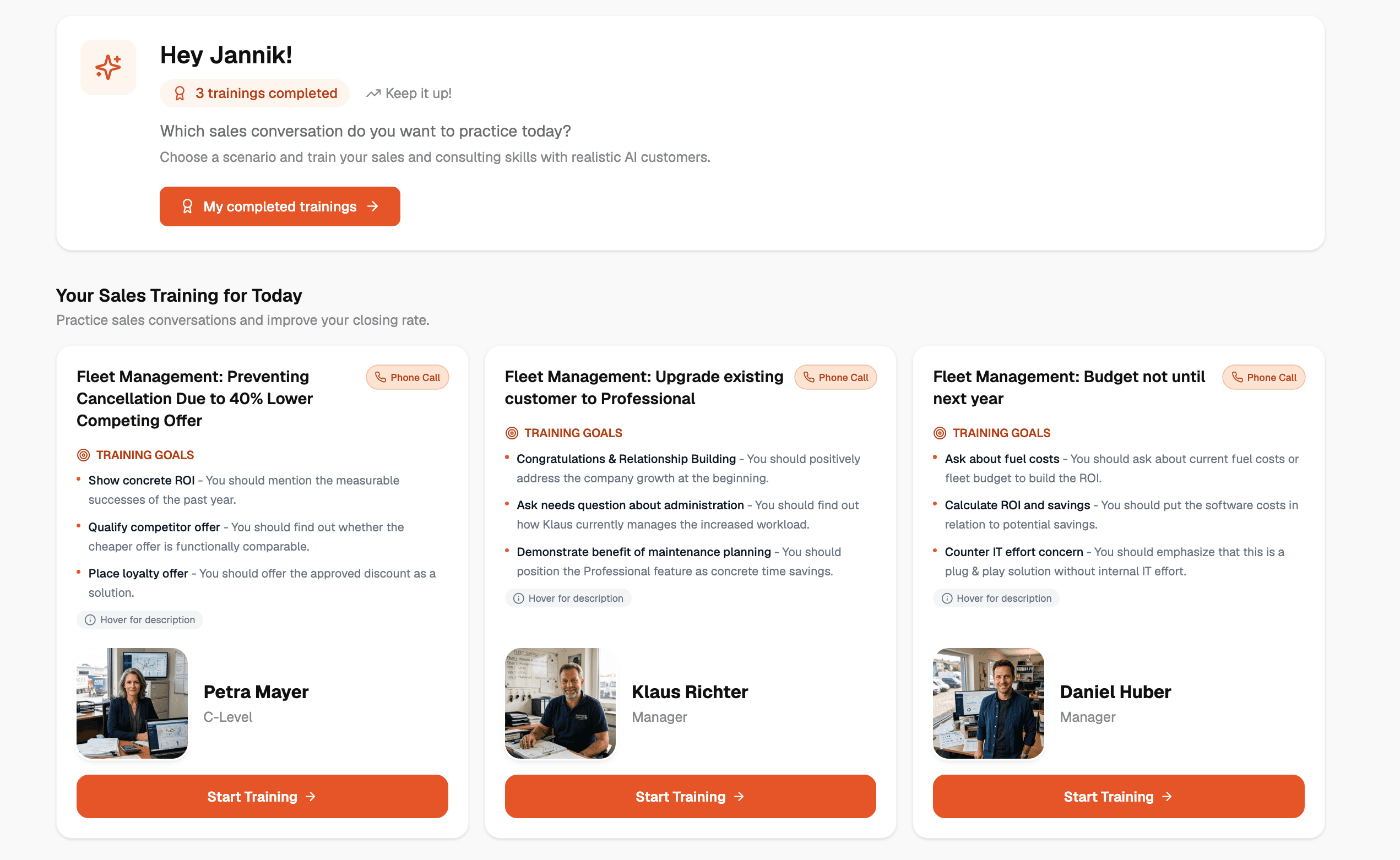
Choose the right pricing conversation for your existing customer.

Choose a role-play that matches your real sales situation—for example, a renewal announcement conversation, a phone call with critical procurement leadership, or an in-person meeting with a long-standing customer under the threat of switching. That way, you don’t just train in theory—you practice the exact moment when questions like “Why now?”, “What do I get for more?”, or “Then we’ll need to re-tender” come up.

Role-play Generator in Careertrainer.ai
2

Practice live price adjustments in an AI conversation.

Run a realistic 5- to 15-minute AI audio role-play with a demanding customer who probes questions, compares options, applies pressure, or asks for an immediate discount. You’ll practice how to open the conversation, clearly explain the value you’ve created, handle objections confidently, and guide the discussion toward an extension, commitment, or the next appointment—without giving away unnecessary margin.

Voice AI Conversation Simulator in Careertrainer.ai
3

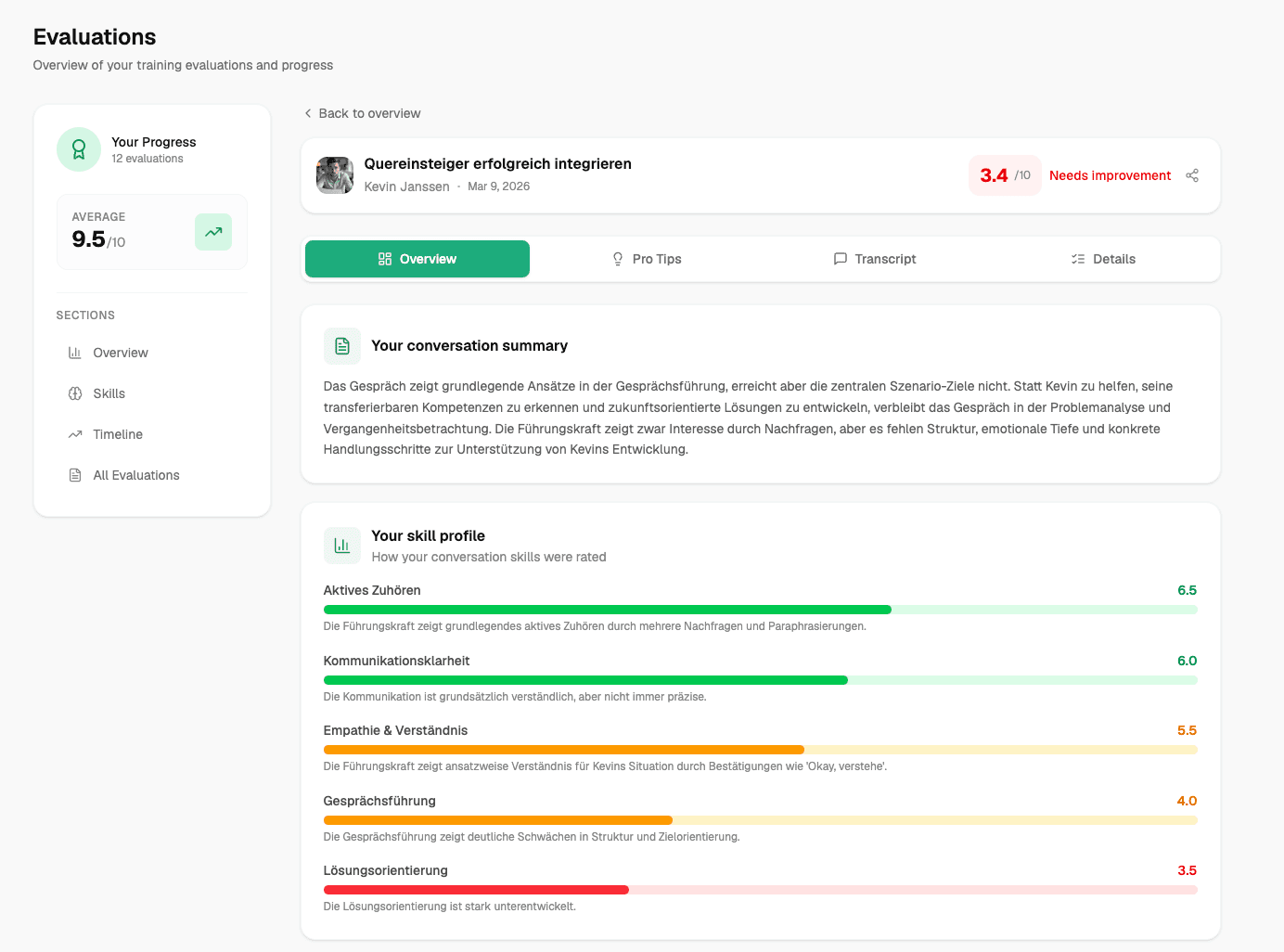
Analyze your feedback and sharpen your conversation skills—measurably.

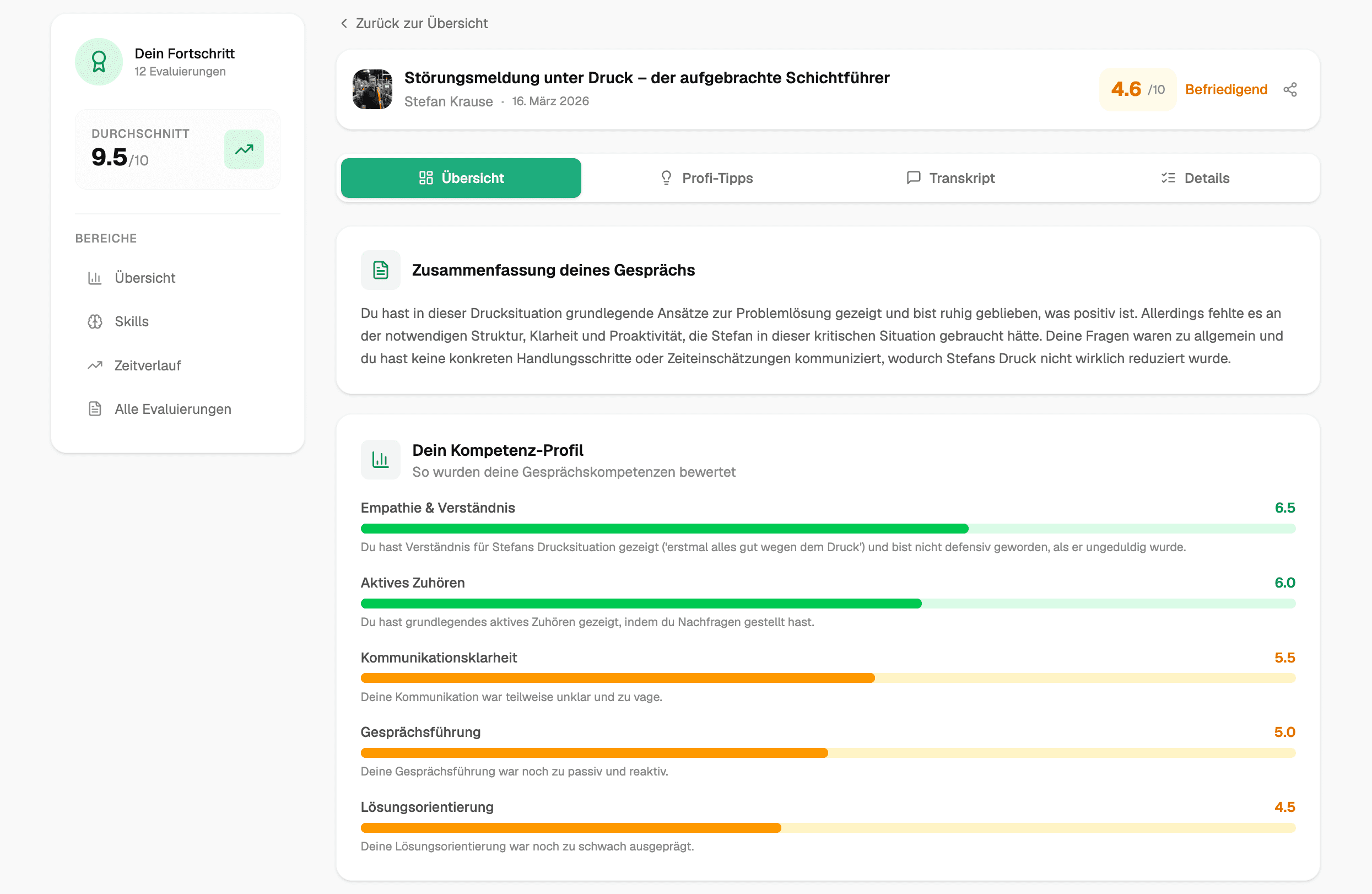
Right after the conversation, Careertrainer.ai shows you how clearly you justified the price increase, how well you handled resistance, and how confidently you guided the customer through critical negotiation moments. You can see exactly where you became defensive, where you offered a discount too early, or where you still need to anchor the added value more precisely. Then you can retrain the same scenario right away with an improved strategy.

Evaluation Dashboard in Careertrainer.ai
Why Careertrainer.ai is the right fit for you

Functions that make sensitive price conversations truly trainable

If you’re announcing a price adjustment to existing customers, you need more than just a script. Careertrainer.ai combines realistic live audio role-play, challenging buyer personas, instant evaluation, and concrete preparation for the real pressure points in negotiations—customer churn threats and requests for discounts in your existing business.

01

For Account Managers, AEs, and KAMs

Price negotiations with real-time, live training instead of dry practice

You train exactly the conversation moments where Renewal discussions go off track: price announcements, pushback, renegotiation, and the next step. With Careertrainer.ai, you simulate realistic live audio calls with existing customers—so you can build strong value-based messaging, handle objections effectively, and negotiate under pressure.

  • Practice pricing announcements ahead of Renewal, QBR, or contract extension
  • Train your value-based argumentation instead of reflexively offering discounts.
  • Simulate follow-up questions on budget, timing, and competing proposals
Learn more
Sales training form for creating a buying center with product, company profile and deal context fields
02

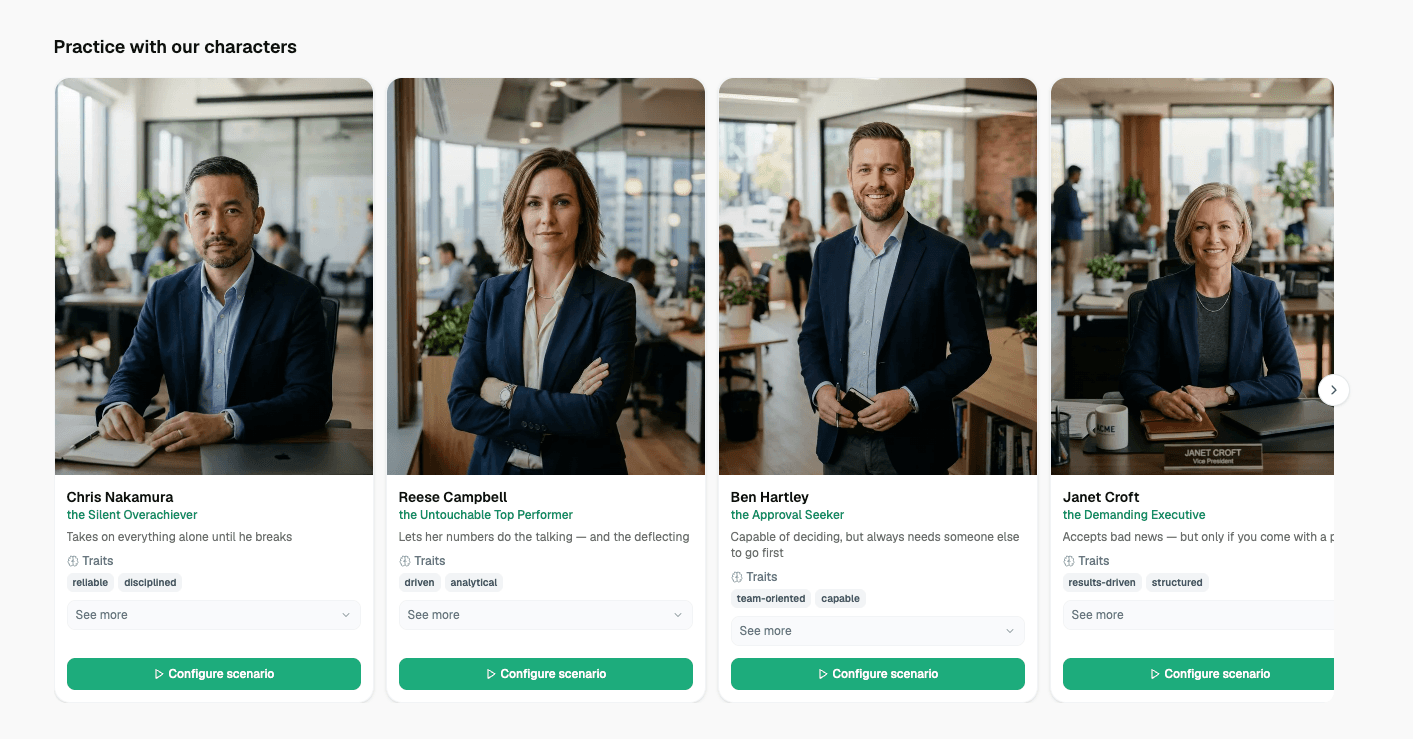
Different customer types in your existing customer base

Practice with real scenarios against CFOs, Procurement, or operational stakeholders—not generic customers.

Not every existing customer reacts the same way to a price increase. With different Buyer Personas, you practice how analytical CFOs, tough procurement managers, or relationship-focused stakeholders respond to your pricing logic, your timing, and your negotiation tactics.

  • A CFO challenges ROI, calculations, and budget approval
  • Procurement increases pressure on your discount and contract length
  • Department-focused on reducing risk, improving service levels, and ensuring continuity.
Learn more
Character selection screen with AI training personas and scenario configuration buttons
03

When the customer immediately refuses

Handle objections without slipping into justification or discounting.

Especially when prices change, objections rarely come one at a time. You’ll train how to respond to statements like “too expensive,” “I don’t see any added value,” or “then we’ll look at alternatives” — without losing control of the conversation or giving away margin unnecessarily.

  • Train your responses to discount pressure and cancellation threats.
  • Test follow-up questions, reframing, and value defense—compared side by side
  • Replicate the same scenario using multiple negotiation strategies
Learn more
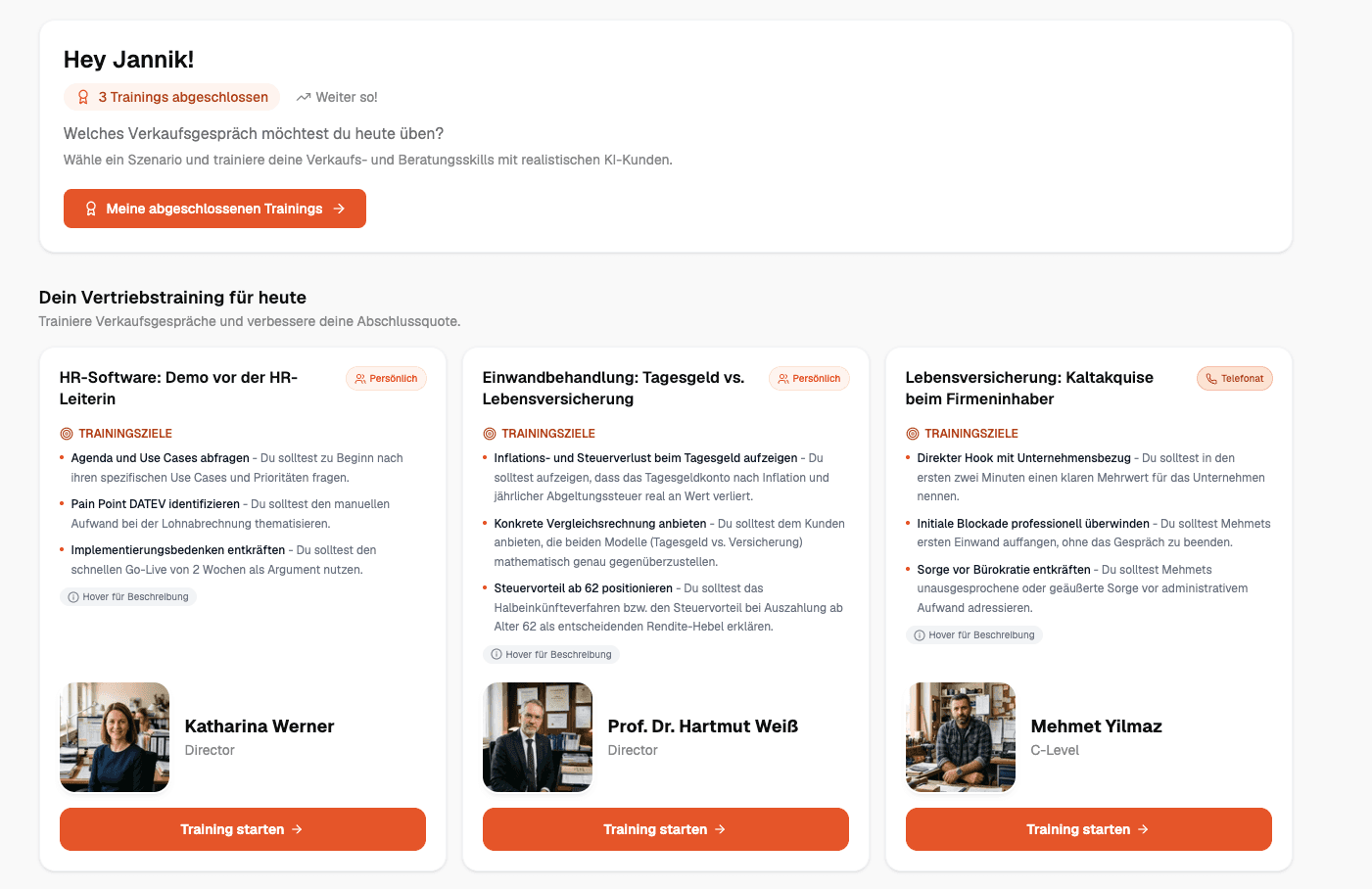
Dashboard for sales training sessions, featuring personalized training goals and participant profiles.
04

See instantly what works in your conversation.

Get direct feedback on clarity, value-based argumentation, and how you close the deal

After every session, you’ll receive a structured evaluation of whether you clearly justified the price adjustment, handled resistance professionally, and guided the next step smoothly. This helps you quickly see what’s causing the conversation to break down—whether it’s your stance, timing, need-based reasoning, or negotiation approach.

  • Assess pricing justification, objection handling, and conversation control
  • Concrete evidence instead of relying on a hunch after the session
  • Ideal for warming up before critical renewal or account conversations
Learn more
Evaluation summary and competency profile for leadership communication under pressure.
05

Psychologically credible responses

AI customers with real intent, hidden motives, and layered resistance

Price conversations only feel truly realistic when your counterpart doesn’t simply stick to a script. The AI characters in Careertrainer.ai have personality, pressure points, and their own motives. That way, you don’t just practice wording—you train how to re-open the conversation when there’s skepticism, frustration, or tactical pressure.

  • Reactions aren’t artificially escalated—they feel realistic and easy to follow.
  • Learn to spot when hard-nosed tactics work—and when real risk is starting.
  • More practical than rigid role-plays with stock phrases
Learn more
Vertriebstraining mit KI-gestützten Szenarien zur Verbesserung von Verkaufs- und Beratungskompetenzen.

Frequently asked questions about handling price conversations with existing customers

Here you’ll find clear, practical guidance on how to announce price changes in your existing business, handle objections smoothly, and train for this sensitive sales situation with Careertrainer.ai.

How can Careertrainer.ai help you when you need to announce a price increase to existing customers?

Careertrainer.ai helps you practice exactly the kind of conversation that, in real sales, can quickly turn into discount pressure, frustration, or even threats of cancellation. You train live via audio with realistic AI customers who challenge you—compare prices, threaten to switch, or request a special solution.

The advantage isn’t a script. It’s the conversational practice under pressure. You’ll learn how to clearly introduce the adjustment, explain the added value in a way that’s easy to understand, respond calmly to objections, and still maintain the relationship. After each session, you get a structured analysis with concrete guidance on your argumentation, conversation flow, and typical mistakes.

If you don’t want to leave these conversations to chance, Careertrainer.ai is a good fit: for Account Managers, sales teams, and customer retention owners who want to handle critical price discussions with more confidence.

How do you announce a price adjustment without triggering unnecessary churn?

Best practice is to announce a price adjustment early, clearly, and with clear value in mind. What’s critical is that you don’t circle the price defensively, but explain the reason for the change, what’s changing, and the implications in a straightforward way. The less clear you are, the more likely the customer hears only: more expensive for the same value.

In strong conversations, you name the adjustment precisely, put the customer’s benefit front and center, and actively address questions. Just as important is to guide the conversation flow: first frame it, then justify it, then handle objections, and move to the next step. If you talk about discounts too early, you often give up your negotiation leverage.

With Careertrainer.ai, you can train exactly this structure before you speak with real existing customers. This way, you can see where your wording builds trust—and where it may strengthen resistance.

What typical objections come up during pricing conversations for existing customers?

Common objections sound like: “Why now?”, “That’s clearly too much,” “The competition is cheaper,” “I don’t see any extra value in this,” or “Then we’ll need to review the contract.” With existing customers, there’s often an additional relationship-based objection too: “After all these years, I expected more flexibility.”

These reactions are tricky because it’s rarely just about price. Often, the customer is testing how confidently you can make your case, how much room you give yourself, and whether you’ll back down under pressure. That’s why memorizing a few standard lines isn’t enough. You need a feel for when to explain, when to ask follow-up questions, and when to set clear boundaries.

Careertrainer.ai recreates these reactions in realistic role-play scenarios. You can practice different customer types and escalation levels—so you don’t only find out what works during the real appointment.

What is the most common mistake sales teams make when pricing increases after onboarding and during contract renewals?

The most common mistake is to apologize for the price increase or address it too late and in a way that’s unclear. Customers notice immediately that you don’t truly stand behind the message yourself. That opens the door to renegotiations, principle-based discussions, and price comparisons you actually wanted to avoid.

Another problem is going into “discount mode” too early. Many sales reps respond to resistance reflexively with concessions instead of first understanding the actual cause of the objection. That reduces your margin without genuinely improving customer retention. A further mistake is arguing only internally—for example, citing rising costs—rather than clearly anchoring the value from the customer’s perspective.

When you train price conversations with Careertrainer.ai, you spot these patterns faster. That’s especially valuable if you regularly handle renewals, annual business reviews, or contract adjustments with existing customers.

How is Careertrainer.ai different from traditional sales training when it comes to price negotiations?

Traditional sales training often teaches models, playbooks, and phrasing examples. Careertrainer.ai steps in exactly where it gets difficult in everyday life: when you have to speak under pressure. You run a 5 to 15-minute live audio role-play with a challenging AI counterpart—and train the exact responses that regularly cause problems in customer conversations.

This is especially relevant when adjusting prices for existing customers. It’s not only about your arguments—it’s about timing, tone, setting boundaries, and handling emotions. Unlike e-learning or role-plays with colleagues, you get immediate feedback that you can repeat. And you can replay the same situation multiple times using different approaches.

If you already know the theory but want to feel more confident in sensitive price discussions, Careertrainer.ai is usually the more practical addition than another slide deck or generic communication training.

Is Careertrainer.ai still worth it if I’m already very experienced in sales?

Yes—especially then. Experienced sales professionals don’t usually fail price discussions because they lack knowledge. They struggle due to habits, blind spots, or situations where long-standing customers suddenly negotiate hard. Experience doesn’t automatically protect you from conceding too early, over-explaining, or misreading critical signals.

That’s why Careertrainer.ai isn’t only for beginners. You can deliberately test difficult existing-customer scenarios—such as tough purchasing logic, emotional disappointment, a quiet threat of termination, or attempts to push for add-on services without any additional price. It’s a risk-free space to sharpen your phrasing, conversation structure, and negotiation approach.

If you already run many customer conversations, the training helps you most by giving you more control in recurring high-risk moments. That’s often where it’s decided whether you protect your margin—or give in unnecessarily.

How realistic are AI customers during high-stakes price negotiations with existing customers?

The AI customers in Careertrainer.ai are designed for realistic conversation dynamics—not for superficial, one-size-fits-all responses. They react differently depending on how the conversation unfolds: skeptical, irritated, tactically negotiating, or open to a clear, well-founded explanation. That means you don’t get a rigid question-and-answer pattern, but a real negotiation conversation.

This matters especially for price discussions in existing accounts, because long-term customers rarely respond neutrally. Some test how firm you are, while others build their arguments around loyalty, internal budgets, or competitor offers. Careertrainer.ai simulates exactly these patterns in live audio role-plays and then gives you feedback on how convincing, calm, and structured your responses were.

If you’ve only practiced with colleagues or static scripts so far, you’ll notice the difference quickly: the training feels much closer to a real customer call or a negotiation appointment.

How often should I practice price discussions before I start speaking with real customers?

For critical price adjustments, it’s worth practicing more than just once. Multiple short runs are often the best approach—until your core message sits reliably and you no longer have to improvise when you encounter the most common objections. This is especially important with existing customers, because subtle differences in wording and tone can be the difference between trust and escalation.

In practice, a training block of just 5 to 15 minutes per conversation type is often enough: an initial announcement, a follow-up discussion with resistance, and a meeting for a tough renegotiation. That way, you don’t only prepare the opening—you also rehearse the critical turning points. If multiple people on your team run these conversations, you can train different difficulty levels.

With Careertrainer.ai, you can repeat these sequences flexibly without having to coordinate schedules with trainers. That makes preparation far more practical—especially ahead of renewal phases or pricing rounds.

How do you measure whether our in-place price adjustment training is really making a difference?

In price negotiations, results show up not just in gut feeling, but in observable changes in behavior. For example: how clearly the adjustment is communicated, how confidently objections are handled, whether conversations less often slip into unnecessary discounts, and how consistently the next step is driven.

Careertrainer.ai supports exactly this kind of measurability. After every role-play, you receive a structured assessment with competency scores and guidance on strengths, weaknesses, and common anti-patterns. For teams, this is especially valuable because you’re not only evaluating individual conversations—you’re spotting patterns: Who loses their line under negotiation pressure? Who makes arguments that are too product-focused? Who keeps margins stable?

If you want to train—not just run sessions, but improve them in a targeted way—this type of feedback is far more useful than purely subjective impressions after a workshop or ride-along.

As a partner, can we offer Careertrainer.ai under our own brand to existing customers who are about to be notified of a price increase?

Yes, Careertrainer.ai can also be used as a White-Label solution for partners who want to offer training for price increases—across existing customers—under their own brand. This is especially relevant for sales training providers, consultancies, enablement partners, or HR platforms that want to deliver practical conversation training to their customers without building their own AI infrastructure.

The advantage of the partner model is that you can work with your own branding, your own customer relationship, and your own pricing logic. At the same time, you leverage a DACH-focused AI platform built for realistic live audio role-plays—designed for lifelike conversation dynamics, immediate feedback, and scalable training. This makes it easy to integrate price conversations in the installed base, negotiation scenarios, or other standard sales situations into your offering.

If you want to grow an existing training business or scale it digitally, White Label is often the fastest way to launch a market-ready solution without developing your own AI.

Which sales roles is Careertrainer.ai particularly well-suited for when adjusting prices?

Careertrainer.ai is especially well-suited for roles that regularly drive revenue within existing accounts and handle difficult customer conversations themselves: Account Managers, Key Account Managers, Customer-Success teams with commercial responsibility, Sales Leaders, and inside sales teams managing renewal or adjustment conversations.

It’s particularly valuable if you conduct recurring price discussions with existing customers, but want to reduce the risk of churn, margin loss, or escalating re-negotiations. It’s also relevant for team leads, because you can standardize conversation quality across the team—without requiring every individual to be coached separately.

If, in your day-to-day sales work, price changes, contract renewals, or tough budget discussions are part of everyday life, Careertrainer.ai fits far better than a general communication training solution without a specific conversation context.