



careertrainer.ai

Practice how to clearly explain ongoing support and handle objections like “We don’t need that permanently.”

From one-off projects to a monthly contract: sell with confidence

Practice realistic live audio role-plays with Careertrainer.ai—using challenging AI customers and decision-makers. Train how to build your value proposition, dig deeper into needs, and handle objections for renewals and recurring contracts.

Live example · This is what training looks like

Phone call

Your own scenario

Olivia Carter

Olivia Carter

Sales·Upsell

Marketing Director · 38

Turn one-off campaign work into a monthly retainer

A satisfied client questions why they should move from project-based work to an ongoing monthly engagement.

Goal: Convince Olivia that a monthly retainer reduces performance gaps, speeds execution, and improves results over time. Handle her concern about paying for support they may not use every week.

Practice with Olivia Carter — it’s free

When recurring agreements break down in conversation

Many sales opportunities don’t fail because of a lack of need—they fail because of the quality of your arguments. If customers see ongoing support as unnecessary overhead, you need a clear value logic, solid conversation management, and confident answers to common objections. With Careertrainer.ai, you can train exactly those sales situations through realistic live audio role-play scenarios.

AI character for industry-focused solutions

AI role-play focus

When ongoing support needs to become realistic

With Careertrainer.ai, you train critical sales conversations with realistic AI customers—before a project turns into just a one-off order again.

Sell outcomes—not hoursProbe objections further calmly
Challenge 01

Customers only see individual projects—not ongoing demand.

To the customer’s side, the project in conversation can feel like a clearly defined task: deliver, close, done. That’s why ongoing monthly support is seen right away as an additional cost block—not as protection for performance, speed, or continuity. With Careertrainer.ai, you train on realistic live conversations with AI customers. You uncover hidden follow-up needs, prioritize benefits clearly, and convincingly justify recurring collaboration.

Book a free demo
Challenge 02

The objection to ongoing support comes early—and it hits hard.

Phrases like “We don’t need this permanently,” “We’ll do it if and when we need it,” or “Monthly doesn’t make sense for us” often stop the conversation before the real needs are properly uncovered. And if you only defend your offer instead of making risks, response times, and opportunity costs tangible, you’ll lose on both price and timing. With Careertrainer.ai, you practice exactly these objections in AI role-play training and learn how to ask better questions, reframe the conversation, and build a solid, defensible case for the value of a long-term collaboration.

Book a free demo
Challenge 03

Monthly budgets are scrutinized more strictly than project budgets.

A one-off project can often be justified by an urgent problem. But an ongoing contract has to be defended internally—over and over. If your argument doesn’t provide a clear ROI logic, the right prioritization, and expectation management, the offer quickly ends up being compared to internal resources or an ad-hoc purchase. With Careertrainer.ai, you train price and value conversations with demanding AI decision-makers—and learn how to turn monthly costs into predictable business value.

Book a free demo
Challenge 04

Multiple stakeholders may agree—but that doesn’t mean you’ve won the deal.

The specialist page may highlight the benefits, but Finance, the executive team, or Procurement will still ask about contract stability, flexibility, and capacity utilization. That’s how a response that initially sounds positive can quickly turn into delays, renegotiation, or a smaller one-off order—without any follow-up. With Careertrainer.ai, you can practice complex sales conversations with different AI personas and learn how to consistently communicate both the specialist value, the commercial certainty, and your internal “next-step” alignment in one coherent approach.

Book a free demo

Close retainer deals with AI role-play training

Four practical scenarios for selling retainers: Train your team with realistic AI characters for the conversations you actually run in Careertrainer.ai.

Olivia Carter

Olivia Carter

Marketing Director · MARKETING_AGENCY

ESFJ

The budget-conscious marketing lead

She has used your agency for one-off campaigns and sees them as useful but optional. She pushes back on ongoing fees unless you make the value of continuous optimization feel tangible and low-risk.

IntrovertExtrovert
DetailConcept
AnalyticalEmotional
StructuredFlexible
Daniel Brooks

Daniel Brooks

Operations Director · MANUFACTURING

ISTJ

The pragmatic operations buyer

He prefers clear scopes, fixed deliverables, and direct accountability. He becomes skeptical when a recurring agreement sounds less concrete than a defined project.

IntrovertExtrovert
DetailConcept
AnalyticalEmotional
StructuredFlexible
Maya Reynolds

Maya Reynolds

Chief Commercial Officer · SAAS

ENTP

The hard-nosed executive sponsor

She is commercially sharp, impatient with soft arguments, and focused on strategic leverage. She challenges whether a retainer creates dependency and expects a compelling executive-level case for ongoing partnership.

IntrovertExtrovert
DetailConcept
AnalyticalEmotional
StructuredFlexible

Typical sales conversation scenarios for ongoing retainer contracts

When a successful one-off project is meant to turn into a long-term partnership, conversations often tip at a few critical points: needs get underestimated, ongoing costs are hard to justify, or the client wants to wait and see first. With Careertrainer.ai, you can train exactly these situations through realistic AI role-play—complete with specific objections, real conversational pressure, and instant feedback on your arguments.

Needs assessment

“Right now, one project is enough for us” — if you don’t see a long-term need

After a successful project, things feel positive—but your counterpart still doesn’t see a reason for ongoing monthly collaboration. The key is not to immediately defend the contract model, but to make recurring risks, bottlenecks, and opportunity costs visible. Effective questions focus on workload, response times, internal approvals, and the time lost between individual assignments. With Careertrainer.ai, you practice exactly this kind of conversation management with realistic AI customers—and you can see in the feedback whether you’re actually building need, not just explaining performance.

Train this conversation
Handling Objections

“Do we really need this all the time?” Sell the value—without the overhead

Here, the customer isn’t necessarily rejecting your offer—they’re questioning the ongoing added value. It’s more effective to build your case around continuity: faster implementation, smarter prioritization, and less coordination overhead—rather than focusing on hours or availability. Top-performing sellers connect the fixed contract to clear, day-to-day consequences, making the difference versus “on-demand order-taking” tangible. With the AI role-play training in Careertrainer.ai, you can test and repeat different response strategies until your objection handling holds up—even under pressure.

Practice objections with confidence
Pricing discussion

“Monthly costs sound higher” — when the CFO only looks at fixed costs

Once a recurring contract is treated as an additional cost item, you need a different conversation logic than in classic project-based selling. Instead of trying to justify the price, focus on predictability, lower friction, faster Time-to-Value, and fewer one-off negotiations per quarter. This works especially well when you compare uncoordinated ad-hoc costs with a clearly prioritized ongoing support model. With Careertrainer.ai, you can train these price discussions with critical decision-makers before you have them in the real meeting.

Practice your price negotiations
Decision-Maker Conversation

Multiple stakeholders, different priorities—Marketing wants speed, Procurement wants flexibility.

In many B2B situations, it’s not the need that prevents you from closing with a long-term contract—it’s conflicting priorities inside the Buying Center. You need to connect value, risk mitigation, and contractual flexibility in a way that gives every stakeholder a credible reason to say yes. Instead of addressing objections only at the end, it’s smarter to handle them early and clearly for each role. With Careertrainer.ai, you can practice these multi-layered conversations in realistic live audio role-plays—and get immediate feedback on whether you’ve addressed the right interests.

Practice stakeholder conversations

So trainierst you the transition from project work to ongoing customer support

With Careertrainer.ai, you practice exactly the sales conversations where a successful one-off order is meant to turn into a recurring monthly contract. Instead of generic sales theory, you train with real objections, clear value-based pitching—and the very next steps you can measure.

1

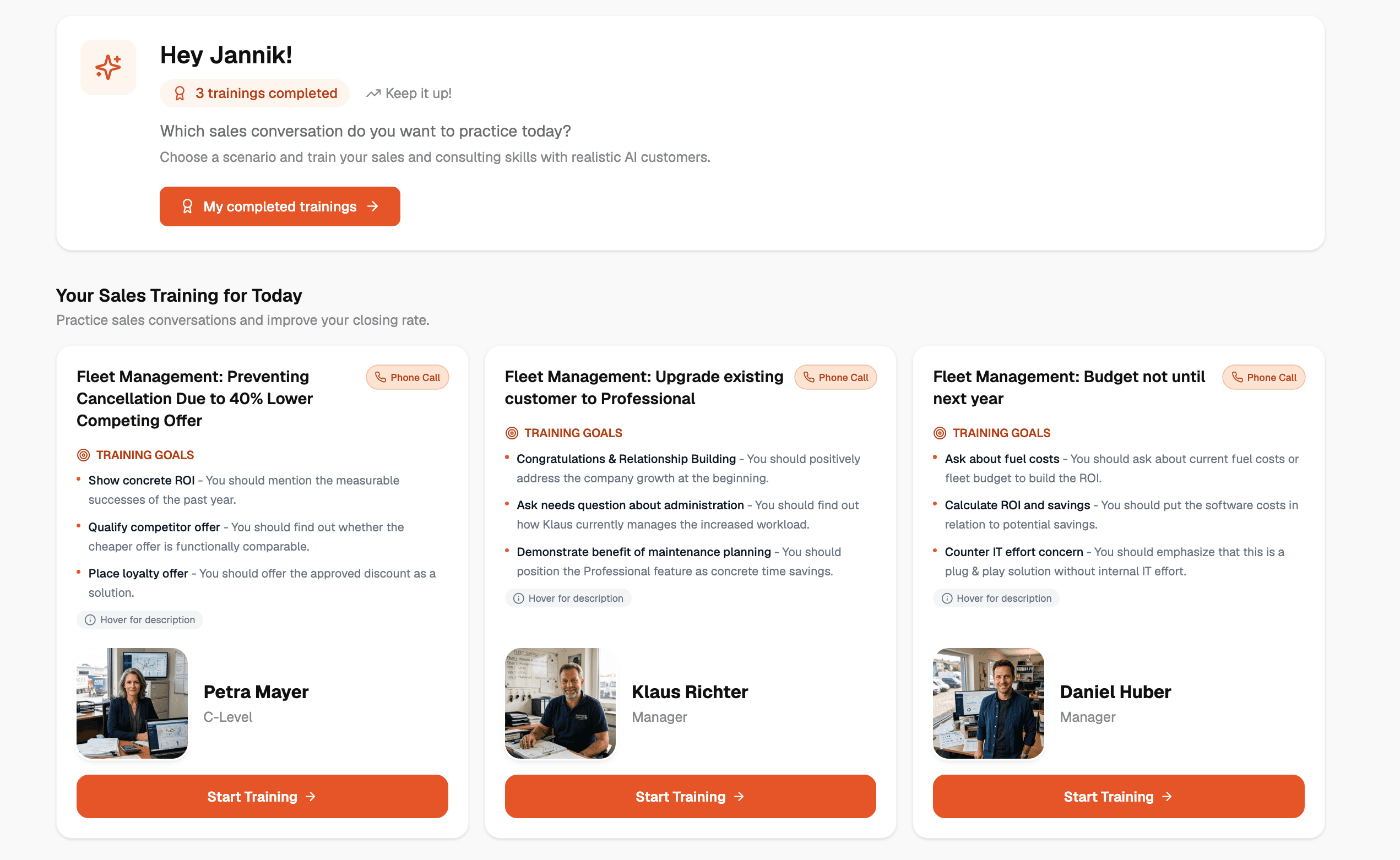
Choose the right conversation to renew your contract within an ongoing mandate

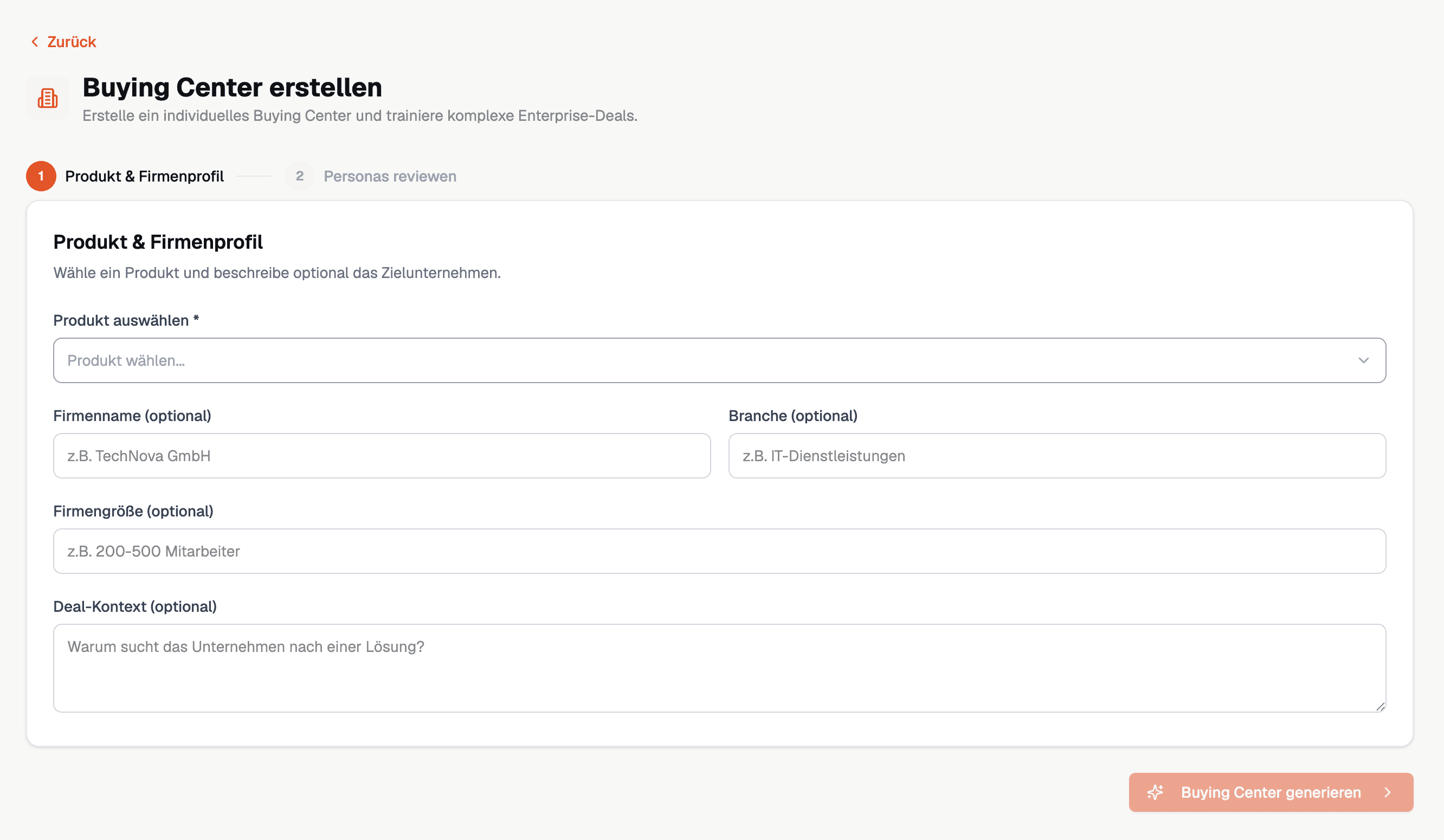
Start with an AI role-play tailored to your real sales situation—e.g., right after a completed project, before a renewal conversation, or with a customer who only wants to purchase occasionally. You choose typical counterparts such as Managing Directors, department heads, or budget owners, and you train objections like “We don’t need this permanently” or “We’ll get back to you when something comes up.”

Role-Play Generator in Careertrainer.ai
2

Practice your live conversation—under real customer pressure—so your arguments hold up when it matters.

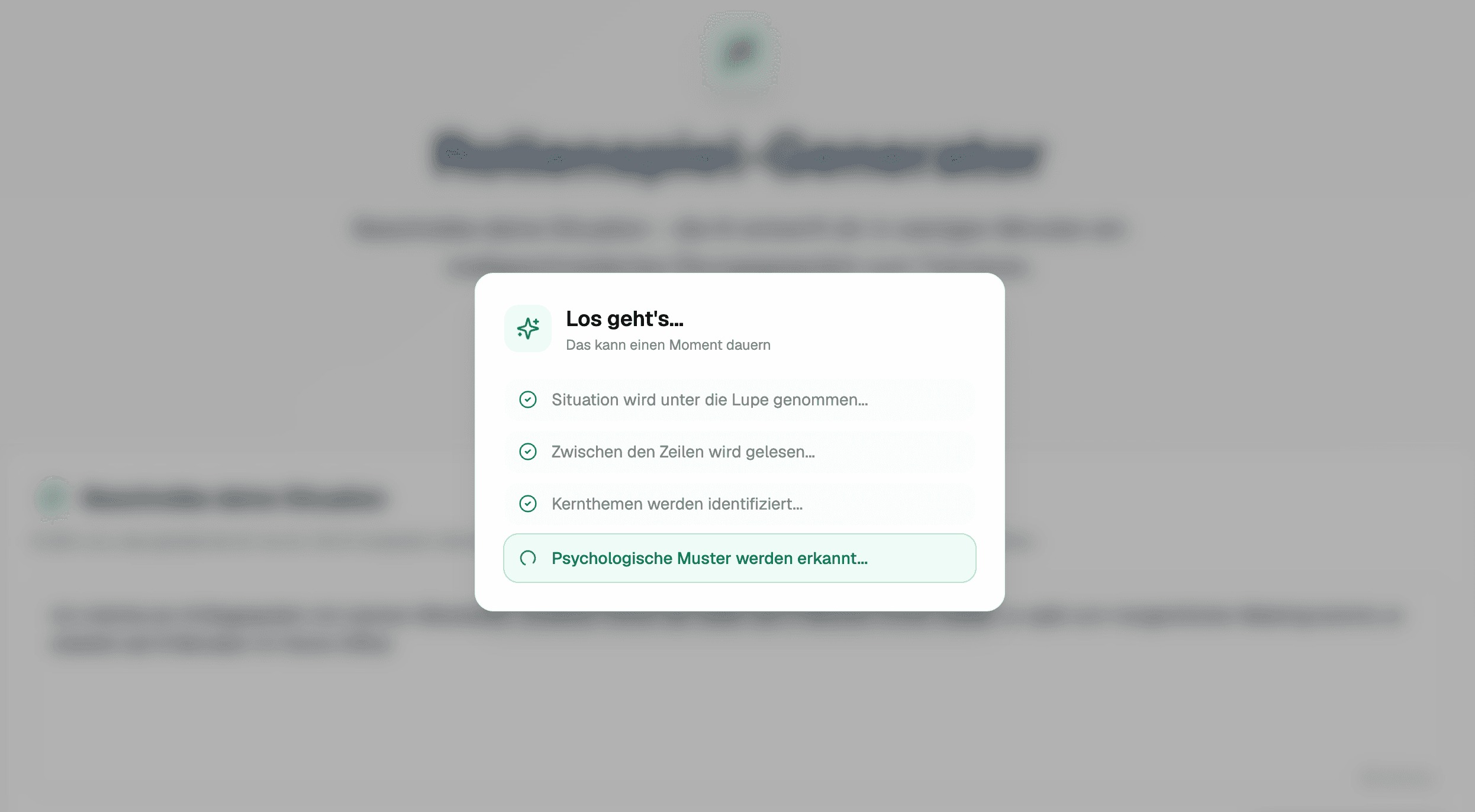
Run a 5–15 minute live audio conversation with an AI customer who responds realistically—and asks skeptical questions about value, scope, timing, and ongoing costs. This helps you train how to move from one-off service to continuous support, make the risks of “reactive mode” visible, and position ongoing support as a predictable business value—not an extra cost.

Voice AI Conversation Simulation in Careertrainer.ai
3

Use insights to improve conversions and drive recurring revenue

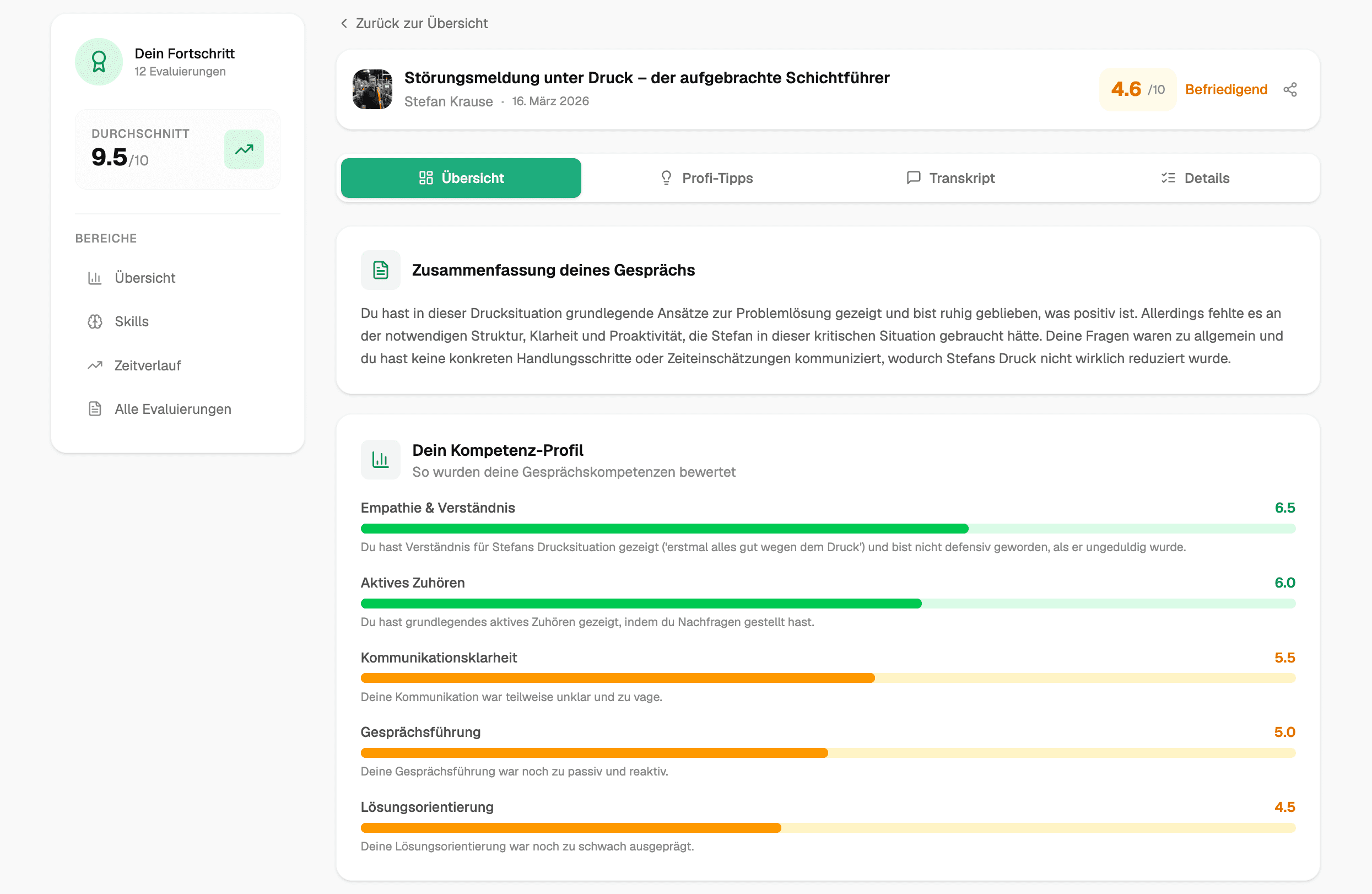
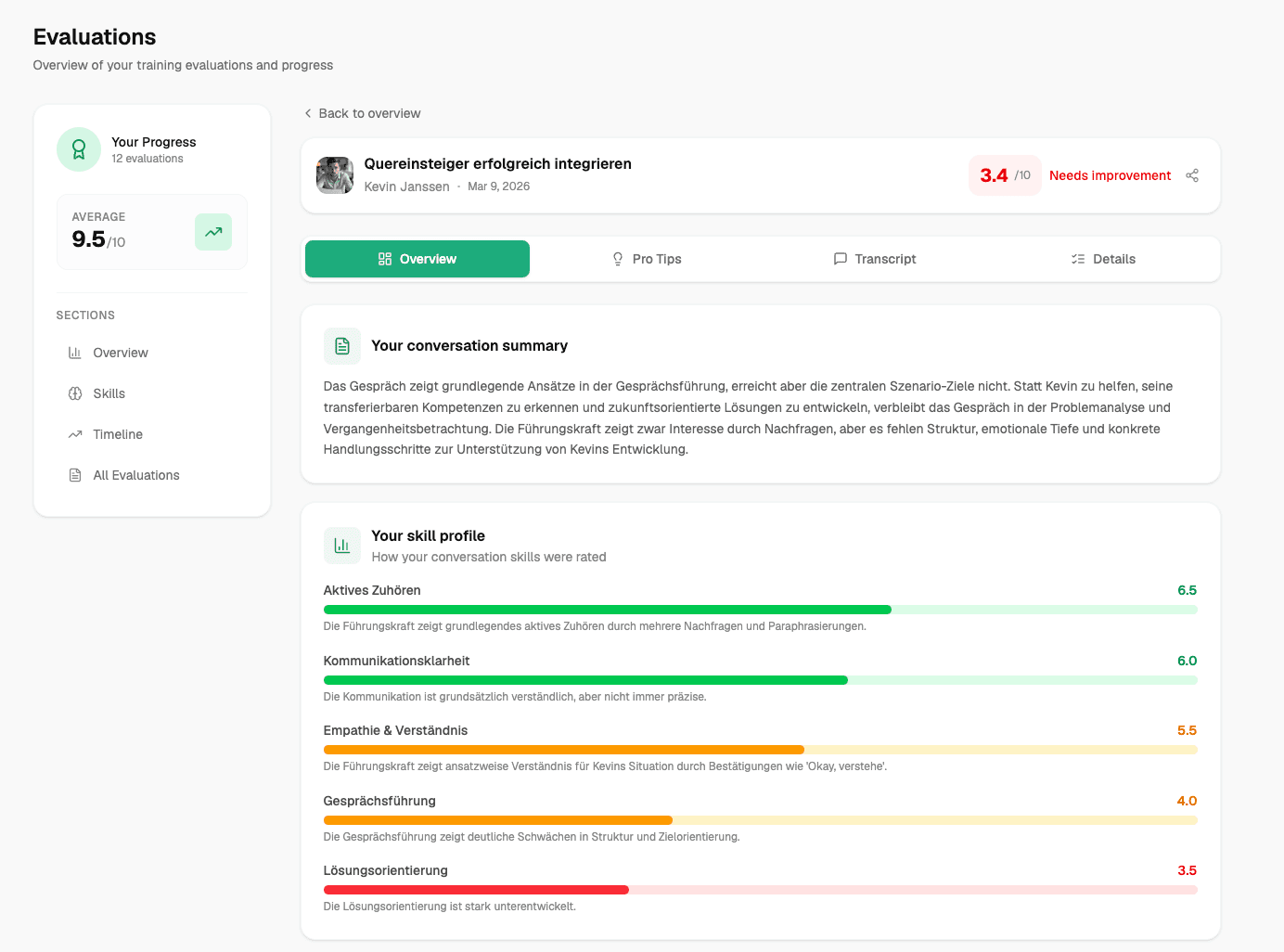
Right after the conversation, you’ll see how confidently you deepen needs, explain the value of a monthly model, and handle critical objections. The feedback pinpoints exactly where you pitch too early, where your benefits are still too vague, or where you miss signals of buying readiness—so you can specifically improve your close rate for recurring contracts.

Evaluation dashboard in Careertrainer.ai
Why Careertrainer.ai is the right fit for you

The features that turn project work into predictable monthly mandates

When a customer doesn’t see a lasting contract after a successful one-off project, you need more than standard objection handling. Careertrainer.ai combines realistic live audio role-play scenarios, challenging buyer personas, and instant evaluation—so you can clearly position the value, manage risk, and build ongoing momentum.

01

For AEs, Account Managers, and consultative sales teams

Sales training for the step from project to ongoing client mandate

You train exactly the conversations where a one-time performance needs to turn into a recurring contract. Instead of generic sales theory, you’ll practice deeper needs discovery, value-based positioning, pricing discussions, and closing in realistic live audio role-play sessions—with demanding customer types.

  • Practice renewal, expansion, and contract extension conversations in a hands-on, real-world way.
  • Train for results—not hours billed or one-off deliverables
  • Ideal for MRR/ARR-focused service and consulting offerings
Learn more
Sales training form for creating a buying center with product, company profile and deal context fields
02

If the customer switches to “wait and see”

Practice objections against ongoing support—deliberately and in realistic scenarios

Many deals get derailed by lines like: “We don’t need this long-term,” “We’ll get back to you if needed,” or “We can only access it on a case-by-case basis.” With Careertrainer.ai, you can practice different response strategies in real conversation scenarios—so you can see which approach actually holds up with skeptical customers.

  • Train objections to ongoing costs and long-term commitment
  • Test reframing, follow-up questions, and business case arguments
  • Practice the same situation with multiple conversation strategies.
Learn more
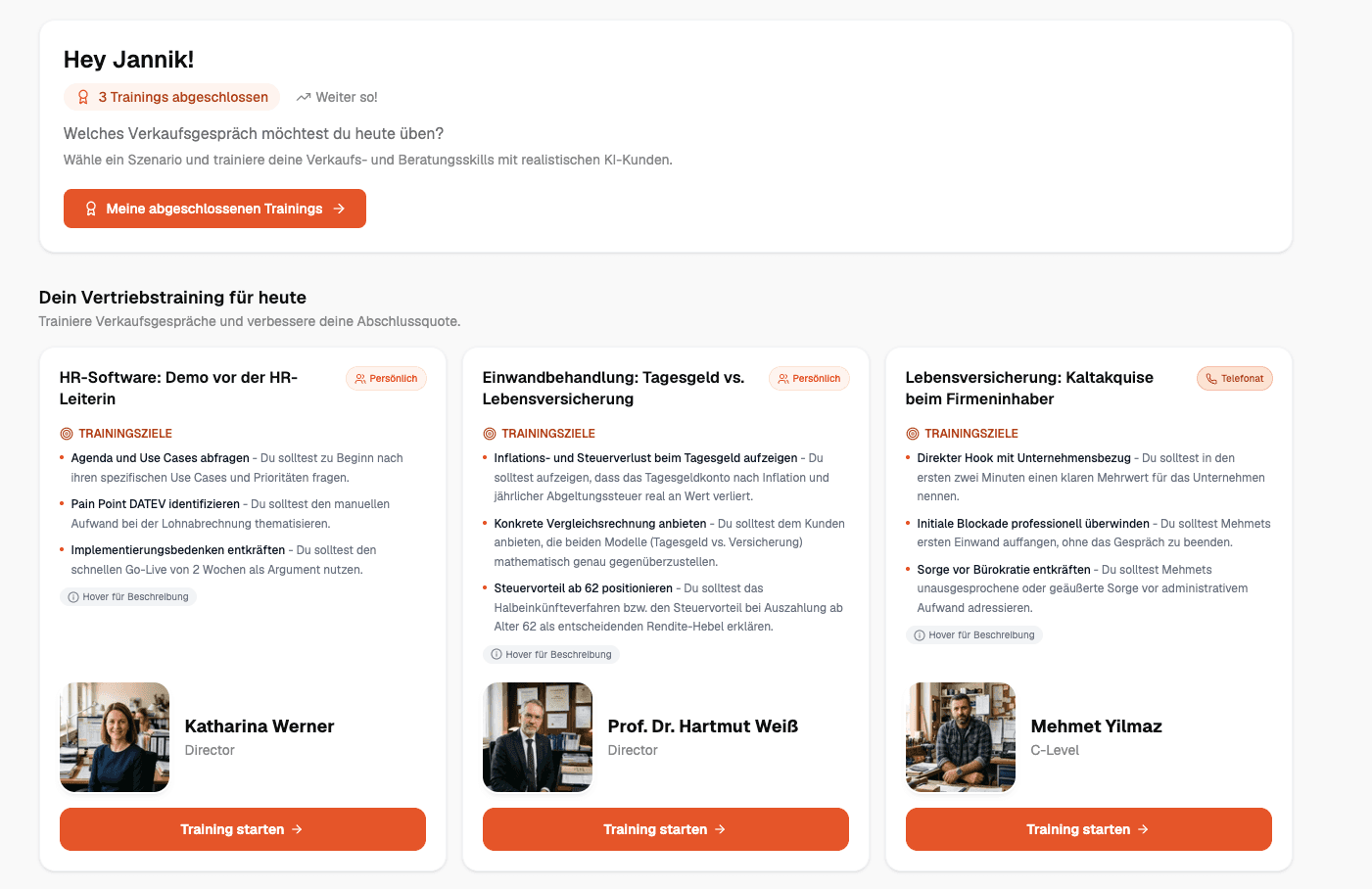
Dashboard for sales training sessions, featuring personalized training goals and participant profiles.
03

Adapt your arguments depending on who you’re talking to.

Buyer Personas for CFOs, Managing Directors, and Operational Stakeholders

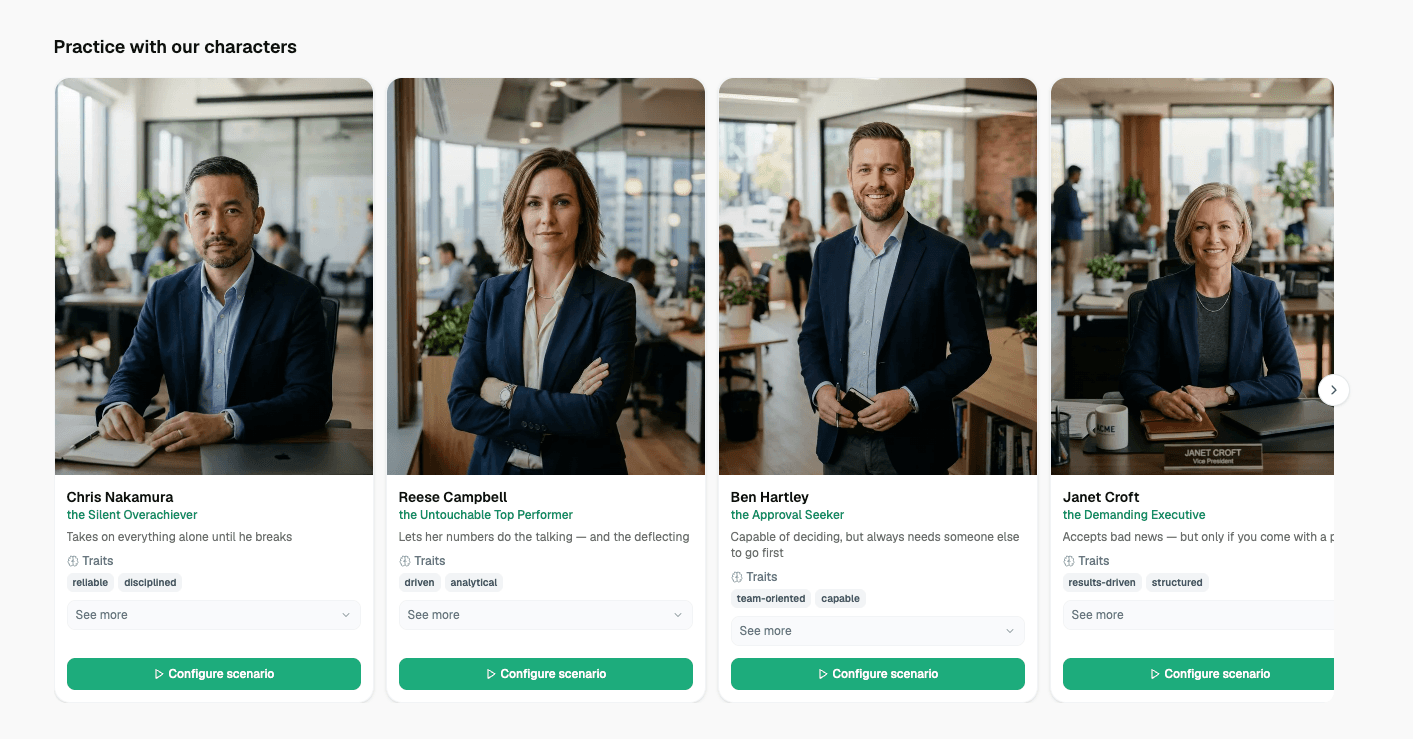
A CFO evaluates ongoing contracts differently than an operational leader or a managing director in a mid-sized company. That’s why you don’t train against a generic “standard customer”—you practice with different buyer types, each with their own decision-making logic, different risk perception, and the typical questions they raise about budget, scope, and commitment.

  • CFOs question your budget, ROI, and predictability
  • Leaders assess relief, pace, and availability
  • Train your tone and arguments based on each buyer type
Learn more
Character selection screen with AI training personas and scenario configuration buttons
04

See immediately after each run what’s actually working.

Analysis to strengthen your value proposition, handle objections effectively, and close with confidence

After every training conversation, a second AI system independently evaluates how well you: - deepened the identified need - made the value of a monthly subscription feel convincing - responded to objections This way, you don’t just see whether the conversation went well—you also understand exactly where your closing starts to lose momentum.

  • Concrete scores instead of guesswork after the conversation
  • Evidence from the conversation—not blanket criticism.
  • Helps improve your win rate, forecast accuracy, and coaching outcomes
Learn more
Evaluation summary and competency profile for leadership communication under pressure.
05

Realistic responses instead of a yes-sayer simulation

AI customer types with real resistance and hidden motives

Especially when switching from a one-off project to an ongoing collaboration, it becomes clear whether your counterpart is driven purely by price, under internal pressure to justify decisions, or simply has no intention of sticking around. The AI characters in Careertrainer.ai respond in a psychologically realistic way—so you can train exactly this type of conversation dynamic.

  • Train skeptical, analytical, and dominant customer types
  • Uncover hidden motives through strong discovery
  • More realism than with scripted role-play practice or chatbots
Learn more
Vertriebstraining mit KI-gestützten Szenarien zur Verbesserung von Verkaufs- und Beratungskompetenzen.

Frequently Asked Questions About Selling Ongoing Fixed-Term Contracts

Here you’ll find clear, practical guidance on how to credibly pitch the shift from a one-off project to an ongoing collaboration, handle common objections, and train with Careertrainer.ai using realistic customer conversations.

How can Careertrainer.ai help you turn a one-off project into a monthly retainer?

Careertrainer.ai helps you practice exactly the sales conversations where customers don’t yet clearly see the value of ongoing support. Instead of abstract sales theory, you run a 5–15-minute live audio role-play with a realistic AI counterpart that responds skeptically, cost-consciously, or with a wait-and-see attitude.

Especially when transitioning from a one-off project to a long-term partnership, conversations often fail not because of past results—but because the question is: why should budget be committed on an ongoing basis in the future? That’s why you train value-based selling, deeper needs exploration, risk communication, and objection handling under real conversational pressure. After the role-play, you get immediate feedback on whether you successfully conveyed value, commitment, and the next steps.

This is particularly useful if you don’t want to improvise before renewal, contract extensions, or upsell conversations—but instead test your arguments realistically in advance.

Why do customers say after a successful project, “We don’t need this on an ongoing basis”?

This objection usually doesn’t mean your project was a bad one. More often, the other side simply doesn’t see the ongoing need clearly enough, evaluates the benefits only in isolated points, or wants to avoid additional fixed costs.

In many conversations, the value of ongoing support is claimed too early—and not sufficiently backed up. Customers then think in terms of completed tasks, not recurring risks, opportunities, or the continuity that’s actually required. If you don’t clearly spell out what will be left behind without ongoing guidance, what will become uncoordinated, or what will come back later at a higher cost, a monthly contract can quickly start to feel like overhead.

That’s why the key is to make the leap from “project done” to “continuous business value” understandable. Strong conversations don’t just list services—they make it visible what outcomes, response times, steering, or relief are regularly secured. Train exactly this logic before you enter a real extension conversation.

How do you negotiate an ongoing contract without immediately getting pulled into a price discussion?

Start by addressing continuity, risk, and outcome logic—not the monthly rate. If you bring up scope or price too early, the other side will compare cost blocks instead of the business value.

What works is a sequence of three steps: First, confirm the current status and the results you’ve achieved. Second, highlight the gap that appears after the project ends—e.g., around steering, delivery speed, monitoring, or adjustments. Third, explain the exact recurring way of collaborating that economically closes this gap. This helps position the contract not as ongoing billing, but as a planned safeguard of meaningful results.

With Careertrainer.ai, you can practice and test this structure in realistic conversations—so you can see how different skeptical customers react to the same argument. This is especially helpful if you often hear: “Let’s get back in touch if needed.”

What exactly do you train in Careertrainer.ai for conversations about monthly retainers?

You don’t train generic sales scripts—you practice specific renewal and expansion conversations. Typical scenarios include: a project was completed successfully, but the customer sees no reason for ongoing support; a managing director wants to reassess in a few months; or a team uses your service inconsistently and therefore considers a fixed structure unnecessary.

The AI counterpart doesn’t behave like a simple chatbot. Instead, it acts like a believable decision-maker with its own motivations, objections, and varying levels of openness. That means you have to respond to follow-up questions, resistance, and uncertainty just like you would in a real conversation.

After each role-play, you get feedback on the key points: Did you make the long-term need visible? Did you sell value instead of tasks? Did you push for a clear next step or drive toward a committed decision? That’s how practice turns into measurable conversation preparation.

Who is Careertrainer.ai especially well-suited for when it comes to selling recurring contracts?

Careertrainer.ai is especially well-suited for sales professionals, consultants, agencies, service companies, and account managers who want to turn one-off assignments into predictable monthly retainers.

It’s a great fit whenever you’re not selling standard products, but instead need to justify ongoing support, steering, expertise, or continuous implementation.

The training is particularly valuable for roles that regularly face similar conversations: after a project ends, before contract renewals, during expansion discussions with existing customers, or when decision-makers underestimate the value of ongoing collaboration. Sales leads and enablement owners can also use it to make typical skill gaps in the team visible—such as communicating value, handling objections, or leading to closing.

If your sales success depends on whether you can turn occasional service into a sustainable business model, Careertrainer.ai is the right training environment.

What makes Careertrainer.ai different from traditional sales training in those renewal conversations?

Traditional training often teaches models, phrasing, and guidelines. Careertrainer.ai starts earlier—at execution: you run the conversation for real, respond live to objections, and receive a structured evaluation immediately afterward.

Especially in sales involving ongoing fixed-term contracts, knowledge alone usually isn’t enough. Many already know in theory to sell outcomes instead of services—but in real conversations they still fall back into justifying themselves, defending the price, or sharing offer details too early. The difference, then, isn’t the theory—it’s repetition under realistic pressure.

Careertrainer.ai is built as a DACH-focused AI platform for practical conversation training via live audio role-play. You can train independently of trainer schedules, as often as you like, and with consistent quality. For teams, there’s an added benefit: progress is measurable instead of relying on subjective assessments. If you want to turn knowledge into reliable conversation routines, this is the decisive advantage.

Does the training still make sense if you’re already experienced in sales?

Yes—especially for experienced salespeople, it often pays off even more. The reason is simple: ongoing contract discussions rarely fail because of missing basic skills. More often, the issue comes down to subtle mistakes in timing, conversation handling, and your value logic.

Seasoned sales professionals have heard objections like “too soon,” “too much commitment,” or “we already have enough internal capacity for that”—not for the first time. Still, it helps to role-play different types of stakeholders and check how precise your own arguments really are. Often, it only becomes clear in the role-play whether you’ve developed the customer’s need deeply enough, whether you’re moving to price too quickly, or whether you’re too willing to accept a convenient postponement.

That’s why Careertrainer.ai isn’t just for beginners. It’s particularly effective when you want to show up more confident, more consistent, and more sharp in critical existing-customer conversations—without having to experiment with real accounts.

How often should you train conversations for transitioning into ongoing support?

Most effective is short, repeated training right before real customer meetings. Instead of doing rare long sessions, you’ll get better results by running multiple rounds of 5 to 15 minutes—and testing one clear variation of your argument each time.

For example, you can start with a first run to lay open your current conversation logic. In the second run, you sharpen the parts where you drifted into justification or generic statements. In the third conversation, you check whether you can sell the value more clearly, more concretely, and with stronger commitment now. This is how you quickly build a reliable routine for similar renewal and upsell/expansion calls.

For teams, a regular cadence before renewal phases or existing-customer campaigns makes sense. For individuals, a compact warm-up before important meetings is often enough to enter the real conversation with a much clearer structure.

How do you measure whether your team is truly getting better at selling monthly contracts?

Improvement isn’t only about whether a single contract closes. What really matters is whether your team argues more clearly in recurring conversations, handles objections with more confidence, and more often reaches clear next steps.

With Careertrainer.ai, you can evaluate exactly that in a structured way. After each role-play, you’ll see competency scores and scenario-specific assessment criteria—e.g., for deepening needs, communicating value, objection handling, or closing. For team leaders, this makes typical skill gaps visible: Is the ongoing value not being made concrete enough? Is pricing brought up too early? Is there a lack of commitment when it comes to the decision?

This kind of measurability is especially important in Sales Enablement, because without it, conversation quality is often judged by gut feeling alone. If you want to steer training and track progress in a transparent, understandable way, you need this clear link between practice and data-driven evaluation.

Can training providers or consulting firms use Careertrainer.ai for conversations to sell on a retainer under their own brand?

Yes, Careertrainer.ai can also be used as a white-label solution for training providers, consultancies, sales enablement partners, or platforms that want to sell conversation training on a retainer—under their own brand.

This is especially valuable if you don’t just want to deliver workshops or scripts, but integrate repeatable hands-on practice training for renewal, upselling, and existing-customer conversations. Partners can keep their own branding, their own customer relationship, and their own pricing logic. Careertrainer.ai positions itself here intentionally as an enabler—not a competing model for traditional training providers.

If you want to make ongoing support, monthly mandates, or similar sales models trainable for your customers, a white-label approach is the right fit. This way, you combine your methodology with a DACH-focused AI platform for realistic, practice-oriented live audio role-play.

What do you need to get started with Careertrainer.ai to practice sales conversations like these?

The entry barrier is intentionally low. You don’t need a camera, a complex setup, or a fixed trainer appointment. Careertrainer.ai is built audio-first, so you can train real conversation situations quickly—without unnecessary friction.

More important than the technology is having a clear reason for the conversation—such as a successfully completed project, an expiring contract, or an existing customer where you want to build long-term collaboration. The more precisely you know the starting situation, the more realistic the training becomes. Especially when handling objections like “We don’t need this long-term” or “We’ll reach out if needed,” this focus delivers the greatest learning impact.

For companies, there’s also the DACH focus, the GDPR context, and the option to roll out training in a structured way across teams. If you want to start quickly, though, the most important thing at the beginning is simply this: a real conversation that you want to lead better.

When is Careertrainer.ai the right choice for this type of sales conversation—and when isn’t it?

Careertrainer.ai is the right choice if you want to do more than just understand difficult sales conversations—you want to practice them realistically. This is especially relevant for meetings where you need to establish long-term collaboration, reduce skepticism, and create commitment.

It’s a strong fit when you want to feel more confident before real customer calls, when your team regularly hears similar objections, or when you want to set up training that’s scalable and measurable. Careertrainer.ai is particularly effective in situations where traditional seminars stay too abstract—and simple chatbots can’t credibly model how real conversation partners behave.

It’s less suitable if you’re only looking for theoretical foundational knowledge or if you don’t have real conversation opportunities to train for. In those cases, content, playbooks, or internal coaching are often enough. But if you need to develop reliable, ongoing mandates from individual projects, hands-on role-play with direct feedback is usually the faster path to better conversation performance.