careertrainer.ai

Train your shift leaders, handle conflicts, reduce turnover, and prepare for performance reviews with realistic live audio role-play.

Leadership development for logistics and transportation—so you can run safe, realistic employee conversations

Careertrainer.ai helps you practice challenging leadership conversations in logistics and transport—targeted and practical. With AI role-play scenarios, you train real employee conversations with shift supervisors, warehouse teams, and direct reports, hands-on and without risk.

Live example · This is what training looks like

12 scenarios
Phone call

Your own scenario

Alex Taylor

Alex Taylor

Leadership

Vocal critic · 47

Authority fades during priority calls for urgent transports

Clarify mandate and secure next behaviour

Goal: Address Alex’s authority erosion in a calm, factual way that still holds boundaries. Ensure the phone call ends with one clear next step for reroute decisions and communication, even if he disagrees.

Practice with Alex Taylor — it’s free

Numbers that make leadership work in logistics and transportation measurable

When turnover, shift pressure, and new managers come together, every conversation matters. These metrics show exactly where structured AI role-play training is especially relevant.

27%
More employee turnover in transport and warehousing
High employee turnover increases the pressure on shift leaders and team leaders to handle sensitive employee discussions safely, consistently, and with confidence. (Source: destatis.de, 2023)
60%
Many employees often experience work under constant time pressure.
With tight pacing and close handovers, conflicts escalate faster. That’s why leadership conversations need a clear structure—not gut instinct. (Source: baua.de, 2022)
70%
Team engagement variance depends on leadership.
The quality of leadership directly impacts motivation, retention, and performance in day-to-day operations—especially in shift and warehouse teams. (Source: gallup.com, 2024)
3.9x
higher risk of quitting when leadership is poor
When managers communicate with uncertainty, employees’ intent to leave and dissatisfaction increase significantly. Training pays off directly for retention. (Source: gallup.com, 2024)

Where day-to-day leadership work in logistics and transport starts to go off track

Between shift pressure, turnover, and constant change, just a few minutes in a performance conversation can determine how well employees perform, how strongly they stay, and whether issues escalate. With Careertrainer.ai, you can train exactly these conversations using AI role-play—practical, repeatable, and supported by direct feedback.

AI character for industry-focused solutions

AI role-play focus

When shift pressure makes every conversation harder

Careertrainer.ai helps you practice sensitive leadership conversations with realistic AI role-plays—before conflicts in dispatch, warehousing, or operations become costly.

Resolve shift conflicts cleanlySecure onboarding for new leaders
Challenge 01

Pressure and tight deadlines can quickly turn small frictions into bigger problems.

In warehousing, dispatch, and transport operations, tight handovers, overtime, or unclear responsibilities are often enough to turn tension into open conflict. That’s when performance, safety culture, and day-to-day reliability suffer. With Careertrainer.ai, you can realistically practice these leadership conversations as AI role-play—so you stay calm, communicate clearly, and de-escalate even under time pressure.

Book a free demo
Challenge 02

From the best specialist to a leadership role, one thing often missing is conversation routine.

Many new team leads in logistics and transport come from dispatch, warehouse control, or day-to-day operations—and suddenly they’re responsible for people who used to be their colleagues. Without a solid approach to conversation, feedback, boundaries, and performance discussions often become inconsistent or come too late. Careertrainer.ai closes this gap with practical conversation training for real employee meetings—not abstract leadership theory.

Book a free demo
Challenge 03

High employee turnover turns every leadership conversation into a retention driver.

When drivers, warehouse staff, or shift workers change frequently, return meetings, probation feedback, and performance conversations become a daily leadership task. Weak conversations cost onboarding time and productivity—and they make the next resignation more likely. Careertrainer.ai helps you repeat critical conversation training in short cycles, so leadership stays consistent in day-to-day operations.

Book a free demo
Challenge 04

New processes are quickly met with resistance in day-to-day operations.

Whether it’s new tour logic, a scanner process, KPI steering, or restructuring your depot: change often meets skepticism, rumors, and hidden resistance. In these moments, leaders don’t just need to explain—they have to address objections and secure trust. With Careertrainer.ai, you can train these change conversations through realistic AI role-plays, so you recognize resistance earlier and lead with confidence.

Book a free demo

Leadership development for logistics and transport with AI role-play training

Four hands-on practice scenarios for leadership development in logistics and transport: Train typical conversations with realistic AI characters in Careertrainer.ai.

Filter by company context, conversation type, challenge and employee persona. Every example leads directly into your own AI role-play.

12 of 12 scenarios

Company context

Conversation type

Challenge

Employee persona

Maya Turner

Maya Turner

Long-tenured high performer

Production shift operationFeedbackconversationDefensive response to feedbackLong-tenured high performer

Right after the 6:00 a.m. dispatch huddle, Maya calls you to respond. She implies you overlooked her concerns during the last pick-rate dip. You need to name the tension factually and secure a clear agreement on what changes in the next handover.

What you'll practise

  • Name the indirect issue
  • Get one behaviour promise
  • Restore respect on both sides
So you noticed the pick-rate drop… after the damage.
Practise with Maya
James Carter

James Carter

Junior with high expectations

Retail branch operationKonfliktloesungFear of changeJunior with high expectations

Between lunch and the afternoon rush, James meets you across the store floor. The new daily stock audit is starting tomorrow, and he looks tense about it. You need to understand his real resistance, mirror it respectfully, and connect the change to what benefits the team on-site.

What you'll practise

  • Unpack the real worry
  • Protect his ownership
  • Set a workable first trial
You want the audit tomorrow. Where do we fit it in peak time?
Alex Taylor

Alex Taylor

Vocal critic

Corporate matrix organisationPriorisierungAuthority challengeVocal critic

On a priority call about urgent transport slots, Alex jumps in before you finish your sentence. He openly questions whether you truly own the sign-off for last-minute reroutes. You must get a concrete commitment without escalation by naming what you observe, clarifying your mandate, and agreeing the next behaviour for the team’s priority order.

What you'll practise

  • Clarify your decision mandate
  • Handle the challenge without escalation
  • Agree one reroute behaviour
Since when do you decide reroutes without logistics control?
Practise with Alex
Hannah Reed

Hannah Reed

Informal leader

Skilled-trades businessDelegation conversationFear of changeInformal leader

On site, after a tool check at 3:30 p.m., Hannah corners you by the loading bay. You plan to delegate tomorrow’s route staging to her team lead, but her tone stays guarded. You need to name her concern without assuming motives, reassure her with concrete security, and agree the smallest next step for the handover.

What you'll practise

  • Name the concern plainly
  • Reassure with concrete safeguards
  • Agree the first delegation step
If we switch routes, what happens to my know-how?
Daniel Walker

Daniel Walker

Return after overload

Production shift operationChange KommunikationQuiet quittingReturn after overload

Your phone rings between two handovers at the logistics bay. Daniel has been back on shift for three weeks and calls because the feedback sounded like judgement.

What you'll practise

  • Name the operational impact
  • Stay with the observation
  • Agree one small follow-up
I’m back on my feet, but you tell me this like I messed up.
Jordan Blake

Jordan Blake

New team member with leadership ambition

Retail branch operationTeam AlignmentDefensive response to feedbackNew team member with leadership ambition

On site at the branch, you catch Jordan by the desk just before the next replenishment burst. Jordan has seen the same stock-out complaint escalate twice this month and is coming in hot.

What you'll practise

  • Mirror the real grievance
  • Create respect through clarity
  • Agree a fix for the next cycle
We missed the replenishment again. You hear the customers, but nobody listens.
Olivia Bennett

Olivia Bennett

Experienced senior close to exit

Skilled-trades businessFeedbackconversationLoyalty conflictExperienced senior close to exit

Late in the afternoon, you dial Olivia on a short call from the dispatch desk. She’s been with the transport team over 25 years and leadership changed last week.

What you'll practise

  • Set role and mandate boundaries
  • Link feedback to measurable impact
  • Confirm one actionable next stance
I can’t be the one breaking trust between dispatch and the foremen.
Michael Brooks

Michael Brooks

Quiet talent

Healthcare shift organisationKonfliktloesungFeeling micromanagedQuiet talent

On site in the hospital logistics corridor, you catch Michael at the desk after a meeting that ran long. Your team needs the next supply run sorted for the night roster, and your check-ins have been too frequent.

What you'll practise

  • Clarify decision scope
  • Set outcome before reporting
  • Agree checkpoint rules
If I must report every step, I start doubting my competence.
Casey Hayes

Casey Hayes

Long-tenured high performer

Production shift operationPriorisierungOverload signalsLong-tenured high performer

Casey picks up quickly before the next dispatch window. You are the shift leader in a production shift control call about delivery priority changes.

What you'll practise

  • Name overload signals
  • Offer one relief step
  • Schedule a follow-up check
I keep the lines moving, but the priorities keep shifting.
Grace Cooper

Grace Cooper

Informal leader

Retail branch operationDelegation conversationQuiet quittingInformal leader

In the store back office, Grace steps in right after the daily stock count discussion. You intended to delegate the next rota improvement, but Grace’s energy feels flat.

What you'll practise

  • Name withdrawal signals clearly
  • Ask causes without pressure
  • Agree a small ownership step
I can cover it, but I am not chasing extra effort anymore.
Owen Foster

Owen Foster

Vocal critic

Corporate matrix organisationChange KommunikationAuthority challengeVocal critic

Owen answers on the dock phone during a short window before the line haul dispatch. You planned to address a planning conflict, but Owen immediately challenges who can decide.

What you'll practise

  • State your mandate briefly
  • Identify the real owner
  • Bring in the decision maker
Since when do you decide routing for our lane?
Practise with Owen
Riley Stone

Riley Stone

Quiet talent

Skilled-trades businessTeam AlignmentFeeling micromanagedQuiet talent

Across from you at a small depot desk, Riley arrives with the tender printouts. The team compared three logistics providers, and Riley looks unconvinced about the chosen checkbox approach.

What you'll practise

  • Reframe the criteria
  • Name the risk of the lowest bid
  • Pick one differentiator that matters
The cheapest quote scares me if service quality slips.

How the AI evaluates your training conversation

After every role-play a separate AI analyses your full conversation transcript — with score, goal feedback and concrete quotes from your own dialogue.

Two layers feed the overall score: scenario-specific goals (70%) and five core competencies for your training type (30%).

SummaryRating: Solid

Maya Turner · Passive digs after a shift breakdown report

Partly factual and agreement-focused, but respect boundary not fully set

Ensure the call stays factual, not personal, even when Maya hints at disrespect. Agree on one behaviour Maya will start next shift and one you will do to remove the friction.

Overall result
6.7/ 10

70% scenario goals + 30% core competencies

Scale 0–10 · backed by quotes from your conversation

Scenario goals · 70%Core competencies · 30%

Scenario goals

Scenario goals · 70%

Name the indirect issue

6.4 / 10

State the concrete handover and pick-rate impact Maya referred to, without blaming her character.

Partially achieved

Names handover and pick-rate, but doesn’t explicitly state the concrete handover quality impact beyond damage/pick-rate.

Maya, let’s keep this about the 6:00 handover and pick-rate.

Get one behaviour promise

8.4 / 10

Agree on a specific action for the next shift, including timing and who confirms it on-site.

Fully achieved

Secures one measurable next-shift behaviour: document damage causes, with Maya confirming the next shift handover check.

I will document damage causes, and you confirm the next shift check on-site.

Restore respect on both sides

6.4 / 10

Acknowledge how the message landed, then set the collaboration boundary for future escalations.

Partially achieved

Acknowledges implied disrespect only indirectly; collaboration boundary for future escalations is not clearly stated.

Last week I flagged it, then it vanished.

Core competencies

Core competencies · 30%

Active listening

6.4

Follow-up questions, paraphrasing, targeted clarifiers

Empathy & understanding

6.9

Reading the counterpart's emotional state and perspective

Conversation control

6.7

Structured and goal-oriented without dominating

Solution focus

7.0

Developing constructive options together

Communication clarity

6.5

Clear, understandable, to the point

Details · Transcript excerpt

YouMaya, let’s keep this about the 6:00 handover and pick-rate.
Maya TurnerSo you noticed the pick-rate drop, after the damage. Last week I flagged it, then it vanished.
YouOkay. I will document damage causes, and you confirm the next shift check on-site.
Pro tip

Use a boundary line after the fact: “I’ll record impacts, and we keep feedback professional.” Example: “I’ll log it and confirm at handover.”

Only your wording is evaluated — not the AI counterpart's. The AI's opening of the conversation is not penalised.

Start your own scenario for free

Train challenging leadership conversations in everyday logistics and transportation scenarios

With Careertrainer.ai, you practice exactly the employee conversations that escalate quickly—in the warehouse, in dispatch, or when leading a shift. Train with realistic AI role-plays via live audio, get immediate feedback, and see how your leadership skills improve.

1

Choose the right conversation scenario for your leadership day-to-day

Choose an AI role-play that fits your specific situation—such as a performance review with a shift supervisor, a conflict after a messy handover, or a return-to-work conversation following high absenteeism. Careertrainer.ai makes it possible to train these challenging employee conversations in a targeted way—especially for new leaders who have moved from being the best specialist to taking on responsibility.

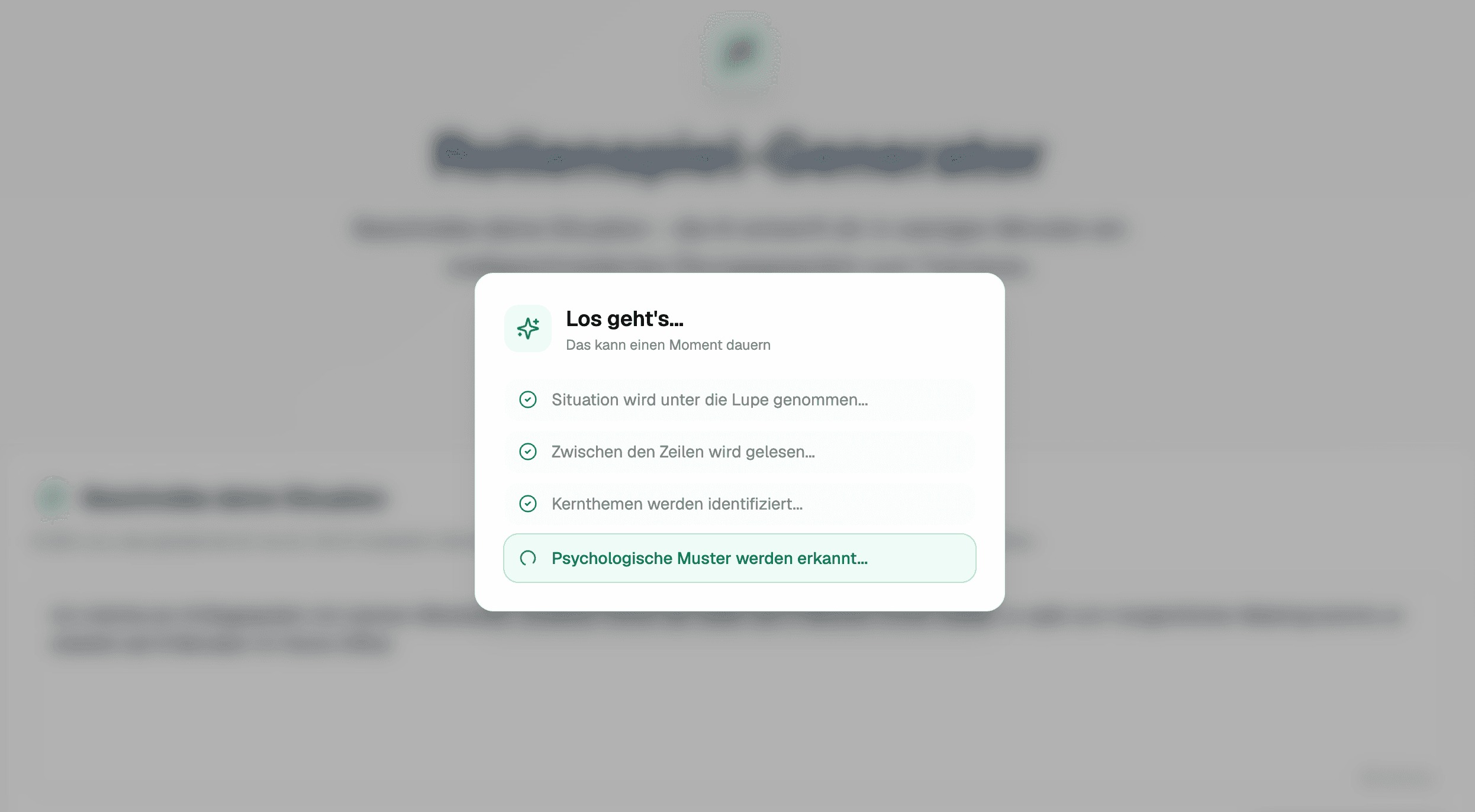
Role-Play Generator in Careertrainer.ai
2

Practice leadership conversations realistically with Voice AI

Run a 5 to 15-minute live audio conversation with a realistic AI character who responds like a real direct report: defensive, frustrated, overwhelmed, or open. This way, even under shift pressure, during high turnover, or throughout a change, you don’t just practice wording—you train clean conversation management, clear expectations, and de-escalation behavior.

Voice AI conversation simulation in Careertrainer.ai
3

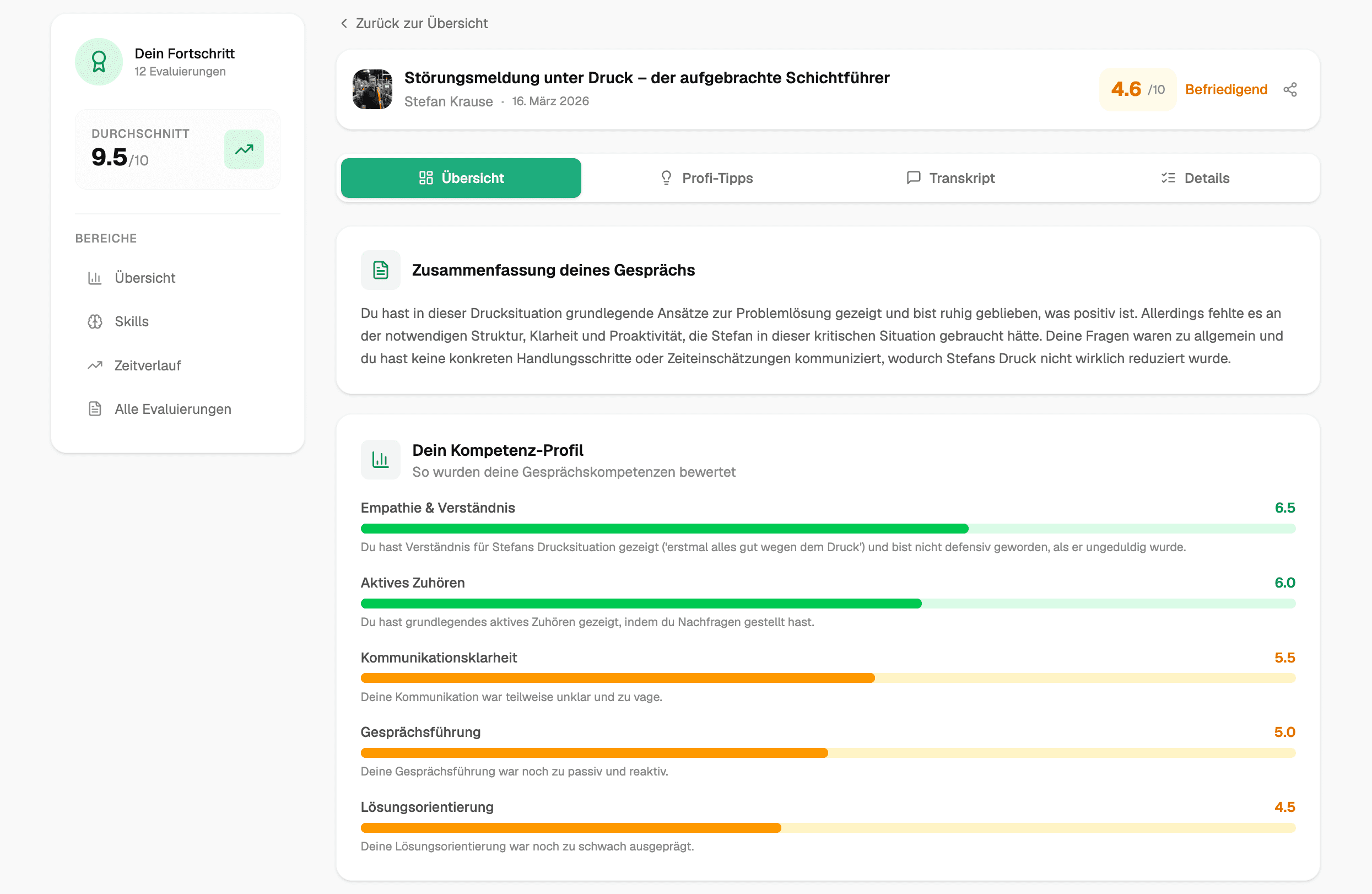
Analyze feedback and make progress measurable

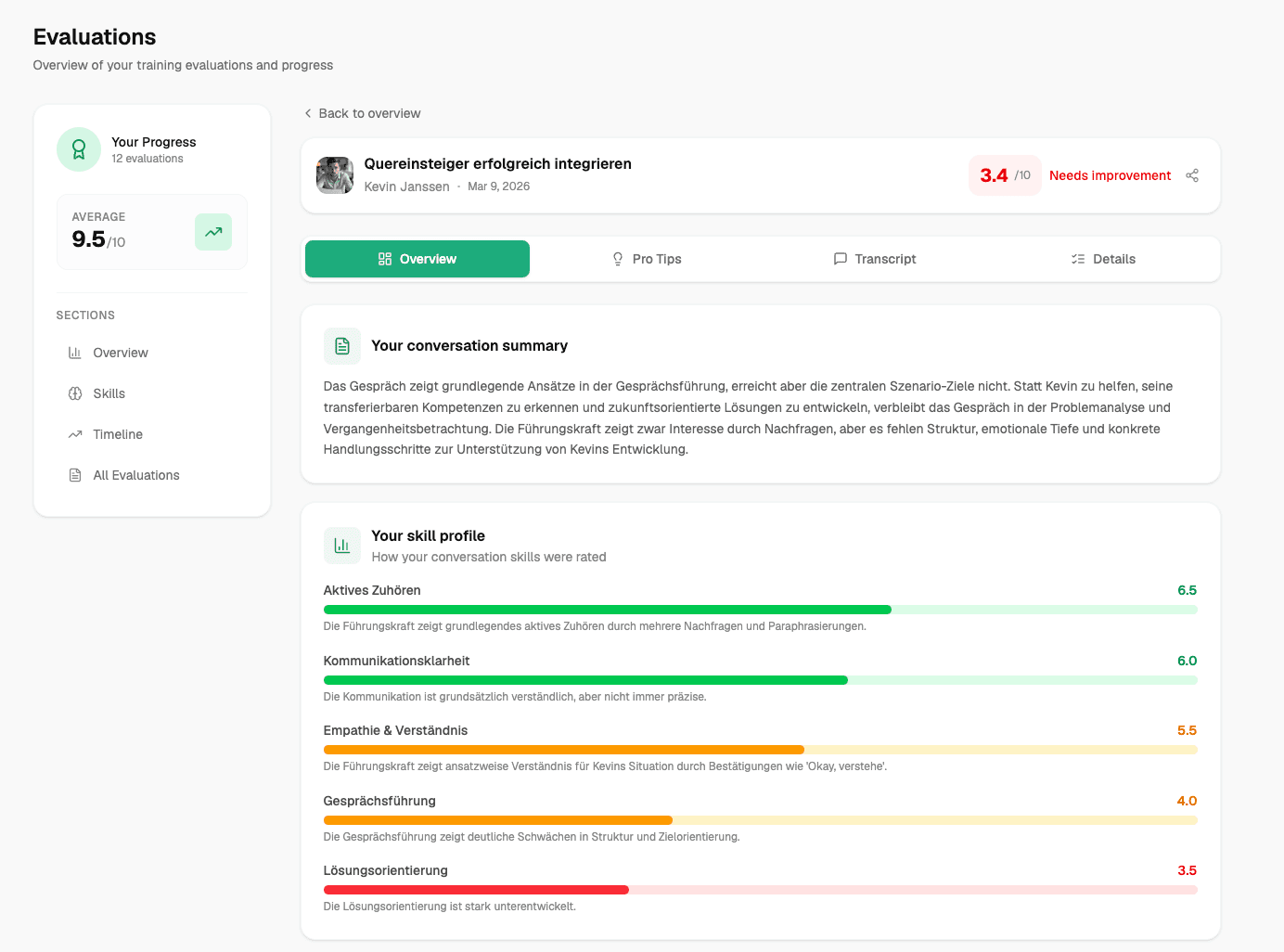
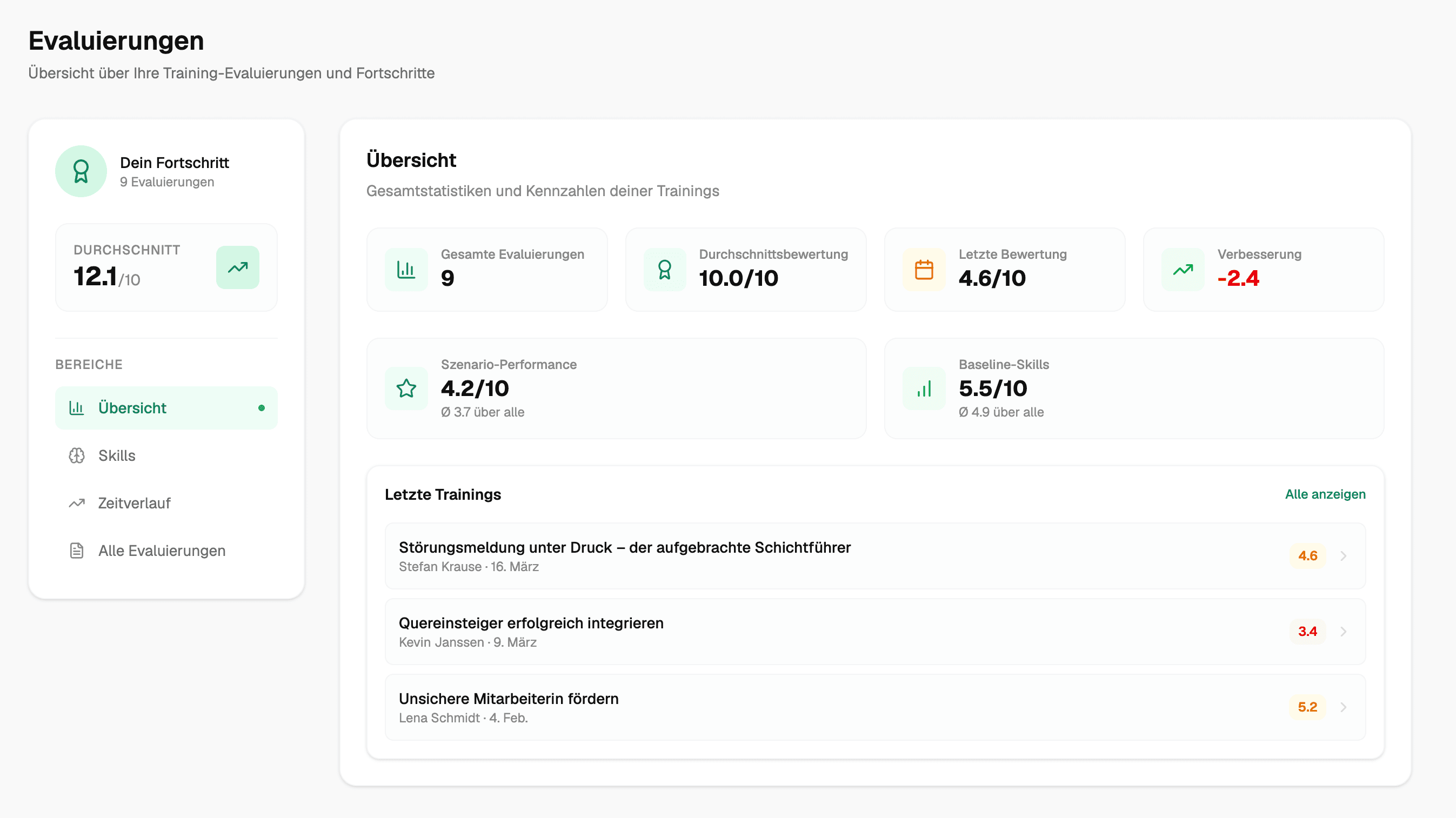
After every conversation training session, you’ll get a concrete evaluation of the key leadership moments: conversation structure, clarity, empathy, consistency, and how you handle resistance. You’ll see where you gain confidence in employee conversations, which patterns are still holding back your leadership development, and how your results improve over multiple conversation trainings.

Evaluation Dashboard in Careertrainer.ai

Typical leadership conversations in logistics and transportation

In warehouses, on the route, and in dispatch, conversations often go off track under time pressure, staffing shortages, and changing shifts. With Careertrainer.ai, you can turn these exact leadership situations into live audio conversation training with AI role-play—so you can lead sensitive employee discussions more confidently before it matters.

Conflict Resolution

After the chaotic handover: “The late shift always leaves everything for us.”

Two shifts blame each other, and shift lead Jens immediately turns defensive during the employee conversation. If you judge too early or only apply pressure, the conflict hardens—and it carries right into the next handover, harming collaboration from the start. What helps is separating observations from accusations, holding people accountable, and agreeing on clear next-step actions for the next shift. With the AI role-play at Careertrainer.ai, you can practice exactly this escalation dynamic and sharpen your approach with immediate feedback.

Practice the conversation with Jens
Performance Review Meeting

Declining picking rate despite experience within the warehouse team

Employee Aylin is technically strong—but for weeks she’s missed her targets and responds irritably to follow-up questions. With experienced team members, conversations can quickly derail when performance is addressed only with numbers and the underlying causes remain unclear. What works better is a clearly structured employee discussion that names performance, surfaces obstacles openly, and connects clear expectations with supportive next steps. You can train this conversation in the AI role-play repeatedly—until you can strike a reliable balance between pressure and fairness.

Practice the conversation with Aylin
Career development conversation

From the best dispatcher to a leader—but your team isn’t on board.

Team lead Marco was promoted for his strong technical performance—but he delegates rarely and, whenever something goes wrong, he slips back into day-to-day work. This quickly becomes critical: the team lacks clear direction, and Marco may interpret any feedback as doubt about his ability. In the conversation, it helps to reflect leadership behavior in a concrete way, redefine responsibility, and agree on the first delegation steps. With Careertrainer.ai, you can train these development discussions realistically—before uncertainty and frustration take root in your team.

Practice the conversation with Marco
Change Conversation

New route planning triggers pushback in day-to-day operations

With a new planning logic, the workflow changes—and driver Sven openly says it simply won’t work in practice. These kinds of conversations escalate quickly when concerns are dismissed as blockers or when the manager merely defends their decision. What works is explaining the change clearly, taking the real impact seriously, and working together to define the room for implementation. In AI role-play training, you practice receiving resistance in a leadership conversation—without losing sight of the direction of the change.

Practice the conversation with Sven
Motivational Interviewing

The work is done—no more stalling: “I’m currently looking externally.”

Dispatcher Katharina still delivers on time, but for months she’s been acting distant and, for the first time, she openly mentions a possible move during the conversation. If you respond now with appeals or quick promises, the underlying retention problem will remain unresolved. What works better is a calm leadership conversation that clearly explores the pressure factors, her development perspective, and the specific “stay” drivers. With Careertrainer.ai, you can practice this sensitive conversation training risk-free—repeat it until you’re able to respond to her intentions to switch in a clear, credible way.

Practice the conversation with Katharina
Why Careertrainer.ai

The functions that make leadership work in warehousing, dispatch, and operations trainable

When new team leads come from back-office roles, shift pressure is high, and employee check-ins don’t get a second chance, you need more than theory. Careertrainer.ai combines practical conversation training, realistic AI role-play scenarios, and measurable leadership development you can use day to day—especially in logistics and transportation.

01

For new shift and team leaders

Practice leadership conversations before they escalate—in the control room or on the shop floor.

Many leaders in logistics and transportation are highly skilled technically—but they’ve never been trained to run a clear feedback conversation, moderate conflicts, or deliver probation-period input. With Careertrainer.ai, you can practice exactly these situations through realistic live audio role-play with an employee or direct report—without risking team dynamics, shift operations, or retention.

  • Practice a realistic feedback conversation with a shift supervisor or dispatcher.
  • Train targeted conflict-handling skills after shift handovers or tour-related stress
  • For your first separation talks and sensitive return-to-work conversations
  • 15 minutes of training fits seamlessly between handovers, shift control, and day-to-day operations.
Learn more
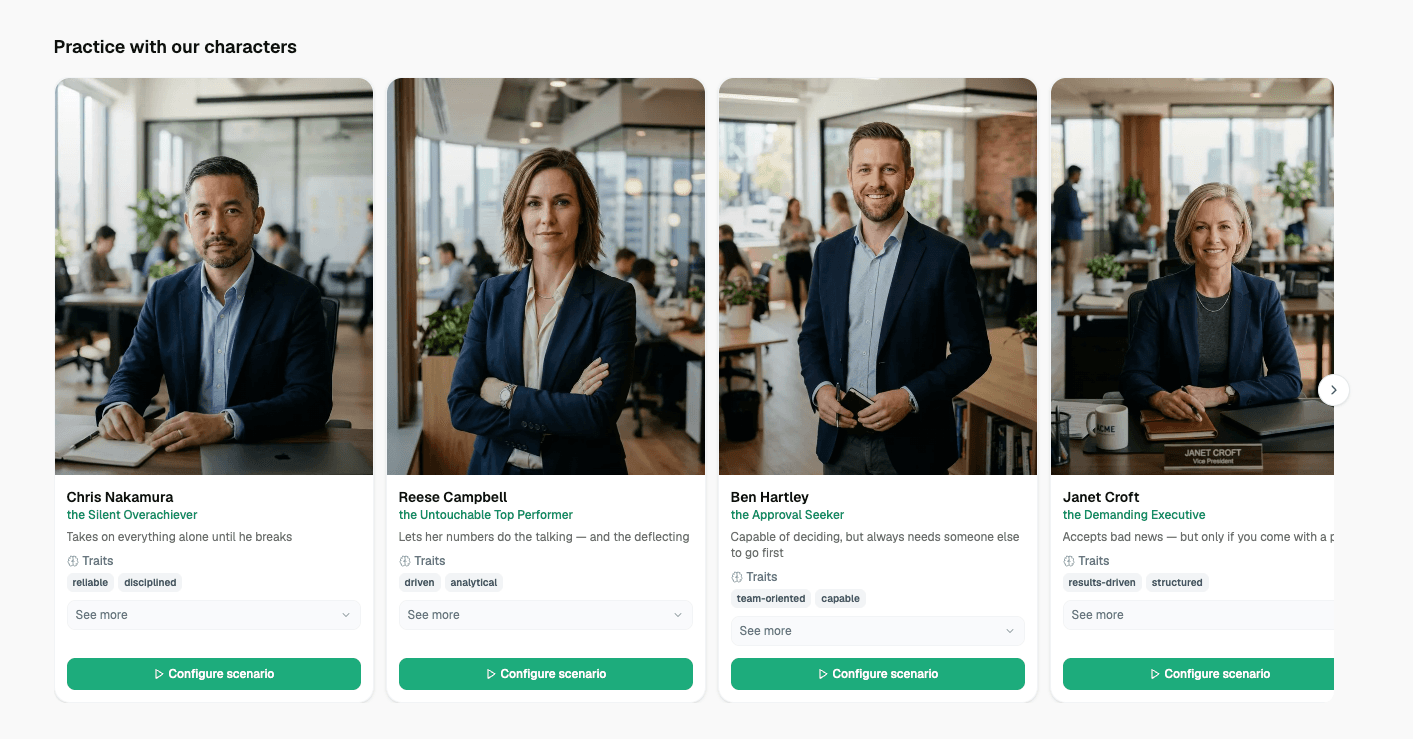
Character selection screen with AI training personas and scenario configuration buttons
02

Realistic conversations instead of standard scripts

AI characters that behave like real employees under shift pressure

Whether you’re an experienced shift supervisor, a frustrated forklift operator, an overburdened dispatcher, or a new team coordinator in probation: your conversation partners don’t follow a script. They respond with their own mindset—sometimes resistance, sometimes openness. That’s how you train leadership work closer to real life in warehousing, handling, and transport—rather than with generic seminar role-play scenarios.

  • Different employee types with clear response patterns
  • A noticeable shift in how you handle pressure, show appreciation, and follow up with questions
  • Helps with turnover, declining performance, and tensions within the team.
  • More practical than playing roles with colleagues by the book
Learn more
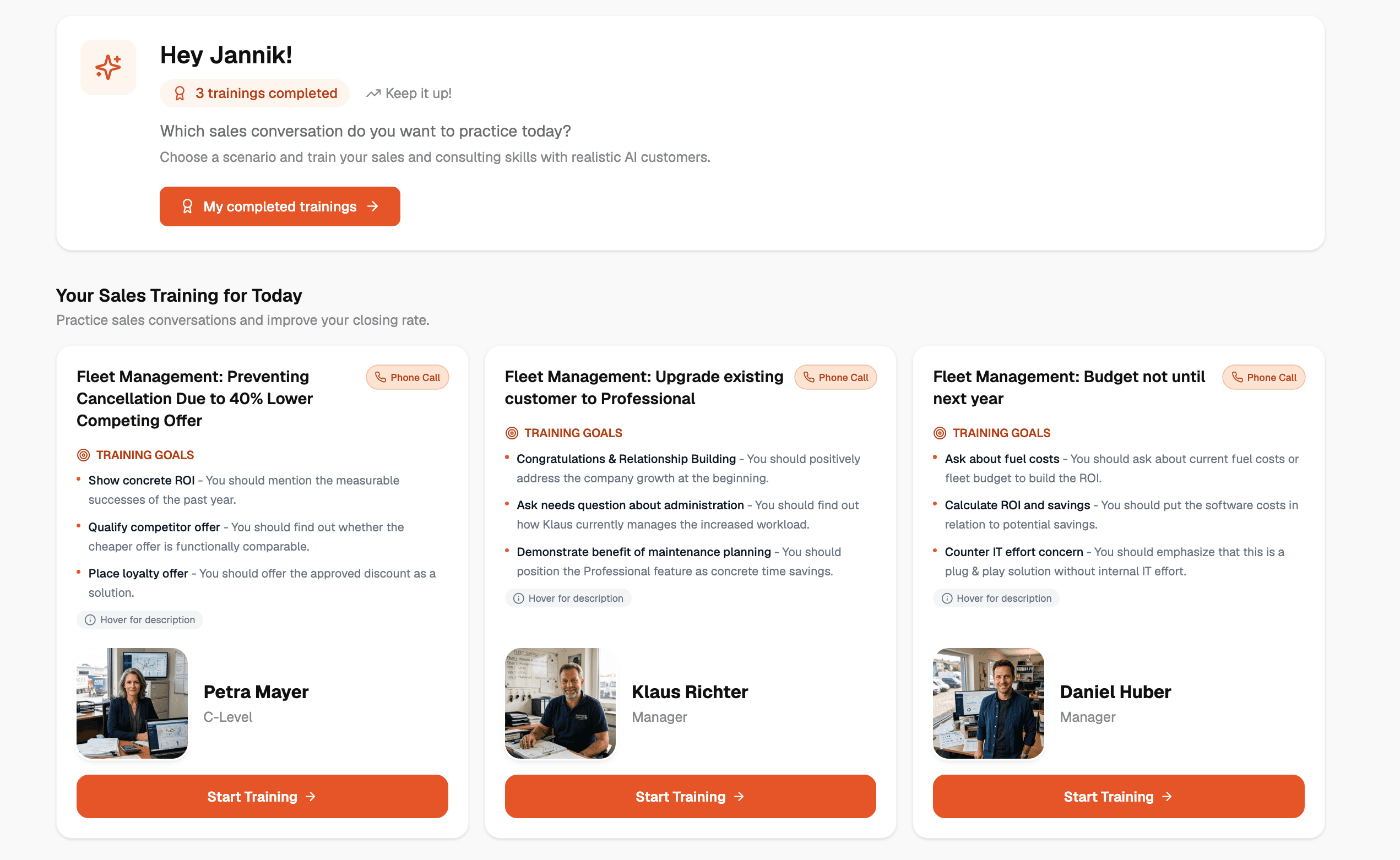
Vertriebstraining mit KI-gestützten Szenarien zur Verbesserung von Verkaufs- und Beratungskompetenzen.
03

Direct feedback after every round

Turn every employee conversation into measurable, actionable training

After every role-play, you get a structured evaluation of your communication—rather than vague seminar impressions. This is especially helpful for leaders who need to balance clarity, empathy, and consistency in 1:1s, feedback conversations, or escalations.

  • Scores for Conversation Leadership, Empathy, and Solution Orientation
  • Concrete text examples instead of generic criticism
  • Pro Tips for Performance Reviews and Resolving Conflict
  • Compare repetitions directly across multiple training sessions
Learn more
Evaluation summary and competency profile for leadership communication under pressure.
04

Measurable leadership development for your team

Identify skill gaps before they show up as turnover, sick leave, or ongoing escalations

When team leads lead in very different ways, it’s not just the quality of conversations that suffers—operational processes are often less stable too. With Careertrainer.ai, you can measure development areas clearly—for example in delegation, conflict facilitation, feedback, or change communication—and pinpoint exactly where individual leaders or locations need targeted support.

  • See skill gaps by role, team, or location
  • Ideal for onboarding new leaders transitioning from operational roles
  • Track your progress over 7 and 30 days
  • The foundation for coaching—not a one-size-fits-all approach—in leadership training
Learn more
Training evaluation dashboard displaying progress, ratings, and performance metrics for leadership development.
05

Relevant for HR, L&D, and sensitive people-management cases

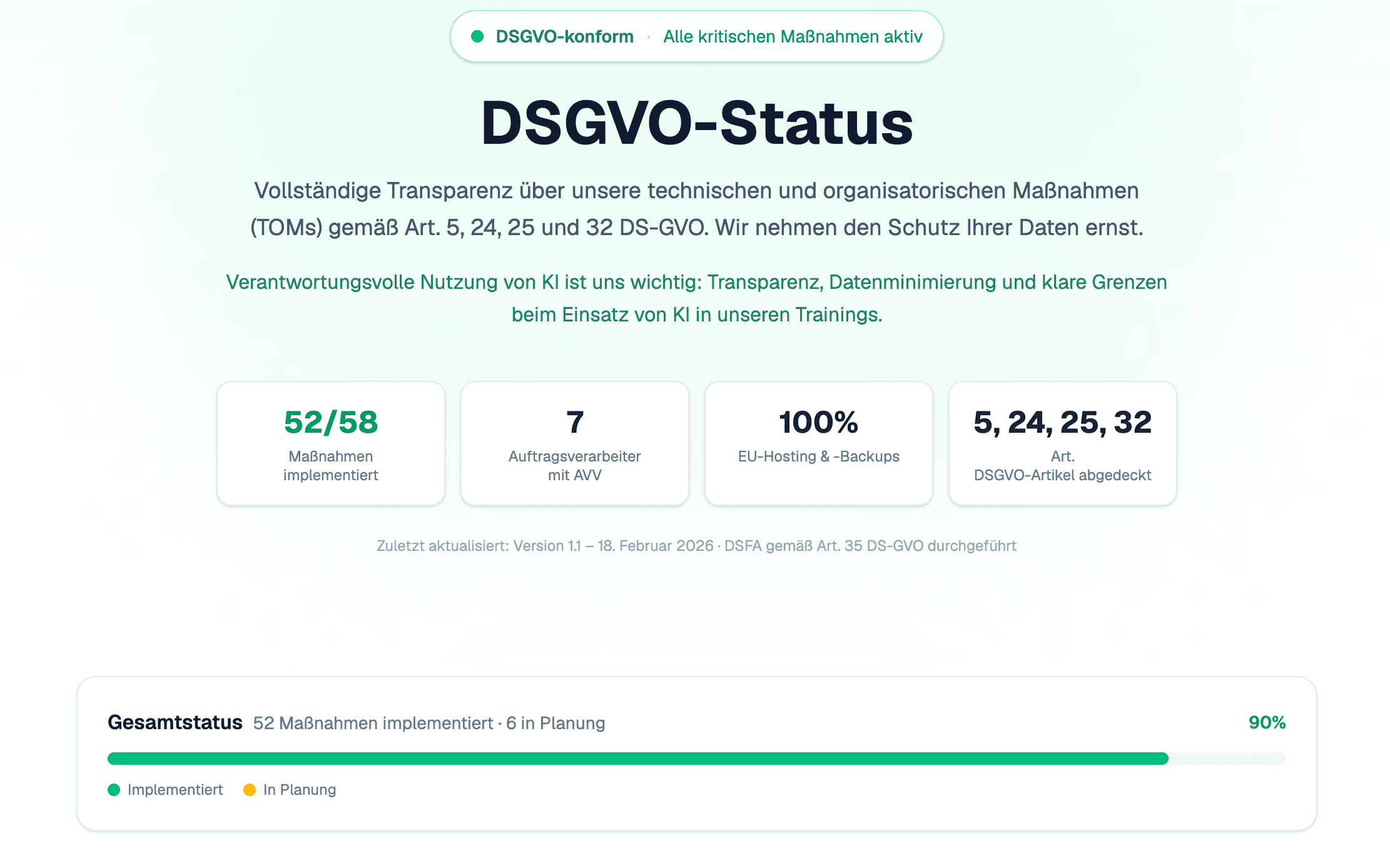
GDPR-compliant conversation training for sensitive leadership situations

Employee conversations often cover performance, absences, workload, conflicts, or separation—so they involve sensitive topics where data protection needs to be built in. Careertrainer.ai is designed for the DACH region, making it a better fit for companies that want clear boundaries when using AI-supported leadership development, without any gray areas.

  • EU hosting for confidential leadership training
  • Suitable for sensitive situations such as sick leave cases or separation conversations
  • Important for HR, people development, and co-determined environments
  • A clean fit for DACH companies with clear compliance requirements
Learn more
DSGVO compliance status overview for AI training, highlighting implemented measures and data protection commitment.
Roles & Responsibilities

These leadership roles in logistics and transportation benefit particularly from Careertrainer.ai.

If you want to lead staff conversations with more confidence under shift pressure, during turnover, and through change, Careertrainer.ai lets you train exactly those situations as AI role-plays. That way, leadership development in everyday operations becomes measurable—not a matter of gut feeling.

Warehouse Shift Supervisor

You lead warehouse teams through peak times, sick leave, and tight handovers. With Careertrainer.ai, you train staff conversations as AI role-play—e.g., around error rates, lateness, or tensions between the early and late shift. This is especially helpful for new managers to steer more clearly and catch escalations earlier.

Address shift-related conflicts and performance issues clearly and constructively

  • Resolve handover errors without entering a blame spiral.
  • Address absences in your 1:1s
  • Performance review for picking errors
  • De-escalate tensions between teams and shifts
Popular

Team Lead – Scheduling & Dispatch

In dispatch, conversations quickly derail when routes are changed, drivers are missing, or complaints from day-to-day operations spill into the process. With Careertrainer.ai, you can train these leadership situations as realistic conversation simulations—so you handle priorities, follow-through, and feedback more confidently even under time pressure. The result: less friction and fewer misalignment errors.

Lead clearly under time pressure—and follow up effectively.

  • Explain the tour planning calmly
  • Handle conflicts with dispatchers
  • Secure reliability during handovers
  • Discuss internal complaint pressure

Branch Manager, Shipping & Receiving

You’re responsible for output, safety, and staffing at a shift location—and you need to combine performance with leadership. With the AI role-play scenarios on Careertrainer.ai, you rehearse sensitive leadership conversations with employees or shift leads before key metrics, occupational health and safety, or team morale start to tip. This gives you greater confidence in real conversations, even under heavy operational pressure.

Connect KPI, security, and leadership pressure

  • Discuss scanquote deviations
  • Address workplace safety violations
  • Coaching foremen on leadership behavior
  • Track team performance at its peak

Fleet and Operations Manager

Driver shortages, tour pressure, and changing requirements make the employee meeting in transport operations especially sensitive. With Careertrainer.ai, you train with live audio role-play exercises on punctuality, customer feedback, rule violations, or resistance to new processes. That makes leadership development in transportation tangible—and helps your teams apply it consistently.

Practice sensitive driver conversations before it matters

  • Address delays constructively
  • Handle rule violations without escalation
  • Overcome resistance to new tours
  • Handle customer complaints internally

Emerging Leaders

Many people move into logistics and transport leadership straight from being top individual contributors. Careertrainer.ai bridges that gap with conversation training for feedback, setting boundaries, and performance in employee check-ins. You practice realistic AI role-play scenarios with defensive or experienced employees—and get immediate feedback on how your message lands and how to improve.

From specialist to confident leadership

  • Get feedback on your past conversations from former colleagues
  • Build authority without being harsh
  • Address low performers effectively
  • Evaluate conversation structure instantly

Head of Change & Processes

When new scanners, updated tour routing logic, or revised process standards are introduced, leadership conversations often determine whether people will adopt the change—or resist it. With Careertrainer.ai, you can turn change-relevant employee conversations into AI role-play training, so you can address concerns, rumors, and operational objections in a structured way. Progress can be measured across teams and time periods.

Tackle resistance to process changes—targeted and deliberate

  • Explain new processes clearly
  • Handle objections and keep the team conversation on track
  • Address rumors after the rollout
  • Compare progress across teams

Frequently Asked Questions about Employee Meetings in Logistics & Transport

Find practical answers to handle challenging leadership conversations in day-to-day operations—and learn how Careertrainer.ai supports your training for warehouse, dispatch, and drive operations.

What matters most in a strong employee conversation in logistics and transport?

A great employee conversation in logistics and transport is above all clear, respectful, and specific. In environments with shift pressure, tight timing, and high dependency between teams, unclear statements quickly have an impact: misunderstandings during handovers, frustration in the warehouse, or resistance to new processes.

What matters is that you separate behavior, impact, and expectations cleanly. Don’t speak in general terms like “not enough commitment”—instead, describe observable situations: delayed feedback, unclear shift handovers, errors in picking and packing, or conflicts with colleagues. Then make it unmistakable what needs to change, by when, and how you’ll measure progress.

Especially in day-to-day operations, tone also plays a key role. If you push under pressure, it’s easy to come across as too harsh or too vague. A strong leadership conversation therefore combines accountability with fairness. That way, you improve the chances that your counterpart takes ownership—rather than retreating into excuses or withdrawal.

How do you lead a performance review with a shift supervisor or team lead—without it escalating right away?

Start your performance conversation with facts instead of accusations. First, describe what you’ve observed—for example, repeated quality issues, unclear shift priorities, or a lack of feedback during bottlenecks. This removes emotion from the opening and gives the conversation a factual foundation.

Then, ask for the other person’s perspective. In logistics and transportation, problems are often not only due to an individual, but also to overload, unclear responsibilities, or conflicting instructions across different shifts. If you identify this early, you can separate cause from responsibility more effectively.

Finally, make it binding: What behavior change do you expect? What support will you provide? When will you review progress together? This combination of clarity, active listening, and follow-through ensures the performance conversation doesn’t turn into a power struggle.

Why are employee conversations in warehousing, dispatch, and transport operations often more difficult than in other areas?

Because in logistics and transport, multiple pressure factors hit at the same time: time pressure, rotating shifts, staff shortages, high operational dependencies—and often leaders who are strong in their craft, but are still growing into the role. As a result, it’s often hard to find the calm needed to lead conversations properly.

And there’s more: many conflicts don’t emerge in formal meetings—they surface right in the day-to-day operations. A messy handover, a driver raising concerns about route planning, or a seasoned employee who rejects new standards immediately creates tension within the team. If these issues are brought up too late or with unclear messaging, they tend to harden quickly.

That’s why leaders here don’t need theory alone, but conversation confidence for real scenarios. If you stay clear under pressure, communicate expectations precisely, and maintain the relationship at the same time, you help prevent turnover, friction, and unnecessary escalations in everyday work.

What mistakes do new managers in logistics and transportation make most often in employee conversations?

A common mistake new managers make is staying too long in the mode of the “best individual contributor.” They solve problems themselves instead of clarifying responsibilities within the team. In conversations, this often shows up as micromanagement, unclear delegation, or addressing performance issues too late.

Just as common is the opposite extreme: being too soft, overly cautious, or indirect. Especially if you used to be part of the team, you may avoid clear wording out of fear of creating tension. After the employee meeting, the atmosphere may seem calm on the surface—but behavior doesn’t change.

Another problem is blanket statements like “You need to be more communicative” or “That didn’t go well.” Without specific observations, the impact, and the expected outcome, your counterpart can hardly respond in a meaningful way. Good leadership here means: be specific, clarify responsibilities—and still remain respectful.

How do you prepare a conflict conversation after a poor shift handover or team friction—so you can handle it constructively?

First, prepare the specific reason for the conversation: What happened, who was affected, and what impact did it have on safety, quality, speed, or collaboration? This way, you don’t walk into the discussion on gut feeling—you bring a solid basis.

Then define your goal. Do you want to clarify the behavior, have responsibility taken, stabilize collaboration, or set a binding rule for future handovers? Without a clear objective, conflict discussions quickly drift into arguments about the past.

It also helps to mentally prepare for sensitive reactions: justification, counterattack, staying silent, or pointing to other shifts/layers. If you have formulations ready for those moments, you’ll stay calmer. Good preparation, therefore, doesn’t mean memorizing a script—it means clearly working out the reason, your goal, potential objections, and the next steps in advance.

How exactly does Careertrainer.ai support your leadership development in logistics and transportation?

Careertrainer.ai is a DACH-focused AI platform for practical conversation training via live audio role-play. For leadership development in logistics and transport, that means you practice exactly the employee conversations that are hardest in everyday life—such as performance talks with shift managers, conflict resolution after handover mistakes, conversations during high staff turnover, or pushback against new processes.

Instead of theory or standard e-learning, you run a realistic 5- to 15-minute conversation with an AI counterpart that responds like a real employee: defensive, annoyed, unsure, or cooperative. After the conversation, you get instant feedback on your communication techniques, clarity, empathy, goal orientation, and the typical mistakes.

This is especially valuable when leaders are new in the role or have few safe practice spaces. You train without risk, repeat challenging situations as often as you want, and build conversation confidence for real-world use in warehouses, dispatch, and on-board operations.

What makes Careertrainer.ai different from seminars or traditional leadership training for logistics and transportation?

The biggest difference is this: you practice real conversations instead of only learning about them. Seminars and workshops can teach models, playbooks, and good principles. That’s helpful—but in day-to-day operations in logistics and transport, leadership often fails not because of a lack of knowledge, but because the ability to execute under pressure is missing.

With Careertrainer.ai, you train Live Audio conversations with realistic AI characters. You’ll hear objections, uncertainty, resistance, or emotional reactions directly—and you have to respond and lead in real time. That’s exactly how you close the gap between knowing and doing. After each role-play, you get an immediate, structured evaluation instead of a vague gut feeling.

For companies, there’s more: the training is scalable, quick to roll out, and measurable. New shift leaders, team leads, or dispatchers can practice the same critical conversation scenarios within a short time—without trainer bottlenecks, travel costs, or long lead times.

Who is Careertrainer.ai particularly suited for in logistics and transportation?

Careertrainer.ai is especially well-suited for leaders who manage operational teams under time pressure and want to handle challenging employee conversations with greater confidence. This includes shift managers in warehouses, team leaders in goods handling and picking/assembly, managers in dispatch/coordination, site managers, as well as new supervisors who are transitioning from subject-matter expertise into a leadership role.

This is particularly relevant in logistics and transportation—when performance discussions, conflicts between shifts, return-to-work conversations, changes to processes, or high-turnover situations must be handled professionally. Even experienced leaders benefit when they want to rehearse sensitive scenarios in advance instead of improvising in the real moment.

For HR, people development, and operational leadership, the platform is a strong fit when you want conversation training to be consistent, repeatable, and measurable. That way, not only individual talent improves—entire leadership groups develop at a comparable level.

How fast can you start leadership conversation training for warehouse and transport teams with Careertrainer.ai?

Getting started is usually quick, because Careertrainer.ai is an audio-first platform designed for hands-on, real-life conversations—and it doesn’t require complex training logistics. You don’t need a seminar plan with long lead times, no travel arrangements, and no dependence on external trainers for every individual manager.

Individual users can begin right away with existing scenarios. Teams and companies can select—or tailor—conversations for typical situations in logistics and transportation, for example conflicts in shift leadership, performance issues, return-to-work conversations, or change communication. After every training session, you get feedback immediately, so managers can move straight into the next exercise.

If you want to build conversation skills fast, that’s exactly the advantage: short training cycles, realistic practice, and a format that fits into your workday in just 5 to 15 minutes.

How do you measure progress with Careertrainer.ai for leadership conversations?

Progress isn’t visible through impressions—it becomes clear through concrete evaluations after every conversation. Careertrainer.ai assesses relevant communication skills, such as structure, clarity, active listening, de-escalation, goal orientation, and how you handle difficult reactions.

This is especially useful for leadership in logistics and transportation, because you can see whether a leader improves in critical situations—for example when employees resist new shift rules, during conflict discussions after mistakes, or in performance conversations with experienced team members. In addition, you can identify common anti-patterns, such as making accusations too quickly, unclear expectations, or avoiding consequences.

For teams and companies, this creates a clearer picture of skill gaps and development progressions. That makes leadership development more predictable—and no longer dependent only on how confident someone appears in the moment.

Can you use Careertrainer.ai for leadership development in logistics and transportation under your own brand, as a training provider?

Yes, Careertrainer.ai can also be used as a White-Label or Partner model if you want to build or expand your own training offerings for leadership development in logistics and transport. This is especially relevant for training providers, consultancies, HR platforms, or enablement partners that want to offer conversation training for shift supervisors, team leads, or frontline leaders under their own brand.

This is particularly useful in logistics and transport, because many customers want to train very specific conversation scenarios: performance discussions under shift pressure, conflicts during handovers, resistance to new processes, or conversations in high-turnover environments. Instead of developing an AI infrastructure yourself, you use the platform as an enabler—while keeping your own branding, your own pricing logic, and your existing customer relationships in the market.

In this context, Careertrainer.ai does not position itself as a direct competitor to training providers, but as a technical and content enabler. For partners, this is especially attractive if you want to integrate scalable AI role-play training into your existing offering—or develop it into your own product.

Other Industries for Leadership Training

Discover industry-specific leadership development and leadership training for other industries.

Leadership Training in the IT Industry

Leadership Training in the IT Industry

Executives in IT companies train with AI role-playing to handle challenging employee conversations, remote leadership, conflict resolution within development teams, and communication between technology and business.

Learn more
L
Leadership Training in Retail

Leadership Training in Retail

Branch managers, team leaders, and retail executives train with AI role-playing to handle challenging employee conversations, shift management, performance reviews, and conflict resolution within the sales team.

Learn more
AI Role-Playing Games for Educational Institutions

AI Role-Playing Games for Educational Institutions

Leaders in educational institutions, training providers, and social organizations train difficult employee conversations, educational leadership, and team development using AI role-playing.

Learn more
Leadership Training in Machinery and Plant Engineering

Leadership Training in Machinery and Plant Engineering

Executives in machinery and plant engineering train with AI role-playing to navigate challenging employee conversations, project management, communication between technical and sales teams, and temporary leadership in customer projects.

Learn more
Leadership Training in Healthcare

Leadership Training in Healthcare

Healthcare executives train with AI role-playing to handle difficult employee conversations, shift management, conflict resolution within nursing teams, and leadership under high emotional stress.

Learn more
Leadership training in manufacturing

Leadership training in manufacturing

Masters, shift leaders, and executives in industrial companies train with AI role-playing to handle challenging employee conversations, shift management, performance reviews, and conflict resolution in production.

Learn more
Use Cases

What do others use Careertrainer.ai for?

Concrete use cases for leaders, HR, and people development — from the first 100 days to measurable skill tracking

From peer to manager — without learning on the job

Newly promoted team leads often run their first employee conversations with zero training. With Careertrainer they practice the typical first conversations — expectation alignment, feedback, onboarding talks — before they happen for real.

  • Learning path "First 100 days as a manager"
  • Structured onboarding across 6–8 weeks
  • Skill tracking shows progress to HR and leadership
Thomas Weber
Frank Zimmermann
Karl-Friedrich Moser
Andreas Kaufmann
Daniel Foster

Resetting expectations with a high-performing but disruptive developer

A strong individual contributor delivers results but damages team trust through blunt behavior and missed collaboration norms.

FührungMitarbeitergesprächFeedback

Learning-path progress

Kick-off
Expectations
Feedback
Conflict
Discover the onboarding solution