

careertrainer.ai

You’re doing the work of C-level management, Procurement, and HR all at once—your training tool has to fit that reality.

Careertrainer.ai for SME CEOs

You have 20 to 80 employees, no HR department, and no desire to kick off the next IT project. But you know the pattern: your shift lead goes into conflict talks as if it’s the first time every single time. Your field sales team caves in during price negotiations. Your top salesperson doesn’t feel confident actively offering your premium range. You’ve already booked a classic training for €4,500—after three weeks, most of it was gone. Careertrainer.ai works differently: no training days, no consultants, no approval hurdles. You set it up in an afternoon, your team practices in the evenings on their phones, and after four weeks you can see in the dashboard what has changed.

Live example · This is what training looks like

Live audio

Your own scenario

Reese Campbell

Reese Campbell

Leadership

Senior · 37 · ENTJ

Coaching: The High Performer Who Thinks Feedback Doesn't Apply to Them

Your top performer's behavior just triggered an HR escalation. Can you make her see that numbers aren't everything?

Goal: Deliver direct feedback about the HR complaints and secure her commitment to change her communication style.

Live audio · 5–15 min · GDPR-compliant

Talk with Reese Campbell as soon as you start

Why Careertrainer.ai is different for SME managing directors

Built for companies where the Managing Director makes the decision directly—no HR, no steering committee, no competing offers.

over 70%
Companies with fewer than 50 employees don’t have an HR role.
Leadership development is a leadership matter—literally. If the CEO (managing director) doesn’t do it, it simply doesn’t happen.
One afternoon
Setup time — not weeks or months
Register, create your own products or topics, and invite your team. One afternoon—done.
approx. 75%
Your sessions take place on mobile and outside of working hours.
Your employees practice on the couch in the evening—or right before the important meeting—not in the office in front of their colleagues.
None
Minimum term — cancelable monthly
You can test it risk-free. If it doesn’t work, you stop. If it does work, you keep going.

What really keeps you, as a managing director in the mid-sized business sector, up at night

Seven topics that come up sooner or later in every managing director conversation in mid-sized companies:

1

You can’t coach every employee in person.

You already know exactly who in your sales team performs strongly—and who doesn’t. You can see which shift leader avoids conflict and which one resolves it. But you don’t have 40 hours a month to coach on the side. Ride-alongs in the field, reflection interviews, feedback loops—they’re all there, but they still fall short, because you’re expected to lead, sell, and keep an eye on the books at the same time.

2

Training costs without any noticeable impact

You’ve tried it before: €4,500 for a two-day training, external consultants, polished slides, and motivated employees on day three. Three weeks later, there’s barely any trace of it. You can’t say what really worked. When the next offer comes in, you think twice. And the one after that—you decline.

3

Juniors take far too long to become productive.

You’re hiring a junior in field sales, a new consultant, or a career switcher in sales. Before they can independently book appointments or lead client advisory conversations, it takes six to twelve months—most of the time working alongside a senior. That ties up two people for one task and costs you measurable revenue. You know it should be faster—but how?

4

Difficult conversations come up every few weeks—usually on the spot.

An employee returns after a long illness. Two people on your team have fallen out. A field sales representative has performed significantly worse this quarter. A long-term customer is asking for a discount. These situations aren’t planned—but they come up all the time. And in most cases, one conversation decides whether you retain them or lose them. No one on your side has learned how to handle these scenarios systematically.

5

You want to make decisions—not spin up a project.

You know the feeling: the moment something needs a dedicated person, a steering group, a kick-off meeting, or a rollout concept—it's basically dead in the water. You need a tool you can actually understand, buy, set up, and hand to your team. That’s it. Everything else wastes time you should be investing in customers and in steering day-to-day business.

6

Smooth succession without structured handover

In a few years, your senior account executive hands things over, your sister retires, and your son takes over a region. The specialist knowledge can be passed on—but the skill to handle difficult customer conversations, lead employees, and navigate sensitive situations has been built over years, almost intuitively. Nobody ever wrote it down. And when the senior person is gone, that expertise goes with them.

7

Employees should get better—without being monitored.

You want development—not control. If your people feel like you’re monitoring every conversation they’ve practiced, trust will disappear. But if you see absolutely nothing, you won’t know whether it’s actually working. You’re looking for a fine balance: clear oversight without it feeling like surveillance.

AI character for industry-focused solutions

AI role-play focus

What really keeps you, as a managing director in the mid-sized business sector, up at night

Train with realistic characters

You can’t coach every employee in person.Training costs without any noticeable impactJuniors take far too long to become productive.
What exactly is it for?

Four typical use cases for managing directors at SMEs

It’s rare for a CEO to cover every area all at once. Most start with a pressing pain point—and expand as soon as they see that it works.

Professionalize your sales without hiring a sales director

You have 3 to 15 sales reps. Maybe a sales manager too—or maybe you’re doing it yourself. You know the pattern: your senior reps perform, your junior reps take forever, and nobody practices in a systematic way. With Careertrainer.ai, you put your real products and typical customer objections into realistic AI role-play training in just half an hour. Your team practices needs analysis, objection handling, and closing using industry-specific scenarios—not generic examples. You can use it yourself before important meetings to prepare properly.

Konkrete Übungen & Vorteile mit KI

  • Set up your own products in 30 minutes
  • Get junior hires ready for the job in weeks—not months
  • Train objection handling and price defense
  • In your dashboard, you can see exactly where the real gaps are.

Make shift managers, team leads, and foremen more confident and effective

You’ve got shift supervisors, team leads, workshop managers—people who are technically excellent but who were never trained in how to lead. Conflicts between two employees, return-to-work check-ins after longer illness, feedback for a senior employee who’s been with the company for 15 years—these are the moments that determine whether employees stay or leave. With Careertrainer.ai, you give your leaders a private space to practice exactly these conversations—without having to risk embarrassment in front of colleagues or having to justify themselves to you.

Konkrete Übungen & Vorteile mit KI

  • Absentee return, conflict, criticism—everything you can practice in advance
  • Shift supervisors became shift supervisors because they’re strong in their craft.
  • Private practice room — no role-play in front of colleagues
  • Your first leadership experience—systematically supported with AI role-play training, immediate feedback, and measurable skill development.

Structure consulting calls and customer service interactions

You run a specialist retail business, a workshop, a practice, or a consulting company—your employees have daily contact with customers. Handling complaints, navigating tough consultation situations, and upselling at the counter: this happens hundreds of times every week, and quality determines recommendations, repeat customers, and margins. With Careertrainer.ai, your team practices exactly these scenarios using your language, your products, and your typical customers.

Konkrete Übungen & Vorteile mit KI

  • Complaints, Advice, Cross-Selling, De-escalation
  • Consistently qualify customer-facing employees across the board
  • Industry-relevant scenarios grounded in your real world—no fluff
  • Mobile use fits shift and branch-day routines.

Structure the handover to the next generation

Soon, you’ll hand over responsibilities to your son, daughter, or a long-time employee. The technical side is usually manageable—but the conversation skills you built over decades, often intuitively, can’t be captured in a handover protocol. With Careertrainer.ai, you turn the typical difficult conversations from your day-to-day work into realistic scenarios. Your successor trains with them over the course of months. Together, you review and reflect on progress every week. The handover becomes measurable—so you’re not relying on gut feeling that everything will work out.

Konkrete Übungen & Vorteile mit KI

  • Make a senior’s experience trainable
  • Your successor can practice at their own pace
  • A weekly 30-minute check-in instead of daily oversight
  • Your handover is documented—not left to chance.

How a SME Managing Director can be introduced to Careertrainer.ai realistically

Four steps. None of them require external consulting, training days, or a steering committee.

1

Try it yourself—no demo appointment needed

You land on the pricing page, see the price per user and per month, sign up for a free account, and jump into your first conversation with the AI—ideally in a scenario from your industry. After 10 minutes, you’ll know whether it helps your people move forward. No sales pitch, no PowerPoint, no need for ROI slide decks. You try it. You decide.

2

Set up in an afternoon

You book the team plan based on the number of employees you want to train. Either you create your own products (for sales training, four fields are enough—the AI builds the rest) or you choose from the available leadership conversation scenarios. Then you invite your employees via a link. That’s it. No IT admins. No training for trainers.

3

Clear expectations instead of a rollout plan

In your next morning meeting, you’ll say: “By Friday, everyone will complete two trainings on Topic X. Mobile access from home is available, and each one takes 15 minutes.” That’s all it takes. If someone else in your company delivers when expectations are clear, they’ll do the same here. If they don’t, they’ll let you know anyway—and then it’s a different conversation.

4

See results after 3 to 4 weeks

In your dashboard, you can see who has been training and where the skill gaps are. You can target individual employees directly. And in day-to-day operations, you’ll notice your people becoming more confident in real conversations. If, after four weeks, you say, “This doesn’t work,” you can cancel monthly—no harm done. If you say, “This works,” you can expand to more topics and more employees.

Conversation features that fit your needs

Lead people better and sell more—without the HR bureaucracy and without a trainer budget

As a SME managing director, what matters is that training delivers results tomorrow: in real conversations about criticism, conflict, and pricing. With AI role-plays, instant feedback, and measurable skill gaps, you’ll see exactly where you need to improve—so you’re not relying on gut feeling.

01

Live AI role-play for real conversations—without wasting time or burning out your nerves

Practice difficult conversations risk-free—before you have to lead them.

Practice criticism, conflict, or price conversations with psychologically deep AI characters that respond to your behavior in real time. No multiple-choice: you lead the conversation by voice, just like in a real phone call. This helps reduce stage fright and prevents costly conversation mistakes you might otherwise make in everyday situations.

  • Practice giving criticism and feedback—before the shift supervisor avoids the conversation again.
  • Practice pricing and objection handling with realistic buyer types
  • 10–25 min per session — in the evening on your phone, not in a seminar room
  • After the conversation, right away: Professional scores + clear next steps
To Function
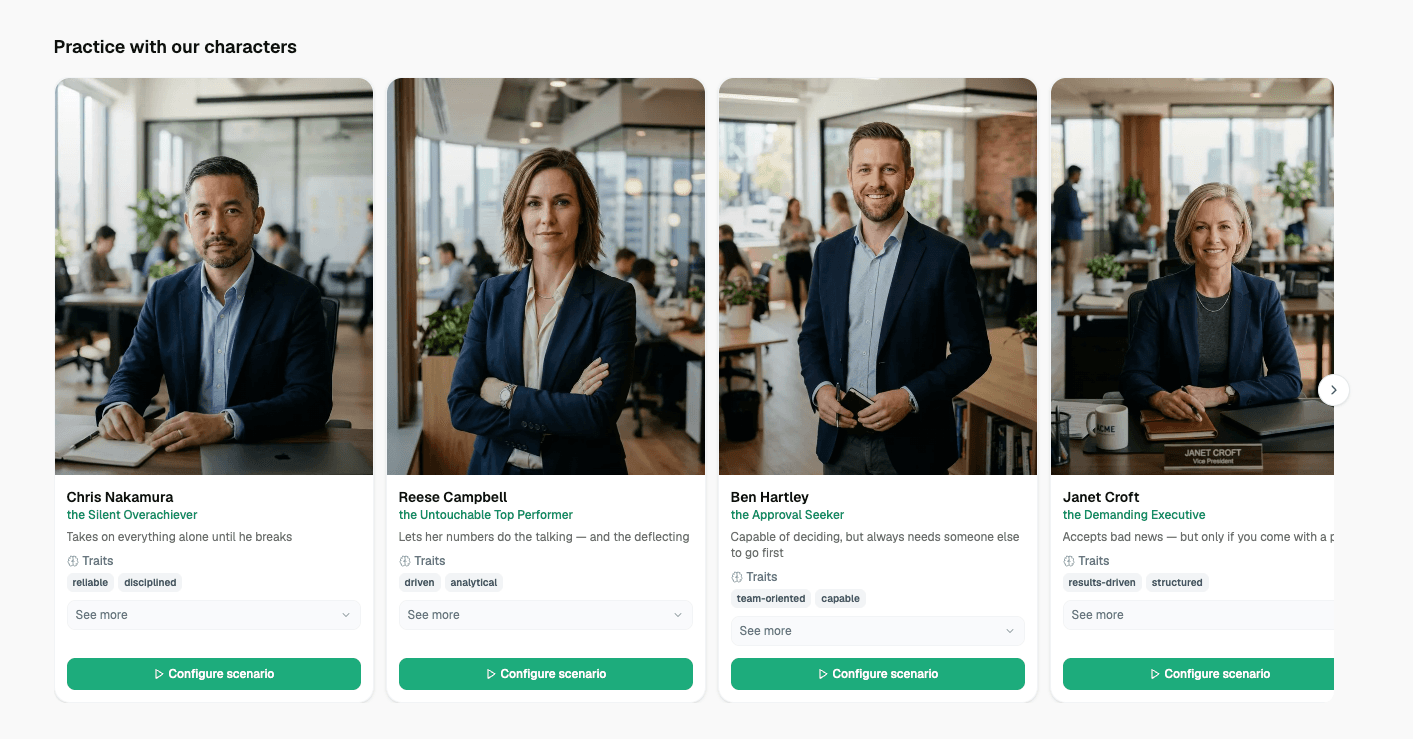
Character selection screen with AI training personas and scenario configuration buttons
02

Onboarding without wasting time — train before your first real conversation

Get new people up to speed faster: leadership, sales, or customer service

If you take over a team of 20–80 employees or fill a new role within a quarter, there’s often no time for intensive coaching. Careertrainer.ai’s AI role-plays begin with onboarding scenarios tailored to your situation—and after every session, you get actionable feedback you can apply immediately in practice.

  • Onboard sales reps before their first client call, discovery meetings, and negotiations
  • Get new team leads ready for feedback and conflict conversations
  • A risk-free practice space instead of mistakes in your real team
  • Make skill gaps visible after each session—so it’s not just “it feels good”
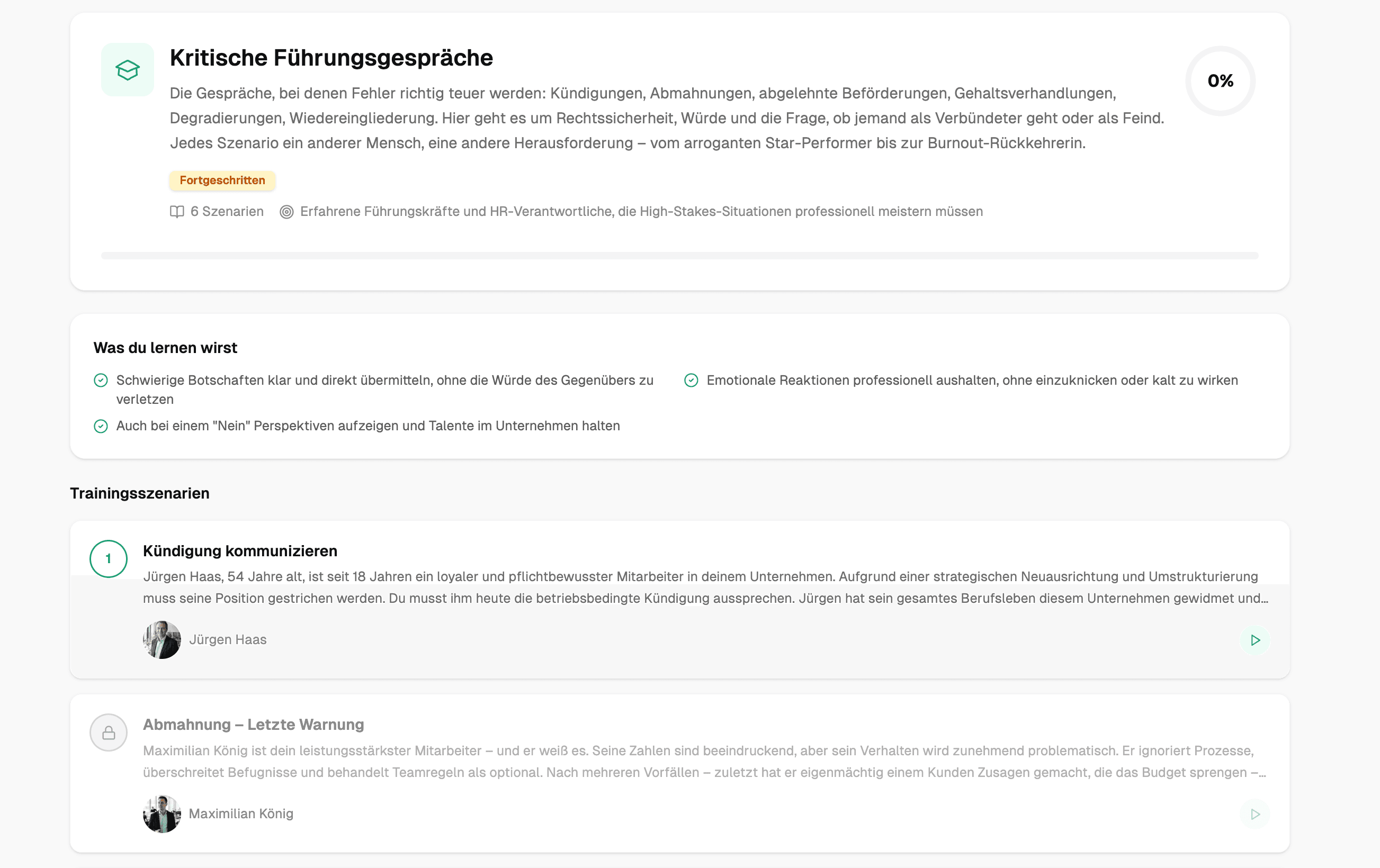
Kritische Führungsgespräche zur Kommunikation schwieriger Botschaften und professionellem Umgang mit Emotionen.
03

Measure and steer: training needs instead of gut feeling

Track competencies objectively—so you can roll out training with confidence.

You don’t just see who “joined in”—you see which conversation skills are missing, based on real training conversations. That gives you clear priorities for the next few weeks, so your team improves faster and you can justify decisions to yourself.

  • Skill gaps from real conversations—e.g., empathy, structure, and follow-up questions
  • Team dashboard for clear focus areas by department and location
  • Progress over time: spot improvement vs. stagnation
  • Training works because you fine-tune the right things.
About the feature
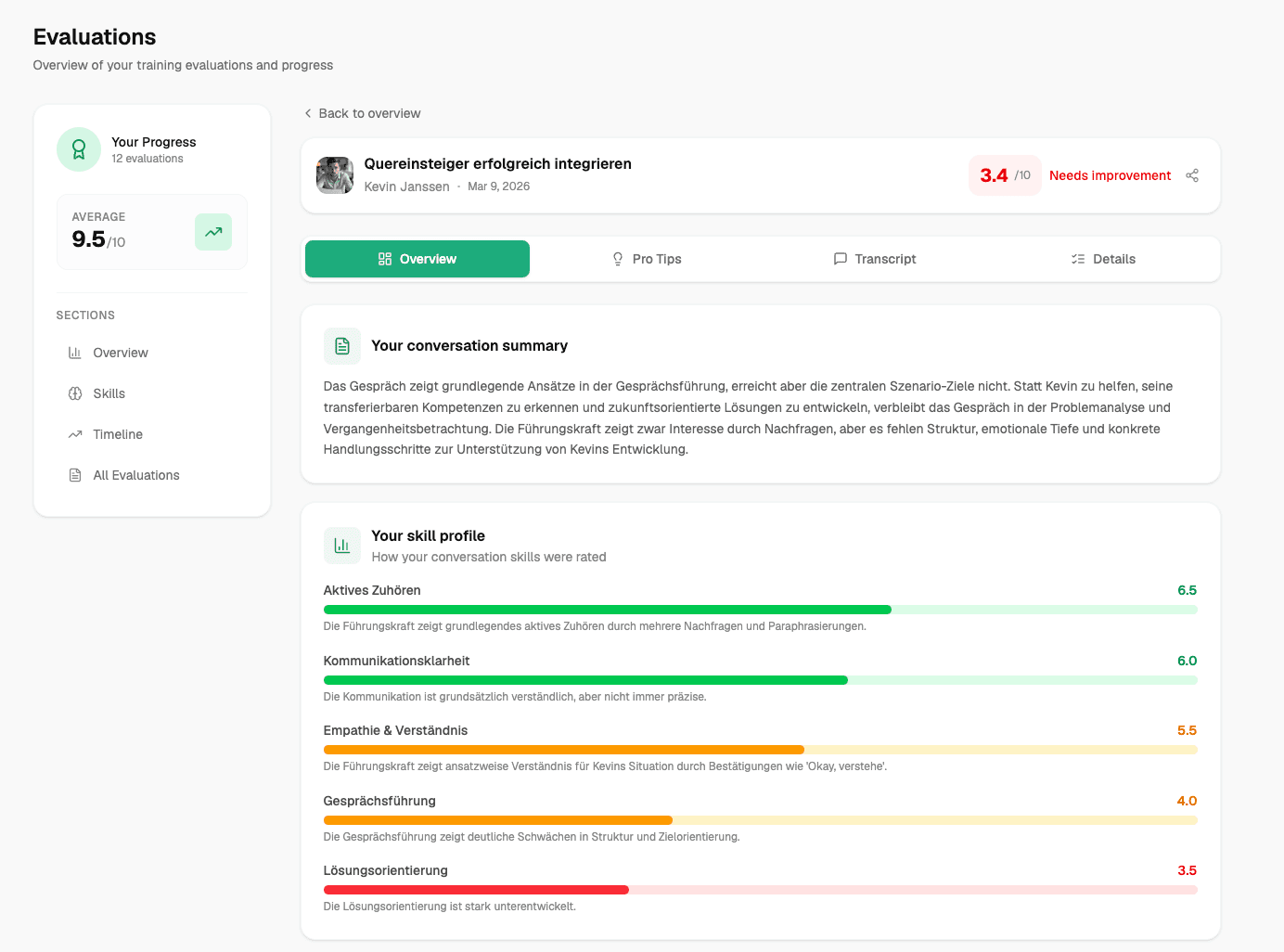
Evaluation summary and competency profile for leadership communication under pressure.
04

If you have a meeting tomorrow: test your wording and reactions.

Prepare for difficult conversations—in 15 minutes instead of sleepless nights

Tell the AI what’s coming up tomorrow—e.g., a feedback or criticism conversation, declining a salary offer, or a price negotiation. From that, you’ll get a realistic conversation partner who responds to your answers. That’s how you practice concrete communication skills—until you can go into the real conversation calmly, confidently, and with a clear plan.

  • Play through your termination or return conversation once—before it matters.
  • Practice salary negotiation without damaging your relationship
  • Warm-up for objection handling before your customer meeting in 10–15 minutes.
  • Risk-free test: wrong phrasing costs you nothing
To enable this feature
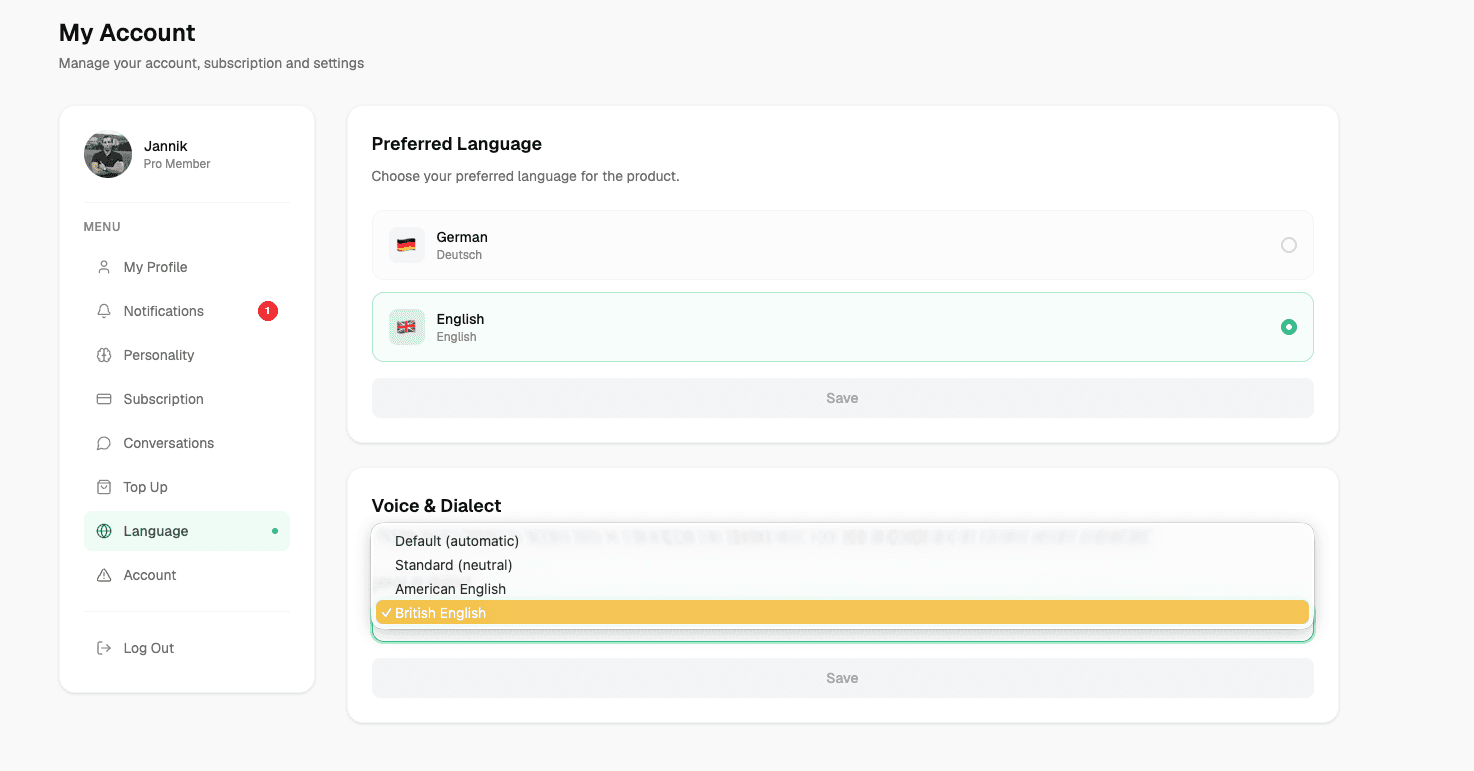
Account language settings with German or English selection and voice dialect dropdown
05

For SME leaders in everyday work: 80% hands-on execution, 20% conversations.

Leadership development for real employee conversations—without the seminar budget

When team leads at SMBs suddenly take on leadership responsibilities, they often lack practice for high-stakes conversations like feedback, conflict resolution, or even terminating employment. Careertrainer.ai’s AI role-play training helps you rehearse these discussions repeatedly—without an audience and without awkwardness—using MBTI-based dynamics and an independent evaluation.

  • Criticism / Feedback / Conflicts: Train behavior, not slide decks
  • Experience a breakthrough: the other side responds only once you lead the conversation well
  • No leadership training required—you practice the real conversation directly
  • Quick to use for recurring situations—instead of a one-off “workshop”
To the feature
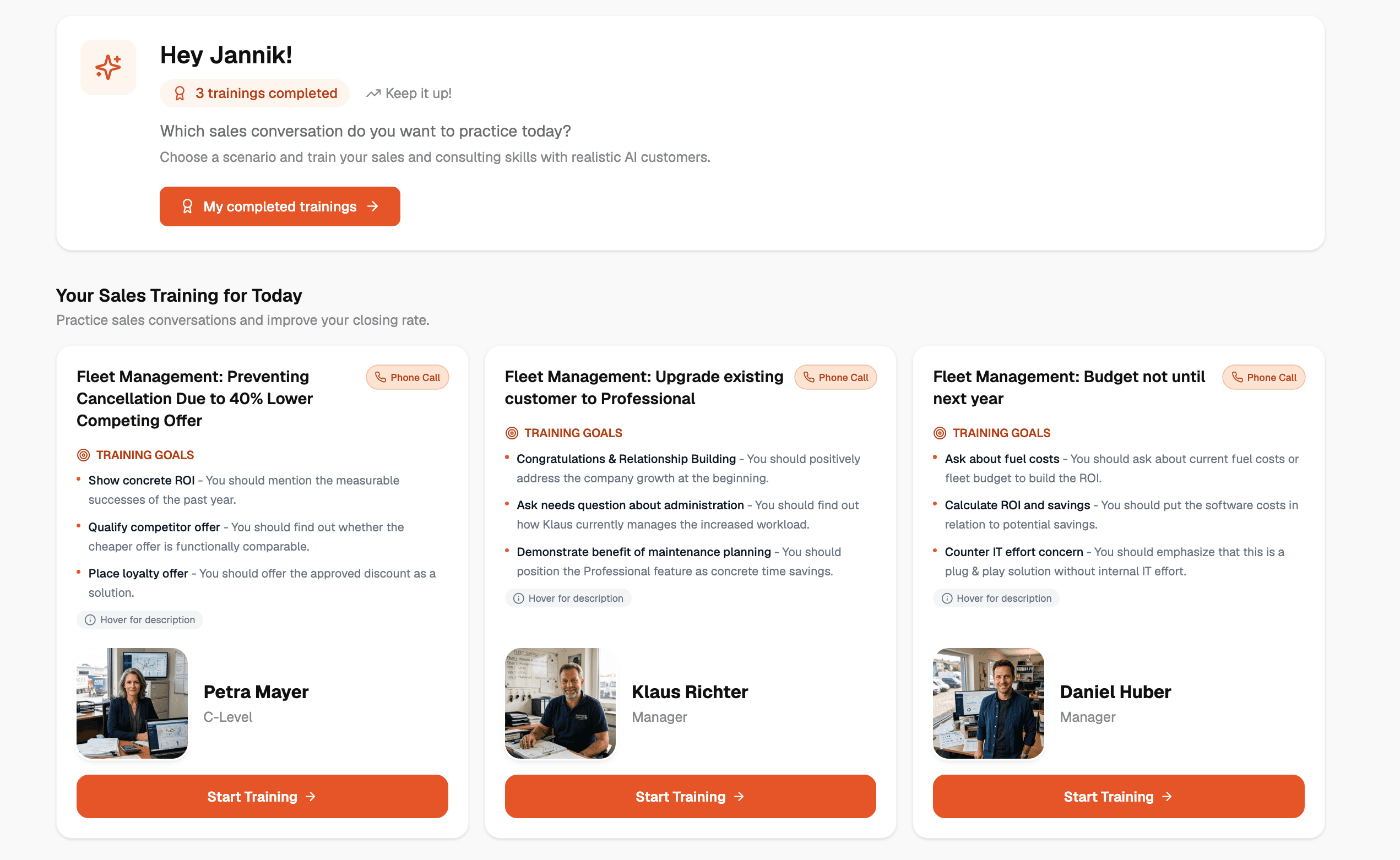
Vertriebstraining mit KI-gestützten Szenarien zur Verbesserung von Verkaufs- und Beratungskompetenzen.
AI Character Library

Practice with realistic personalities

Every employee is different – and reacts differently to feedback. Our characters are built on scientifically validated personality models and simulate realistic conversation dynamics: from the insecure junior employee to the critical senior developer.

Every character reacts differently

Thomas Weber

Thomas Weber

The skeptical IT decision-maker

IT & Cybersecurity

Analytical and slightly defensive – defends his team even though he knows NIS2 can't be managed alone.

references internal know-howblocks external solutionswants complement not replacement
Introverted
Extroverted
Detail-oriented
Conceptual
Analytical
Emotional
Structured
Flexible
Tobias Kern

Tobias Kern

The frustrated existing customer

After-Sales & Service

System hasn't worked for 3 weeks – threatens legal action. Doesn't want apologies, wants a solution with a date.

threatens legal actiondemands concrete deadlinerejects excuses
Introverted
Extroverted
Detail-oriented
Conceptual
Analytical
Emotional
Structured
Flexible
Dr. Anna Berger

Dr. Anna Berger

The ambitious part-time returner

Healthcare

Excellent senior doctor returning with a part-time request. Fears part-time will be seen as a career brake.

emphasizes capabilityimmediately sets perception boundariesseeks creative solutions when understood
Introverted
Extroverted
Detail-oriented
Conceptual
Analytical
Emotional
Structured
Flexible
Sophia Berger

Sophia Berger

The ambitious top advisor

Insurance

Excellent closing numbers, but fears coaching juniors will hurt her own figures.

emphasizes own performanceworries about commission lossneeds career perspective
Introverted
Extroverted
Detail-oriented
Conceptual
Analytical
Emotional
Structured
Flexible
16+
Different Personality Types
50+
Realistic scenarios
24/7
Available for training anytime
Use Cases

What do others use Careertrainer.ai for?

Typical scenarios for leaders, team managers, and anyone who wants to have better conversations

Onboarding for new leaders

Productivity from week 2 instead of month 6. New leaders practice their first difficult conversations before they have to lead them – from the first feedback conversation to taking over a team. No more learning by doing with real employees.

  • Practice first leadership conversations risk-free
  • Avoid typical beginner mistakes
  • Faster effectiveness in the new role
  • Structured onboarding program with progress tracking
Thomas Weber
Frank Zimmermann
Karl-Friedrich Moser
Total ProgressWeek 1
First feedback conversation practicedTeam meeting simulated
Discover onboarding solution

Choose your plan

Transparent pricing for you alone or your whole team. Enterprise and White Label kept separate – clearly split, no jargon.

Still have questions? We're happy to advise you.

Contact Us

Typical questions from a CEO’s day-to-day routine

Honest answers to what’s truly on the table before you make your decision.

I don’t have an HR department and no formal people development team. Am I even the right person to use a tool like this?

You’re not just the target audience—you’re the main reason Careertrainer.ai is built the way it is. Most providers in conversation training are designed for enterprises with dedicated HR teams, their own change budgets, and multi-month rollout projects. That kind of infrastructure simply doesn’t exist in a mid-sized company with 30 employees. The CEO decides personally, buys personally, and wants to see for themselves whether it works—without a steering committee needing three meetings to make a software selection.

That’s exactly why Careertrainer.ai is usable without an HR apparatus. You register, set up your topics or products, and invite your employees via link—the onboarding replaces training, and the dashboard replaces manual reporting. What typically takes months in large corporations (requirements workshop, specification document, selection process, pilot, rollout planning) can happen in your case—ideally—in a single afternoon. There are CEOs with 25 employees who set up the product on a Saturday and rolled it out on Monday. That’s small-to-midsize company reality, not enterprise logic.

What you, as a CEO, need to handle isn’t the workload of an HR department—it’s the two or three decisions that, in an enterprise, would usually be delegated to different stakeholders: What do we want to train? Who will start? And how do we measure whether it’s working? You can clarify those three questions in 30 minutes—and that gives you more content control than any enterprise where HR decides on personal development independently of the business.

I once spent €4,500 on a trainer—and nothing really stuck. Why should a software tool work better?

The honest answer: both have their place, but they work in different ways. A classic two-day training is great for deep reflection, real personal interaction, and conceptual inputs—yet it struggles with the forgetting curve. Two to three weeks after the workshop, a large portion is gone, because the format delivers information once rather than offering continuous practice. What actually transfers into day-to-day work depends heavily on the person—and on chance.

Careertrainer.ai works the other way around: instead of one big session, you get frequent, focused practice. 10 to 15 minutes, multiple times per week, over months—this is the learning format that has been shown to change behavior. There’s also the context factor. In a classic workshop, you often train on generic examples from a trainer’s book. With us, your salesperson trains with your real products, against your real competitors, using objections they also hear in the market from your customers. That’s the difference between “learned” and “transferable.”

The real gain comes from combining both. Many of our customers still book a targeted one-day workshop once per year—but they use it for reflection and deeper reinforcement, not for basic knowledge anymore. This makes the workshop days more productive and keeps ongoing development continuous. A strong trainer won’t “lose” against Careertrainer.ai—they’ll become easier to apply effectively, because workshop time isn’t wasted on foundational content, but focused on the topics that only work well in personal conversation.

Our employees will never practice in front of you or their colleagues. Isn’t that doomed to fail from the start?

That skepticism is valid—and you’re not the first to have it. The reality is: in a 40-person company, nobody is going to do a role-play in front of colleagues. It’s simply embarrassing, and that one hurdle causes many training programs in the mid-market to fail. With Careertrainer.ai, usage is typically around 70–80%, and most sessions happen outside working hours—on the couch in the evening, Sunday mornings, or right before the important Monday meeting. This isn’t an accident; it’s designed on purpose.

Your employees practice with an AI voice on their own phone. No one can listen in, and nobody can review the practice conversation afterward except the employee themselves. The dashboard shows you skill levels and training activity—never the verbatim content of individual sessions. This separation is intentional and non-negotiable: training has to remain a private practice space, otherwise it won’t be used honestly.

What you’ll notice as a managing director: at first, employees practice cautiously—maybe once or twice. Once they realize it truly stays private and that the AI doesn’t respond in a degrading way, but instead helps, usage increases significantly. That’s an effect you don’t get with traditional training: honest practice fails there due to the social element. Your salesperson won’t rehearse the “too expensive” objection in front of a colleague who’ll roast them for it the next day. With Careertrainer.ai, they’ll rehearse it five times in a row—because nobody’s watching.

How long does it realistically take to set up Careertrainer.ai?

Realistic: a single afternoon—once you’re focused. You register, select the plan based on the number of your employees, add either your products (for sales training) or the relevant conversation topics (for leadership training), and send the invitations. For sales training, four fields per product are enough—the AI automatically generates a complete briefing with USPs, typical objections, and negotiation room, so you only need to review it and adjust it if necessary.

There’s nothing to install: no IT integration, no servers, no data migration. Your employees sign in via browser or in the app. What really matters is the question of what you want to train specifically—and sometimes it helps to collect two or three critical conversation scenarios from your day-to-day beforehand.

A typical flow in practice: on Thursday or Friday, you invest two to three hours in setup and content preparation. In the Monday morning meeting, you tell your team you’re rolling it out now, send the invitation link in the team chat or via email, and set clear expectations—for example, two training sessions by Friday. During the week, you’ll see in the dashboard who has joined, who hasn’t yet, and where the first skill values stand. At the latest after two weeks, you’ll know whether the format fits your organization—if not, you can cancel on a monthly basis. No harm done.

Can I test it first with two or three employees before rolling it out to the rest of my team?

We even recommend it explicitly. The classic mistake in SME rollouts is trying to get everything going at once: all employees, all topics, all industries—with a perfect measurement concept. In most cases, that ends with either nothing happening or the project going quiet after three weeks, because too much was launched at once.

Our recommendation for getting started: two to five people, and one clear pain point. Either an issue that’s burning right now (for example, defending prices in sales ahead of an upcoming price increase) or a specific person (for example, a shift lead who’s taking on leadership for the first time and feels unsure). Run the setup for four to six weeks, check whether it has an impact, and then decide. Cancel monthly, no minimum term—your only risk is the 4 to 6 weeks of licensing costs.

What we regularly see in small pilot setups: after three weeks, additional employees start approaching the managing director on their own and ask whether they can take part too. That’s far more sustainable than a top-down rollout that’s often met with passive resistance. When the first shift lead realizes that conflict conversations are going better—or when the first junior field sales rep comes out of a meeting for the first time with real confidence—that spreads through the company. In this way, a pilot with three people usually grows into a setup with eight to ten without any pressure.

What about data privacy? My Data Protection Officer is going to ask me about it.

Fully GDPR-compliant, hosted in the EU, with no transfer of data to third countries unless an adequate level of protection is in place. For us, this isn’t an afterthought—it’s a core requirement. And in your position as Managing Director, you will usually have an external Data Protection Officer who will ask you about exactly this before you put any employee data into a tool.

As for your employees specifically: training transcripts are only visible to the individual employee concerned—not to management. As the owner, you can see skill levels, activity, and progress—but not the verbatim content. If an employee wants to be coached and you need specific material, they can actively share individual conversations or reports with you. This never happens automatically.

This separation is also relevant from a works council perspective: it’s exactly what works councils and employees expect when a tool like ours is introduced. If you have a works council—or you want to handle things transparently with your employees—this separation is your key argument: it’s a tool for self-development, not a monitoring instrument. Flip that logic, and you’ll struggle with employee buy-in—and miss the point entirely.

Compared to US tools, you also get a clear advantage regarding your own compliance requirements—especially if you operate in regulated industries or have customers from the public sector. EU hosting and a German contract partner help you avoid recurring discussions about third-country transfers and standard contractual clauses that are unavoidable with US providers.

I’m going to be handing over over the next few years—can this tool help during the handover transition?

Yes—and it’s exactly one of the use cases where the product is particularly well suited. In family-run businesses, knowledge handover is usually well organized: your son or daughter knows the business, the products, and your established customers. What’s rarely handed over in a systematic way is the conversation skills you’ve built intuitively over decades—how you handle difficult long-standing customers, how you de-escalate complaints, and how you find the right balance of clarity and appreciation in employee conversations.

With Careertrainer.ai, you can create typical situations from your day-to-day life as training scenarios. Your successor practices them at their own pace, and you discuss the insights together once a week for 30 minutes. After three to six months, your successor has completed 50 to 100 simulations with structured feedback—in this form, you could never achieve that yourself, because you’re simultaneously the senior, the handover person, and the managing director.

The transition becomes structured and verifiable instead of happening by chance. This is also relevant for banks, tax advisors, or external consultants who, in the months leading up to the formal handover, often ask whether succession is really prepared. A dashboard that shows how your successor’s conversation skills develop over several months is a far stronger argument than the usual “My son will manage—he’s been working in the business for three years.” That also changes how you approach the handover—because you can see where your successor already stands and where they still need specific support.

Do my employees need an onboarding or introduction training in the tool?

No—and that’s exactly the advantage. App onboarding replaces any traditional training. Your employees sign up, get guided through a short tutorial, pick their first scenario, and simply start talking. If you can use a smartphone, you can handle this too—this was designed that way on purpose, because not all mid-sized company employees are equally digitally savvy, and they shouldn’t be expected to complete a course before using it.

What you, as a Managing Director/CEO, should invest one or two times: a 10-minute slot in the morning meeting where you say, “We’re doing this now. Here’s the link. By Friday, please complete two trainings on topic X.” No further preparation is needed. If employees have specific questions, there’s in-app support—so you’re not the first contact for technical issues.

A practical tip: sometimes it helps if you do two or three sessions yourself before you roll it out to your team. Not because you need to train them—but because then you can say from your own experience, “I tried it last night, and honestly, it was surprisingly good.” That’s far more convincing than, “We’ve bought new software.” In mid-sized companies, employees react differently to “The boss tried it himself” than to abstract instructions.

What happens if my employees accidentally over-train and drive up costs?

Small- and mid-sized business concerns—totally justified. The answer has two levels. First, technically: there is no pay-per-use mechanism that could rack up costs without you knowing. You subscribe to a fixed team plan for a specific number of users—that’s the monthly cap. Nothing more can be added. If you want to enable additional users, you have to do that actively—nothing happens automatically.

Second, practically: in the SMB environment, excessive training hasn’t been a real use case so far. Most employees complete 4 to 12 sessions per month, each lasting 10 to 15 minutes. That’s also what drives behavior change—without turning into a burden. Nobody sits in AI conversations for eight hours a day. And if you want, you can set an additional limit per employee at any time.

What you’ll actually notice is the opposite effect: some employees train a little, others train a lot. That’s normal and completely fine. If someone trains less, you’ll see it in the dashboard—you can handle it in a standard employee conversation. If someone trains a lot, they’re usually already development-oriented and genuinely appreciates the opportunity. Either way, both behavior patterns cost you the same as a managing director—namely nothing beyond what you’ve already booked. That’s exactly the kind of cost control that fits SMB logic: capped at the top, flexible at the bottom.

Can you show me a quick example for my specific industry?

Gladly—and that’s exactly what the free demo is for. Instead of a PowerPoint presentation, you can start a role-play scenario tailored to your industry and speak with the AI for 10 minutes. We already have pre-built content for, among others: floristry, car dealerships, plumbing & sanitary, mechanical engineering, healthcare, hospitality, logistics, IT, real estate, consulting, construction, and retail.

If your exact niche isn’t included—say you run a specialist company for plastic parts in medical technology—then you can create your own scenario in 5 minutes. In a few sentences, you describe the situation, and the AI builds a complete simulation from it, including a suitable character, defined conversation goals, and an evaluation logic. That’s the difference from generic tools: you don’t train abstract sales or leadership knowledge—you train your real day-to-day situations, using your own wording.

Practically, it looks like this: you can sit down for 15 minutes tonight, create an account, choose a scenario (or describe one yourself) and run the conversation. After that, you’ll know from your own experience what the tool could deliver for your employees. It creates a different kind of insight than any demo presentation, because you can immediately feel the impact using your own example. Many managing directors report that after this first hands-on experience, they’re much clearer on whether it fits their business—and which two or three employees they would equip with it first.