Train to Handle Difficult Conversations as a Challenge

Curated topic programs featuring multiple live audio role-plays, a clear sequence, and measurable progress instead of isolated individual exercises.

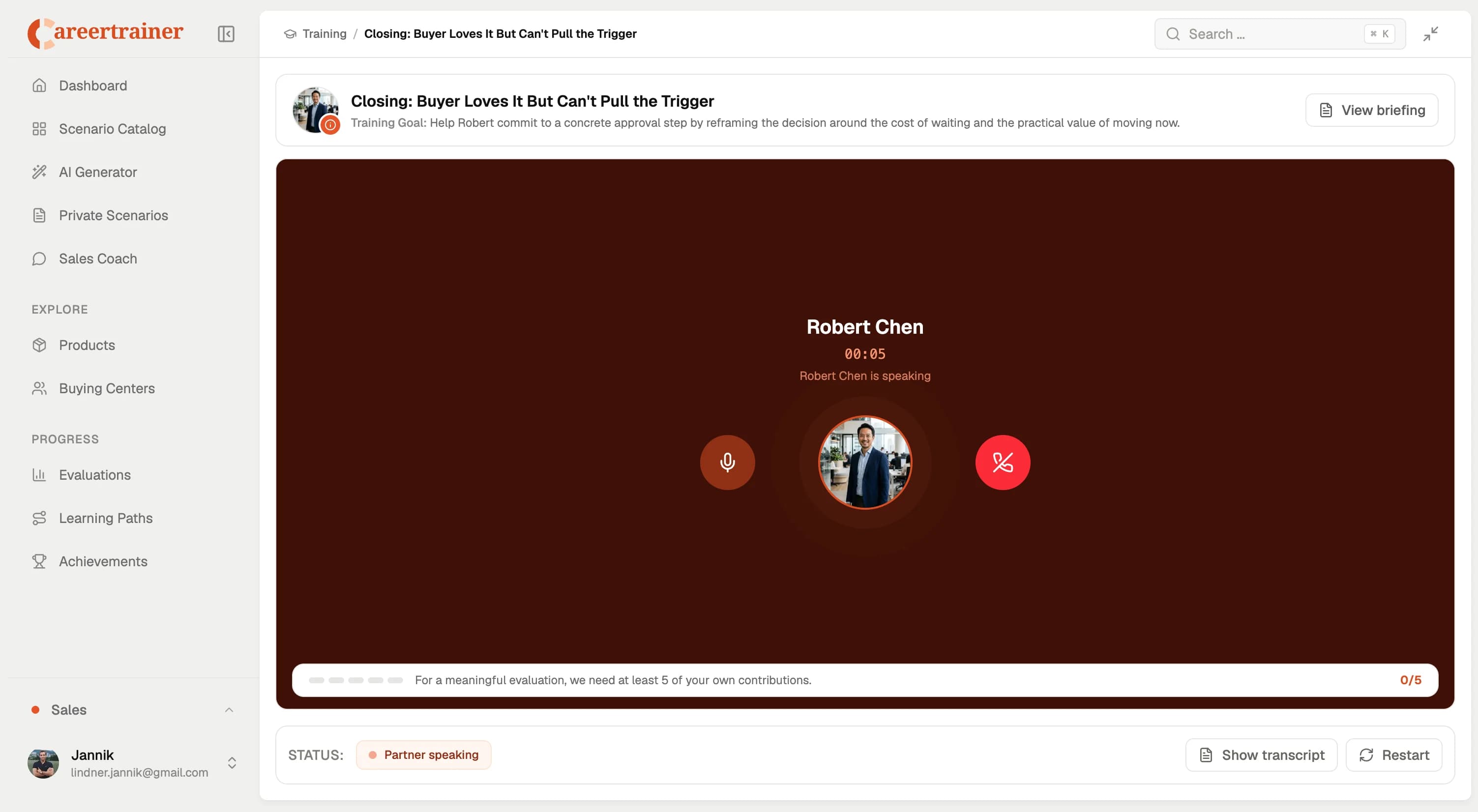
With challenges, you train a conversation topic as a cohesive learning path. Instead of starting just a single role-play, you progress through multiple interconnected scenarios that increase in complexity: first mastering the basics, then exploring variations, and finally engaging in conversations with more pressure, emotions, or objections. This approach allows you to practice not just once, but to develop a robust behavioral pattern for real-life situations. This is especially valuable for topics that recur in everyday life, where structure, timing, and phrasing need to be refined step by step.

Live trainingSales

Practise with your case

Leadership · Live audio

Coaching: The High Performer Who Thinks Feedback Doesn't Apply to Them

Reese Campbell

Reese Campbell

Senior · 37

Your goal: Deliver direct feedback about the HR complaints and secure her commitment to change her communication style.

Practice now

What's inside

What the feature Challenges offers

Discover the key capabilities and how they enhance your training.

Thematic Programs

Multiple scenarios are combined into a cohesive training program. Instead of practicing randomly similar conversations, you will focus on a clearly defined topic across various conversational contexts. This approach allows you to train and reinforce the same skill in multiple variations, step by step.

Combines multiple relevant role-plays into a specific conversation topic.

Covers various difficulty levels, personalities, and objection scenarios.

Helps you train the same core competency in various scenarios instead of just one standard case.

Ideal for recurring topics such as feedback, discovery, objection handling, or negotiation.

Clear Structure & Conclusion

Every challenge follows a defined process with a clear starting point, sequence, and recognizable conclusion. This way, you know what you're working towards, which stage comes next, and when a topic has not just been initiated but truly mastered. This provides clarity for individuals and makes training pathways for teams easier to plan and replicate.

Guides you through a clear progression from the basics to more advanced conversation scenarios.

Avoid aimlessly jumping between individual exercises without a coherent learning strategy.

Make progress and the completion of a topic transparent.

Facilitates team rollouts by ensuring everyone follows the same training path.

Creates a clear framework for repetition, comparison, and targeted deepening.

Who it's for

Who is this made for?

For new leaders and team leads who want to ensure that recurring employee conversations—such as feedback, criticism, or return discussions—are not left to chance.

For SDRs, AEs, and sales teams looking to train on objection handling, discovery, negotiation, or closing not just once, but through a progressive learning series that increases in difficulty.

For freelancers and experienced individuals who want to strategically prepare for multiple similar situations before entering a real conversation phase.

For L&D, HR, and sales enablement teams in small to large organizations that need a standardized, repeatable training program to address a clear skill gap.

For consulting firms and training providers seeking a structured topic format with a clear start, progression, and conclusion for their participants.

Typical use cases

What you actually train with it

1

You prepare newly appointed leaders for a series of feedback conversations, ensuring they can confidently navigate positive feedback, critical responses, and defensive behavior.

2

Your sales team should not just hear objections about price, timing, and competition once; they need to train through multiple conversation stages until their arguments and demeanor remain strong under pressure.

3

Before an upcoming round of return-to-work conversations after a prolonged illness, you want to practice phrasing, conversation structure, and handling emotional reactions multiple times.

4

An enablement team is developing a discovery program that trains a key decision-maker, a skeptical department representative, and an analytical buying center stakeholder in succession.

5

After experiencing low closing rates, you want to systematically improve a focused topic like closing, ensuring that every critical conversation moment from the initial contact to the final agreement is executed flawlessly.

6

An internal academy or consultancy aims to guide learners through a clearly defined negotiation or leadership topic and provide a transparent record of program completion.

Structure Instead of Loose Practice

Individual role-plays were helpful, but it was the challenge that enabled our leaders to truly master a sensitive conversation topic in various scenarios, rather than just handling it well once.

People Development Manager · DACH SaaS Company

3–7

Completed scenarios per topic path

What sets it apart

What makes this feature special

01

Multiple scenarios are intentionally designed as a learning pathway: the same skill set applied to different situations, with increasing difficulty rather than random isolated exercises.

02

You engage in live audio training with psychologically realistic AI characters that respond to tone, objections, and the flow of conversation, rather than rigid text prompts.

03

After each conversation, you receive immediate feedback on your actual performance in that specific session, allowing for targeted improvement through repetition.

04

Challenges can be utilized instantly for individuals and rolled out as a standardized training pathway for teams, enabling comparison and repetition.

05

The benefit lies not in more content, but in better progression: from a confident start to resilient performance under pressure.

Honestly assessed

When it fits — and when it doesn't

Right for you if …

  • Ideal if you want to systematically develop a recurring conversation topic rather than just testing it once.
  • Ideal for situations where multiple individuals need to follow the same training path, providing you with a clear sequence and a trackable completion process.
  • Less suitable if you only want to train a one-time special case without the need for repetition or a learning series.
  • Less suitable if you are looking for completely open coaching without a specific topic, progression, or measurable training framework.

Choose your plan

Transparent pricing for you alone or your whole team. Enterprise and White Label kept separate – clearly split, no jargon.

Still have questions? We're happy to advise you. Contact Us

FAQ

Frequently Asked Questions

What exactly is a challenge in conversation training?
A Challenge is a curated thematic program consisting of multiple live audio role-plays. You won't just train on a single conversation; instead, you'll engage in a series of interconnected scenarios in a meaningful sequence. This approach is particularly beneficial when a topic recurs in practice, such as feedback discussions, objection handling, or discovery calls. You typically start with a manageable variant and gradually progress to more complex conversations that involve heightened emotions, objections, or resistance. This structure transforms individual simulations into a genuine learning pathway: practice, receive feedback, apply again, and increase the difficulty. This is precisely what sets Challenges apart from a loose collection of standalone scenarios.
Which conversation topics are particularly beneficial for addressing challenges?
Challenges are particularly relevant for topics that recur and where you want to build not just knowledge but also conversational confidence. Typical examples include providing feedback, handling criticism, conflict resolution, return-to-work discussions, discovery calls, objection handling, negotiation, and closing. They are especially beneficial when a single good run-through isn't enough. When you need to navigate different personality types, objections, or escalation levels in real-life situations, a structured program will serve you far better than a one-time exercise. This format is less suitable for very rare special cases where repetition or progression isn't necessary.
How does a challenge typically unfold?
You will navigate through multiple scenarios in a predetermined sequence. It typically begins with an introductory conversation where you establish structure, objectives, and key messages. Following this, you will encounter variations featuring different characters, more challenging objections, or heightened emotional responses. After each conversation, you will receive immediate feedback on your performance throughout the interaction. This allows you to identify whether you are asking clearer questions, leading more effectively, de-escalating situations better, or handling objections more convincingly. For you, this means not engaging in random conversations, but systematically developing a skill until it holds up under pressure.
How many scenarios should a good challenge include, and how much time do you need for it?
For most topics, a few clearly defined scenarios are more effective than an overloaded path. Often, three to seven conversations are sufficient, provided each has a distinct learning function: introduction, variation, escalation, and final test. Each role-play session typically lasts only a few minutes, followed by immediate feedback. This allows you to tackle a challenge in several brief sessions or spread it out over a few days. What matters is not the maximum length but meaningful progression. If you want to quickly enhance a recurring topic, a focused program is usually more effective than a lengthy, vague training experience without clear milestones.
What are the advantages of AI role-play training compared to traditional role-plays, seminars, or e-learning?
Individual role-plays are great for spontaneous practice, but they often lack a systematic learning structure. A challenge combines sequence, repetition, and increasing difficulty. This means you train not just once, but reinforce your behavior across multiple scenarios. Compared to seminars, you can practice more frequently, on short notice, and without the need for scheduling. Unlike e-learning, you won’t be stuck in theory; instead, you engage in real live audio conversations. And unlike generic chatbots, the simulation responds to your actual conversational behavior and provides immediately actionable feedback. If you want to build confidence for real conversations, this combination of practice, repetition, and evaluation is typically much closer to everyday situations than purely knowledge-based formats.
How realistic are the conversations in a challenge?
The conversations are designed to feel like real professional situations. You engage in live audio dialogues with AI characters that not only provide responses but also exhibit relatable behaviors, motivations, and reaction patterns. This is particularly important during challenging scenarios, as you train the same core competencies in various contexts. One conversation partner may be open, while the next could be defensive, skeptical, or under time pressure. This approach allows you to not only memorize phrases but also develop flexibility in navigating different dynamics. This is the key difference from rigid practice scripts: you are training genuine conversational skills, not just following sequences of text blocks.
Who can benefit most from a challenge: individuals, teams, or organizations?
The format works effectively at all three levels, but for different reasons. As an individual, you can use it to systematically build your skills on a specific topic before engaging in real conversations. For small teams, it’s beneficial because everyone follows the same training path, creating a consistent standard. For larger organizations, the main advantage lies in repeatability. When many individuals need to train the same competency, a curated program is easier to implement and provides cleaner comparisons than randomly selected individual exercises. In short: The clearer the topic and the more frequently it occurs in daily interactions, the greater the benefit of the challenge.
What prerequisites do you need to start with a challenge?
You primarily need a clearly defined conversation topic. The more precisely you understand which situation needs improvement, the more effectively you can utilize a thematic pathway. Typical starting points include recurring employee reviews, low closing rates, uncertain objection handling, or an upcoming team rollout. From a technical standpoint, the entry barrier is low since it involves live audio conversations without the need for a complex IT project. For teams, it’s also beneficial if the target vision and audience are well-defined, such as new leaders, SDRs, or Account Executives. If you’re unsure about which behavior to train, it’s often more effective to first clarify the topic rather than jumping straight into a complete training pathway.
How do you budget for challenges when planning for a team?
It's more effective to focus on the business context rather than just the number of isolated exercises. A challenge is particularly worthwhile when a topic frequently arises, has significant consequences, and affects multiple individuals—such as leadership quality, discovery skills, or objection handling. To assess your budget, consider three key questions: How often does this conversation occur? What are the costs of mistakes or low success rates? How many individuals need to develop the same skill at a comparable level? When the answers are clear, a structured training pathway is usually easier to justify than sporadic individual training sessions that lack comparability. For individuals, the primary focus is on the benefits before a specific conversation phase. For teams, standardization, repeatability, and rapid rollout are also crucial.
Can training providers or consultancies implement challenges as white-label solutions?
This is particularly appealing for providers looking to offer recurring programs under their own brand in areas such as leadership, sales, or negotiation. A challenge is well-suited for this purpose, as it is designed as a clear learning path with a defined start, progression, and conclusion. For consultancies, academies, or enablement partners, this means you can not only facilitate a specific conversation topic once but integrate it as a repeatable AI role-play format into your own offerings. This is especially powerful when your clients need to train in similar situations regularly, and you are seeking a scalable practical format rather than just one-off workshops. It's also important to note that Careertrainer.ai is tailored for the DACH market and supports partner models as well as white-label implementations.

Ready to try it yourself?

Start in minutes with a realistic AI role-play — no setup required.

Related features

Other features from Careertrainer.ai

Discover more features that fit this topic.

Account & Security with Real Control
LeadershipSales

Account & Security with Real Control

When you train with realistic AI role-plays, it's essential that not only the conversations are on point, but also the surrounding conditions. Careertrainer.ai gives you control over sensitive access through two-factor authentication, ensures linguistic compatibility in the DACH region with language and dialect options, and manages the entire lifecycle of your account, including complete deletion. This is particularly important for individuals looking to get started quickly, teams managing multiple roles, or companies and partners prioritizing robust security and self-management features before a rollout.

AI Coach for Preparation and Reflection
LeadershipSales

AI Coach for Preparation and Reflection

The AI Coach is your text-based sparring partner before and after challenging conversations in leadership, sales, and negotiations. You bring a specific situation, outline your goals, risks, and challenging points, and receive not just general advice but precise follow-up questions, phrasing options, conversation structures, and actionable next steps. This transforms a vague scenario into a clear conversation plan. Unlike a standard chat, the Coach goes beyond text-based support; it helps you turn your preparation or follow-up into a trainable scenario and guides you directly into relevant voice role-plays, allowing you to practice critical passages aloud under pressure.

AI Conversation Training in Your Brand
LeadershipSales

AI Conversation Training in Your Brand

Provide realistic live audio role-play scenarios for leadership, sales, and negotiation under your own brand. You manage the domain, branding, customer access, quotas, and approved scenarios centrally, while your clients can immediately engage in high-quality, speech-based training. This allows you to create a digital premium offering that bridges the gap between workshops, coaching sessions, and rollouts, providing genuine practice opportunities without the need for you to facilitate every session personally.

AI Role-Play Training for Authentic Conversation Moments
LeadershipSales

AI Role-Play Training for Authentic Conversation Moments

Whether it's a termination conversation, handling price objections, delivering critical feedback, or navigating sensitive negotiations, you will train for these specific scenarios through realistic live audio role-plays with psychologically accurate AI characters. Instead of theory or text chat, you engage in real-time conversations, receive immediate, evidence-based feedback, and can revisit the exact moments where things often go awry in real situations.

Corporate Management for AI Training
LeadershipSales

Corporate Management for AI Training

To make AI conversation training effective in your organization, you need more than individual access. With Careertrainer.ai's Enterprise Management, you can centrally control which scenarios are visible, which company-specific training cases are deployed, and how the experience appears to employees under your brand. At the same time, you can monitor training activities across your organization, identify skill gaps, and determine where additional enablement is needed. This way, you combine self-directed practice for individual employees with clear governance for HR, Sales Enablement, and leadership.

Create Role-plays Instantly
LeadershipSales

Create Role-plays Instantly

With Careertrainer.ai's role-play generator, you can create tailored conversation training in just minutes, designed specifically for your unique situation rather than relying on generic templates. Simply input the context, objectives, audience, product or company details, and common objections, and our AI will generate a comprehensive scenario for leadership, sales, or negotiation. The result is not a static text block, but a dynamic live conversation featuring a credible persona, appropriate difficulty level, and a clear conversation focus. This allows you to practice the exact phrases, follow-up questions, and objections that are likely to arise in your real-life scenario.