
careertrainer.ai

Sales learning paths for systematic sales training

From cold outreach to closing with clear structure, measurable progress, and practical scenarios.

With the Sales Learning Paths, you train sales not as a loose collection of individual exercises, but as a clearly structured development pathway. Each phase of the sales funnel – from cold outreach to needs analysis, presentation, objection handling, negotiation, and closing – is trained with concrete scenarios. This is especially valuable for onboarding new salespeople, targeted team development, and for companies looking to establish uniform sales standards. Through progress tracking, you can see which phases are already mastered and where further practice is needed. In conjunction with the product library, the training becomes even more realistic: teams practice with their actual offerings rather than generic example products.

Live example · This is what training looks like

Live audio
Robert Chen

Robert Chen

Sales

Director · 42 · ENTP

Closing: Buyer Loves It But Can't Pull the Trigger

He wants to buy, but every final step feels like losing a better option.

Goal: Help Robert commit to a concrete approval step by reframing the decision around the cost of waiting and the practical value of moving now.

Live audio · 5–15 min · GDPR-compliant

Talk with Robert Chen as soon as you start

What Sales Learning Paths offers

Discover the key capabilities and how they enhance your training.

Learning logic throughout the entire sales funnel

The learning paths represent the sales process in six clear phases – from initial contact to closing.

6 Phases: Cold Outreach, Needs Analysis, Presentation, Objection Handling, Negotiation, Closing

Each phase trains a different core competency in sales.

Clear sequence instead of disconnected individual exercises
Concrete scenarios per phase

Each stage in the learning path includes relevant role plays, allowing new salespeople to train in real conversation scenarios rather than learning abstractly.

Scenarios with realistic conversation goals

Suitable for juniors, career changers, and targeted further education

Practical training instead of theoretical knowledge assessment

Ideal for Sales Onboarding

New team members receive a clear training path that builds confidence and prepares them more quickly for real customer conversations.

Aids in onboarding new SDRs, BDRs, and AEs

Reduces reliance on mere participation and ad-hoc coaching

Unified standard for multiple teams and locations

Progress tracking per user

You can see which steps have already been completed and where further training is needed.

Progress visible at the learning path level

Current step and completed content traceable

Useful for self-management and team reviews

Connection to the product library

Sales learning paths can be linked to real products and services from the company, ensuring that training aligns with everyday sales activities.

Scenarios along the funnel based on our own products

USPs, objections, and competitors are incorporated into the training.

Higher relevance than generic standard scenarios

Targeted training instead of random training

Even experienced sales professionals use learning paths to intentionally strengthen specific phases rather than training indiscriminately.

Good for focused skill development

Applicable for performance differences within the team

Aids in repetition and standardization

At a glance

Everything you need to know about the audience, use cases, and what makes Sales Learning Paths special.

Who is this for?

For sales teams, SDRs, BDRs, account executives, sales enablement, sales managers, and companies looking to systematically onboard new salespeople and strategically develop existing teams.

Typical Use Cases

  • You want to train new salespeople through the 6 Sales Phases instead of just using shadowing and PDFs.
  • Your team is looking for a structured sales training program covering everything from cold outreach to closing.
  • You want to use product-related scenarios for onboarding in each funnel phase.
  • You want to make progress in sales onboarding visible rather than relying solely on gut feeling.
  • You are looking for a scalable alternative to one-off sales workshops for repeatable training.
  • Your company aims to specifically prepare junior sales representatives for discovery, objections, and negotiations.
  • You want clear training paths for different sales roles instead of a confusing list of scenarios.
  • You are looking for a tool that quickly prepares new employees for real customer conversations.

Right for you if...

  • Right for you if you want to make new salespeople productive in a structured and faster way.
  • Right for you if your team needs to actively practice conversations for each funnel phase, not just learn theory.
  • Especially for teams looking to establish a consistent sales onboarding process across multiple locations or managers.
  • Especially for companies that want to make training progress in sales visible and manageable.
  • Right for you if you want to combine product-related sales scenarios with clear learning logic.
  • Especially for teams that specifically prepare junior sales representatives for initial conversations, discovery, objection handling, and closing.

What sets us apart

Unlike traditional sales training, e-learning, or isolated role plays, the Sales Learning Paths are systematically structured and connect each phase with real conversation simulations. You train not only knowledge about the funnel but also actual behavior in conversations. Through progress tracking, phase-specific scenarios, and integration with the product library, a practical training system is created instead of isolated learning content without transfer to daily sales activities.

Practical sales training with a clear structure

6

Sales phases in the learning path

Instead of simply throwing new colleagues into calls, we can now guide them systematically through the key phases of conversation.

Sales Manager

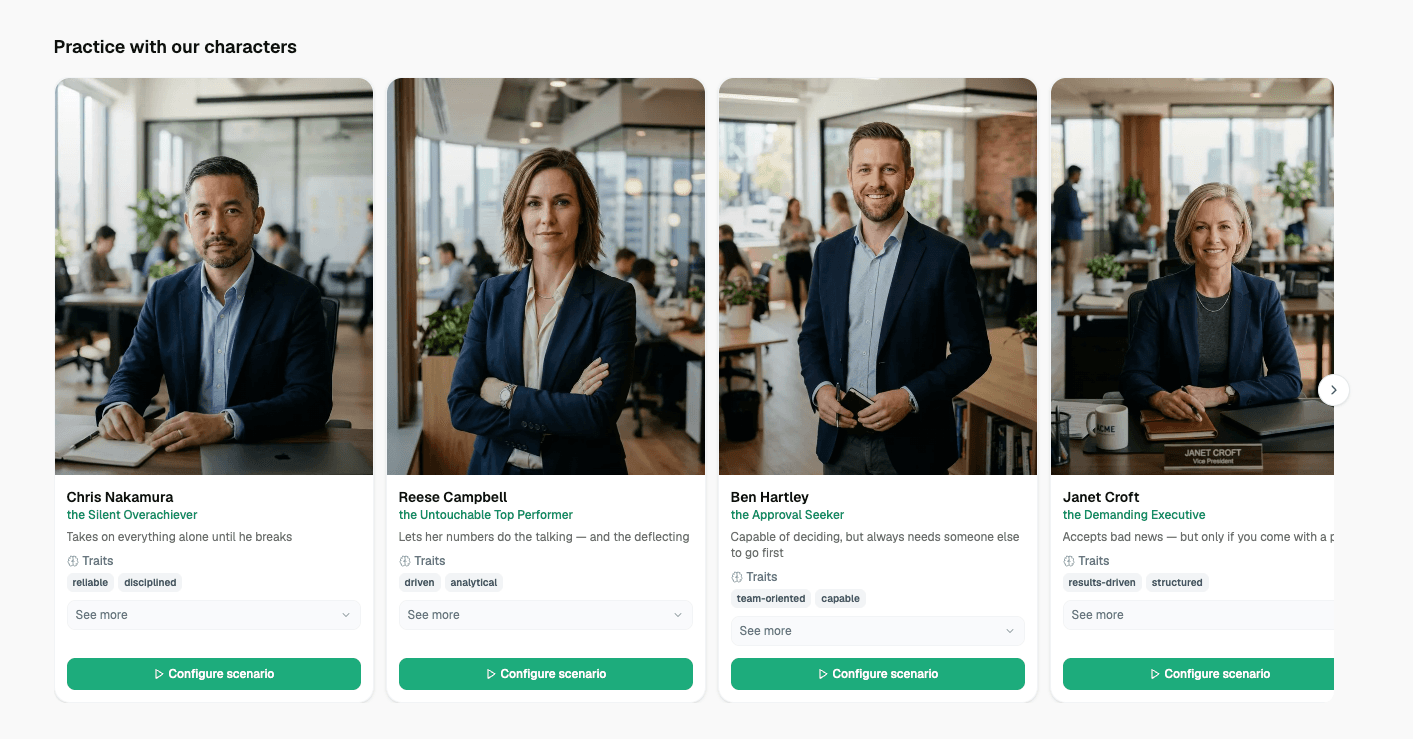
AI Character Library

Practice with realistic personalities

Every employee is different – and reacts differently to feedback. Our characters are built on scientifically validated personality models and simulate realistic conversation dynamics: from the insecure junior employee to the critical senior developer.

Every character reacts differently

Mira Kowalski

Mira Kowalski

The self-critical high-potential

Project Management

Reflexively deflects praise and downplays successes. Opens up when given specific praise with examples.

downplays own performancesays 'it was nothing special'responds to concrete examples
Introverted
Extroverted
Detail-oriented
Conceptual
Analytical
Emotional
Structured
Flexible
Marcus Berger

Marcus Berger

The fallen top performer

Private Banking

Was formerly a top performer, now 40% below target. Blames market conditions, but missed the digital shift.

references external factorsdefends old methodsopens up with support not blame
Introverted
Extroverted
Detail-oriented
Conceptual
Analytical
Emotional
Structured
Flexible
Jürgen Haas

Jürgen Haas

The loyal long-tenured employee

Human Resources

18 years devoted to the company. The termination feels like personal failure, not a business decision.

defines himself through worktakes termination personallyneeds dignity and respect
Introverted
Extroverted
Detail-oriented
Conceptual
Analytical
Emotional
Structured
Flexible
Thomas Weber

Thomas Weber

The skeptical IT decision-maker

IT & Cybersecurity

Analytical and slightly defensive – defends his team even though he knows NIS2 can't be managed alone.

references internal know-howblocks external solutionswants complement not replacement
Introverted
Extroverted
Detail-oriented
Conceptual
Analytical
Emotional
Structured
Flexible
16+
Different Personality Types
50+
Realistic scenarios
24/7
Available for training anytime

Choose your plan

Transparent pricing for you alone or your whole team. Enterprise and White Label kept separate – clearly split, no jargon.

Still have questions? We're happy to advise you.

Contact Us
FAQ

Frequently Asked Questions

What are Sales Learning Paths in Careertrainer.ai?

Sales learning paths are structured training sequences for sales. Instead of randomly selecting individual scenarios, you progress step by step through the key phases of the sales process – from Cold Outreach to Closing.

Each phase includes relevant conversation simulations, allowing you to practice specific situations that occur in everyday sales. This is particularly beneficial for onboarding, targeted training, and for teams looking to establish a consistent training standard. This transforms ad-hoc training into a coherent learning process with a clear direction.

Who are the Sales Learning Paths particularly suitable for?

The learning paths are primarily designed for new sales representatives, junior sales managers, SDRs, BDRs, and account executives, and are structured systematically. At the same time, experienced team members also benefit when specific funnel phases need to be strengthened.

This feature is particularly useful for sales leaders and sales enablement teams looking to standardize onboarding and make progress visible. If you want to avoid onboarding relying solely on shadowing, intuition, and individual coaching, sales learning paths are a highly suitable solution.

How do Sales Learning Paths assist in onboarding new sales representatives?

Sales learning paths provide new salespeople with a clear sequence in which to practice key conversation scenarios. Instead of jumping directly into real customer calls, they first rehearse typical situations such as initial outreach, needs analysis, objection handling, or negotiation in a safe environment.

This reduces the time to confident conversation management and makes onboarding more consistent. Leaders and team leads do not need to explain everything individually but can rely on a repeatable training process. This is especially valuable when multiple new employees start simultaneously or teams grow rapidly.

Which sales phases do the learning paths cover?

The Sales Learning Paths are based on six key phases of sales: Cold Outreach, Needs Analysis, Presentation, Objection Handling, Negotiation, and Closing. This structure covers the core of the typical sales funnel.

The advantage of this structure is that each phase requires different skills. In Outreach, the focus is on relevance and initiating conversation; in Discovery, it’s about questions and needs; later, it involves objections, negotiation, and closing. This way, you train not just general "sales" skills, but very specific abilities that are crucial in each funnel phase.

What distinguishes Sales Learning Paths from traditional e-learning or sales training?

Classic e-learning typically imparts knowledge, processes, and methods. Sales learning paths in Careertrainer.ai take it a step further: you actively train real conversation scenarios through role-playing rather than just reading content or watching videos.

Compared to traditional training, the difference lies in repeatability and structure. You can practice individual phases as often as you like, receive immediate feedback, and build confidence step by step. Instead of a one-time workshop, a continuously usable training system is created that translates theory into measurable conversational practice.

Can I link the Sales learning paths with our product library?

Yes, exactly, this is a significant advantage. The Sales Learning Paths can be integrated with the product library, allowing scenarios along the sales funnel to be trained based on your actual products or services.

This means you practice not with generic example offers, but with your USPs, typical objections, competitors, and negotiation margins. This is particularly beneficial for onboarding, as new salespeople not only learn the sales phases but also become more confident in representing your specific offerings. This greatly enhances practical relevance and reduces the gap between training and real customer conversations.

How does progress tracking work in the Sales learning paths?

The progress tracking shows you which steps in the learning path have already been completed and where you currently stand. This makes it clear whether someone is still training at the beginning of the funnel or has already progressed to advanced phases such as negotiation and closing.

For individual users, this provides orientation and motivation. For team leads, it serves as a practical foundation to better manage onboarding and training. You no longer have to guess whether someone is "far enough along"; instead, you can track progress based on the learning path and derive targeted next steps.

Are Sales Learning Paths suitable for experienced sales professionals?

Yes, learning paths are not just for beginners. Experienced sales professionals also benefit when specific sales phases need to be intentionally trained or refined. This applies, for example, to Discovery, price negotiations, or closing in more complex deals.

The advantage lies in the targeted structure: instead of generally "training more," you work on clearly defined conversation types along the funnel. This is particularly useful when teams show weaknesses in specific phases or when new products, markets, or target groups require an adjustment of the sales routine.

How does Careertrainer.ai assist with onboarding a junior sales representative, as in the case of Klaus from the steel industry?

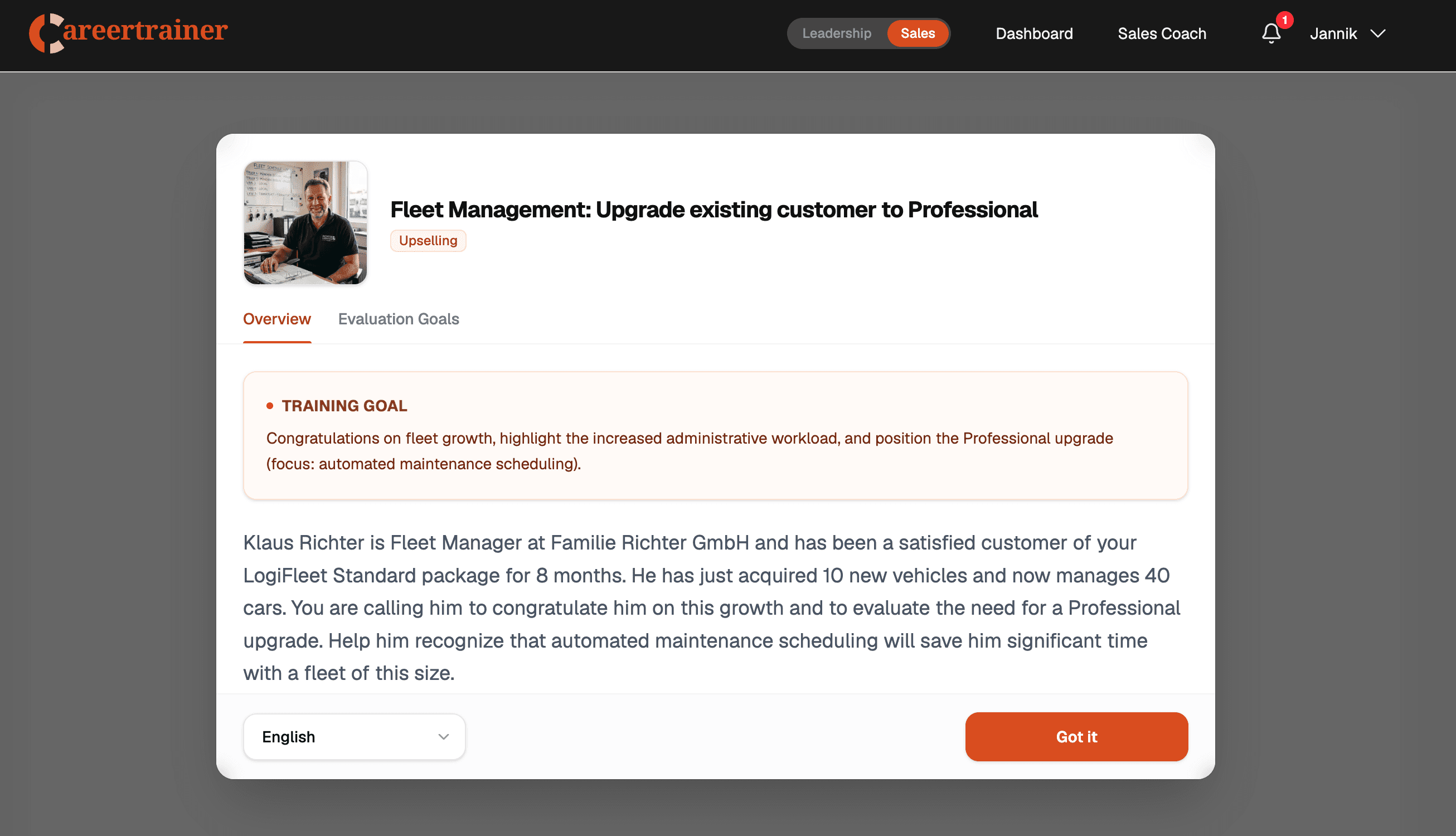
In the case of Klaus in the steel trade, structured Sales learning paths are beneficial during junior onboarding. Instead of merely providing Klaus with product information, price lists, and ride-alongs, he can actively train in the typical sales phases.

For example, he practices initial contact, needs assessment with commercial clients, handling price comparisons and objections, as well as later negotiation situations. This makes onboarding more robust and transferable. Particularly in industries with complex offerings, this form of training helps build confidence before real customer relationships are at stake.

Can training providers use sales learning paths for sales training in a white-label format?

Yes, Careertrainer.ai is explicitly positioned for training providers, consultancies, and enablement partners to use the platform under their own brand or embedded. This is particularly attractive for sales training with structured sales learning paths, as it allows you to offer your clients a scalable training format without having to build your own AI infrastructure.

The advantage: You stay close to your clients, maintain your brand, and can integrate learning paths, scenarios, and product-related training logic into your offerings. Careertrainer.ai sees itself as an enabler for partners, not as a replacement for their business model.

Are the Sales learning paths available in English yet?

The English version is currently not fully developed according to the product plan. The focus is primarily on the German-speaking market and a strong DACH fit in sales training.

If you are working with the Sales learning paths today, you should primarily plan for the German rollout. For international teams, the direction is generally compatible, but the current emphasis is on establishing a clear, functional structure for German-speaking sales onboarding and targeted training. This creates a solid foundation before expanding to additional language versions.

Related features

Other features from Careertrainer.ai

Discover more features that fit this topic.

Leadership
Leadership

Leadership development with AI for HR teams

Careertrainer.ai helps you make leadership development practical, planned, and measurable. Instead of one-off training sessions, your leaders practice real employee conversations through live audio role-plays: feedback discussions, conflict resolution, development conversations, separation situations, or remote leadership. HR receives reliable data on usage, skill gaps, and progress across teams, locations, and levels. This way, you complement seminars and coaching with a scalable practice space where leaders train the conversations that truly matter in everyday situations.

View feature
LeadershipSalesCustomer SupportInterview

AI Role-plays – Practice the conversation before it happens

Difficult conversations often go awry because they can't be practiced in advance – until now. Our AI role-plays provide you with an interlocutor that behaves like a real person. It has its own personality, beliefs, and responds to what you say – not according to a script. In empathetic dialogue, it opens up; under pressure, it shuts down. Afterwards, you receive specific feedback: what went well, what didn't, and how a professional would have handled it. Ideal for leadership discussions, sales, customer communication, and job interviews.

View feature
LeadershipSalesCustomer SupportInterview

Train with realistic AI characters instead of generic bots.

The AI Character Library from Careertrainer.ai adds depth to your conversation training. Instead of interchangeable standard figures, you train with various personality types, decision-making styles, and internal tensions. In leadership training, these are employees with their own needs, uncertainties, or resistances. In sales, you encounter buyer personas, purchasers, and decision-makers with genuine buying motives, objections, and priorities. This way, you learn to tailor conversations to different types of people—not just an average case.

View feature
LeadershipSalesCustomer Support

Prepare for difficult conversations with AI

Do you have a conversation tomorrow that’s making you anxious? Describe the situation – the AI will create a conversation partner that reacts just like your real counterpart likely would: defensively, emotionally, evasively, or confrontationally. You’ll practice the conversation, try out different strategies, and go into the real discussion with a concrete plan. In 15 minutes instead of sleepless nights.

View feature
Leadership

Role-playing for leaders – practice before it matters

Leadership is not learned in seminars. It is learned through conversation – ideally in an environment where mistakes have no consequences. With Careertrainer.ai, leaders practice criticism, feedback, and conflict conversations with AI characters that behave like real employees. Alone, on their phones or at their desks, as often as needed. Especially valuable for those who have not had formal leadership training – but were simply promoted.

View feature
LeadershipSales

Data Protection & GDPR Compliance

Training conversations involving sensitive data requires the highest security standards—whether for sales discussions, customer service simulations, or leadership training. Careertrainer is designed from the ground up to meet German and European data protection requirements.

View feature
Sales
Sales

Sales training with AI – practice real sales conversations instead of just theory

With Careertrainer.ai, you train sales conversations as they occur in real life: through live audio role-playing with challenging buyer personas, noticeable conversation dynamics, and clear evaluations after each session. You practice cold outreach, needs analysis, product presentation, objection handling, price negotiation, and closing in a safe environment without risking real deals. Instead of slides, lectures, or rigid scripts, you receive repeatable conversation practice, specific professional tips, and a platform that can be tailored to your product, industry, and team.

View feature
Sales

Buying Center Training for B2B Sales

In Enterprise Sales, deals are rarely lost due to a single poor call; rather, they fail because a stakeholder is overlooked, information is miscommunicated internally, or the deal collapses due to hidden interests. With the Buying Center from Careertrainer.ai, you train for this reality: complete buying committees with 4–6 personas, each with their own role, KPIs, objections, communication style, and decision-making logic. You practice not isolated conversation moments, but a cohesive virtual deal over multiple sessions – including persona memory, deal state management, milestones, next-best-action, and deal analytics. This prepares you for real multi-stakeholder sales situations before they become critical in the actual account.

View feature
Sales

Buyer Personas in Sales Training – realistically simulate different buyer types

With Buyer Personas in sales training, you don't just practice any sales conversation; you specifically present your product to different buyer types. Careertrainer.ai simulates typical reactions from dominant, analytical, relationship-oriented, and expressive Buyer Personas, complete with relevant objections, priorities, and communication styles. This allows you to experiment with various sales tactics, vary terminology, refine value propositions, and directly experience what works for each persona type. This makes training significantly more realistic than rigid role plays or generic characters without a clear sales context.

View feature