

careertrainer.ai

Systematically develop management skills – practical rather than theoretical.

Management training software with AI role-playing games.

Modern management training software for effective leadership development: Your managers practice critical employee conversations with realistic AI characters, while HR centrally measures and optimizes all training data. From traditional seminars to scalable practical training.

Live example · This is what training looks like

16 scenarios
Phone call

Practise with your situation

Emily Parker

Emily Parker

Leadership
The experienced matrix operations lead

Long-tenured high performer · 41 · ENTJ

Cross-IndustryFeedbackconversationAutoritaetsanzweiflungHigh Performer Langjaehrig

Phone feedback call where Emily doubts your mandate

Emily challenges your authority after late direction

At your desk, the phone rings and Emily picks up with a sharp edge. You are calling because two stakeholders aligned late, and the follow-up plan landed without her sign-off. She does not treat your direction as final, and she keeps referencing the old approval steps from her lane.

Goal: Get Emily to commit to one clear next behaviour. Do it by naming what you observed, making your mandate boundaries explicit, and asking for her concrete agreement.

Learning goals

  • Name the observed pattern
  • Clarify your decision mandate

What to expect

  • Anchor on observable facts, not character judgement
  • State mandate and boundaries briefly, then ask for agreement
Practise with your situation
From theoretical workshops to practical skill training with measurable results.

Management Training Software for Effective Leadership Development

Our management training software revolutionizes traditional leadership seminars: Instead of multi-day workshops, your managers train with AI-powered role-playing scenarios—available anytime, endlessly repeatable, with instant feedback and comprehensive analytics for HR teams.

Management training software with voice-first technology for realistic practice.

Our management training software utilizes real conversations instead of artificial chat simulations. Your managers engage naturally with AI characters that respond with emotional authenticity: defensive in the face of poor leadership, open when met with empathy. This allows them to practice conversation skills in realistic conditions—without the fear of real consequences.

Echte Sprachgespräche mit Speech-to-Text statt Text-Chat oder Multiple-Choice-Tests

10-25 Minuten pro Session – realistisch wie echte Mitarbeitergespräche, kurz genug zwischen Meetings

Emotionale KI-Reaktionen: Stress durch schnelleres Sprechen, Defensive durch abgehackte Sätze, Öffnung durch leisere Stimme

Unbegrenzte Wiederholungen möglich – Manager können dieselbe Situation mehrfach üben, bis sie sicher sind

Management training software with voice-first technology for realistic practice.

Comprehensive analytics for data-driven management training.

As a management training software, we provide HR teams with all the KPIs needed for strategic decision-making: Who trains regularly? Which management skills are company weaknesses? Where is training most effective? Completion rates, score development, skill gap analyses – all exportable for management reporting and ROI documentation.

Performance-Tracking: Sessions gesamt, Completion Rate (z.B. 80%), durchschnittlicher Score, 8-Wochen-Trend

Skill-Gap-Analyse: Welche Management-Kompetenzen (Kritikgespräche, Delegation, Konfliktlösung) sind schwach?

Team-Vergleiche: Welche Abteilungen performen gut? Wo braucht es Nachschulung?

ROI-Kalkulator: Messbarer Business-Impact durch reduzierte Fluktuation, höhere Produktivität, weniger HR-Konfliktaufwand

Comprehensive analytics for data-driven management training.

14 Types of Management Conversations for Every Leadership Situation

Our management training software covers all critical management situations: from feedback conversations to delegation meetings and termination discussions. With over 50 predefined scenarios that are continuously updated, your managers are prepared for every conversation before they encounter them in real team settings.

Kritikgespräche: Leistungsprobleme konstruktiv ansprechen ohne Demotivation

Entwicklungsgespräche: Karrierewege aufzeigen, Potenziale erkennen und fördern

Konfliktgespräche: Teamkonflikte moderieren, Mediation zwischen Mitarbeitern

Kündigungsgespräche: Trennungen professionell und respektvoll gestalten

14 Types of Management Conversations for Every Leadership Situation

Management training software with custom scenarios tailored to your company culture.

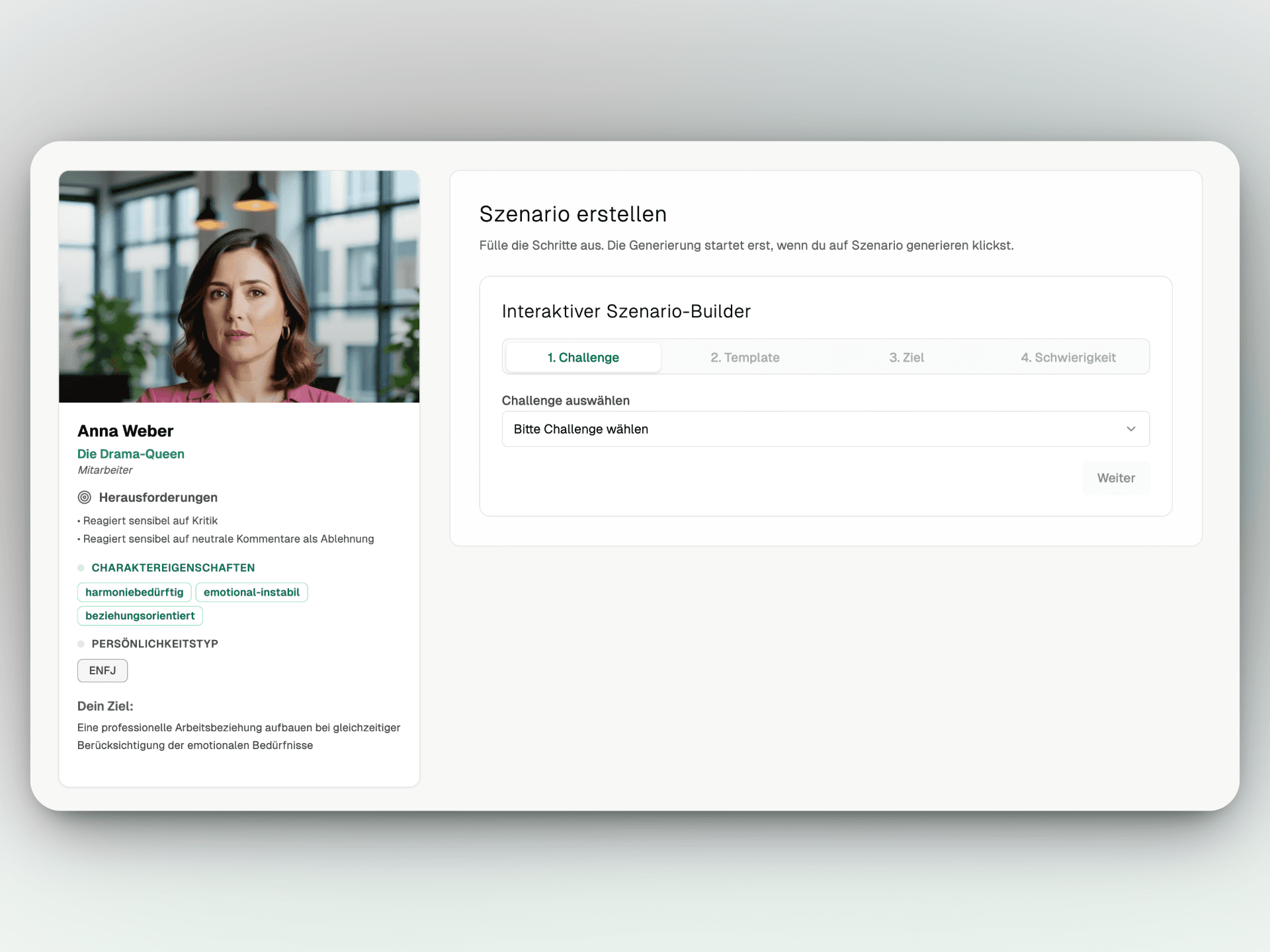
The software is fully customizable: you can upload your own leadership guidelines, corporate values, and communication standards. The system automatically generates custom management training that reflects your culture. This way, your managers train on the specific situations they encounter daily in your company, rather than generic theoretical scenarios.

Szenarien-Builder: Custom-Trainings basierend auf euren Unternehmenswerten und Führungsleitlinien

Branchen-Anpassung: IT, Healthcare, Manufacturing, Retail – automatische Generierung branchenspezifischer Varianten

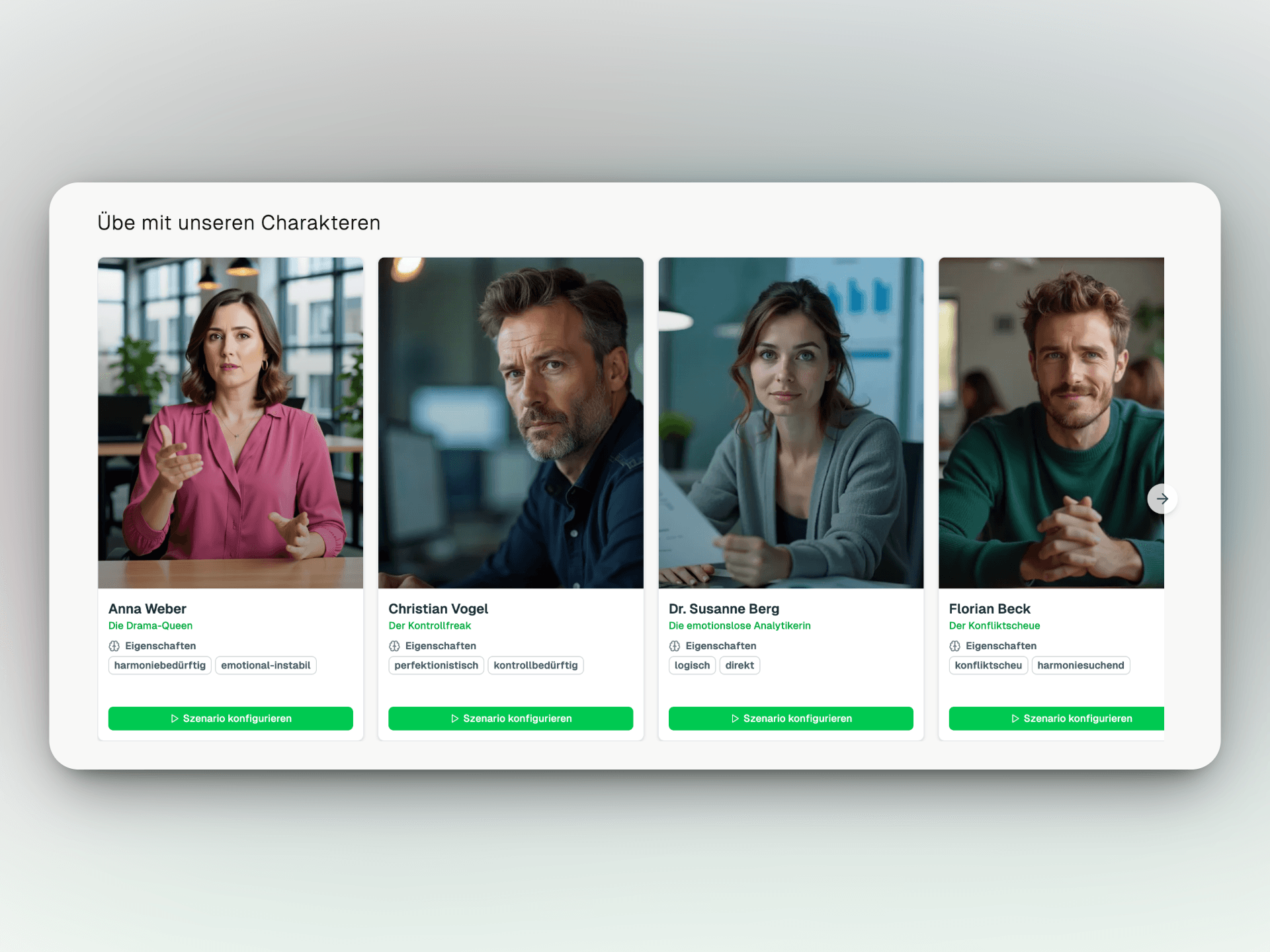
Eigene Charaktere: KI-Profile basierend auf typischen Mitarbeiterpersönlichkeiten in eurem Unternehmen

Template-System: Universelle Kern-Szenarien automatisch an eure Branche und Terminologie anpassen

Management training software with custom scenarios tailored to your company culture.

Practice with realistic AI characters

Pick a scenario that matches your situation, then jump into the AI role-play.

Filter by company context, conversation type, challenge and employee persona. Every example leads directly into your own AI role-play.

16 of 16 scenarios

Company context

Conversation type

Challenge

Employee persona

Emily Parker

Emily Parker

Long-tenured high performer

Corporate matrix organisationFeedbackconversationAuthority challengeLong-tenured high performer

At your desk, the phone rings and Emily picks up with a sharp edge. You are calling because two stakeholders aligned late, and the follow-up plan landed without her sign-off. She does not treat your direction as final, and she keeps referencing the old approval steps from her lane.

What you'll practise

  • Name the observed pattern
  • Clarify your decision mandate
  • Agree one next action
So who exactly decides this now, because it sure isn't me.
Ethan Collins

Ethan Collins

Junior with high expectations

Remote and hybrid teamKonfliktloesungFear of changeJunior with high expectations

Between two meetings, you catch Ethan across the open-plan floor. He is tense because the team has to switch to a new workflow this week, and his tasks feel suddenly unclear. He argues his way into the corner, saying the old way still works and the timeline is unrealistic.

What you'll practise

  • Surface the real concern
  • Give specific reassurance
  • Agree the next small step
If I learn this wrong, I look incompetent in front of everyone.
Alex Taylor

Alex Taylor

Vocal critic

Production shift operationPriorisierungDefensive response to feedbackVocal critic

On your morning call list, you dial Alex and he answers with a sigh. The topic is a priority mismatch, but the critique surfaced late and he hears it as judgement. Before you finish the first sentence, he pushes back with the sequence of events as if you got it wrong.

What you'll practise

  • Keep to facts and timing
  • Name the impact clearly
  • Ask for Alex’s view
You're telling me this like it was my mistake all along.
Sophie Morgan

Sophie Morgan

Informal leader

Family-led midmarket companyDelegation conversationLoyalty conflictInformal leader

Across from you at the station desk, Sophie walks in and starts venting. You planned a delegation chat about a repeat handover failure, but the escalation message has landed on her desk without context. Her first focus is respect, not solutions, because the team feels exposed to patients and supervisors.

What you'll practise

  • Allow the vent and mirror core
  • Set the delegation boundary
  • Agree the next shift fix
I do not mind owning it, but you did not even ask us first.
Noah Mitchell

Noah Mitchell

Return after overload

Remote and hybrid teamChange KommunikationLoyalty conflictReturn after overload

Noah calls while he is heading into a site-to-home handover window. Since the new leadership rollout started, he keeps circling the team split and what he should agree to.

What you'll practise

  • Name role boundaries early
  • Probe the real stakes
  • Agree one practical first stance
Look, I want it to work, but people are watching.
Jordan Blake

Jordan Blake

New team member with leadership ambition

Corporate matrix organisationTeam AlignmentFeeling micromanagedNew team member with leadership ambition

Between sprint planning sessions, you pull Jordan into a small meeting room across from the whiteboards. He looks frustrated because his last handoff had weekly status checks and vague decision lines.

What you'll practise

  • State outcome and authority
  • Justify checkpoints by purpose
  • Confirm a respectful delegation agreement
I can run it, but these pings sound like I’m incompetent.
Rachel Bennett

Rachel Bennett

Experienced senior close to exit

Production shift operationFeedbackconversationOverload signalsExperienced senior close to exit

Rachel answers on the line with a tight window between shift rounds. With the next duty roster draft coming, she says she is fine, but her tone and pace give overload signals away.

What you'll practise

  • Separate observation and care
  • Confirm work priority for next shift
  • Agree relief and a follow-up
I’m not the weak one. I just can’t keep running on fumes.
Liam Edwards

Liam Edwards

Quiet talent

Skilled-trades businessKonfliktloesungTeam splitQuiet talent

On site, you catch Liam across from the workshop bench with the afternoon rush ticking. Since the last client installation issue, he has been polite but distant, and the team handles tasks in cliques.

What you'll practise

  • Name tension without blame
  • Clarify impact on next job
  • Agree a behavioural standard
No drama. It’s just that the handover is getting messy.
Casey Hayes

Casey Hayes

Long-tenured high performer

Production shift operationPriorisierungQuiet quittingLong-tenured high performer

Casey picks up a line while the sprint board is already behind. They planned to sign off later, then dial back the effort since the last extra push.

What you'll practise

  • Name the withdrawal concretely
  • Ask for causes without blame
  • Agree one small next step
I’ll do my part. But you’ll have to stop moving the target.
Laura Hughes

Laura Hughes

Informal leader

Family-led midmarket companyDelegation conversationFear of changeInformal leader

Across the shopfloor, Laura checks stock numbers at the end of a long shift. You want to assign ownership for the new service standard, and she immediately slows down the conversation.

What you'll practise

  • Mirror the real resistance driver
  • Clarify delegation boundaries
  • Connect to a practical upside
If we take this on, the queue still hits the same wall.
Oliver Harris

Oliver Harris

Vocal critic

Corporate matrix organisationChange KommunikationAuthority challengeVocal critic

Oliver picks up while you are dialing in for a quick check-in about a priority change. He cuts in with a complaint about a different department’s decisions from last week.

What you'll practise

  • Acknowledge the concern briefly
  • Reframe to the shared objective
  • Define the next follow-up step
So now we’re doing this? Explain the change like I matter.
Riley Stone

Riley Stone

Quiet talent

Remote and hybrid teamTeam AlignmentFeeling micromanagedQuiet talent

In a meeting room after stand-up, Riley sits with a notebook beside the Kanban wall. When you ask for ownership of an outcome, they answer carefully and seem to shrink from responsibility.

What you'll practise

  • Define outcome versus decision rights
  • Reduce micromanagement signals
  • Invite a small ownership agreement
I can do the work. I just need to know what is actually my call.
Maya Turner

Maya Turner

Return after overload

Healthcare shift organisationFeedbackconversationOverload signalsReturn after overload

This is a quick call right after you notice her energy dip on the night shift. Maya answers carefully and says she cannot be seen backing out now.

What you'll practise

  • Name withdrawal using facts
  • Agree one capacity-compatible next step
  • Check fit without pushing empathy
I’m back, but please don’t make this sound like weakness.
Henry Clark

Henry Clark

Informal leader

Production shift operationKonfliktloesungDefensive response to feedbackInformal leader

Between two standup calls, you catch Henry across his desk and he waves off any extra talk. He is right back from covering a gap and sounds annoyed at being pulled in.

What you'll practise

  • Acknowledge the interruption honestly
  • Ask for the current real blocker
  • Agree a next step that protects face
Look, I’m fixing the gap. Don’t make this a debate.
Hannah Reed

Hannah Reed

New team member with leadership ambition

Family-led midmarket companyPriorisierungFeeling micromanagedNew team member with leadership ambition

You catch Hannah on the phone just as the team is about to send out a vendor shortlist email. She hears the word benchmark and immediately starts listing differences like a checklist.

What you'll practise

  • Clarify the decision criteria quickly
  • Name the risk of choosing wrong
  • Agree on one defendable differentiator
I don’t need more rows. I need one risk we actually own.
Olivia Bennett

Olivia Bennett

Long-tenured high performer

Corporate matrix organisationDelegation conversationLoyalty conflictLong-tenured high performer

At your desk meeting with Olivia, you notice she stays polite but keeps redirecting to committees. She mentions multiple sign-offs and looks cautious about what she can promise today.

What you'll practise

  • Clarify decision rights and scope
  • Set timing based on sign-off steps
  • Agree a safe delegation without overcommitment
In this matrix, you don’t decide alone. You decide with receipts.

How the AI evaluates your training conversation

After every role-play a separate AI analyses your full conversation transcript — with score, goal feedback and concrete quotes from your own dialogue.

Two layers feed the overall score: scenario-specific goals (70%) and five core competencies for your training type (30%).

SummaryRating: Solid

Emily Parker · Phone feedback call where Emily doubts your mandate

Solid mandate clarity, but no commitment to one next step

Get Emily to commit to one clear next behaviour. Do it by naming what you observed, making your mandate boundaries explicit, and asking for her concrete agreement.

Overall result
6.8/ 10

70% scenario goals + 30% core competencies

Scale 0–10 · backed by quotes from your conversation

Scenario goals · 70%Core competencies · 30%

Scenario goals

Scenario goals · 70%

Name the observed pattern

6.5 / 10

Describe what you saw and when, using concrete examples from this week. This keeps the focus on facts instead of personality.

Partially achieved

You referenced the approval pattern, but it stayed general without a concrete example tied to the late stakeholder alignment.

you said old approvals kept work moving—what now?

Clarify your decision mandate

6.5 / 10

Make your role and decision boundary clear in one short statement. This reduces authority erosion in a matrix.

Partially achieved

You stated mandate boundaries, but you did not clearly limit escalation to a specific forum or condition.

treat you as decision maker for your lane; agree a new sign-off rule?

Agree one next action

4.3 / 10

End with one clear next behaviour and confirm Emily’s commitment. This creates an executable agreement without pushing higher levels.

Not achieved

You asked for agreement, but you did not secure commitment to one concrete next behaviour you can track (date, document, owner).

agree a new sign-off rule?

Core competencies

Core competencies · 30%

Active listening

6.5

Follow-up questions, paraphrasing, targeted clarifiers

Empathy & understanding

7.0

Reading the counterpart's emotional state and perspective

Conversation control

6.8

Structured and goal-oriented without dominating

Solution focus

7.0

Developing constructive options together

Communication clarity

6.6

Clear, understandable, to the point

Details · Transcript excerpt

YouEmily, you said old approvals kept work moving—what now?
Emily ParkerSo who exactly decides this now, because it sure isn't me.
YouI will treat you as decision maker for your lane; agree a new sign-off rule?
Pro tip

In a matrix process, end feedback with one owned action: "Emily, will you sign off by Friday on the revised request form?"

Only your wording is evaluated — not the AI counterpart's. The AI's opening of the conversation is not penalised.

Practise with your situation
Use Cases

What do others use Careertrainer.ai for?

Concrete use cases for leaders, HR, and people development — from the first 100 days to measurable skill tracking

From peer to manager — without learning on the job

Newly promoted team leads often run their first employee conversations with zero training. With Careertrainer they practice the typical first conversations — expectation alignment, feedback, onboarding talks — before they happen for real.

  • Learning path "First 100 days as a manager"
  • Structured onboarding across 6–8 weeks
  • Skill tracking shows progress to HR and leadership
Thomas Weber
Frank Zimmermann
Karl-Friedrich Moser
Andreas Kaufmann
Olivia Bennett

Address quiet pushback on cross-team feedback

Cross-team feedback turns into sideways friction

LeadershipFeedbackConflict

Learning-path progress

Kick-off
Expectations
Feedback
Conflict
Discover the onboarding solution

Choose your plan

Transparent pricing for you alone or your whole team. Enterprise and White Label kept separate – clearly split, no jargon.

Still have questions? We're happy to advise you.

Contact Us

FAQs

What sets your management training software apart from traditional seminar providers?
Traditional management seminars cost €100,000 for 50 participants, last 2-3 days, and primarily focus on theory. In contrast, our management training software is available for €480 per year per manager, accessible 24/7, and provides practical training through real conversations. Managers practice between meetings in 15-25 minute sessions, receive immediate feedback instead of waiting weeks, and can repeat sessions as often as needed until they feel confident. The result: faster skill development at 95% lower costs.
For which management levels is the software suitable?
The management training software is designed for all leadership levels: new team leads (first leadership experience, basics like giving feedback), middle management (conflict resolution, performance management, delegation), senior leadership (strategic conversations, change communication, difficult separations), and high potentials in leadership programs (preparation for their first leadership role). Each level trains on scenarios relevant to their specific needs.
How quickly can we expect to see ROI from the management training software?
Typical ROI Timeline: After 3 months – Initial measurable improvements (higher employee engagement scores, fewer escalated conflicts in HR). After 6 months – Reduced turnover becomes evident (15-25% fewer resignations among well-managed teams). After 12 months – Full ROI realized (averaging 800%). Our ROI calculator demonstrates that with 100 managers, you can save an average of €738,000 annually through reduced turnover, eliminated external training costs, and increased productivity.
How does the Management Training Software integrate into our existing learning environment?
The software integrates seamlessly: SSO/SAML for Single Sign-On (no additional logins), API connectivity to HR systems (SAP SuccessFactors, Workday, Personio), SCORM export for existing LMS systems (if desired), and automatic user synchronization (new managers are created automatically). The management training software enhances your existing e-learning content with practical skill training.
What training data does the Management Training Software provide for HR?
The HR Dashboard presents all relevant management training KPIs: usage statistics (Who trains and how often? Active vs. inactive managers), performance metrics (Average scores per conversation type, improvement over time), skill gap analyses (Which management competencies are weak across the organization?), completion rates (Which scenarios are completed? Which are abandoned?), and individual development plans (Which managers require targeted retraining?). All data can be exported as PDF/CSV.
Can the management training software also be used for international teams?
Yes, the software is designed for global enterprises: Currently available in German and English (additional languages upon request), all scenarios and characters are multilingual, featuring centralized admin management with location-specific activations, and ensuring consistent training quality across all locations while allowing for local custom scenarios. Perfect for international corporations with multiple branches.
How does the management training software differ from e-learning platforms?
E-learning platforms offer videos, courses, and tests—but lack practical application. Our management training software focuses on real-world practice: managers engage in authentic conversations with AI characters that respond emotionally, show resistance, or open up—depending on the quality of leadership. This is the key difference: it's not just about knowledge of management (videos), but about developing management skills through practice (conversations). Both can be combined: e-learning for theory, and our software for practical experience.
How long does it take to implement the Management Training Software?
Standard Implementation: 2-4 weeks. Week 1: Technical setup (SSO integration, user management). Week 2: Onboard pilot group (10-20 managers). Week 3: Gather feedback and potentially create custom scenarios. Week 4: Company-wide rollout with change communication. For simple setups without SSO integration, a start is possible within 2-3 days. Your dedicated Account Manager will guide you through the entire process and assist with change management.
Does the Management Training Software also work for small businesses?
Absolutely. The software scales from 5 to 10,000 managers: Small businesses (5-50 managers) benefit from professional management training without external trainer costs, medium-sized companies (50-500 managers) receive structured development with comprehensive analytics, and large corporations (500+ managers) gain access to enterprise features (SSO, API, dedicated support). Pricing model: Per active user (€480/year), no setup fees, no minimum contract duration. Perfect for any company size.
Can the management training software also be used for non-management topics?
The core technology is designed for various conversation training scenarios. Currently available are leadership scenarios (14 conversation types), with upcoming offerings including sales training (negotiation skills, objection handling), recruiting training (conducting job interviews), and customer service training (complaint management). The AI role-play technology is universally applicable; however, we are currently focusing on management training due to the significant demand and impact in this area.
What happens when managers do not utilize the management training software?
You have complete transparency in the HR dashboard: you can see exactly who is training and who is not (7-day activity, last session). Typical measures include automated reminders (email notifications for inactive managers), manager discussions (HR engages with leaders about missed participation), and integration into performance reviews (management training as part of goal agreements). Successful clients make management training a standard expectation rather than an option, resulting in an average completion rate of over 80%.
More Solutions

More Careertrainer.ai Solutions

Discover more professional solutions for your leadership development.