Understand Your Conversation Profile Better

Big Five-based self-reflection for leadership, sales, and negotiation – serving as a guide for your self-image, not as an automatic training filter.

Your personality profile reveals your inner approach to challenging conversations: are you more direct or deliberative, structured or spontaneous, open or security-oriented? You will receive a Big Five-based self-assessment, allowing you to compare past results and track changes over time. This provides you with a solid foundation for reflection in feedback discussions, negotiations, cold calling, or conflict resolution—without the platform automatically imposing a rigid training framework.

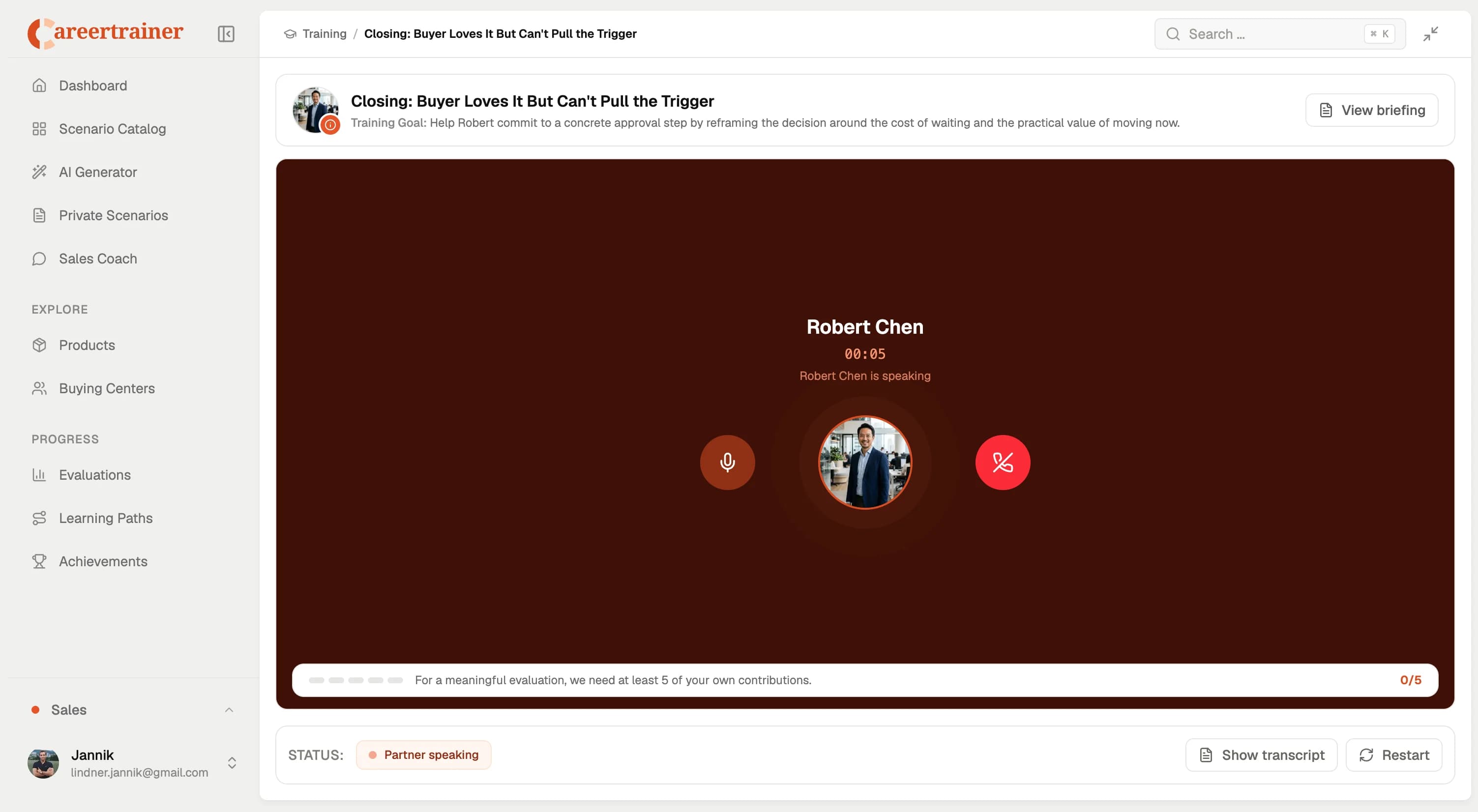
Live trainingSales

Practise with your case

Leadership · Live audio

Coaching: The High Performer Who Thinks Feedback Doesn't Apply to Them

Reese Campbell

Reese Campbell

Senior · 37

Your goal: Deliver direct feedback about the HR complaints and secure her commitment to change her communication style.

Practice now

What's inside

What the feature Personality Profile offers

Discover the key capabilities and how they enhance your training.

Big Five Assessment

The assessment reflects your self-image across the five major personality dimensions and translates this into a professionally relevant conversation context. Rather than reducing you to a simplistic type label, it provides a nuanced understanding of how you typically perform in leadership, sales, or negotiation scenarios. You complete the self-assessment directly on the platform and receive a clearly readable profile that serves as a foundation for reflection and training.

Big Five-based classification instead of rigid personality types

Helps you become more aware of patterns such as directness, security orientation, or structure.

Practical for feedback discussions, conflict resolution, cold calling, and negotiations.

Easily understandable without psychological jargon and quickly applicable in everyday conversations.

Radar Chart & Progress

Your results are visually represented in a radar chart, allowing you to quickly identify strengths, areas of tension, and skill levels at a glance. Additionally, the trend line illustrates how your self-perception evolves over time. This is especially useful when you want to track changes in your self-awareness following training, a role change, or new leadership responsibilities.

Visual representation of all dimensions in an easily comparable view

Progress tracked over multiple assessment points instead of a one-time isolated result.

Useful for coaching, retrospectives, and personal development work.

Quickly reveals changes in self-perception

Comparison of Previous Results

By comparing your previous results, you can track whether your self-image remains stable or shifts under new demands. This is particularly useful if you want to assess changes in your perception after several months of training, a team transition, or increased leadership responsibilities. This way, the profile becomes a reusable reflection tool rather than just a one-time assessment.

Direct comparison of current and previous profile statuses

Shows you developments after training, coaching, or role changes.

Helps you not only anticipate change but also make it visible.

Useful for ongoing self-reflection rather than a one-time snapshot.

Who it's for

Who is this made for?

- New leaders looking to better understand their communication patterns before engaging in feedback, conflict, or return conversations.

- Sales professionals and account executives who want to learn how they typically perform under pressure, during pricing discussions, or with analytical clients.

- Coaches, trainers, and team leaders seeking a clear framework for preparing and reflecting on conversation training sessions.

- Small and medium-sized teams that want to pragmatically combine self-reflection with real practice, without complex diagnostic processes.

- L&D and enablement managers aiming to systematically develop conversation skills without implementing a formal assessment procedure.

Typical use cases

What you actually train with it

1

You’re preparing for a critical feedback conversation and want to understand in advance whether you come across as too harsh, evasive, or overly focused on harmony in sensitive moments.

2

You’re entering a price negotiation with a confident buyer and want to reflect on how much you tend to concede or justify under pressure.

3

You analyze after several discovery calls why you succeed with structured contacts but tend to lose control of the conversation more quickly in emotionally charged discussions.

4

You're stepping into your first leadership role and want to gain a clearer understanding of how to balance authority, empathy, and structure before engaging in employee and conflict conversations.

5

You use the profile in coaching or training to not only describe conversation styles in vague terms but to connect specific patterns with subsequent role-plays and feedback.

6

You will retake the assessment after a few months to evaluate how your self-perception has changed following training, a role transition, or increased leadership responsibilities.

Self-perception becomes tangible rather than vague.

The profile was not just a personality label for us; it served as a valuable mirror. Especially before challenging conversations with employees and customers, it helped us clearly identify our own patterns and then practice more effectively.

Sales Enablement Team Lead · DACH SaaS Company

visible over time

Comparable Profile Levels

What sets it apart

What makes this feature special

01

- No hidden profiling system: Your profile is designed for self-reflection and does not automatically dictate your training in the background.

02

- Big Five instead of simplistic labels: You can explore five understandable dimensions, allowing for a more nuanced assessment of your conversational behavior than just labels like dominant or introverted.

03

- Progress tracking and comparison instead of a one-time test: Previous results remain accessible, enabling you to visualize changes in your self-perception over time.

04

- Directly within the context of conversation training: The value is not isolated but arises from the integration with live audio role-plays, evaluations, and specific conversational scenarios.

05

- Clearly not a substitute for diagnostics: This tool is intentionally not a clinical, psychometric, or HR-selective method, but rather a practical reflection tool.

Honestly assessed

When it fits — and when it doesn't

Right for you if …

  • Ideal for those looking to identify recurring behavior patterns before challenging conversations and to reflect more consciously on their own presence.
  • Ideal for those looking to combine self-reflection with practical exercises, using a profile as a foundation for coaching, leadership development, or sales training.
  • Less suitable if you expect the personality profile to automatically personalize all training scenarios for you or provide you with ready-made behavioral recipes.
  • Not suitable if you are looking for a clinical, diagnostic, or psychological assessment procedure for selection decisions, therapy, or evaluations.
  • Not the right fit if you’re solely focused on hard performance metrics and don’t value self-image, reflection, or personal development.
  • Not the right choice if you're looking for an isolated testing tool without relevance to real conversation scenarios; its strength lies in the integration of training and feedback.

Choose your plan

Transparent pricing for you alone or your whole team. Enterprise and White Label kept separate – clearly split, no jargon.

Still have questions? We're happy to advise you. Contact Us

FAQ

Frequently Asked Questions

What specific benefits does a personality profile offer you for challenging conversations?
The personality profile helps you better understand your own conversational behavior before entering a challenging situation. For instance, you can identify whether you tend to become confrontational under pressure, avoid conflicts, overly seek harmony, or adhere strictly to structure. This self-awareness is particularly valuable in feedback discussions, negotiations, cold calls, or conflicts, as many mistakes arise not from a lack of knowledge but from automatic patterns. By recognizing your patterns, you can train more consciously and focus on typical weaknesses during role-play exercises. It’s important to note: the profile does not replace conversation training. Instead, it provides a clearer foundation for reflection, enabling you to approach real-life conversations with greater awareness.
Is the personality profile a genuine Big Five test or just a rough categorization?
The profile is based on the Big Five personality traits and is intentionally designed as a self-reflection tool. You receive a comprehensive overview across multiple dimensions, such as extraversion, conscientiousness, and openness, rather than being placed into a rigid category. The distinction from simplified typologies is crucial: you won’t receive a label like "this is always how you are," but rather a nuanced perspective for your self-image. This is particularly beneficial for conversation training, as communication behavior is rarely explained by a single type. However, if you require a clinical, diagnostic, or psychometric assessment, this profile is not intended for that purpose. It is meant for practical reflection in a professional context.
Does your personality profile automatically influence your training scenarios on Careertrainer.ai?
No. The personality profile at Careertrainer.ai is explicitly not a hidden training filter that automatically adjusts your scenario or evaluation in the background. Instead, it is designed to help you gain a better understanding of your own behavior in leadership, sales, and negotiation. You can use the profile as a guide: for instance, to consciously focus on directness, uncertainty, or structure before a challenging employee conversation, or to better interpret your own performance after a sales meeting. This is where the strength lies: the tool makes your self-image more tangible without forcing you into a rigid framework. The responsibility for conclusions and personal development remains with you.
Who can benefit most from the personality profile?
This solution is particularly beneficial for individuals who regularly engage in challenging conversations and wish to understand not only techniques but also their own communication patterns. This includes new leaders preparing for their first employee discussions, sales professionals gearing up for negotiations or discovery calls, coaches and trainers in their preparation and follow-up, as well as team leads looking to systematically enhance their conversational skills. Small and medium-sized teams will find this profile appealing, as it can be utilized without extensive diagnostic efforts. Larger organizations can integrate it as a complement to role-playing, feedback, and enablement initiatives. However, it may not be suitable if you are solely seeking a selection process for recruiting, promotions, or suitability assessments.
How does the personality profile work, and how much time should you plan for it?
The process is intentionally streamlined: You complete the assessment, receive your Big Five-based self-profile, and can then visually analyze the results and compare them with previous versions. The real benefit comes from applying this knowledge. You use your profile as a foundation for reflection in specific conversation scenarios, such as feedback discussions, price negotiations, or coaching sessions. This transforms a one-time test result into a practical reference for your actual behavior. You don’t need a separate diagnostic project or a background in psychology for this. However, if you are looking for just a simple test certificate, this is not the right use case.
How can you tell if a personality profile is the right choice for you, or if you need direct role-play training instead?
The Profile is the ideal choice if you want to first understand the internal patterns you bring to conversations. It helps you identify recurring tendencies, such as directness, security orientation, openness, or structure. If your primary goal is immediate conversation practice—perhaps for a specific negotiation tomorrow or a challenging employee discussion next week—live audio role-plays are typically the more direct approach. Here, you can train your reactions, phrasing, and conversation management under realistic pressure. The most effective strategy combines both approaches: first, sharpen your self-awareness, then practice the difficult conversation, and finally evaluate with feedback. This way, you connect reflection and behavior instead of focusing on just one aspect.
How does the personality profile differ from seminars, e-learning, or generic chatbots?
Seminars and e-learning often provide models and language for communication, but they don't automatically show you how you typically react under pressure. A generic chatbot can answer questions, but it usually fails to deliver a structured, reusable self-profile with history and comparisons. Careertrainer.ai addresses this gap with its personality profile: you gain a concrete foundation for self-reflection that you can directly connect to conversation training. This ensures that the profile is not just abstract but becomes applicable in real situations such as feedback discussions, cold calling, or negotiations. It's neither an isolated personality test nor just a learning module. The real value comes from the integration of self-perception, realistic practice, and subsequent evaluation.
Can you also use the personality profile in team settings, coaching, or enablement?
Yes, this is an excellent fit. In coaching, it establishes a common language to describe conversation styles not just with vague terms like dominant, defensive, or unstructured, but through systematic reflection. For team leads, L&D, and sales enablement, the profile is particularly valuable when self-reflection is intended to complement role-playing and feedback. It aids in making development efforts more tangible without the immediate need for a heavy diagnostic program. It's essential to maintain the right context for use: the profile should be utilized for development and preparation, not as the sole tool for evaluation, selection, or formal suitability judgments.
Are there white-label or partner models available for the personality profile at Careertrainer.ai?
Yes. If you are a training provider, coaching boutique, HR platform, or enablement partner looking to offer self-reflection and conversation training under your own brand, the personality profile can be a valuable component. This is particularly appealing in the areas of leadership, sales, and negotiation, as partners can provide their clients not only with practice scenarios but also with a structured basis for reflection. This enhances the preparation and follow-up of training sessions without the need to develop a proprietary diagnostic product. Depending on your setup, integration into a larger training offering or white-label usage is possible. It's important for partners to note that the profile is positioned as a practical self-reflection tool, not as clinical or psychometric diagnostics.
Is the personality profile also suitable for companies that prioritize data protection and clear categorization?
Yes, especially if you're looking for a tool that is clearly positioned for self-reflection and not used as a covert assessment or selection instrument. For companies, this clarity is crucial to ensure that expectations, frameworks, and internal communication remain transparent. Careertrainer.ai is focused on the DACH region and designed for professional conversation training. The personality profile fits well within development, coaching, and enablement contexts, where employees are encouraged to reflect on their own conversational behavior. If you need a formal procedure for personnel diagnostics, suitability assessments, or medical-psychological evaluations, you should opt for a different, specifically designed tool.

Ready to try it yourself?

Start in minutes with a realistic AI role-play — no setup required.

Related features

Other features from Careertrainer.ai

Discover more features that fit this topic.

Account & Security with Real Control
LeadershipSales

Account & Security with Real Control

When you train with realistic AI role-plays, it's essential that not only the conversations are on point, but also the surrounding conditions. Careertrainer.ai gives you control over sensitive access through two-factor authentication, ensures linguistic compatibility in the DACH region with language and dialect options, and manages the entire lifecycle of your account, including complete deletion. This is particularly important for individuals looking to get started quickly, teams managing multiple roles, or companies and partners prioritizing robust security and self-management features before a rollout.

AI Coach for Preparation and Reflection
LeadershipSales

AI Coach for Preparation and Reflection

The AI Coach is your text-based sparring partner before and after challenging conversations in leadership, sales, and negotiations. You bring a specific situation, outline your goals, risks, and challenging points, and receive not just general advice but precise follow-up questions, phrasing options, conversation structures, and actionable next steps. This transforms a vague scenario into a clear conversation plan. Unlike a standard chat, the Coach goes beyond text-based support; it helps you turn your preparation or follow-up into a trainable scenario and guides you directly into relevant voice role-plays, allowing you to practice critical passages aloud under pressure.

AI Conversation Training in Your Brand
LeadershipSales

AI Conversation Training in Your Brand

Provide realistic live audio role-play scenarios for leadership, sales, and negotiation under your own brand. You manage the domain, branding, customer access, quotas, and approved scenarios centrally, while your clients can immediately engage in high-quality, speech-based training. This allows you to create a digital premium offering that bridges the gap between workshops, coaching sessions, and rollouts, providing genuine practice opportunities without the need for you to facilitate every session personally.

AI Role-Play Training for Authentic Conversation Moments
LeadershipSales

AI Role-Play Training for Authentic Conversation Moments

Whether it's a termination conversation, handling price objections, delivering critical feedback, or navigating sensitive negotiations, you will train for these specific scenarios through realistic live audio role-plays with psychologically accurate AI characters. Instead of theory or text chat, you engage in real-time conversations, receive immediate, evidence-based feedback, and can revisit the exact moments where things often go awry in real situations.

Corporate Management for AI Training
LeadershipSales

Corporate Management for AI Training

To make AI conversation training effective in your organization, you need more than individual access. With Careertrainer.ai's Enterprise Management, you can centrally control which scenarios are visible, which company-specific training cases are deployed, and how the experience appears to employees under your brand. At the same time, you can monitor training activities across your organization, identify skill gaps, and determine where additional enablement is needed. This way, you combine self-directed practice for individual employees with clear governance for HR, Sales Enablement, and leadership.

Create Role-plays Instantly
LeadershipSales

Create Role-plays Instantly

With Careertrainer.ai's role-play generator, you can create tailored conversation training in just minutes, designed specifically for your unique situation rather than relying on generic templates. Simply input the context, objectives, audience, product or company details, and common objections, and our AI will generate a comprehensive scenario for leadership, sales, or negotiation. The result is not a static text block, but a dynamic live conversation featuring a credible persona, appropriate difficulty level, and a clear conversation focus. This allows you to practice the exact phrases, follow-up questions, and objections that are likely to arise in your real-life scenario.