Feature · Training Modes

Training Modes for Real-Life Conversation Scenarios

Train leadership and sales using your own coaching logic, tailored competency models, and realistic AI responses in the background. You can practice negotiations, salary discussions, and job interviews directly, without the need to switch between tools or training methods.

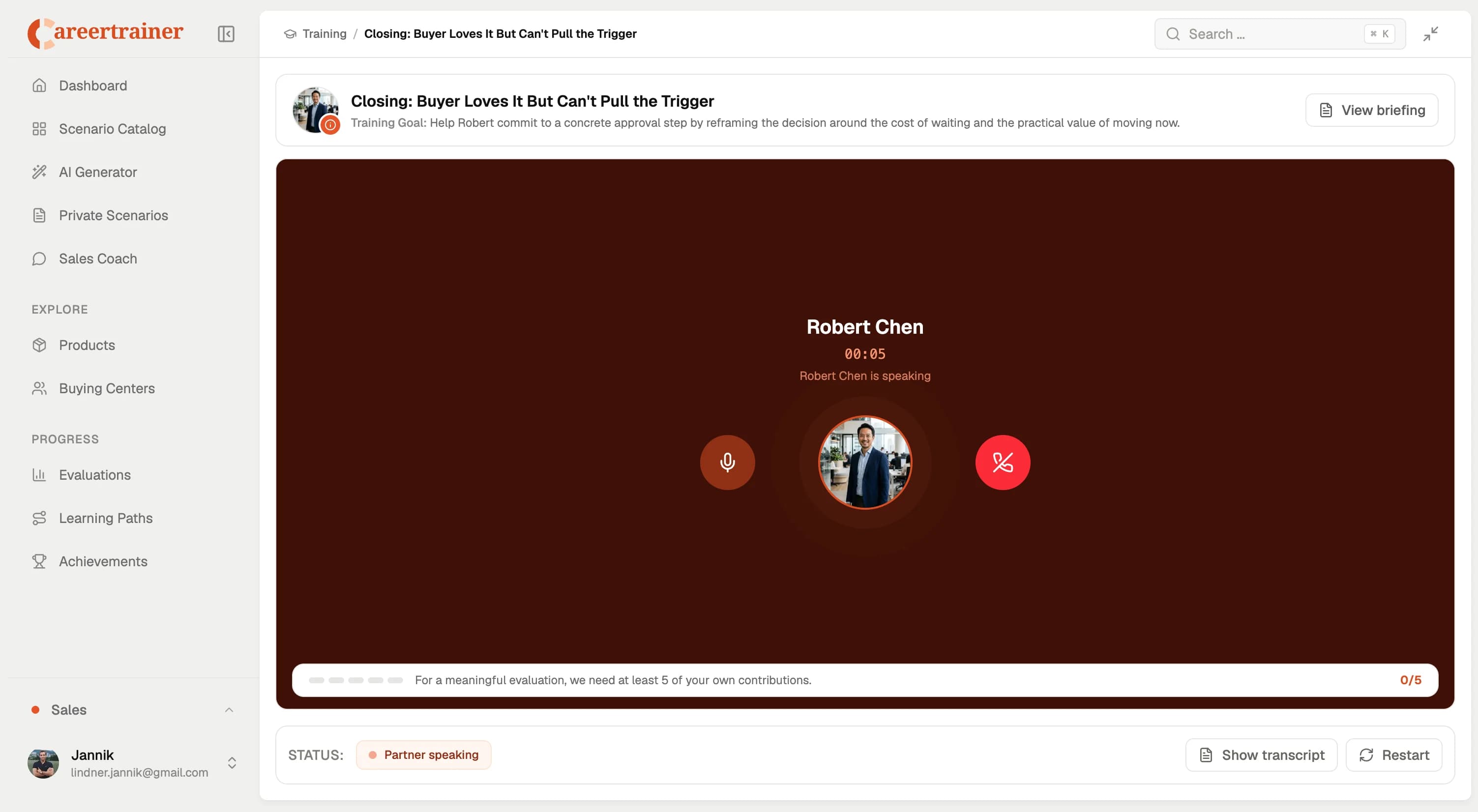
A return-to-work conversation after illness, handling tough objections in sales, or conducting a termination discussion each require different skills. That's why Careertrainer.ai offers various training modes instead of a one-size-fits-all role-play. In the leadership mode, for instance, clarity, empathy, de-escalation, and expectation management are crucial, unlike in a discovery or pricing negotiation. In the sales mode, our AI responds to relevance, questioning techniques, value propositions, buying center dynamics, and managing pushback. You engage in live audio conversations, train in just a few minutes with a psychologically designed persona, and receive feedback tailored specifically to the type of conversation you're practicing.

Start conversationLeadership · Coaching: The High Performer Who Thinks Feedback Doesn't Apply to Them
Reese Campbell

Reese Campbell

Senior

  • Cross-Industry

Your task

Deliver direct feedback about the HR complaints and secure her commitment to change her communication style.

Also available:+25 more

What's inside

What Training Modes can do

Leadership & Management

The Leadership Mode is designed for sensitive personnel situations where relationship-building, clarity, and emotional control are crucial.

You will engage in live conversations addressing topics such as feedback, conflict resolution, return-to-work discussions, or terminations with a persona that credibly responds to uncertainty, pressure, or misunderstandings. The evaluation focuses not on sales techniques, but rather on leadership behaviors, de-escalation strategies, clarity of expectations, and conversation structure.

  • Train critical conversations such as feedback, conflict resolution, return discussions, and termination talks with realistic emotional responses.
  • Evaluates skills such as empathy, clarity, boundary-setting, de-escalation, and accountability.
  • Utilize a leadership coach optimized for sensitive personnel situations rather than sales metrics.

Sales

The Sales Mode simulates typical B2B and consultative selling scenarios with appropriate buying dynamics.

You will engage in live training for cold calling, discovery, objection handling, pricing discussions, and upselling with target individuals who respond differently based on their perception of value, risk assessment, and stakeholder situation. The feedback will indicate whether you are creating relevance, accurately diagnosing needs, articulating value, and maintaining composure under pressure.

  • Train cold calling, discovery, demos, objection handling, pricing discussions, closing, and existing customer development.
  • Considers products, buying centers, decision-making logic, and typical B2B objections throughout the conversation.
  • Evaluates skills such as building relevance, questioning techniques, value proposition, stakeholder understanding, and resilience.

Additional Trainable Areas

Additional conversation topics such as negotiation, procurement, salary discussions, or job interviews can be trained directly on the platform without the need for a specialized tool.

The platform leverages the robust mechanics of existing modes and tailors scenarios to real conversation dynamics: clarifying interests, managing pushback, self-positioning, or diagnostic questioning. This allows you to quickly cover additional formats without resorting to a separate system or disconnected training methodologies.

  • Covers negotiation and purchasing as well as salary discussions and job interviews.
  • Leverage the existing engine logic instead of isolated mini-tools or rigid script-based training.
  • Enables rapid scenario creation for tailored occasions with similar conversation mechanics.

Who is Training Modes for?

For users

For executives, team leaders, and aspiring people managers looking to gain confidence in handling feedback, conflict, return, or termination conversations.

For SDRs, AEs, account managers, and sales leaders who want to practice cold calling, discovery, objection handling, pricing discussions, and upselling in realistic scenarios.

For HR, L&D, and sales enablement teams in organizations of all sizes seeking to train various conversation types on a unified, scalable platform.

For freelancers, consultants, and individuals who want to practice before a real meeting without the need to coordinate with a trainer.

For training providers and consultancies looking to deliver conversation training consistently, roll it out faster, and offer it under their own brand when needed.

Typical moments for Training Modes

Other moments

You are preparing for a feedback conversation with a technically skilled employee who tends to become defensive quickly, and you want to communicate clearly without damaging the relationship.

You are conducting a discovery session with an analytical B2B decision-making group and want to systematically uncover needs, stakeholders, and decision-making logic.

You practice a pricing discussion with an existing customer and aim to defend value clearly instead of reflexively offering discounts.

You are simulating a return-to-work conversation after a prolonged illness and want to professionally connect care, resilience, and next steps.

You’re practicing a cold call with a skeptical prospect and need to establish relevance in the first few minutes before they disengage.

You use the same training framework for salary negotiations or job interviews and want to communicate more clearly under pressure and follow up more effectively.

When Training Modes fits — and when it does not

Fits when …

you expect a leadership conversation to be evaluated differently than a discovery call, objection handling, or price negotiation.

A great fit if you want to practice for real conversations on short notice while simulating specific reactions, pushback, and emotionally challenging moments.

Does not fit when …

A great fit if you want to scale from individual training to team or enterprise use without the need to switch platforms later.

you're only looking to read learning materials, watch videos, or test your knowledge with multiple-choice questions without engaging in live conversations.

you're looking for a rigid standard library that doesn't adapt to conversation dynamics, personas, or specific discussion contexts.

your needs are purely technical and do not focus on conversation skills, behavior under pressure, or communicative impact.

How Careertrainer is built

Practice, not courses. Careertrainer.ai trains conversations. E-learning and courses are the better choice for transferring knowledge.

Simple, so people use it. Ready in minutes, in the browser, without an IT project. Sessions of 5–15 minutes fit into any working day.

Leading language models, not an in-house model. Careertrainer.ai integrates leading models from external providers and switches when a better one becomes available. The subprocessors list shows which providers are used.

Frequently asked questions about Training Modes

Which training mode is right for my conversation?

<p>The appropriate mode depends on the type of conversation you want to conduct and the skills you wish to be evaluated on.

For employee reviews, feedback, conflict resolution, return-to-work discussions, or termination conversations, the Leadership mode is ideal. For cold calling, discovery, demos, handling objections, pricing discussions, or upselling, the Sales mode is more suitable.</p><p>The distinction goes beyond just the topic. Each mode employs its own set of rules, coaching logic, and competency models. This means that a challenging feedback conversation is not assessed using sales logic, nor is a discovery session evaluated against leadership standards. If you also want to practice negotiation, salary discussions, or job interviews, you can seamlessly incorporate these conversations based on the existing modes.</p>

What is the difference between leadership mode and sales mode?

<p>In Leadership mode, Careertrainer.ai focuses on evaluating conversation skills in sensitive personnel situations: clarity, empathy, de-escalation, expectation management, accountability, and emotional handling.

This is crucial when dealing with resistance, uncertainty, or relationship issues.</p><p>In Sales mode, different skills take center stage: building relevance, questioning techniques, value proposition, stakeholder understanding, objection handling, and managing purchasing pressure. The AI responds appropriately to the sales context, addressing skepticism, price pressure, or buying center dynamics. This ensures you receive feedback that aligns with the conversation's objectives rather than just generic communication tips.</p>

Yes, you can train negotiation skills, salary discussions, or job interviews, even though these are not standalone modes. Our platform allows you to customize scenarios to practice these important conversations effectively.

<p>Yes, these conversation areas can be directly trained, even though they are not a separate engine mode.

Careertrainer.ai leverages existing strengths in leadership and sales, depending on whether the conversation focuses more on relationship-building, clarity, and de-escalation, or on value arguments, pushback, and decision-making logic.</p><p>This approach is often more practical than artificially creating a third or fourth mode. For instance, a salary negotiation requires both clear communication of interests and resilience under pressure. A job interview can be more diagnostic or more persuasive. You’re training not just a label, but the real dynamics of conversation.</p>

How does a training session with the appropriate mode actually work?

<p>First, you select the conversation context and mode, such as leadership or sales.

Next, you briefly describe the situation, including the role of the other party, the goal of the conversation, and any specific tensions or objections. Based on this information, the platform generates a suitable persona and a realistic role-play scenario.</p><p>Then, you engage in a live audio conversation, typically lasting between 5 to 15 minutes. Afterward, you receive a structured evaluation that includes competency scores, strengths, weaknesses, common mistakes, and specific strategies for your next attempt. If you wish, you can immediately repeat the same scenario and test a different conversation strategy under comparable conditions.</p>

What prerequisites do I need to start using the training modes?

<p>You don’t need a workshop, a dedicated training team, or typically even an IT project.

What’s essential is that you know what type of conversation you want to practice and the goal you aim to achieve. The clearer the purpose, the more precise the simulation will be.</p><p>For individuals, often a specific appointment is enough to prepare for. For teams, it’s beneficial to identify typical conversation scenarios, such as performance reviews in leadership or discovery and objection handling in sales. Getting started is easy, but the benefits increase with the context you provide for the scenario.</p>

Who can benefit most from a dedicated training mode?

<p>This is especially beneficial for roles that frequently engage in challenging conversations, requiring not only expertise but also the ability to make an impact under pressure.

This includes leaders, team leads, HR professionals, SDRs, AEs, account managers, and sales directors. Individuals also gain significantly when they want to practice specifically before an important meeting.</p><p>For teams, separating training modes is advantageous when different types of conversations need to be effectively practiced. A company doesn't have to use the same approach for termination discussions, discovery calls, and price negotiations. This tailored approach increases acceptance within the team and makes feedback much more actionable.</p>

How does this differ from seminars, e-learning, or manual role-playing?

<p>Seminars and e-learning often provide valuable models, but they rarely offer enough real conversation practice under pressure.

Manual role-plays with colleagues or trainers can be effective, but they are time-consuming, inconsistent, and difficult to scale. Additionally, people often respond either too kindly or too artificially in practice scenarios.</p><p>Careertrainer.ai combines repeatability with realistic responses. You engage in live audio conversations with an AI persona that doesn’t just confirm keywords but reacts based on your behavior—opening up, blocking, or applying pressure as needed. Unlike generic chatbots, you receive mode-specific training with tailored feedback rather than just generic text responses.</p>

How realistic are the conversations in the different training modes?

<p>The conversations are designed to replicate real dynamics rather than just going through a list of questions.

The AI persona exhibits a consistent behavioral pattern, responding in phases and adjusting its openness based on how you ask, argue, or handle tension. This means that a defensive employee feels different than a skeptical buyer or an analytical decision-maker.</p><p>Importantly, realism is achieved not just through voice but also through appropriate reactions. In leadership mode, this manifests as emotion, withdrawal, or resistance. In sales mode, it typically appears as skepticism, time pressure, objections, or buying center behavior. This is precisely why having separate training modes is beneficial.</p>

How can I estimate the effort and budget for different training modes?

<p>The most important question is not how many modes you could theoretically use, but which types of conversations will have the greatest impact for you.

When training individually, you typically start with the mode that aligns with your next real conversation. For teams, a focused approach is often beneficial, such as starting with leadership or sales before expanding to other conversation areas.</p><p>The effort remains manageable because you don't need to implement separate systems. The same platform supports individual training, team usage, and future rollouts. For budget estimation, it's crucial to consider how often training will take place, how many roles are involved, and whether you need only standard cases or more customized scenarios.</p>

Can training providers or consultancies use the training modes as white-label solutions?

<p>Yes.

If you are a training provider, consultancy, or enablement partner offering conversation training for leadership or sales, you can utilize Careertrainer.ai under your own brand or as an integrated solution. This is particularly appealing if you want to digitally scale recurring formats such as feedback conversations, discovery sessions, objection handling, or price negotiations without resorting to generic chatbot experiences.</p><p>The advantage for partners is that you not only deliver content but also provide interactive live audio role-plays with tailored logic. This allows you to consistently implement your training approach, customize it for different customer segments, and seamlessly integrate your own scenarios, branding, and organizational framework as needed.</p>

Related features

Other features from Careertrainer.ai

Discover more features that fit this topic.

Account & Security with Real Control
LeadershipSales

Account & Security with Real Control

When you train with realistic AI role-plays, it's essential that not only the conversations are on point, but also the surrounding conditions. Careertrainer.ai gives you control over sensitive access through two-factor authentication, ensures linguistic compatibility in the DACH region with language and dialect options, and manages the entire lifecycle of your account, including complete deletion. This is particularly important for individuals looking to get started quickly, teams managing multiple roles, or companies and partners prioritizing robust security and self-management features before a rollout.

AI Coach
LeadershipSales

AI Coach

Before important conversations, there is often a lack of a clear next practice step, and after the role play, questions about the evaluation remain open. Four AI coaches accompany you via voice or text, clarify the situation, and build a suitable role play after your confirmation. Afterwards, you discuss the evaluation results, criteria, transcript, and professional tips, and track up to three focus competencies.

AI Role Plays for Difficult Conversations
LeadershipSales

AI Role Plays for Difficult Conversations

Before a difficult conversation, there is often no opportunity to practice your opening under realistic pressure. In a spoken role-play, an AI character responds to your arguments; a conversation lasts 5–15 minutes. Afterwards, a second AI evaluates the transcript with quotes, and you can repeat the same situation as many times as you like.

Company Profile: AI Role-Playing Games with the Knowledge of Your Company
LeadershipSales

Company Profile: AI Role-Playing Games with the Knowledge of Your Company

If practice cases miss the offer, customer types, and tone of conversation, the connection to your own company is lacking. The profile organizes confirmed company knowledge for all four training areas and feeds it into the scenario generator, conversation figure, and evaluation. Only after your confirmation do profile contents flow into the training and shape conversations with the context of your company.

Try Training Modes now

Start your first AI role-play and practice the exact situation you need next.