careertrainer.ai

Practice handling objections, objection-handling training, contract negotiations, and customer retention in realistic live audio role-play scenarios.

Sales training in the energy industry for confident customer and pricing conversations

Careertrainer.ai helps you train challenging sales conversations in energy sales—everything from discount pressure to cancellation intent. With AI role-play training, you practice in realistic scenarios and get immediate feedback on your conversation skills.

Live example · This is what training looks like

12 scenarios
Phone call

Practise with your product

Rachel Bennett

Rachel Bennett

Sales·Discovery
The fast skeptical sales filter

Head of Sales · 32 · ESTP

Energy & RenewablesCold call openingHead of Sales

Cold energy call shuts down in 30 seconds

A quick call turns into a no for Rachel

At 9:10 a.m., Rachel answers from her desk, clearly already booked for the day. She immediately pushes back and asks why you are calling at all.

Goal: Use one sharp question or value statement tied to energy switching and contract timing. Keep it under half a minute by targeting the sales team’s current renewal pressure and decision process.

Learning goals

  • Earn permission for one question
  • Deliver one relevance hook

What to expect

  • Uses short relevance questions under strict time
  • Challenges generic purpose and demands energy-market context
Practise with your product

Metrics that make price negotiations, churn risks, and training success measurable and actionable

If you want to handle customer conversations more confidently in energy sales, what matters most are margin, customer retention, response speed—and the real impact that practice has.

5–25%
Increase your margin with better pricing
Even small pricing deviations can impact profit disproportionately. That’s exactly why targeted conversation training for negotiation and discount pressure is worth it. (Source: mckinsey.com, 2003)
32%
Switch for a better price
Price remains a key driver for churn and switching. If you handle objections cleanly and confidently, you protect your existing customers—and improve your chances of closing, especially in competitive markets. (Source: verivox.de, 2023)
In under 24 hours
Expected response time in B2B sales
Fast responses often decide who wins the deal. Teams that practice critical conversations in advance go into callbacks and negotiation meetings more structured—and more confident. (Source: hubspot.com, 2024)
20%
Higher performance through deliberate practice
Structured practice with feedback measurably improves performance more than knowledge alone. That’s the real leverage behind modern sales coaching. (Source: hbr.org, 2011)

Where energy sales conversations go off the rails

In energy sales, it comes down to price logic, switching risk, buying-center dynamics, and contract details whether you protect your margins—or lose deals. With Careertrainer.ai, you can train exactly these critical conversation moments through realistic AI role-play scenarios.

AI character for industry-focused solutions

AI role-play focus

When price, risk, and committee pressure take the lead

Careertrainer.ai helps you rehearse sensitive sales and retention conversations in energy sales as realistic live audio role-plays with instant feedback—so you can train, repeat, and improve.

Handle discounts smoothly and consistentlyNavigate the Buying Center
Challenge 01

Spot market comparisons can dismantle your pricing arguments.

Buyers and existing customers enter negotiations with daily prices, comparison websites, or aggressive counteroffers—and squeeze every bit of pricing logic down to a pure work-cost basis. If your team doesn’t translate risk, procurement, contract terms, and service requirements clearly into the discussion, your margin, close rate, and contract quality will suffer. With Careertrainer.ai, you can train these exact pricing and contract conversations with AI role-plays—using realistic objections, negotiation pressure, and immediate feedback on your argumentation and wording.

Book a free demo
Challenge 02

Great offers often fail in the buying center—not because of the idea, but because of quiet objections.

In B2B energy sales, it’s rarely just one decision-maker at the table. Procurement wants the best price, Finance needs planning certainty, Operations focuses on supply security, and leadership asks about risk and flexibility. If you identify stakeholders too late—or address them incorrectly—you lose time, trust, and ultimately the deal. Careertrainer.ai trains this multi-stakeholder logic in real-world conversation simulations, so you can reliably handle needs, objections, and decision-making priorities for each role.

Book a free demo
Challenge 03

New sales reps trip over contract logic instead of mastering conversation technique.

General sales training alone isn’t enough during onboarding if new colleagues can’t clearly explain pricing components, contract terms, notice periods, bundled models, or the procurement logic during customer meetings. The result: long ramp-up times, uncertain conversations, and avoidable escalations in Pre-Sales or specialist teams. Careertrainer.ai shortens the path to confident, safe conversations with industry-relevant AI role-play scenarios—so your team practices the exact critical phrasing and objection patterns that matter.

Book a free demo
Challenge 04

Existing customers’ intent to cancel can shift faster than you think.

When a customer has already requested comparison offers due to pricing, contract changes, or dissatisfaction, a standard script isn’t enough to win them back. Every weak sentence increases churn risk, revenue loss, and pressure to re-negotiate terms or offer a discount. With Careertrainer.ai, you can train these high-stakes retention and switching conversations as live conversation training—so your team masters objection handling, structured discussions, and retention logic under realistic pressure.

Book a free demo

Sales training in the energy industry: lead customer conversations confidently—train for typical conversations with AI

Four practical scenarios for “Sales training in the energy industry: handle customer conversations confidently” — practice typical conversations with realistic AI characters in Careertrainer.ai.

Filter by industry, situation, objection and buyer persona. Every example leads directly into your own AI role-play.

12 of 12 scenarios

Situation

Objection

Buyer persona

Emily Parker

Emily Parker

Midmarket CEO

Energy & RenewablesDiscovery callWe already have a providerMidmarket CEO

Late afternoon, Emily answers from her office while the supplier rate sheet is open. She says she already has an energy provider and asks why your call matters now.

What you'll practise

  • Ask value drivers first
  • Qualify the switching trigger
  • Turn price into cost context
Our price looks fine on paper, but what changes in real life?
Michael Brooks

Michael Brooks

Small Business Owner

Energy & RenewablesGatekeeper block on phoneBad past experienceSmall Business Owner

On site at the factory meeting room, Michael drops his checklist on the table. He smiles and says your proposal must beat the cheapest line item from the last tender.

What you'll practise

  • Reframe comparison criteria
  • Name the risk in low price
  • Anchor a decision metric
These tenders turn into a spreadsheet, and one missing clause hurts.
Alex Taylor

Alex Taylor

Midmarket CFO

Energy & RenewablesExecutive briefingContract still runningMidmarket CFO

Early morning on the phone, Alex interrupts with his contract start date and renewal month. He says the current energy agreement is still running and asks why change matters now.

What you'll practise

  • Quantify in-term cost pressure
  • Design a controlled pilot option
  • Use CFO language for negotiation
We’re in the middle of the term, so show me the financial drift.
Sophie Morgan

Sophie Morgan

Midmarket CTO

Energy & RenewablesExecutive briefingGDPR concernMidmarket CTO

At the city utility office lobby, Sophie stands by a printer with a stack of papers. She says she planned to discuss an IT connection for meter data, then forces a pivot when the contract decision is due soon.

What you'll practise

  • Acknowledge hijacked priorities
  • Bridge to the next contract decision
  • Align on approval conditions
We can’t miss the data handling part, but we’re also near the deadline.
Owen Foster

Owen Foster

IT Director

Energy & RenewablesChurn prevention with existing customerIT Director

Late afternoon, Owen picks up your call after the contract notice hit his desk. He says he is not accountable for the supplier decision, and he wants the call to end quickly.

What you'll practise

  • Confirm decision ownership early
  • Handle IT denial calmly
  • Lock next contact without pressure
I’m not the person signing anything, so why am I on this line?
Jordan Blake

Jordan Blake

HR Director

Energy & RenewablesActive closingBudget lockedHR Director

On site at your client’s office, Jordan meets you near the conference room after the quarterly targets brief. He notes HR funding is frozen, and he does not want any commitment that will later look like overspend.

What you'll practise

  • Distinguish freeze from bad timing
  • Build a phased business case
  • Agree next decision touchpoint
If finance sees a commitment now, it lands on my report.
Rachel Bennett

Rachel Bennett

Head of Sales

Energy & RenewablesCold call openingHead of Sales

At 9:10 a.m., Rachel answers from her desk, clearly already booked for the day. She immediately pushes back and asks why you are calling at all.

What you'll practise

  • Earn permission for one question
  • Deliver one relevance hook
  • Confirm next step with sales timing
If this is a sales pitch, I’m not doing it today.
Ethan Collins

Ethan Collins

Procurement Lead

Energy & RenewablesExecutive briefingContract still runningProcurement Lead

On a weekday morning at the client site, Ethan sits with you by the procurement desk. He says his team can discuss pricing, but the decision requires sign-off steps tied to an active contract.

What you'll practise

  • Clarify contract timeline trigger
  • Expose committee approval path
  • Request the right meeting next
We can talk pricing, sure, but approval runs through a committee.
Casey Hayes

Casey Hayes

Marketing Director

Energy & RenewablesCustomer complaint handlingBad past experienceMarketing Director

On the phone, Casey starts with numbers and a complaint about last month’s delivery SLAs. She cuts in mid-explanation because customers already asked for contract changes.

What you'll practise

  • Summarize the SLA failure
  • Ask a measurable correction question
  • Agree a next repair step
Casey here. Last month’s SLA breach is on your side, not ours.
Laura Hughes

Laura Hughes

Operations Director

Energy & RenewablesDiscovery callCompliance reasonsOperations Director

Across from you at the office, Laura says the planned contract change depends on technical compliance evidence. She already reviewed the meter data flow with her controls team.

What you'll practise

  • Ask one compliance evidence question
  • Match proof to an approval deadline
  • Confirm the next approval step
Show me the meter data handling, not another discount slide.
Noah Mitchell

Noah Mitchell

General Practitioner

Energy & RenewablesGhosting recoveryCall back laterGeneral Practitioner

Over the phone, Noah initiates the talk with renewal timing worries and then goes quiet. He suggests a pilot comparison is underway, but answers stay vague.

What you'll practise

  • Clarify who decides and by when
  • Identify what blocks renewal momentum
  • Agree one next info step
We are comparing internally. Calling again costs everyone time, so I want it right.
Riley Stone

Riley Stone

Private Customer

Energy & RenewablesDiscovery callNeed to discuss with partnerPrivate Customer

On site at the customer’s home, Riley starts guarded and mentions her partner has the final say. She says the contract and delivery timing feel too tight to decide today.

What you'll practise

  • Uncover the real stalling reason
  • Present two slot options for decision
  • State the impact of doing nothing
I’ll talk to my partner, but I need to know what changes for delivery.

How the AI evaluates your training conversation

After every role-play a separate AI analyses your full conversation transcript — with score, goal feedback and concrete quotes from your own dialogue.

Two layers feed the overall score: scenario-specific goals (70%) and five core competencies for your training type (30%).

SummaryRating: Solid

Emily Parker · Filtering a B2B energy price anchor call

Lead with usage and clause drivers before touching the rate number

Pivot from price anchor to decision criteria by qualifying contract scope and risk exposure. Confirm whether a switching event is even on the table and what would make it worth it.

Overall result
6.7/ 10

70% scenario goals + 30% core competencies

Scale 0–10 · backed by quotes from your conversation

Scenario goals · 70%Core competencies · 30%

Scenario goals

Scenario goals · 70%

Ask value drivers first

6.4 / 10

Ask at least two open questions about the site’s energy usage risk and current contract structure before any pricing discussion. This keeps the call from turning into a list-price comparison.

Partially achieved

You asked about cost drivers, but you only made one concrete open question tied to usage risk and clause structure before price talk.

For ENergy contracts, what drives your total cost besides kWh rates?

Qualify the switching trigger

6.4 / 10

Identify the concrete event that would justify switching, such as contract end date or a tariff change impact. Tie it to a measurable business consequence for Emily.

Partially achieved

You probed whether switching depends on timing or risk, but you didn’t link it to business impact like budget or exposure.

Is switching tied to contract end date or a risk event? (discovery)

Turn price into cost context

8.4 / 10

Reframe pricing as total cost drivers, like forecasted demand and contract duration, instead of quoting rates. Confirm the decision criteria so Emily can judge relevance fast.

Fully achieved

You reframed the discussion from list rate focus to total cost context by referencing kWh rate vs cost drivers.

For ENergy contracts, what drives your total cost besides kWh rates?

Core competencies

Core competencies · 30%

Needs analysis

6.4

Systematically uncover needs and requirements

Value articulation

6.9

Present concrete value for the customer

Objection handling

6.7

Address objections professionally and constructively

Closing orientation

7.0

Work toward a close or clear next step

Relationship building

6.5

Build trust and rapport

Details · Transcript excerpt

YouFor ENergy contracts, what drives your total cost besides kWh rates?
Emily ParkerWe already have a provider. Our price looks fine on paper, honestly.
YouIs switching tied to contract end date or a risk event? (discovery)
Pro tip

In energy discovery, ask first: "What clauses or load changes drive your annual cost?" before stating any per kWh.

Only your wording is evaluated — not the AI counterpart's. The AI's opening of the conversation is not penalised.

Practise with your product

Train your toughest customer conversations in energy sales with Careertrainer.ai

Choose realistic AI role-play sales training for your day-to-day work, run the conversation as a live audio simulation, and see right away how confidently you handle price discussions, churn risks, and contract negotiations.

1

Choose the right conversation for pricing, contract change, or existing customer scenarios

You start with an AI role-play that matches your sales phase: first meetings, objection handling, price negotiations, contract renewals, or winning back customers who are considering switching. You’ll train the kinds of real conversations you face with procurement managers, energy buyers, managing directors, and technical decision-makers in B2B energy sales.

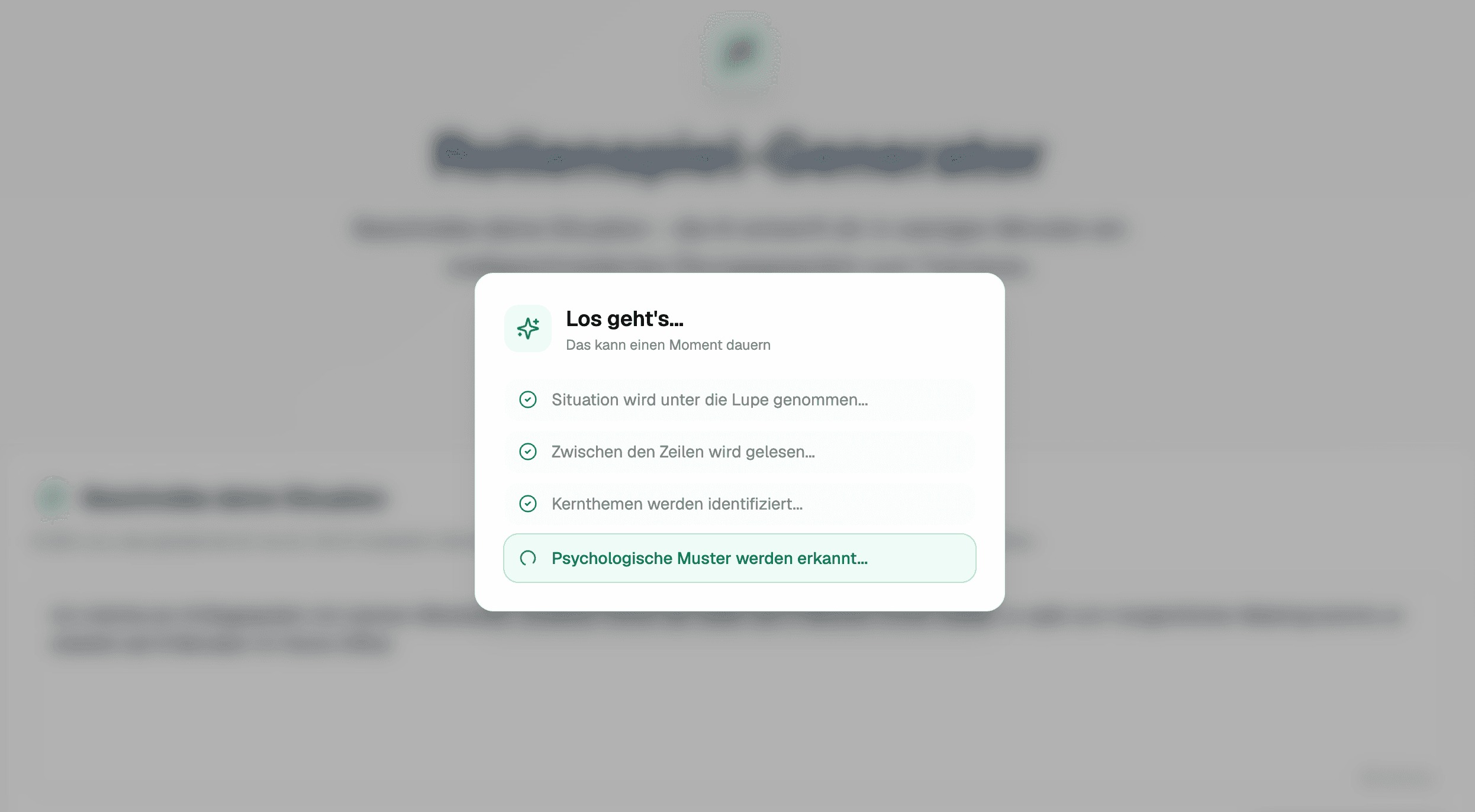
AI Role-Play Generator in Careertrainer.ai
2

Practice customer conversations with realistic Voice AI simulations

In the simulation, you speak live with an AI counterpart that responds credibly to discount pressure, competitor offers, contract terms, price-locking, risk-based arguments, or internal approvals. This lets you practice conversation skills under realistic conditions—not theory—and test different approaches for sales training, sales coaching, and conversation training without any risk to real accounts.

Voice AI conversation simulation in Careertrainer.ai
3

Analyze feedback and measure progress in deal performance, margin, and retention

After each conversation, you’ll receive a clear, actionable evaluation of your objection handling, needs discovery, price defense, negotiation management, and closing strength. You’ll see exactly where you may be giving up margin in energy sales, which wording works better when customers are considering switching—and how your sales conversation training improves in measurable terms.

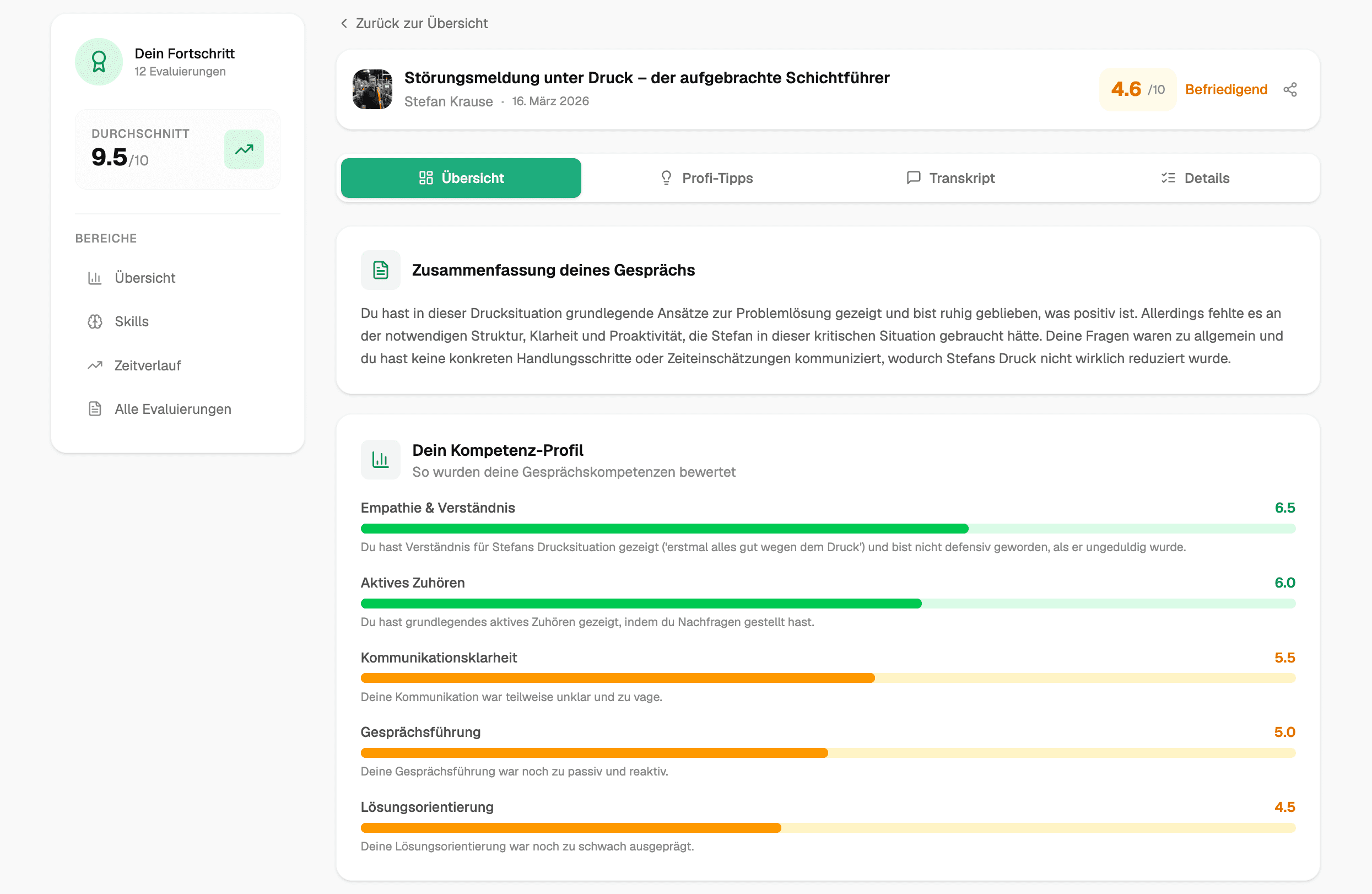
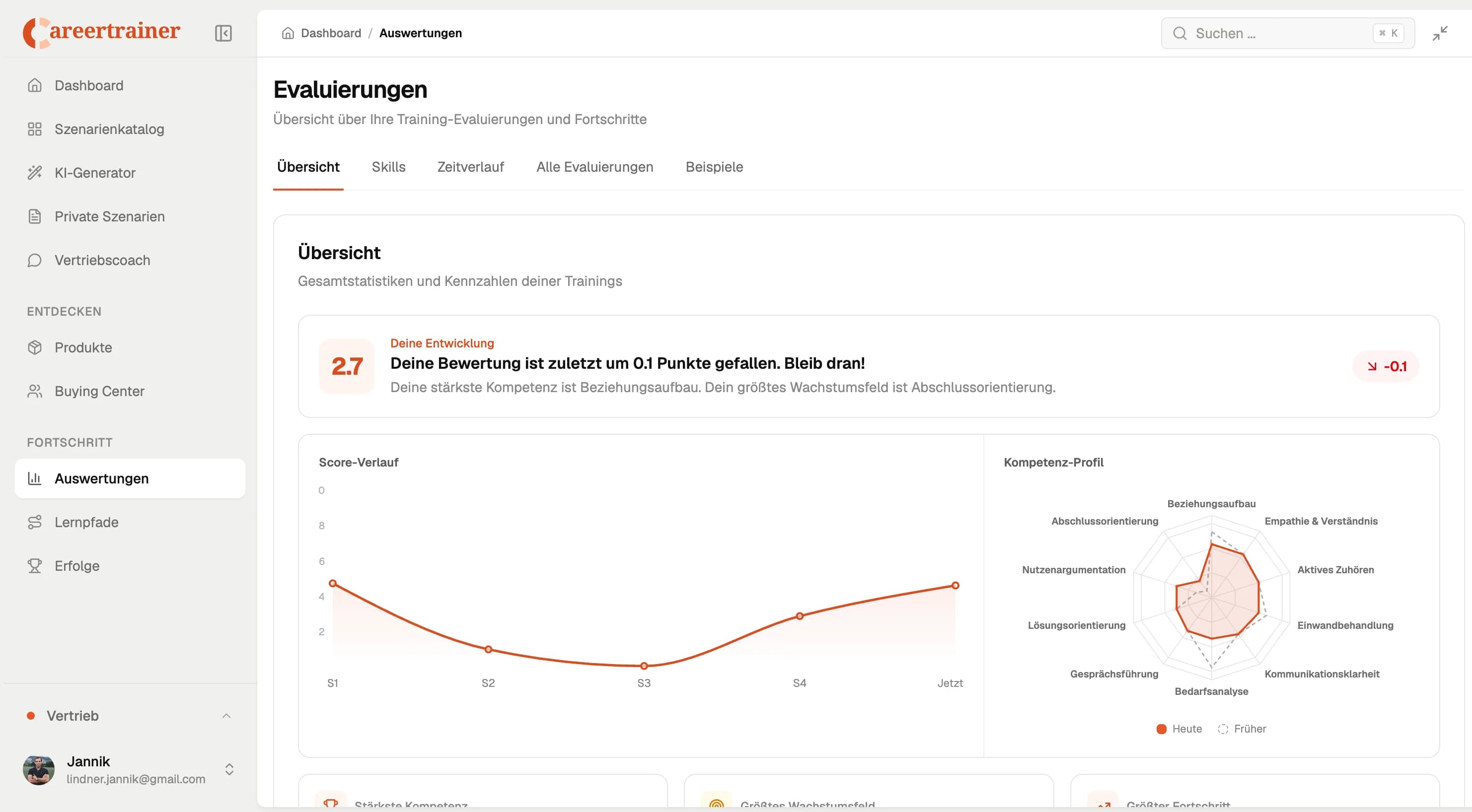
Evaluation Dashboard in Careertrainer.ai

Typical customer conversations in B2B energy sales

In energy sales, a few minutes of the right conversation often determine your margin, contract term, and churn risk. With Careertrainer.ai, you can train exactly those sensitive moments through realistic live audio role-play—from your first needs conversation to winning back a customer who’s ready to cancel.

Needs assessment call

The energy supplier demands an energy price right away—before you’ve had a chance to fully clarify your needs.

A mid-sized manufacturing company is reviewing new supply models—but the energy buyer wants to talk about cents per kWh right from the first few minutes. The conversation can quickly go off track if you jump into price details too early and don’t clarify load profile, tranche logic, or risk preferences. It helps to acknowledge the price request first, and then guide the discussion in a structured way—covering consumption, contract duration, procurement strategy, and the decision-making process. In AI role-play training, you practice this needs assessment under real time pressure and get immediate feedback on your conversation skills.

Practice the conversation with Thomas
Price negotiation

“You’re more expensive than the competition” — How to handle discount pressure right before signing

After you’ve submitted an offer and gone through several rounds of alignment, the procurement manager comes back with a competitor’s bid and pushes for a significant discount. It gets critical when you have to defend your price without making the contractual structure, service levels, and risk allocation tangible. It works better if you open up the comparison, lay out the price components clearly, and tie any concessions to the contract term, the order quantity, or bundling. With Careertrainer.ai, you can run this negotiation multiple times as AI role-play training—so you can build confidence in how you respond to discount pressure.

Practice the conversation with Miriam
Buying Center

You’ll build security of supply, procurement will reduce costs, and management will gain the flexibility it needs.

In a negotiation meeting, three stakeholders with different priorities sit at the table: operations, procurement, and management. These conversations often fail when you only respond to the loudest objection and don’t actively moderate the buying center. What works is making conflicting goals explicit, defining shared criteria, and meeting each stakeholder where they are—by aligning to their risk and KPI. You can train this in realistic AI role-play scenarios so you lead more structured conversations in real meetings.

Practice the conversation with Sabine
Customer Retention

Your existing customer signals a switch because a new provider is cheaper.

A current customer calls and openly says a competitor offered a cheaper plan with a more attractive term. It gets dangerous when you jump straight to price and overlook the real switching drivers—contract frustration, service experience, or procurement uncertainty. It’s better to clarify the real reason for cancellation, your decision readiness, and the criteria that would lead to loss—then work with a tailored counter-offer. With Careertrainer.ai, you can train these win-back conversations in AI role-play scenarios and see immediately whether you’re truly retaining the customer.

Practice the conversation with Jan
For energy sales teams

The features, price negotiations, Buying Center, and churn risks you can train with

Careertrainer.ai combines practical sales training with realistic live-audio conversations for B2B energy sales. You practice price and contract negotiations, objection handling, buying committee dynamics, and customer retention—getting immediate feedback instead of relying on theory, scripted talk tracks, or feel-good roleplays.

01

For AE, Key Account, and Sales Enablement

Train your sales conversations before you lose margin or contract time during the meeting

In energy sales, product sheets and price lists aren’t enough. You need AI role-play training that lets you practice real, live audio conversations across the actual sales phases—from the discovery call and objection handling to negotiating contract terms like the unit price, contract term, and notice periods. This is especially valuable for teams that want to improve win rate, close rate, and reliable, accurate forecasts.

  • Practice discovery calls with energy traders and procurement teams—realistically, with AI role-play training
  • Train price negotiations across duration terms, index models, and discount pressure
  • Instant feedback on your needs analysis, value proposition, and closing
Learn more
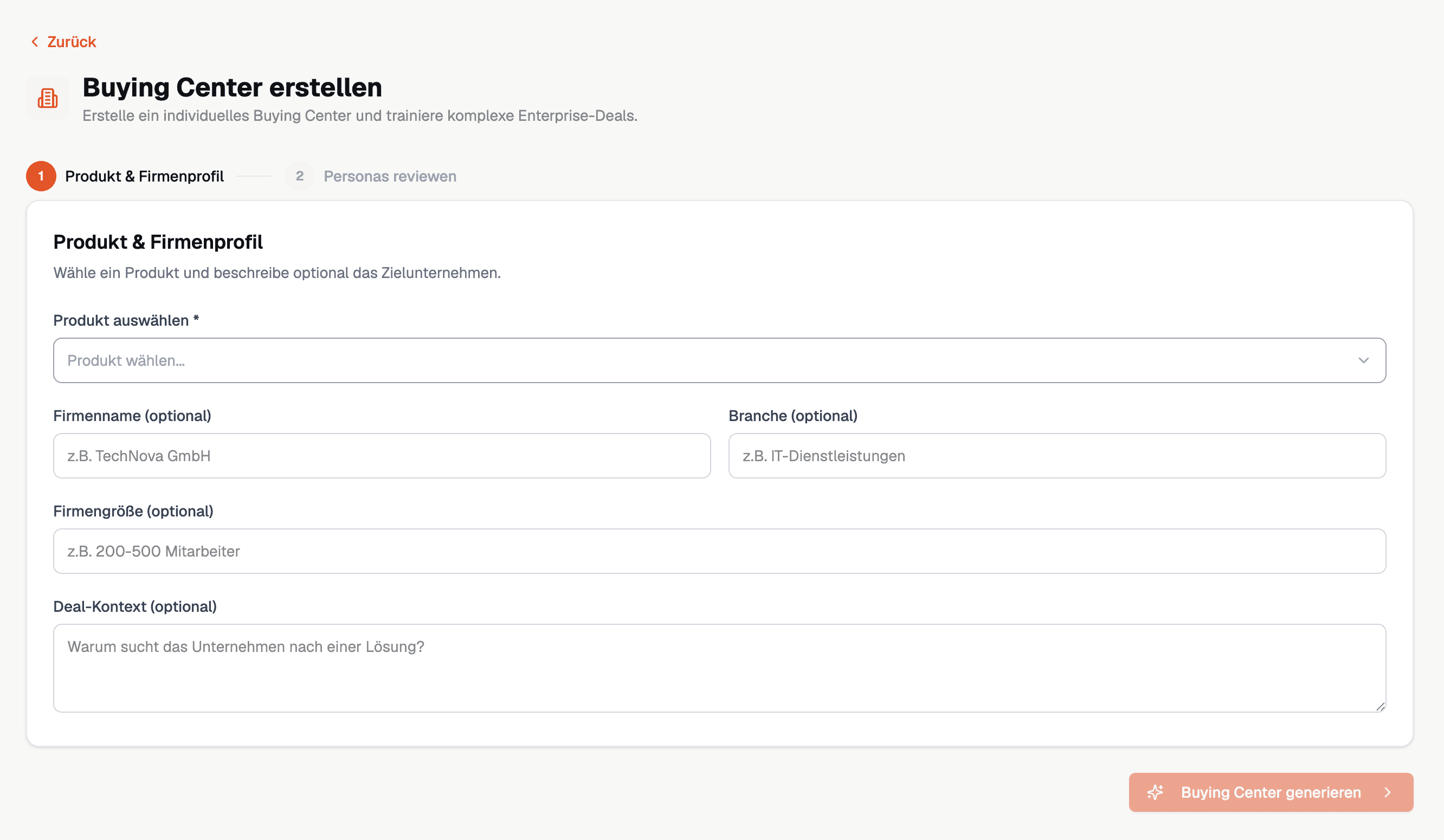
Sales training form for creating a buying center with product, company profile and deal context fields
02

When pricing, risk, and switching providers are holding you back

Handle objections properly instead of automatically giving in to the first discount request.

Objections in energy sales rarely come in isolation: they’re often about pricing being too high, a lack of planning certainty, a preferred existing supplier, unclear pricing formulas, or internal approvals within procurement. With Careertrainer.ai, you train exactly these conversation moments through repeatable AI role-play scenarios—and after every run you can see where you pitch too early, discount too quickly, or fail to uncover the underlying need deeply enough.

  • Train objections like price fixing, switching risk, and competing offers.
  • Test different answer strategies for the same objection to buying
  • Ideal for renewal, save-call, and negotiation situations
Learn more
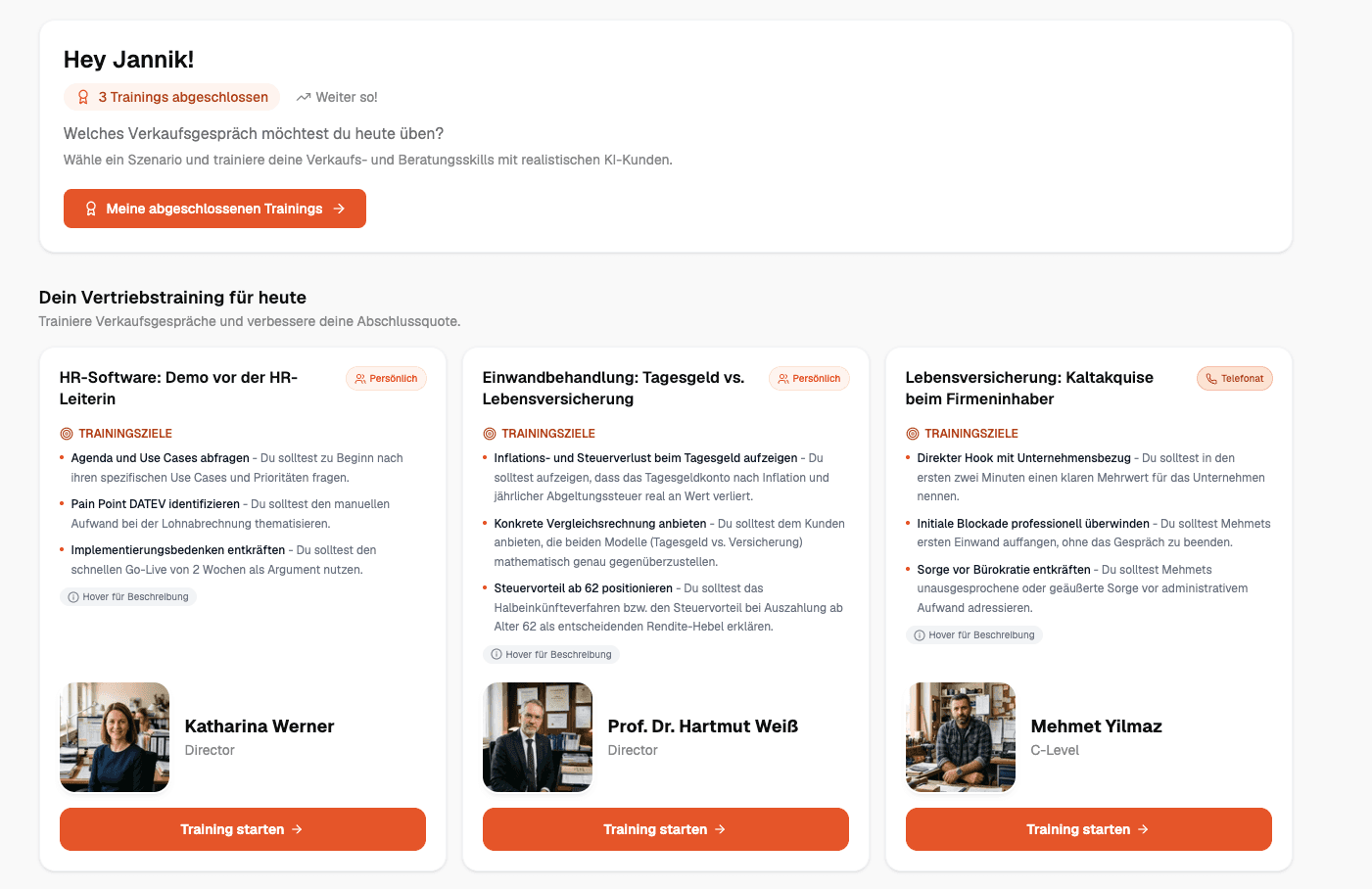
Dashboard for sales training sessions, featuring personalized training goals and participant profiles.
03

For complex B2B deals with multiple stakeholders

Train buying-center dynamics when the CFO, procurement, and technical teams think differently

Many energy deals don’t fail in the first conversation—they fall apart later, due to internal tensions within the Buying Center. With Careertrainer.ai, you train conversations with the CFO, Head of Procurement, plant management, or the technical lead as a continuous deal dynamic—not as isolated one-off roleplays. This supports stakeholder mapping, multi-threading, and a cleaner, more MEDDICC-oriented approach to deal leadership.

  • Simulate CFO, Procurement, and Technical stakeholders with their own priorities
  • Sharpen stakeholder mapping and multi-threading throughout your training journey
  • Be better prepared for tenders, the review committee, and approval rounds
Learn more
Sales deal simulations page with custom buying center creation feature
04

Measurable sales coaching instead of gut instinct

After every conversation, see whether you truly handled your needs, objections, and closing.

After every training conversation, a second AI system evaluates your communication style independently of your role or personality. You’ll get clear scores, evidence directly from the conversation, and actionable guidance on whether you introduced pricing arguments too early, failed to develop the champion, or agreed on the next step too vaguely. This makes sales coaching in the energy sector comparable, consistent, and repeatable.

  • Scores for needs analysis, handling objections, and closing effectively
  • Evidence from the conversation—not generic trainer opinions
  • Measurable progress across multiple negotiations and customer types
Learn more
Evaluation summary and competency profile for leadership communication under pressure.
05

Important for sensitive customer data and regulated markets

GDPR-compliant conversation training for a market with compliance and documentation requirements

If your team works with price lists, consumption data, contract terms, or sensitive customer details, data protection isn’t just a side issue. Careertrainer.ai is built for the DACH region—making it a strong fit for companies that need EU hosting, clear data flows, and reliable compliance in conversation training. Especially in regulated energy environments, that can be a real deciding factor.

  • EU hosting without third-country transfers for sensitive training data
  • Built for regulated sales processes with compliance requirements
  • Even for larger teams—with SSO, audit logs, and retention/deletion periods.
Learn more
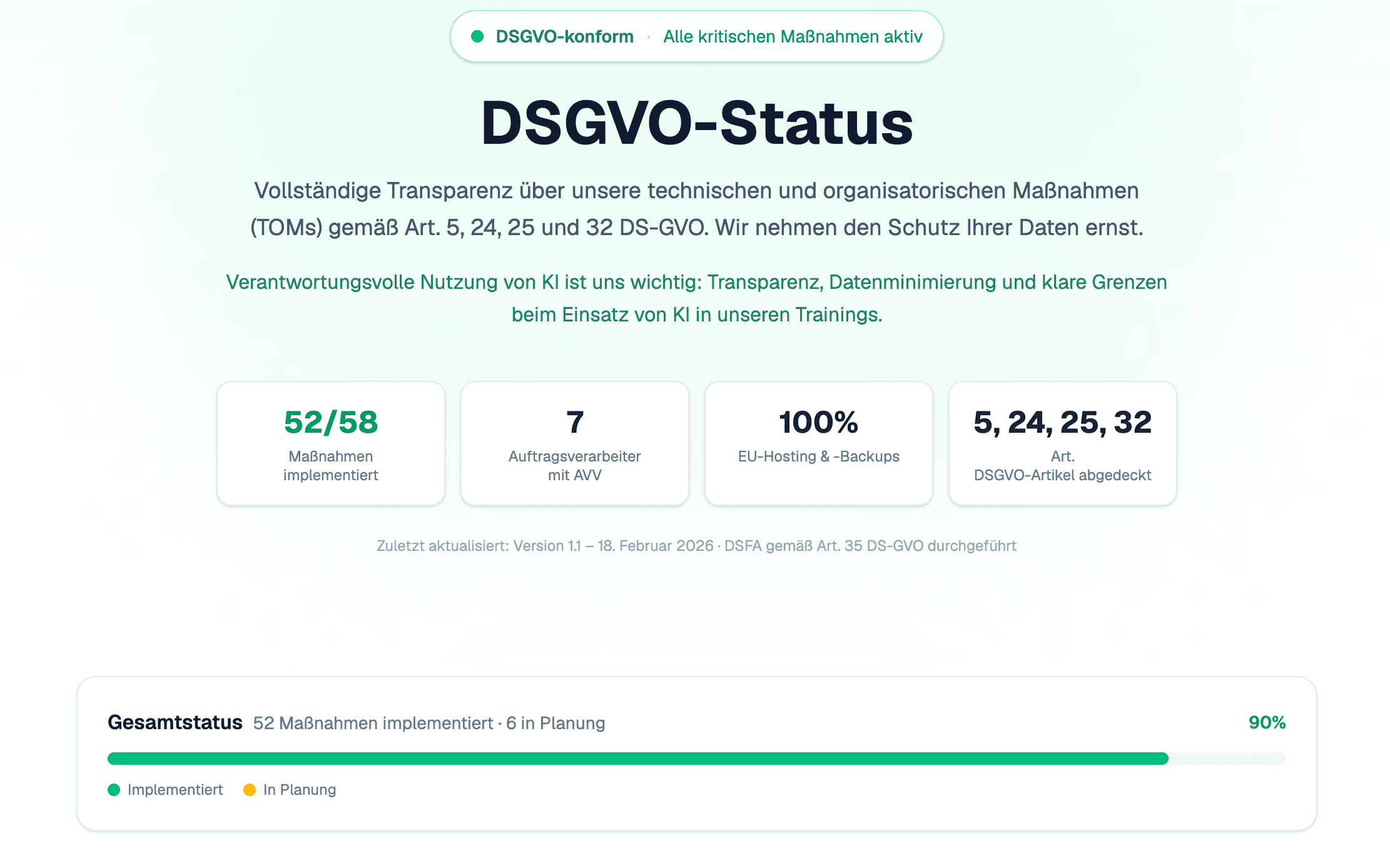
DSGVO compliance status overview for AI training, highlighting implemented measures and data protection commitment.
Roles & Responsibilities

Roles in energy sales benefit particularly from Careertrainer.ai.

If you want to train pricing talks, switching signals, and contract negotiations in B2B energy sales, you need more than guidelines. With Careertrainer.ai, you can measurably train sensitive customer conversations as AI role-plays and conversation simulations.

Outside Sales for Commercial Clients

You run first conversations with procurement managers, plant managers, or managing directors—and you often get to the price discussion too early. With Careertrainer.ai, you can train these exact situations as live audio role-play practice, so you clearly uncover the load profile, contract duration, delivery/acceptance points, and decision logic before the customer presses for the work price.

Don’t put the price on the table too soon.

  • Discovery call before a price request
  • Cleanly qualify your target profile
  • Identify the buying center early
  • Objection handling training: timing & risk
Popular

Energy Key Account Manager

In existing-customer business, you negotiate renewals, bundled pricing, and margins under heavy competitive pressure. With Careertrainer.ai, you practice AI role-plays with professional energy buyers, train objection handling for comparison offers, and see in your feedback how stable your margin, close rate, and retention are as you improve.

Keep your existing customers, even through competitive tenders

  • Renewal under Discount Pressure
  • Practice RFP conversations
  • Price anchor vs. comparison offers
  • See retention and engagement

Inside Sales & Sales Support

You clarify follow-up questions at the start of the contract—pricing sheets, term details, and switching processes—often right when the customer is already uneasy. Careertrainer.ai helps you with conversation training for critical phone calls, so you can explain cancellation intent, deadlines, instalment logic, and contract details with confidence—without unnecessarily triggering escalation.

Explain contractual questions without friction

  • Confirm the runtime details
  • Threat of cancellation over the phone
  • Explain the pricing clearly
  • Explain the change process clearly

Energy Sales Leadership

You’re responsible for pipeline, margin, and close rates across multiple sales teams—but conversation quality often still feels like a gut decision. Careertrainer.ai combines sales training for the energy sector with team analytics, a clear view of skill gaps, and repeatable practice scenarios for price negotiations, win-back conversations, and buying committee discussions.

Make conversation quality measurable across your team

  • See skill gaps by conversation type
  • Train your teams by sales stage
  • Coaching for Price Negotiations
  • Track progress across quarters

B2B New Customer Sales for Electricity & Gas

You win new locations, branch networks, or mid-market customers—and you face skepticism around switch-over effort, creditworthiness, and supply reliability. With Careertrainer.ai, you train realistic conversation simulations for discovery, proposal presentations, and objection handling—so you can steer value, risk mitigation, and closing readiness more precisely.

Remove barriers to new business

  • Practice discovery with retail store customers
  • Counter the “changeover effort” objection
  • Explain Energy Security
  • Check your graduation readiness thoroughly

Sales Enablement & Coaching

You’re building conversation training for new colleagues, product updates, or shifting market phases with strong pricing pressure. With Careertrainer.ai, you get scalable AI role-play training with realistic customer types, instant feedback, and clear standards for handling objections, needs analysis, and negotiation in the regulated energy market.

Roll out onboarding and coaching faster

  • Ramp up for new sales reps
  • Practice scenarios by customer segment
  • Standards for Handling Objections
  • Feedback without a trainer bottleneck

Frequently Asked Questions about Customer Conversations in Energy Sales

Here you’ll find practical answers to pricing discussions, switch signals, buying committee dynamics—and how you can use Careertrainer.ai to train energy-industry sales conversations in a targeted way.

What matters most in pricing and contract negotiations in energy sales?

The key is that you don’t start talking about the work price too early. First, you need to understand the consumption profile, procurement logic, contract term, risk tolerance, and internal decision-making paths.

In B2B energy sales, price, contract structure, and timing directly affect your margin, the likelihood of closing, and the switching risk. Many conversations fall apart because the customer immediately asks for a comparison price—before load profiles, forecasting reliability, take-or-pay or deviation volumes (plus/minus), contract term windows, or service requirements have even been clarified properly.

That’s why strong conversation management means: work out the need precisely, explain your pricing logic clearly, handle objections without going on the defensive, and help the customer understand the difference between “cheap” and “a good fit.” Just as importantly, you need to know whether you’re speaking with the purchaser, the commercial manager, or a technical co-decision-maker. Everyone assesses offers and risk differently.

If you want to win in these conversations, you don’t just need to negotiate well—you need to handle complex contract and pricing questions in a way that’s simple, confident, and credible.


Which objections come up most often in customer conversations in the energy sector?

Common objections include: it’s too expensive, we already have a provider, we’ll wait a bit longer, the market might drop again, or we don’t want a long commitment.

You’ll also run into industry-specific variations such as uncertainty around price fixing, skepticism about contract terms, questions about spot market vs. forward model, doubts about forecasts, or the claim that Procurement can only move forward after an internal approval. If you’re working with existing customers, you’ll often hear additional concerns: the competition offers better conditions, we’re currently evaluating a switch, or we first need full transparency on all additional costs.

The key is not to treat objections as outright rejection. In energy sales, objections are often a sign that risk is being assessed. If you only counter, you tend to increase resistance. If you ask questions, understand the motivation behind the objection, and then respond with the right argument, you’ll get much further.

That’s why effective objection handling doesn’t start with the perfect standard line—it starts with your ability to accurately decode the customer’s pricing, risk, and decision logic.

How do you tell in follow-up meetings whether a prospect is truly ready to buy?

You rarely recognize buying intent from just one sentence. It’s usually a combination of behavior, follow-up questions, and the next step.

In energy sales, strong signals include: the customer shares specific usage figures, mentions existing contract deadlines, asks about term options, wants to understand pricing components, or brings additional decision-makers into the conversation. And even if someone asks about implementation timing, contract start dates, the cancellation process, or how the onboarding/handling works, it’s usually more than mere interest in information.

Be careful with seemingly positive statements that don’t come with commitment. Phrases like “Send me something” or “That sounds interesting” aren’t real progress if no meeting is set, no data is approved for sharing, and no internal process follows. In particular in buying-center situations, you need to tell whether you’re talking to an information gatherer or an actual co-decision-maker.

That’s why a good conversation isn’t just about rapport—it drives clear progression: data, stakeholders, decision criteria, and a next step that’s truly actionable.

Which typical mistakes cost you margin—or lower your close rate—in energy sales?

The most common mistakes are quoting the price too soon, qualifying too little, unclear leadership within the buying center, and responding defensively when discount pressure mounts.

Many salespeople answer the price question immediately, even though key factors are still unknown. That means you’re comparing yourself on too narrow a basis—and you effectively hand over control of the conversation. Another frequent mistake is only talking to the operational contact and not involving commercial or technical co-decision makers early enough.

It’s also critical to explain contract details purely from a legal or technical perspective instead of making the economic value clear. For existing customers, it can also hurt to recognize change signals too late or to treat objections as a price issue only—when, in many cases, there’s more behind them: service experience, trust, risk, or internal approvals.

If you want to protect your margin, you don’t need to sell more aggressively—you need to lead more structured: qualify better, argue more precisely, and make the next step binding earlier.

How do you prepare for a conversation when you need to address Procurement, the business department, and the Executive Board all at once?

For each stakeholder, you need a clear hypothesis about their goals, risks, and decision criteria—not just a generic sales pitch you’ve prepared.

In energy sales, Procurement often focuses on price, comparability, and room to negotiate. The specialist team tends to prioritize supply security, feasibility, and operational stability. Management is usually more interested in predictability, risk, budget impact, and strategic fit. If you address all three with the same line of argument, you’ll typically lose relevance.

Practically, this means: clarify in advance who will be in the conversation, what role each person plays, which open points are likely to matter, and where goal conflicts may arise. Also prepare short, easy-to-understand explanations around pricing logic, contract term, risk mitigation, implementation, and service—so you can go deeper as needed, depending on who you’re speaking with.

A strong multi-stakeholder conversation isn’t broader—it’s better structured. You bring different interests together into a decision that’s truly defensible.

How does Careertrainer.ai help you with customer conversations in energy sales?

Careertrainer.ai is a DACH-focused AI platform for hands-on conversation training through live audio role-play. For energy sales, you can train the exact conversations where margin, contract term, and churn risk are decided.

Instead of just reading guidelines, you run 5 to 15-minute live conversations with realistic AI characters—for example, an energy procurement buyer, a skeptical commercial director, or an existing customer who’s ready to cancel. The characters don’t respond like simple chatbots; they react with believable motivations, objections, and different escalation levels.

Right after the role-play, you get feedback on the points that truly matter in energy sales: needs assessment, pricing arguments, handling objections, steering the buying center, and guiding the closing conversation. That way, you’ll see whether you’re discounting too early, missing signals of switching readiness, or setting the next step too loosely.

Careertrainer.ai is especially a fit when you want to practice sensitive sales conversations more often—without putting real customer relationships at risk.

What sets Careertrainer.ai apart from traditional sales training or sales coaching in the energy industry?

The biggest difference is this: you don’t just train knowledge—you practice real behavior in real conversations.

Traditional sales training, seminars, or sales coaching often teach frameworks, question techniques, and argumentation patterns. That’s useful, but in energy sales, theory alone rarely gets you there. Under time pressure, when facing price objections, or during complex Buying Center conversations, you quickly find out whether you’re asking the right questions, staying calm, and leading the discussion cleanly.

With Careertrainer.ai, you practice these situations as live audio role-plays as often as you want. You can repeat price negotiations, switching calls, win-back conversations, or objection training—and evaluate your performance directly, without depending on trainer appointments or your team’s availability. Feedback is immediate and focused on specific conversation goals, not just a general gut feeling.

If you want to build conversation confidence in energy sales in a systematic way, Careertrainer.ai complements classic training—or replaces parts of it with more frequent, measurable practice.

Is Careertrainer.ai also suitable for experienced B2B energy sales professionals?

Yes—experienced salespeople often benefit particularly strongly, because you’re not starting with fundamentals. Instead, you focus on critical levers.

In B2B energy sales, it’s rarely only about opening the conversation or asking standard questions. Experienced teams want to work on negotiation depth, margin, stakeholder management, retention of existing customers, and handling complex objections. That’s exactly what Careertrainer.ai is built for: you can train specific, difficult situations that are uncommon in day-to-day customer conversations—but business-critical when they do occur.

For example, you can practice how to respond to aggressive price comparisons, uncover internal blockages within the buying center, or avoid offering a discount too quickly when a long-standing customer signals a change in intent. Since the AI characters respond differently, you can test different approaches and see in the feedback what impact your behavior truly had.

For experienced salespeople, this isn’t a replacement for market knowledge. It’s a tool to sharpen your conversation performance under realistic pressure—on purpose.

How quickly can you roll out Careertrainer.ai for a sales team in energy distribution?

Getting started is usually quick, because Careertrainer.ai is designed as an AI platform for conversation training that you can use immediately.

Individual users can begin right away with existing scenarios and practice typical conversations such as price negotiation, needs analysis, win-back, or objection handling. For companies, you can tailor training focus areas by role, conversation stage, and industry-specific situations in energy sales—such as calls with business customers, Buying Center meetings, or existing customers who are considering switching.

If you want to build team training, there are three key things to define: which roles you want to train, which conversation types to prioritize, and which KPIs you want to track—for example, the quote-to-next-meeting rate, discount behavior, close rate, or the development of individual skills. For larger teams, you can add admin features, analytics, and—if you want—custom scenarios.

If you want fast, operational impact, start with a few critical conversation triggers and then measure how conversation quality and confidence develop in day-to-day work.

Can training providers or consulting firms offer Careertrainer.ai for sales training in the energy industry under their own brand?

Yes—Careertrainer.ai is also designed for a partner model for training providers, consultancies, HR platforms, and enablement providers who want to offer conversation training in energy sales under their own brand.

That’s especially valuable for sales training in the energy industry: partners can keep their industry expertise, their methodology, and their customer relationships—without having to develop their own AI infrastructure. You can embed the AI role-play into your own offering, present it with your own branding, and replicate customer conversations for price negotiations, churn readiness, retention of existing customers, and buying center scenarios—tailored to your needs.

Careertrainer.ai positions itself as an enabler, not a direct competitor for your customer relationship. What matters to partners is the tenant-capable architecture, individually configurable scenarios, and the ability to build scalable conversation training for the energy sector—without relying on manual role-plays alone.

If you want to expand your portfolio in energy sales as a provider, White Label is particularly useful when you want to deliver repeatable training and measurable skills development.

Which KPIs can you monitor with Careertrainer.ai in energy sales to make training truly measurable?

Above all, focus on the metrics that connect conversation quality with real sales outcomes.

At training level, you’ll look at how skills such as needs discovery, objection handling, negotiating confidence, closing leadership, and stakeholder management develop. In energy sales, it’s also especially interesting to see whether sellers in simulations hold back on discounts longer, recognize switching signals more effectively, and move negotiations smoothly to the next step.

In everyday sales work, you can then reflect these improvements with operational KPIs—for example, appointment rate after the first call, proposal rate, win rate, average discount, contract term, retention rate, or success in regaining at-risk existing customers. Careertrainer.ai doesn’t replace your CRM, but it gives you a measurable training foundation between theory and results.

Most useful is a setup where you define a few core KPIs and compare them over several weeks with the conversation types you’ve trained. That way, sales coaching in energy sales becomes far more tangible.

Other Industries for Sales Training

Discover industry-specific sales training and sales conversations for other industries.

A
AI sales training for consulting firms

AI sales training for consulting firms

Train your consulting sales team with AI role-play training for pitch situations, client meetings, and proposal presentations.

Learn more
P
Public sector sales training: help agencies confidently navigate complex procurement processes

Public sector sales training: help agencies confidently navigate complex procurement processes

Train with Careertrainer.ai on realistic AI role-play training for sales training, objection handling, and public-sector conversations: authorities, procurement law, long buying-center processes, and high-stakes follow-up questions—delivering measurable conversation training for sales teams.

Learn more
R
Retail Sales Training: Lead Sales Conversations with Confidence

Retail Sales Training: Lead Sales Conversations with Confidence

Train realistic sales conversations in retail with AI role-play training—effective outreach, overcoming price resistance, cross- and upselling, objection handling, and sales coaching for teams on the shop floor—with immediate feedback after every conversation training session.

Learn more
A
AI Sales Training for Staffing Agencies & Recruiting

AI Sales Training for Staffing Agencies & Recruiting

Train your recruiters and sales teams in staffing and recruitment with AI role-play training for new customer acquisition, candidate interviews, and fee negotiations.

Learn more
A
AI Sales Training for SaaS & Software

AI Sales Training for SaaS & Software

Train your software sales teams with AI role-playing for improved discovery calls, confident technical objection handling, and shorter sales cycles.

Learn more
S
Sales Training for Logistics: Practice customer conversations, objections, and price negotiations with confidence

Sales Training for Logistics: Practice customer conversations, objections, and price negotiations with confidence

Train with Careertrainer.ai on realistic AI role-play for logistics sales: sales training, conversation training, objection handling, and sales coaching for transport, freight forwarding, and contract logistics—practical, measurable, and GDPR-compliant.

Learn more
Objection handling

Practise the most common sales objections

Compact objection handling drills for sales conversations in Sales training in the energy industry: handle customer conversations with confidence.

“It's too expensive”: Train objections handling in sales

When a customer says “It’s too expensive,” they often don’t mean the price alone. More often, uncertainty, a missing sense of value, competitive pressure, or an unclear ROI are be…

Practise response

Train objections handling for “No budget” with AI role-play training

Train the exact customer statement “No budget” in realistic live audio role-plays with Careertrainer.ai. Practice follow-up questions, psychologically sound response strategies, a…

Practise response

Train handling the objection “I’ll get back to you” in sales

Practice objection handling with the “I’ll get back to you” scenario using realistic AI role-play training in live audio. With Careertrainer.ai, you’ll learn to stay proactive, re…

Practise response

Handle the “No interest” objection—and train with AI

Practice handling the objection “no interest” in realistic live audio role-play scenarios for both cold and warm outreach. With Careertrainer.ai, you’ll learn the right response s…

Practise response

Safely practice objection handling: “I’ll think about it”

Train “I’ll think about it” objection handling with Careertrainer.ai through realistic AI role-play training with live audio. Practice the right responses for B2B, B2C, and person…

Practise response

Objection Handling: Train “I need to talk to my partner first”

Practice the objection “I need to talk to my partner first” with Careertrainer.ai through realistic live audio role-plays. Learn the right follow-up questions, understand the psyc…

Practise response

Full overview: sales objections and AI conversation practice