
careertrainer.ai

Practice contract renewals, objection handling, churn prevention, and expanding existing accounts in real sales conversations.

Sales training for telecoms using realistic AI role-play scenarios

Careertrainer.ai trains you with realistic live audio conversations from telecom sales—covering everything from discount pressure to change-of-provider intent. Improve your sales training, conversation training, and sales coaching with no risk to real customers.

Live example · This is what training looks like

12 scenarios
Phone call

Practise with your product

Rachel Bennett

Rachel Bennett

Sales·Cold Call
Skeptical mid-market CEO

Midmarket CEO · 44 · ENTJ

Financial ServicesChurn prevention with existing customerBad past experienceMidmarket CEO

Rachel vents after another telecom SLA miss

SLA breach threatens churn and trust

You’re in a quick call with Rachel while she’s still fired up. She asks why the line quality dropped again this week.

Goal: Allow the complaint to fully land, then mirror only the core problem. Tie it to a concrete next measure with an internal owner and timing.

Learning goals

  • Confirm churn triggers
  • Mirror the anger briefly

What to expect

  • Mirror the core telecom failure once
  • Ask for the exact impacted service and timestamp
Practise with your product

Key metrics that directly impact telco sales and customer retention

These figures show why structured conversation training is economically relevant—especially when you’re dealing with churn risk, price pressure, and expanding your existing customer base.

5x
More expensive than retention
Winning a new customer typically costs significantly more than retaining an existing one—especially when it comes to renewals and churn prevention. (Source: harvardbusinessreview.org, 2014)
32%
Switch for better service
A large share of customers end the relationship after poor service. That’s why great conversations directly impact churn and create upsell opportunities. (Source: pwc.com, 2023)
60–70%
Higher chance of closing with existing customers
Closing sales with existing customers is statistically much more successful than winning new ones—so training for renewals and expansion is especially worth it. (Source: marketingmetrics.com, 2020)
8%
More revenue with less churn
Even small improvements in customer churn can noticeably increase revenue—especially in margin-driven telecom models with contract-based billing. (Source: bain.com, 2010)

Where team and telesales sales conversations get stuck in everyday life

In telecommunications sales, deals rarely fall through due to a lack of product knowledge. More often, it’s the tricky moments in real conversations: price discount pressure, a customer’s intent to cancel, multiple decision-makers, and inconsistent conversation quality across the team. With Careertrainer.ai, you can train exactly these situations with realistic AI role-play—practical, repeatable, and with immediate feedback.

AI character for industry-focused solutions

AI role-play focus

Make even difficult call and video-conference conversations trainable

Careertrainer.ai simulates real pricing, retention, and escalation conversations—so your team can sell with confidence in critical moments.

Handle discounting cleanlyWin over the buying committee
Challenge 01

Discount pressure eats into your margin at renewal.

Existing customers come to the table with competing offers, push for discounts before renewing the contract, and openly question things like bandwidth, contract length, or service packages. If your team gives in too early, ARPU, contribution margin, and retention rate drop at the same time. With Careertrainer.ai, you can train these exact pricing conversations as AI role-play with realistic objections, switching threats, and instant feedback—so your team improves its objection-handling in sales.

Book a free demo
Challenge 02

Too many decision-makers are stalling B2B calls and deals.

In B2B sales, the table is often crowded with Procurement, IT, the business unit, and senior management—but each stakeholder evaluates risk, SLAs, migration, and costs differently. If you only manage to convince one stakeholder in the conversation, you lose speed, trust, and forecast reliability. Careertrainer.ai prepares you with AI role-play training for Discovery, needs analysis, and negotiation within complex buying committees.

Book a free demo
Challenge 03

Your team’s conversation quality varies too much.

Some sales reps handle contract renewals, cross-selling, and plan changes with confidence—others struggle with even the first questions about contract terms, number portability, or switching barriers. That usually means fluctuating conversion rates, a longer ramp-up period, and more effort in sales coaching. Careertrainer.ai scales conversation training with consistent AI role-plays, clear evaluation criteria, and measurable progress for each employee.

Book a free demo
Challenge 04

Termination or disengagement intentions are often only recognized too late.

Many churn signals don’t show up in your CRM. They appear in side comments about disruptions, value for money, service frustration, or when customers stop using additional services. If sales and account teams miss these triggers during real conversations, churn, downgrades, and lost upsell opportunities increase. Careertrainer.ai trains churn prevention through realistic conversation simulations with escalating customer reactions and specific, actionable feedback.

Book a free demo

AI Objection-Handling Role-Play Training

Four practical scenarios on “Sales training in telecommunications: AI role-plays for handling objections, contract retention, and churn prevention”: Practice typical conversations with realistic AI characters in Careertrainer.ai.

Filter by industry, situation, objection and buyer persona. Every example leads directly into your own AI role-play.

12 of 12 scenarios

Industry

Situation

Objection

Buyer persona

Rachel Bennett

Rachel Bennett

Midmarket CEO

Financial ServicesChurn prevention with existing customerBad past experienceMidmarket CEO

You’re in a quick call with Rachel while she’s still fired up. She asks why the line quality dropped again this week.

What you'll practise

  • Confirm churn triggers
  • Mirror the anger briefly
  • Agree next measurable step
We’ve paid for stable lines, not excuses. This is the third miss.
James Carter

James Carter

Small Business Owner

ConstructionDiscovery callContract still runningSmall Business Owner

You meet James in the break area after his crew briefing. He tells you the telecom contract still runs, and he’s tired of explaining it.

What you'll practise

  • Pin down cost of delay
  • Clarify the timing boundary
  • Design a small pilot approach
We signed two years. I’m not breaking that just because lines feel off.
Alex Taylor

Alex Taylor

Midmarket CFO

Energy & RenewablesExecutive briefingChange fatigueMidmarket CFO

Alex calls from his office and starts with a billing question. He says your agenda is fine, but the real issue is cost control for the next quarter.

What you'll practise

  • Acknowledge agenda pivot fast
  • Extract measurable telecom drivers
  • Bridge to governance and rollout risk
Fine, show me. But I need the billing logic and who owns it.
Laura Hughes

Laura Hughes

Midmarket CTO

AutomotiveGatekeeper block on phoneGatekeeper blocksMidmarket CTO

You’re on site with Laura during a tight handover window. She cuts in that nobody owns the outcome and she will not take responsibility later.

What you'll practise

  • Clarify who owns the decision
  • Acknowledge deflection without escalation
  • Set the next step with the right person
If it breaks, it lands on my desk. I need the accountable owner.
Daniel Walker

Daniel Walker

IT Director

Financial ServicesExecutive briefingBudget lockedIT Director

Daniel picks up on a tight call window, sounding uneasy about any new spend. The CFO is reviewing every euro this week.

What you'll practise

  • Time the telecom approval window
  • Propose phased start for spend
  • Negotiate around budget freeze
If finance is scanning every line item, this just looks risky.
Jordan Blake

Jordan Blake

HR Director

Cross-IndustryGatekeeper block on phoneGatekeeper blocksHR Director

On site, Jordan is already half-standing, waving you toward the lobby. He says this is not the right moment for another telecom request.

What you'll practise

  • Open with one relevant value
  • Ask for the real approval owner
  • Secure a specific next interaction
We’re in the middle of training and it needs to stay that way.
Maya Turner

Maya Turner

Head of Sales

AutomotiveDiscovery callWe already have a providerHead of Sales

In a quick phone slot, Maya starts with the comparison spreadsheet on her screen. She’s got a provider already, so she watches for any mismatch.

What you'll practise

  • Reframe telecom comparison criteria
  • Identify hidden risk in switch
  • Propose the one differentiator
Your rate matters less than whether churn drops after we switch.
Michael Brooks

Michael Brooks

Procurement Lead

ConstructionDiscovery callContract still runningProcurement Lead

On site at the construction office, Michael takes the meeting but keeps the agenda tight. He says the telecom contract is still running, so he cannot sponsor anything now.

What you'll practise

  • Clarify contract end trigger
  • Identify the committee sign-off steps
  • Propose preparation tasks for the active term
Our current telecom contract still runs, so promises won’t help.
Casey Hayes

Casey Hayes

Marketing Director

Energy & RenewablesDiscovery callMarketing Director

You dial Casey and she interrupts with her own churn dashboard metrics. Then she pivots to the exact contract binding terms you skip.

What you'll practise

  • Ask one metric question
  • Use proof, not features
  • Respect the expert identity
Show me churn prevention, not slides. What clauses actually bind?
Hannah Reed

Hannah Reed

Operations Director

ConstructionGhosting recoveryOperations Director

On site in the telecom rack room, Hannah cuts you off during a short check-in. She says she is already running a comparison internally and needs nothing else right now.

What you'll practise

  • Identify decision path fast
  • Separate politeness from intent
  • Agree a next beat
We already test two options. Asking for more input costs us time.
Owen Foster

Owen Foster

General Practitioner

EducationCold call openingGeneral Practitioner

Late afternoon your caller line connects with Owen, who sounds drained. He says the telecom decision is stuck and he is worried about next week’s handover.

What you'll practise

  • Surface the real stalling risk
  • Offer two time options
  • Explain impact if nothing changes
I do not want another surprise. Patients notice delays.
Riley Stone

Riley Stone

Private Customer

AutomotiveActive closingPrivate Customer

At the dealership reception, Riley sits across from you with a tight schedule. She asks if the telecom package is “worth it” before hearing any details.

What you'll practise

  • Frame value before numbers
  • Qualify the price context
  • Confirm fit and next step
Do not start with the price. Tell me what I actually gain.

How the AI evaluates your training conversation

After every role-play a separate AI analyses your full conversation transcript — with score, goal feedback and concrete quotes from your own dialogue.

Two layers feed the overall score: scenario-specific goals (70%) and five core competencies for your training type (30%).

SummaryRating: Solid

Rachel Bennett · Rachel vents after another telecom SLA miss

Lock in churn evidence, then tie it to an owned next action with a date

Allow the complaint to fully land, then mirror only the core problem. Tie it to a concrete next measure with an internal owner and timing.

Overall result
6.9/ 10

70% scenario goals + 30% core competencies

Scale 0–10 · backed by quotes from your conversation

Scenario goals · 70%Core competencies · 30%

Scenario goals

Scenario goals · 70%

Confirm churn triggers

6.5 / 10

Elicit what specifically is making Rachel consider switching, using one precise reliability question. This matters because churn prevention depends on the real trigger, not the loud emotion.

Partially achieved

You referenced the third SLA miss, but didn’t clearly confirm the exact impacted service and impact scope for churn.

the third miss on SLA occurred Tuesday, right? (g1)

Mirror the anger briefly

8.5 / 10

Reflect the core complaint in one sentence and avoid defending. This matters because it reduces escalation risk and keeps the call cooperative.

Fully achieved

You briefly mirrored the anger and core problem by echoing the paid-for-stability complaint without arguing.

We’ve paid for stable lines, not excuses; next step is fix ownership by June 5. (g2,g3)

Agree next measurable step

6.5 / 10

Propose a specific next step tied to telecom reliability and confirm an accountable owner. This matters because retention requires a credible action plan, not reassurance.

Partially achieved

You proposed a next measurable step with a date and an implicit owner, but ownership wasn’t explicitly named in the line.

next step is fix ownership by June 5. (g2,g3)

Core competencies

Core competencies · 30%

Needs analysis

6.6

Systematically uncover needs and requirements

Value articulation

7.1

Present concrete value for the customer

Objection handling

6.9

Address objections professionally and constructively

Closing orientation

7.2

Work toward a close or clear next step

Relationship building

6.7

Build trust and rapport

Details · Transcript excerpt

YouRachel, the third miss on SLA occurred Tuesday, right? (g1)
Rachel BennettYes, the line dropped again during treasury payments; we’re exposed to downtime.
YouWe’ve paid for stable lines, not excuses; next step is fix ownership by June 5. (g2,g3)
Pro tip

In finance retention, say: "Confirm the impacted service and timestamp, then name the fix owner and date." Example: "Cust dialler SLA breach at 14:20; Tom to remediate by June 5."

Only your wording is evaluated — not the AI counterpart's. The AI's opening of the conversation is not penalised.

Practise with your product

So you can train critical calls and team check-ins with Careertrainer.ai

Careertrainer.ai turns typical sales and customer retention situations in the telecommunications industry into structured conversation training—everything from objection handling under price pressure to contract renewals when churn is looming. You practice realistic live audio conversations—guided by AI—and get immediate feedback to build measurable communication skills you can use right away.

1

Choose the right conversation for renewal, objections, or expansion.

You start with an AI role-play tailored to your day-to-day sales work—for example, renewing contracts with at-risk existing customers, handling a price conversation with procurement leadership, or cross-selling on an existing business connection. This isn’t generic training. You practice the exact scenario where churn, margin loss through discounts, or pipeline stagnation would otherwise happen.

Role-play Generator in Careertrainer.ai
2

Run customer conversations as a live audio simulation

Then you run realistic conversation training with Voice AI—handling common telecom objections like “too expensive,” “we’re reviewing switching providers,” or “send us a better offer first.” The AI responds like a real counterpart from the Buying Center, so you can practice—hands-on—how to uncover needs, address switching barriers, manage contract commitment, and negotiate under time pressure.

Voice AI Conversation Simulation in Careertrainer.ai
3

Analyze your feedback and improve your completion rate—targeted and measurable.

After the conversation, you’ll get a concrete analysis of the key drivers in telecom sales: needs assessment, objection handling, value-based pitching, retention conversations, and the next step. That’s how sales coaching becomes a measurable process you can use to systematically improve call quality, conversion rate, renewal rate, and expansion of existing customers.

Evaluation Dashboard in Careertrainer.ai

Typical conversation scenarios in telecommunications sales

In tech sales, a few minutes often decide whether a customer renews, expands, or walks away. With Careertrainer.ai, you can train exactly these high-stakes conversation moments through realistic live-audio role-play: realistic objections, typical buying-center dynamics, and feedback right after the conversation.

Customer Retention

The IT director says: “If you don’t concede on the price, we’ll cancel at the end of the contract term.”

An existing customer is just about to renew, but the IT manager openly compares your offer with a cheaper competitor. The conversation can turn fast if you immediately grant a discount—or if you don’t clearly spell out the switching costs. What works is to precisely uncover the real reason for cancellation, make the operational risks of changing providers visible, and re-anchor the value of your current solution. In AI role-play training, you practice this exact moment under realistic pressure—and get immediate feedback on objection handling and retention argumentation.

Practice the conversation with Markus
Business growth

Get more bandwidth, security, and mobile connectivity—even if procurement only looks at OPEX.

You’re speaking with a Procurement Manager about expanding an existing site contract to include SD-WAN, security, and additional mobile phone SIM cards. The situation gets critical when Procurement only focuses on the monthly incremental costs, while the specialist area is barely visible during the meeting. What helps is framing the business case around downtime risks, scalability, and reduced coordination effort in day-to-day operations—rather than focusing only on product features. With Careertrainer.ai, you can role-play this sales training scenario multiple times and practice how to turn a price discussion into a strategic upsell conversation.

Practice the conversation with Sabine
Objection handling

The CFO blocks it in the buying committee: “Nice and technical—but it’s not a priority from a business standpoint.”

In an ongoing B2B meeting, you may have the right department on your side—but the CFO shuts down the discussion by citing budget constraints and other priorities. These conversations often fail when you dive deeper into features instead of rebuilding the economic argument for the decision-maker. What matters is translating investment risk, downtime costs, SLA relevance, and implementation consequences into CFO language. You can practice this very precisely with AI role-play training—complete with feedback on whether you’re truly leading multiple stakeholders in the room.

Practice the conversation with Thomas
Price Negotiation

The customer is requesting a 12% discount for the contract renewal and citing a competitor’s offer.

Just before closing, the customer pulls up an offer from another provider and demands a clear discount on the same contract term. It gets risky when you go into the negotiation without actively shaping the deal—no trade-offs, no volume levers, and no control over key contract parameters. Better results come from a conversation where you link discounts to things like contract duration, purchase quantity, service levels, or bundling—so the comparison isn’t reduced to the monthly price alone. Practice this type of negotiation in Careertrainer.ai until you have price discipline—and still stay closing-ready.

Practice the conversation with Nadine
For Telco Sales Teams

The features that make real-world sales calls—pricing discussions, renewals, and expansions—trainable the way they actually happen

Careertrainer.ai combines hands-on sales training with realistic live audio conversations from the telecommunications sales sector. Train Renewal Calls, objection handling, buying center dynamics, and product-focused negotiations—not as theory, but as repeatable conversation training with measurable progress.

01

For SDRs, AEs, and Account Managers in Telco sales

Train sales conversations along real Telco sales phases

Whether you’re rolling out Outbound to new locations, running Discovery with your IT leadership team, or extending deals right before contract end dates: you train the conversations that directly impact pipeline, win rate, and net revenue retention. The AI responds like a real customer—based on timing, benefit-driven argumentation, and the pressure applied during closing.

  • Discovery, Renewal, Negotiation & Closing—built on one clear logic
  • Ideal for Business Internet, SIP, UCaaS, and multi-site connectivity
  • Train for live audio conversations instead of scripts, slides, or chat windows
  • Repeatable ahead of QBRs, proposal rounds, or forecast commitments
Learn more
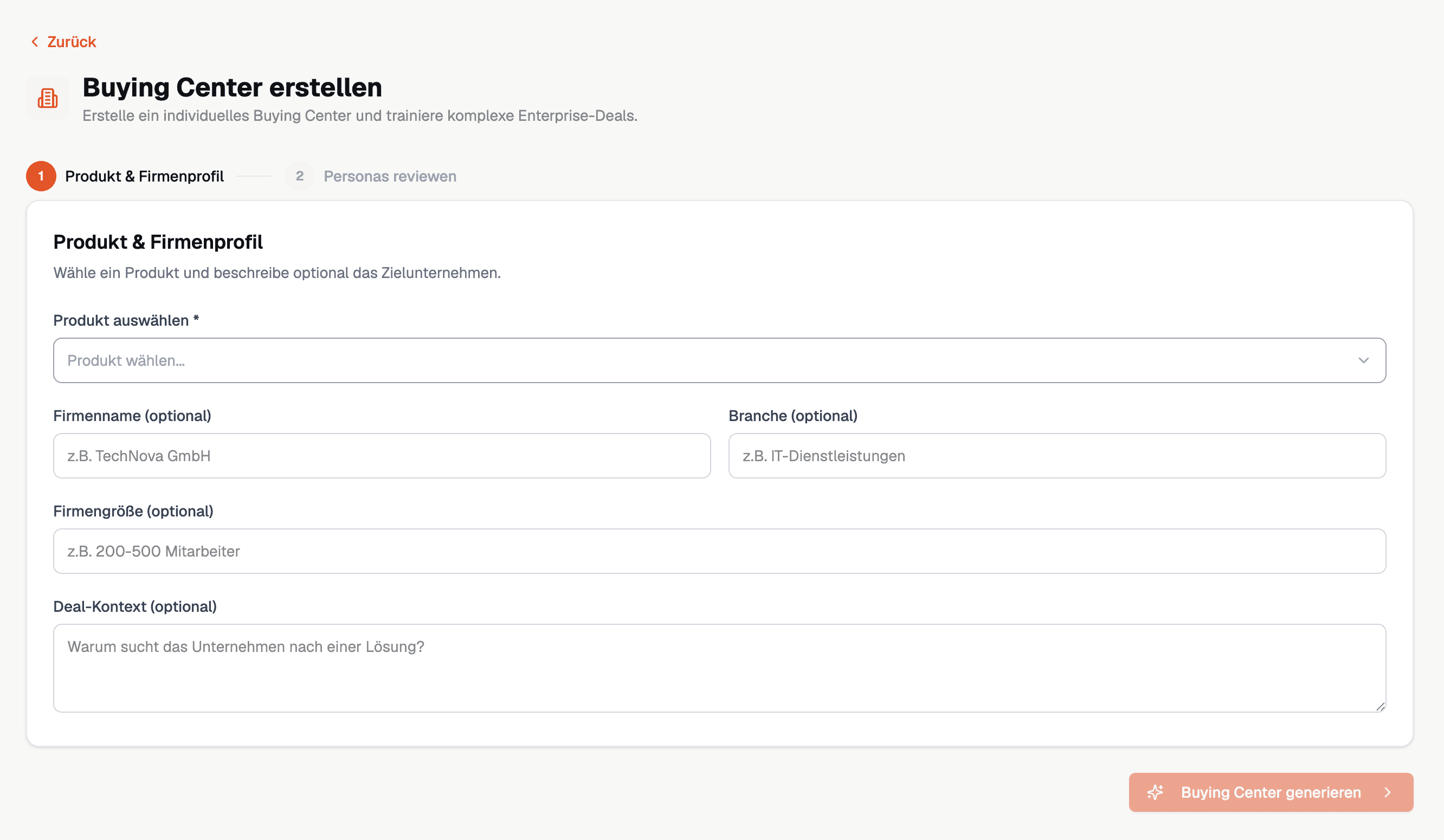
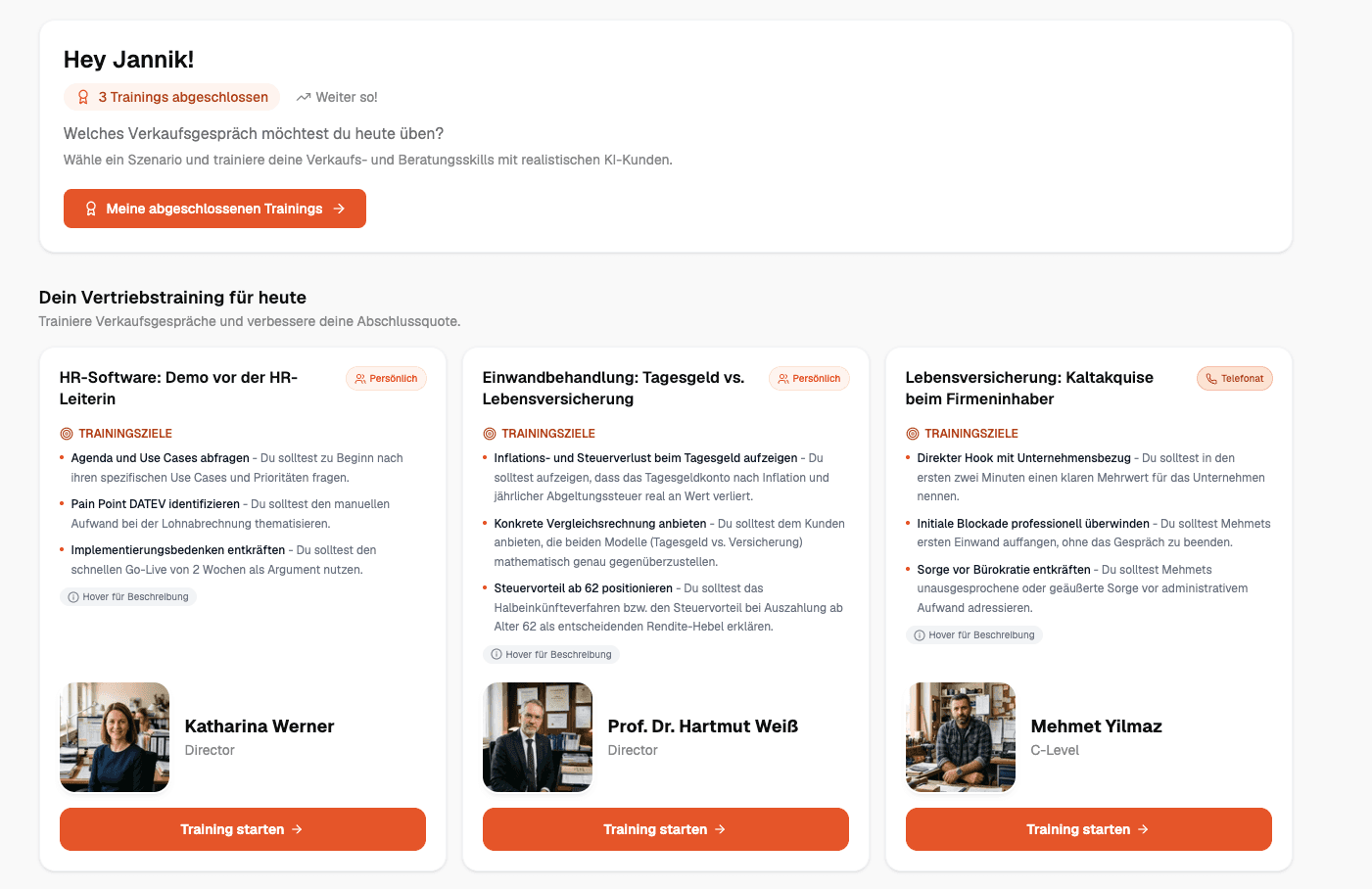
Sales training form for creating a buying center with product, company profile and deal context fields
02

When, during a customer meeting, multiple interests clash at the same time

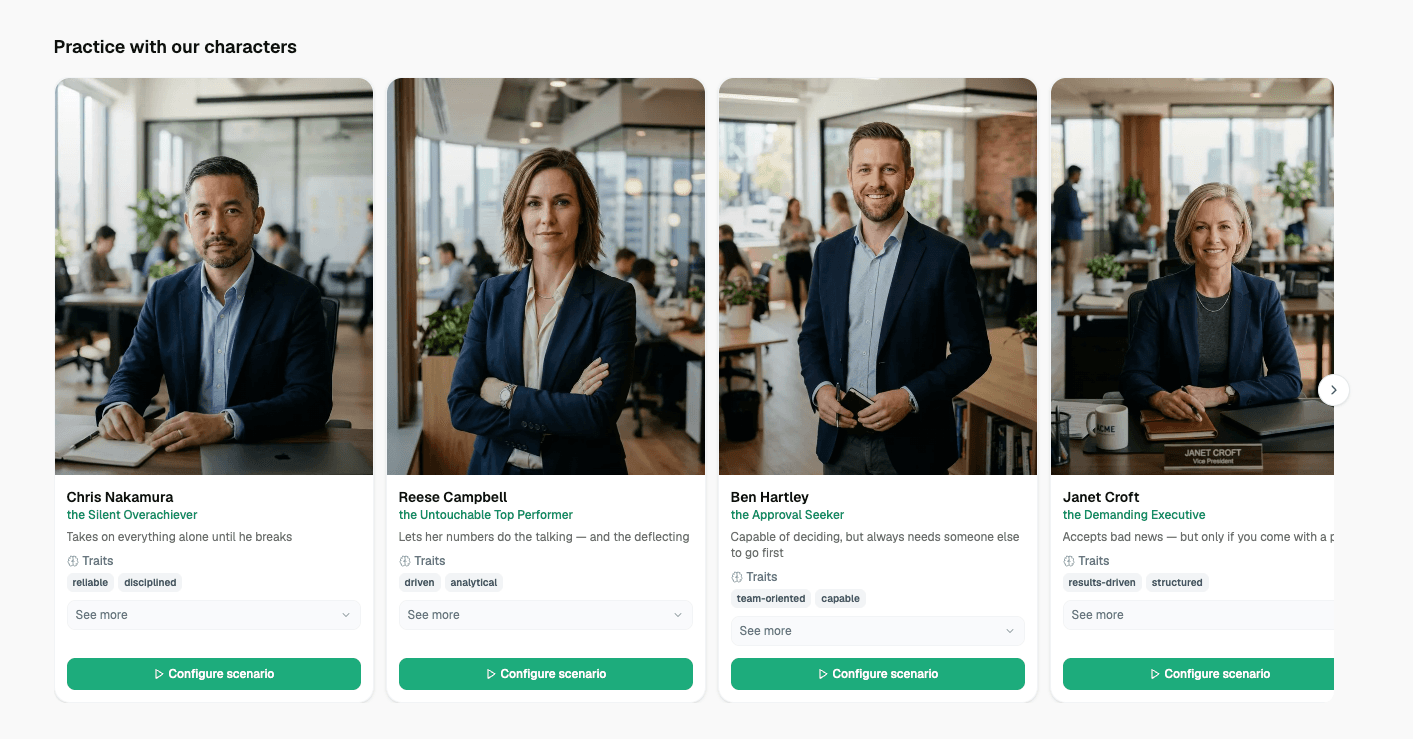
Realistically simulate buyer personas for CFOs, Procurement, and IT

In telecommunications sales, you rarely sell to just one person. Train how CFOs, Heads of Procurement, IT leadership, or department managers behave differently—what objections they bring—and how to position value, risk, and price clearly for each role.

  • The CFO asks about total cost of ownership (TCO), and Procurement pushes for a bigger discount.
  • It checks SLA, migration, security, and the integration effort.
  • Multi-threading instead of one pitch for all stakeholders
  • Test conversation strategies for every role—without any risk with your customer
About the feature
Character selection screen with AI training personas and scenario configuration buttons
03

For discount pressure, switching intent, and contract commitment

Train objections that actually come up in real Renewal and Save conversations

When an existing customer threatens to cancel, points to a competitor, or only wants to extend if you offer a discount, you need more than standard scripts. With Careertrainer.ai, you can replay these exact moments as AI role-play—then get instant feedback on your questioning technique, reframing, and closing strategy.

  • Typical objections like “it’s too expensive” or “we’ll switch our carrier”
  • Train your save-calls before contract end and when churn risk is high
  • Compare multiple responses to the same price pressure
  • Find out whether you’re discounting too early—or handling it the right way.
Learn more
Dashboard for sales training sessions, featuring personalized training goals and participant profiles.
04

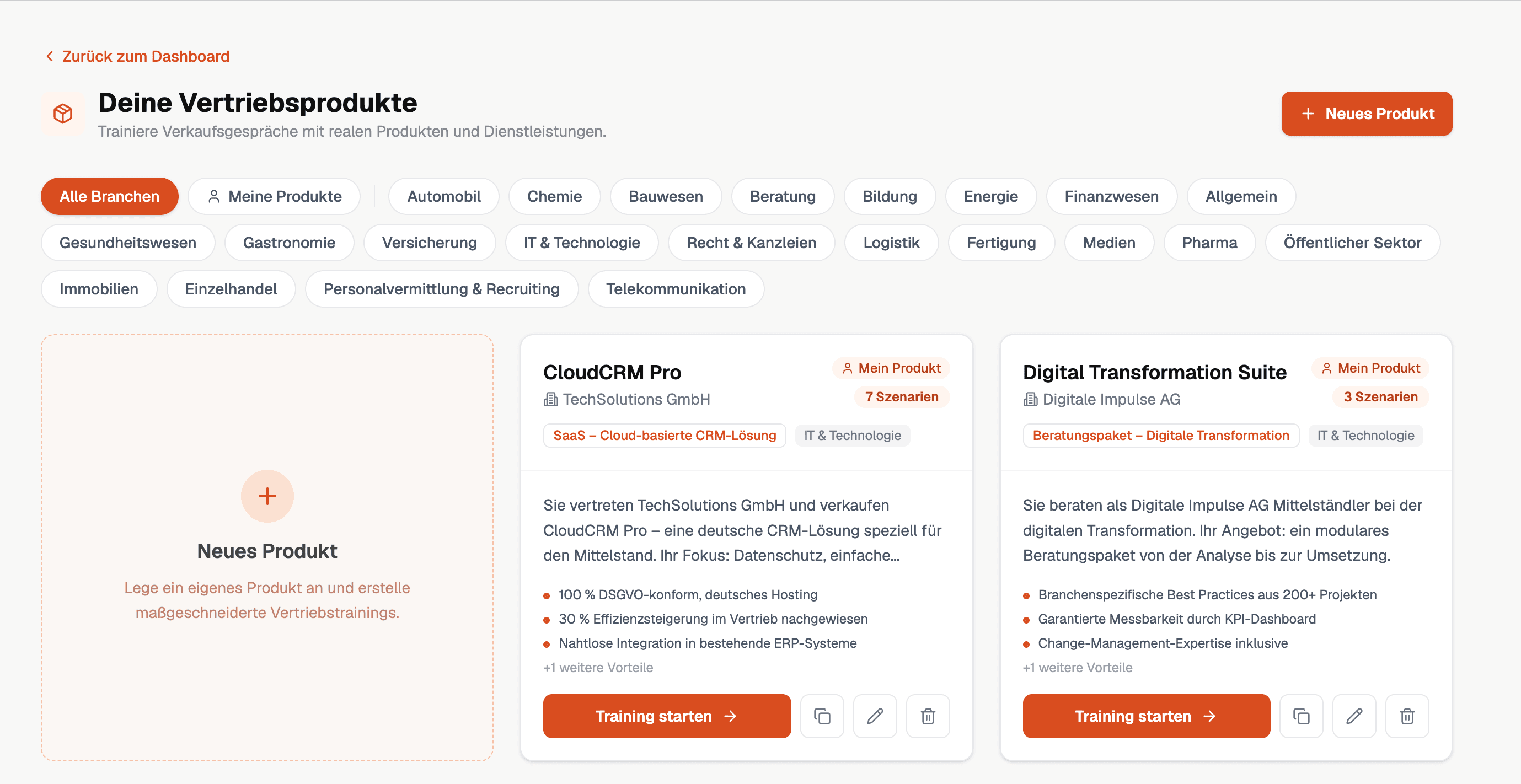
…if your team should not practice with demo products

Train with your real tariffs, SLAs, and competitor positioning.

In telco sales, conversations often hinge on factors like contract duration, migration risks, bundled pricing, or unclear service levels. With product-specific training, you can back up your offers with the right differentiation and help reps handle typical competitor positions—so renewal, cross-sell, and negotiation conversations feel closer to real life.

  • Integrate your own pricing, contract models, and bundle logic
  • Centralize your competitors, switching barriers, and USPs in one place
  • Helpful for cross-selling across mobile, landline, and cloud telephony
  • Get new offers into onboarding and coaching faster
To Feature
Produktspezifisches Vertriebstraining
05

So your sales coaching doesn’t rely on gut instinct

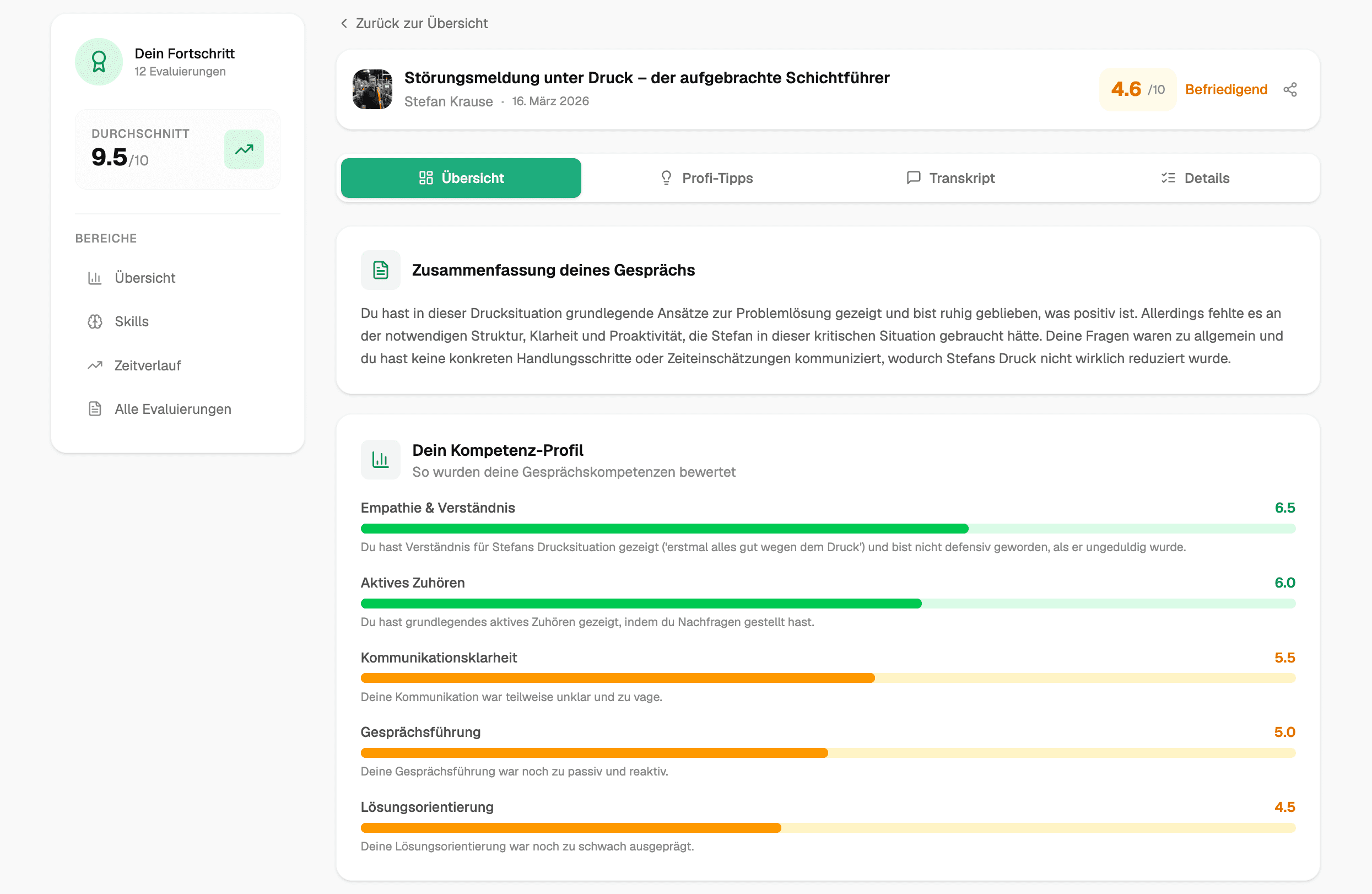
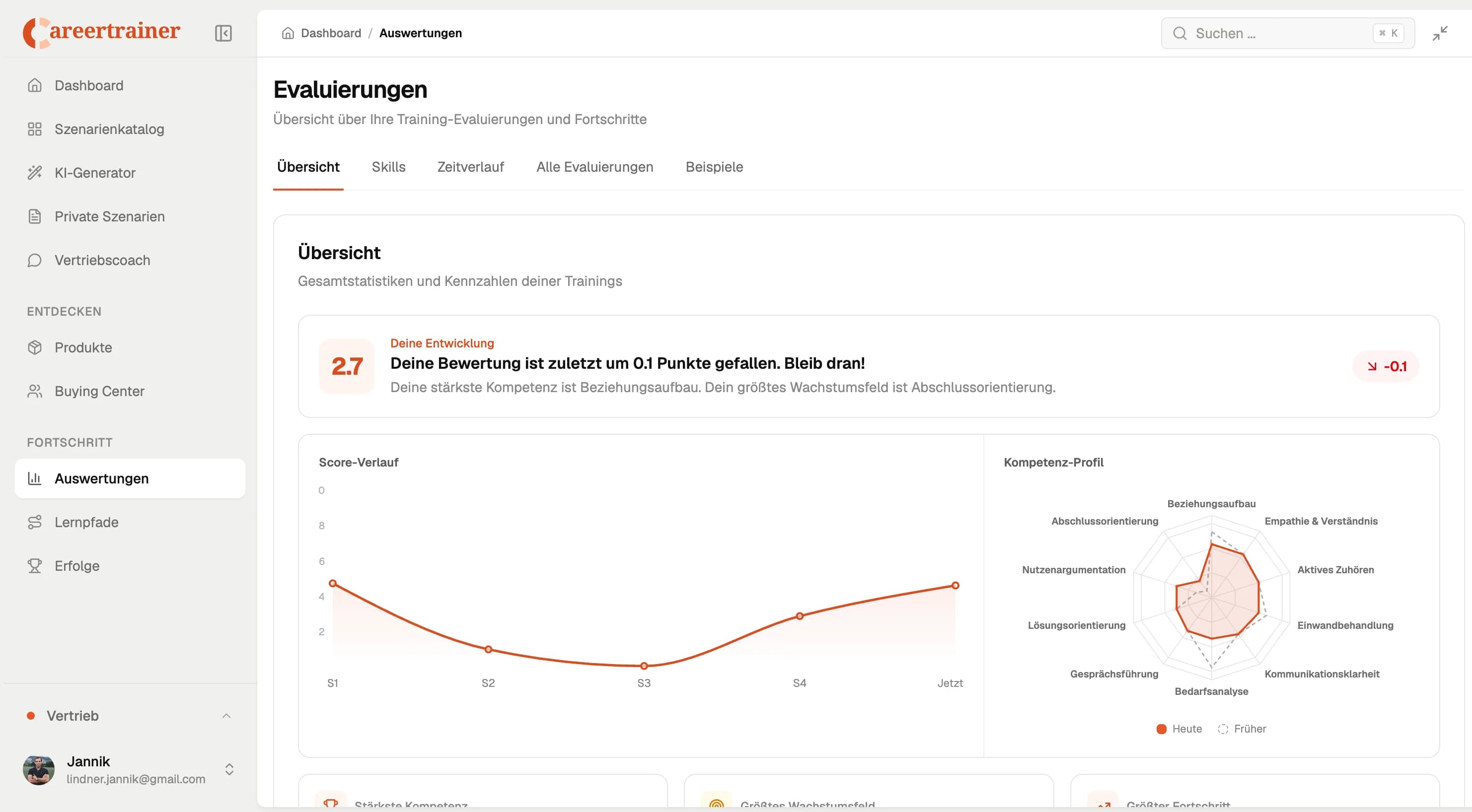
After every conversation, see exactly where you still need to improve closing confidence and your questioning technique.

After the role-play, you don’t get a vague assessment—you receive a structured evaluation with scores, evidence, and specific improvement recommendations. This makes it clear whether your team qualifies properly during Discovery, whether objections are actually handled, and whether unnecessary margin gets left on the table in renewal conversations.

  • Scores for needs analysis, value proposition and closing
  • Evidence from the conversation—rather than subjective trainer opinions
  • Ideal for team leads, Enablement, and coaching you can repeat consistently
  • Track progress you can measure across multiple sessions
Learn more
Evaluation summary and competency profile for leadership communication under pressure.
06

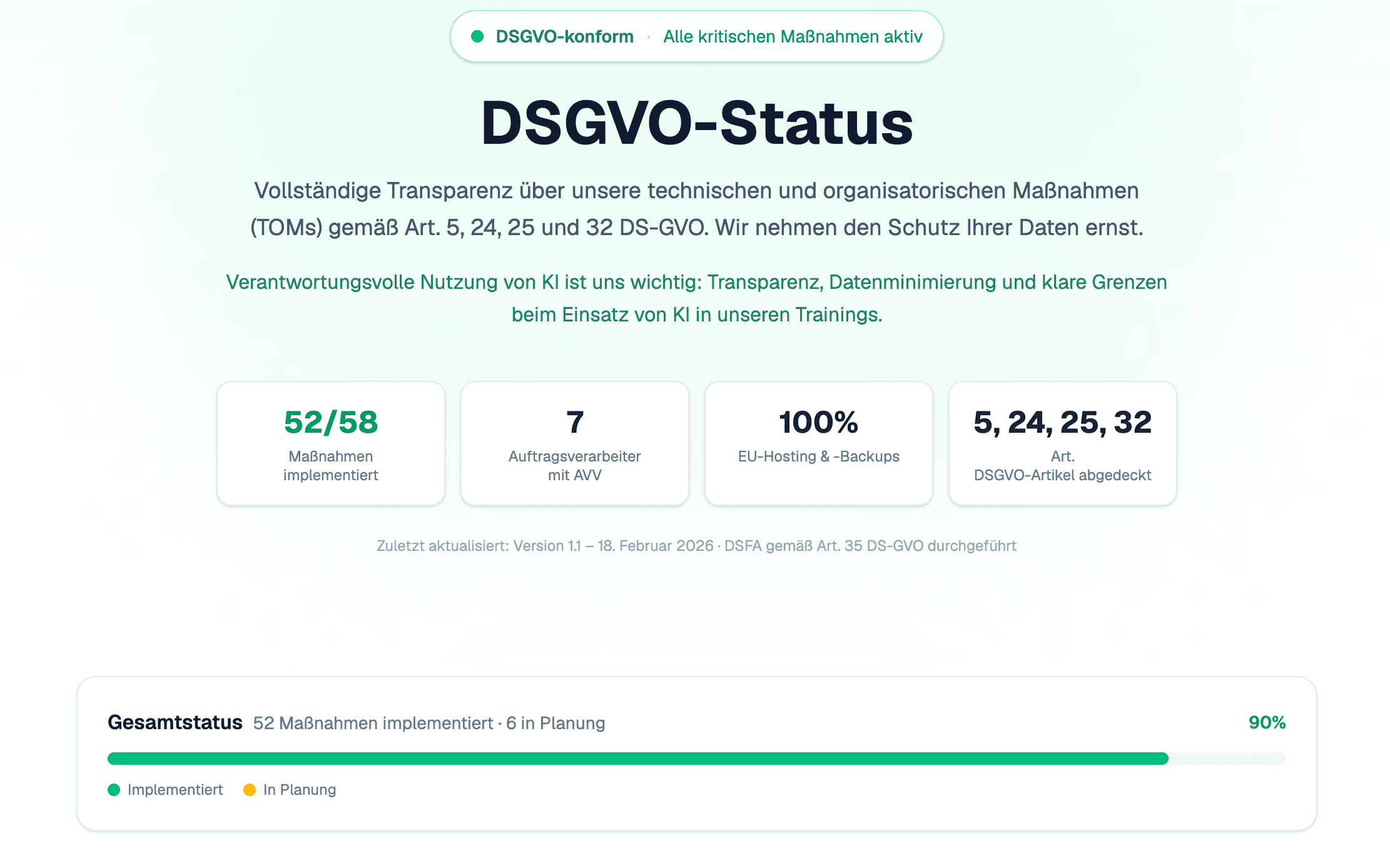
When customer data, conversation content, and compliance matter

GDPR-compliant conversation training for sensitive sales data in the DACH region

Telecommunications sales often relies on contract data, customer details, and sensitive renewal conversations. Careertrainer.ai is built for EU hosting and clear data protection requirements—so you can evaluate and use AI role-plays properly in regulated B2B environments.

  • EU hosting without third-country data transfers
  • Ideal for enterprise sales and regulated customer segments
  • Clear data flows for Procurement and data protection review
  • Built for DACH teams with high compliance requirements
To Function
DSGVO compliance status overview for AI training, highlighting implemented measures and data protection commitment.
Roles & Responsibilities

These sales call roles train the conversations that drive revenue and retention with Careertrainer.ai.

Whether it’s a new contract, a renewal, or a risk of churn: with Careertrainer.ai, you practice realistic AI role-plays from telecom sales—and identify in your conversation training where your pricing arguments, needs analysis, and churn prevention still have gaps.

Account Executives (B2B)

You’re leading first discussions and proposal rounds with IT leadership, Procurement, and the business department—even though your customer already has competing offers in-house. With Careertrainer.ai, you turn this into an AI role-play for discovery, objection handling, and buying center dynamics—so you qualify needs properly and don’t get pulled into price too early.

Sharpen your complex B2B deals before you make an offer

  • Discovery with IT and Procurement
  • Set a price anchor before any discount pressure.
  • Identify multi-site requirements
  • Counter your competitors effectively
  • Track your completion rate for each phase

Inside Sales & SDR

In the first phone call, often just 30 seconds decide whether you get a scheduled meeting—or the lead quickly loses interest. With Careertrainer.ai, you train live audio exercises for gatekeepers, callback blockers, and common objections like “we’re already taken care of” or “no need to switch.” It’s designed to help you generate more qualified meetings per week.

Get more appointments from both cold and warm leads

  • Pass the gatekeeper confidently
  • Objection: already with the provider
  • Callback after campaign contact
  • Qualify your need in just 5 minutes
  • Compare team quotes
Especially relevant

Retention & Winback

When an existing customer wants to cancel—whether due to price, service issues, or contract end—every phrase matters. Careertrainer.ai simulates real conversation scenarios for cancellation threats, number porting, contract end dates, and win-back efforts—so your conversation training directly supports churn prevention, improved retention rates, and lower discount losses.

Spot early customer drop-off and respond faster

  • Catch cancellation intent during the call
  • Handle objection to transfer
  • Negotiate an extension
  • Get a discount without losing margin—set limits
  • See churn risks in your feedback

Scaling Customer Success

You manage existing customers and want to add more locations, SIMs, Security, or UC solutions—without sounding like a pure upsell. Careertrainer.ai turns expansion conversations into hands-on sales training, helping you translate usage data, service topics, and contract windows into real cross-selling opportunities.

Improve existing business without feeling pushy with AI role-play training

  • Place it as a cross-sell after the service case.
  • Set up additional locations quickly and cleanly
  • Bundle mobile and landline
  • Identify your UC or security needs
  • Increase win rate

Channel and Partner Manager

In indirect sales, you have to keep partners motivated—even though commission structures, campaign priorities, and product focus constantly change. With Careertrainer.ai, you train AI role-play conversations for target setting, activation calls, and tough discussions around leads or margins—so partner business becomes more predictable, and what you decide in the office actually reaches the field.

Practice partner steering—balancing margin and focus.

  • Commit your partners to new plans
  • De-escalate leadership conflicts
  • Handle Objection Handling
  • Structure Activation Calls
  • Reflect partner performance quarterly

Telecommunications Sales Manager

You manage your pipeline, renewal quotes, and call quality across both inside and field sales—but in your CRM, you only see the results, not the root causes of what’s happening in the conversation. Careertrainer.ai complements your sales coaching with measurable AI role-play training, skill-gap analysis, and repeatable practice scenarios for teams, regions, or product lines.

Coaching that’s based on real conversation patterns

  • Identify skill gaps by team
  • Standardize renewal calls
  • Onboarding for new colleagues
  • Standardize pricing discussions across the team
  • Measure progress across quarters

Frequently Asked Questions about Sales Calls, Customer Retention, and AI-Powered Conversation Training

Find practical answers to typical sales situations in telecommunications—everything from discount pressure and contract renewals to churn prevention—and see how Careertrainer.ai supports you with realistic live audio role-play training.

What makes great sales training in telecommunications?

Great training for telecom sales prepares you for the moments when customers truly slip away or decide to renew—under price pressure, threats of switching, service disruptions, contract renewals, and cross-selling within the existing customer base.

What matters isn’t only product knowledge, but the confidence to hold the conversation under pressure. You need to clarify needs properly, assess objections in context, argue in a commercially sound way—and still maintain the relationship. In B2B telecom sales, several stakeholders are often involved, such as IT, procurement, and the business department, each with different priorities.

Sales training works when it reflects real conversation situations, enables repetition, and provides concrete criteria for effective call handling. Otherwise, it stays theoretical—something you can’t reliably draw on during the renewal call or in negotiations.

What objections come up most often in telecommunications sales?

In telecommunications, objections typically revolve around price, contract length, switching readiness, service experience, and competing offers. You often hear statements like: “Our competitor is cheaper,” “We want to stay flexible,” “Our current provider offers the same level of service,” or “After the last outages, we don’t have much trust.”

For existing-customer business, you’ll also see intent to cancel, demands for discounts, and skepticism toward upsell offers. In B2B contexts, objections are often not driven purely by price. An IT leader looks for stability and integration, procurement focuses on contract terms, and the business side cares about feasibility and response times.

So good objection handling doesn’t mean pushing back immediately. First, clarify the real underlying driver: Is it about budget, risk, frustration with the service, or internal comparability? Only then will your argument land with precision.

How do you handle a contract renewal conversation when the customer threatens to switch providers?

A strong contract extension conversation doesn’t start with a discount—it starts with diagnosis. If a customer threatens to switch, you need to first understand whether the trigger is pricing, performance, support, the contract model, or internal requirements.

Then structure the conversation in three steps: clarify the situation, make the consequences of switching tangible, and only then position a fitting extension offer. In telecommunications, the arguments that carry the most weight typically revolve around migration effort, the risk of downtime, service quality, SLA terms, compatibility, and planning reliability. Only after these factors are addressed clearly does a price discussion make sense.

It’s also crucial to distinguish between a genuine intention to switch and negotiation tactics. Someone merely trying to apply pressure requires a different conversation approach than a customer who has already prepared an internal tender. The earlier you recognize these differences, the better you protect both your margin and customer retention.

What are the most common mistakes in churn prevention for telecom sales?

The most common mistake is recognizing churn and cancellation risks too late—as a conversation problem. Many teams only react once the customer has already had multiple negative experiences, explored alternatives internally, or involved Procurement.

A second mistake is reacting with discounting too quickly. If you offer a price reduction without first analyzing the root causes, you often only confirm that you were overpriced before. This weakens your position and doesn’t resolve service, performance, or trust issues. Also critical: too much product detail, too little active listening, and a lack of alignment with the Buying Center.

In practice, conversations often fail because signals are missed: frustration about response times, uncertainty as the contract comes to an end, unclear usage expectations, or political tensions between IT and Procurement. Effective churn prevention means addressing these triggers early and steering the conversation intentionally—rather than just pushing a new offer.

How do you handle B2B sales calls with different decision-makers in the buying center?

In B2B tele-sales, you rarely win with a one-size-fits-all pitch. IT, Procurement, the business department, and Management assess the same offer using different criteria. That’s why you don’t just need to sell—you need to translate interests.

With IT, you’re talking about stability, integration, security, and operations. In Procurement, price logic, contract structure, term length, and comparability matter. Business teams want to see real-day value, while Management focuses on risk, scalability, and the financial impact. If you address everyone with the same wording, your offer loses relevance.

So the key is to clarify early who has which influence, who can block decisions, and who might become your internal champion. Strong conversation management in the Buying Center means separating information needs, reflecting interests clearly, and actively moderating contradictions between stakeholders.

How does Careertrainer.ai help you with pricing negotiations and objection handling training in telecommunications?

Careertrainer.ai is a DACH-focused AI platform for practical conversation training through live audio role-play. For telecom sales, that means you practice exactly the conversations where deals can make or break—such as discount pressure, churn/switching threats, contract renewals, or expanding services with existing customers.

Instead of static scripts, you speak with realistic AI characters that respond like real conversation partners: skeptical, impatient, analytical, or demanding. This way, you don’t just train your arguments—you also build timing, how to ask follow-up questions, how to set priorities, and how to handle emotional pressure. After each conversation, you get immediate feedback against clear evaluation criteria, including typical mistakes and specific improvement opportunities.

That’s especially valuable for objection training in telecom, because you can repeat critical situations as often as you need without risking real customer relationships. Knowledge turns into conversation skills you can access on demand.

What makes Careertrainer.ai different from classic seminars or typical e-learning for telecom sales?

The biggest difference is this: you practice real conversation skills—not just content. Seminars and e-learning teach you frameworks for conversations, objection handling, or negotiation techniques. With Careertrainer.ai, you train whether you can actually apply that knowledge in a tense live conversation.

In telecommunications sales, that’s crucial, because customers rarely respond like a textbook. They increase price pressure, set conditions, switch between service frustration and budget arguments, or bring in additional decision-makers. With Careertrainer.ai, you run 5 to 15-minute live audio role-plays with realistic AI counterparts—and get structured feedback immediately afterward.

For teams, it also adds scalability: consistent training quality for many employees, without scheduling chaos, trainer bottlenecks, or travel costs. If you want to develop conversation quality in a measurable way, this is often more effective than theory-only training.

Which roles in telecommunications sales is Careertrainer.ai especially well-suited for?

Careertrainer.ai is especially well-suited for roles that regularly face critical sales and customer retention conversations. This includes Account Executives in B2B sales, Inside Sales teams, Retention and Renewal Managers, Key Account Managers, as well as leaders who want to standardize sales coaching.

The platform is particularly relevant whenever conversation quality directly impacts renewal rates, churn, expansion potential, or margins. An Account Executive can train discovery and offer negotiation, a retention team can practice win-back efforts and reduce switching barriers, and an existing-customer team can improve cross-selling within active contracts.

Because Careertrainer.ai is DACH-focused, works in German, and offers live audio role-plays with instant feedback, it’s ideal for teams that want to train hands-on rather than only reading playbooks. It’s also helpful for distributed teams, since everyone can practice in short sessions anytime.

How measurable is conversation training with Careertrainer.ai for telecom sales teams?

Conversation training with Careertrainer.ai is significantly more measurable than purely manual coaching. After every role-play, you receive a structured assessment with competency scores, clear evaluation goals, identified strengths, and specific weaknesses throughout the conversation.

For telco sales teams, you can do more than just see that training happened—you can pinpoint where it falls short, such as needs analysis, price defense, conversation structure, handling cancellation intent, or closing clarity. In a company context, team analytics add another layer: leaders can identify skill gaps and track progress over time.

What matters most: Careertrainer.ai doesn’t replace every sales KPI—it links training to observable skill development. That’s especially valuable if you no longer want to judge training quality by gut feeling, but instead want to systematically see which conversation skills in your team are improving.

Can you offer Careertrainer.ai for sales training in telecommunications under your own brand?

Yes, Careertrainer.ai can also be used for sales training in the telecommunications industry as a white-label or partner model. This is especially relevant for training providers, consultancies, enablement partners, or HR platforms that want to integrate AI role-play training for Telco sales under their own brand into their offering.

That’s particularly useful in telecom because many providers need industry-specific conversation scenarios: objection handling under price pressure, contract retention within the existing base, renewal conversations with multiple decision-makers, or churn prevention when service frustration sets in. With Careertrainer.ai, you get an enabler—not a competitor to your customer relationship. You keep your branding, customer access, and offer logic, while the AI infrastructure runs in the background.

For partners, the multi-tenant architecture is especially important. This way, you can embed conversation training into your own service model without having to develop your own AI platform.

How quickly can you get started with Careertrainer.ai in telecom sales?

Getting started is fast because Careertrainer.ai is built for short, practical training sessions. Individual users can begin right away with existing role-plays and, in just a few minutes, practice their first conversations around price negotiations, contract renewals, or expanding existing customer relationships.

For companies, setup is just as quick—there’s no traditional training logistics needed, such as travel planning, room coordination, or long lead times. Teams can use standardized scenarios and, if needed, add their own conversation situations from telecommunications sales—for example, tailored to specific products, competitors, or customer types.

If you want to prepare a sales team quickly for critical conversation moments, that’s exactly the advantage: you’re not waiting for the next workshop—you can train immediately, repeat it as needed, and rely on consistent quality.

Other Industries for Sales Training

Discover industry-specific sales training and sales conversations for other industries.

A
AI sales training for consulting firms

AI sales training for consulting firms

Train your consulting sales team with AI role-play training for pitch situations, client meetings, and proposal presentations.

Learn more
P
Public sector sales training: help agencies confidently navigate complex procurement processes

Public sector sales training: help agencies confidently navigate complex procurement processes

Train with Careertrainer.ai on realistic AI role-play training for sales training, objection handling, and public-sector conversations: authorities, procurement law, long buying-center processes, and high-stakes follow-up questions—delivering measurable conversation training for sales teams.

Learn more
A
AI Sales Training for Staffing Agencies & Recruiting

AI Sales Training for Staffing Agencies & Recruiting

Train your recruiters and sales teams in staffing and recruitment with AI role-play training for new customer acquisition, candidate interviews, and fee negotiations.

Learn more
A
AI Sales Training for SaaS & Software

AI Sales Training for SaaS & Software

Train your software sales teams with AI role-playing for improved discovery calls, confident technical objection handling, and shorter sales cycles.

Learn more
S
Sales Training for Logistics: Practice customer conversations, objections, and price negotiations with confidence

Sales Training for Logistics: Practice customer conversations, objections, and price negotiations with confidence

Train with Careertrainer.ai on realistic AI role-play for logistics sales: sales training, conversation training, objection handling, and sales coaching for transport, freight forwarding, and contract logistics—practical, measurable, and GDPR-compliant.

Learn more
AI Sales Training for Logistics & Transport

AI Sales Training for Logistics & Transport

Train your logistics sales teams with AI role-playing for complex tender negotiations, price defense, and new customer acquisition in a highly competitive market.

Learn more
Objection handling

Practise the most common sales objections

Compact objection handling drills for sales conversations in Sales Training in Telecommunications: AI Role-Plays for Objection Handling, Contract Retention, and Churn Prevention.

Handle the “No interest” objection—and train with AI

Practice handling the objection “no interest” in realistic live audio role-play scenarios for both cold and warm outreach. With Careertrainer.ai, you’ll learn the right response s…

Practise response

Train handling the objection “I’ll get back to you” in sales

Practice objection handling with the “I’ll get back to you” scenario using realistic AI role-play training in live audio. With Careertrainer.ai, you’ll learn to stay proactive, re…

Practise response

Train objections handling for “No budget” with AI role-play training

Train the exact customer statement “No budget” in realistic live audio role-plays with Careertrainer.ai. Practice follow-up questions, psychologically sound response strategies, a…

Practise response

Objection Handling: Train “I need to talk to my partner first”

Practice the objection “I need to talk to my partner first” with Careertrainer.ai through realistic live audio role-plays. Learn the right follow-up questions, understand the psyc…

Practise response

“It's too expensive”: Train objections handling in sales

When a customer says “It’s too expensive,” they often don’t mean the price alone. More often, uncertainty, a missing sense of value, competitive pressure, or an unclear ROI are be…

Practise response

Handle the objection “Send me an offer” confidently

Train your objection handling for “Could you send me an offer?” with realistic AI role-play training in live audio. Practice the right follow-up questions, understand the psycholo…

Practise response

Full overview: sales objections and AI conversation practice