careertrainer.ai

Practice giving feedback, handling conflicts, motivating others, and running development conversations with INTJ employees—safely and before the real meeting.

Train realistic INTJ leadership conversations with AI role-play training

Careertrainer.ai lets you train challenging live audio role-plays with INTJ-style characters in everyday leadership scenarios. You get instant feedback, practice risk-free, and measurably improve your conversation skills.

Live example · This is what training looks like

12 scenarios
Phone call

Practise with your situation

Liam Edwards

Liam Edwards

Leadership
Skeptical matrix operations lead

Long-tenured high performer · 41 · INTJ

Cross-IndustryKritikgespraechAbwehrhaltung FeedbackHigh Performer Langjaehrig

Call about missed milestones Liam hints you do not notice

Late feedback lands like judgement

In a quick phone call, you reach Liam right after the weekly steering call. He answers politely, then circles back to blame you for delays.

Goal: Name the pattern you observed without moral judgement, and ask him to reflect. Get one specific commitment on what he will do differently next week.

Learning goals

  • Anchor feedback in one fact
  • Ask for his viewpoint

What to expect

  • Use one observation plus impact, no character judgement
  • Ask for his perspective before proposing a change
Practise with your situation

INTJ conversations often don’t shift loudly—they shift quietly.

When you address INTJ employees with feedback, conflicts, or development, conversations usually don’t fail because of a lack of logic. They fail due to tone, timing, and reactance. With Careertrainer.ai, you can train exactly these critical leadership moments through realistic live-audio AI role-play—risk-free, true to real life, and with instant feedback.

AI character for industry-focused solutions

AI role-play focus

Practice sensitive INTJ leadership moments in advance

Careertrainer.ai simulates realistic conversations with INTJ employees, so you can safely practice handling pressure, maintaining distance, and overcoming resistance before the real meeting.

Precise feedback—without defensivenessManage conflicts under pressure—using logic and clear communication.
Challenge 01

INTJ employees tend to dismiss vague feedback immediately.

If your feedback feels imprecise, emotionally off-target, or poorly justified, INTJ employees often tune out internally very quickly—and may challenge your reasoning more than the behavior itself. That costs buy-in, delays behavior change, and leaves the sense that the conversation was factual, but didn’t move anything forward. With Careertrainer.ai, you can train exactly these feedback conversations through realistic live audio AI role-play—complete with direct feedback on clarity, structure, and the risk of reactance.

Book a free demo
Challenge 02

INTJ conflicts often escalate through withdrawal rather than loud confrontation.

When INTJ employees are in conflict, they’re often perceived as cooler, more concise, and more argumentative rather than openly emotional. For leaders, that’s tricky: agreement can look like consensus—while trust, speed, and collaboration are already starting to slip. With Careertrainer.ai, you can simulate this quiet escalation realistically through AI role-play. That way, you can deliberately practice asking follow-up questions, assessing the situation, and de-escalating effectively under pressure.

Book a free demo
Challenge 03

INTJ motivation is easy to misread in everyday situations.

When an INTJ direct report comes across as distant, critical, or unimpressed, it can quickly be interpreted as demotivation, resistance, or a lack of loyalty. The result: leadership signals that miss the mark, avoidable tension, and conversations that never hit the real lever. Careertrainer.ai helps you train motivation and development conversations with realistic INTJ patterns—so you can clearly distinguish between underchallenge, loss of autonomy, and genuine performance decline.

Book a free demo
Challenge 04

INTJ development conversations often fail due to poorly grounded perspectives.

INTJ employees rarely embrace development paths just because they’re well-meant or politically convenient. They want consistency, logical competence, and a clear, understandable purpose. Without that line, doubts can emerge about leadership, engagement, and the next career step. With Careertrainer.ai, you can train these development discussions as AI role-play—so you can communicate perspectives, expectations, and learning paths convincingly, without empty phrases.

Book a free demo

Train INTJ in everyday leadership: AI role-play training for feedback, conflict, and motivation—practice the kinds of conversations you face every day with realistic scenarios.

Four real-world practice scenarios to train an INTJ in everyday leadership: AI role-plays for feedback, conflict, and motivation. Practice typical conversations with realistic AI characters in Careertrainer.ai.

Filter by company context, conversation type, challenge and employee persona. Every example leads directly into your own AI role-play.

12 of 12 scenarios

Company context

Conversation type

Challenge

Employee persona

Liam Edwards

Liam Edwards

Long-tenured high performer

Corporate matrix organisationCritical feedback conversationDefensive response to feedbackLong-tenured high performer

In a quick phone call, you reach Liam right after the weekly steering call. He answers politely, then circles back to blame you for delays.

What you'll practise

  • Anchor feedback in one fact
  • Ask for his viewpoint
  • Get a concrete next step
I heard the steering deck. The part about my queue felt missing.
James Carter

James Carter

Junior with high expectations

Family-led midmarket companyConflict conversationLoyalty conflictJunior with high expectations

Between two customer pickup tasks, you meet James across from the production office door. He nods, then quietly steers the discussion back to the team’s previous practice.

What you'll practise

  • Clarify decision and role scope
  • Surface the loyalty pull
  • Get one committed next action
I am on board. I just need to stay consistent with how we do things here.
Alex Taylor

Alex Taylor

Vocal critic

Tech scale-upCritical feedback conversationDefensive response to feedbackVocal critic

Alex picks up the line during the sprint retro window. You have one concrete slip, but his first response is a justification.

What you'll practise

  • Keep judgement out of feedback
  • Ask for his interpretation
  • Agree a next-sprint behaviour
Your timing is the problem. The metrics you cite are old.
Emily Parker

Emily Parker

Quiet talent

Public-sector organisationCritical feedback conversationFeeling micromanagedQuiet talent

At the desk across from you, Emily looks rushed and avoids eye contact. She says little as you mention last week’s extra check-ins.

What you'll practise

  • Separate outcome from control
  • Adjust checkpoints to necessity
  • Confirm Emily’s autonomy boundary
I can deliver. I just need to know what is mine to decide.
Daniel Walker

Daniel Walker

Return after overload

Healthcare shift organisationMotivation conversationOverload signalsReturn after overload

Daniel picks up during a short gap between night handovers. He avoids details and stays focused on getting through the shift.

What you'll practise

  • Name the overload signals clearly
  • Prioritize work for today and this week
  • Agree relief and a follow-up check
I am functioning. That should be enough, right?
Jordan Blake

Jordan Blake

Informal leader

Skilled-trades businessDevelopment conversationQuiet quittingInformal leader

On site at the workshop desk, Jordan arrives with his notes in hand. He answers politely, but you can tell he is done investing extra effort.

What you'll practise

  • Name the withdrawal behavior concretely
  • Ask for causes without escalating
  • Agree one binding improvement step
I will handle what is assigned. Beyond that is your problem.
Sophie Morgan

Sophie Morgan

New team member with leadership ambition

Retail branch operationConflict conversationFear of changeNew team member with leadership ambition

Sophie picks up from the backroom break schedule, between tills and stock checks. She already sounds convinced the next initiative will cost her staff hours.

What you'll practise

  • Understand the real resistance driver
  • Mirror concerns to reduce distrust
  • Connect change to her personal upside
Another program means more extra work for us, again.
Michael Brooks

Michael Brooks

Experienced senior close to exit

Remote and hybrid teamDelegation conversationAuthority challengeExperienced senior close to exit

At the hybrid desk, you catch Michael right after the weekly steering call. He smiles, but the way he repeats instructions tells you the mandate is eroding.

What you'll practise

  • Describe authority erosion with examples
  • Clarify mandate and sign-off lines
  • Agree one next behaviour commitment
In this setup, whose signature counts? You or the other line?
Casey Hayes

Casey Hayes

Long-tenured high performer

Production shift operationDelegation conversationFear of changeLong-tenured high performer

Casey calls during a shift handover and questions the new role design. The update feels like a competence risk, not a simple process change. If it fails, their standards and credibility will look negotiable to others.

What you'll practise

  • Name the real fear
  • Reassure with concrete boundaries
  • Agree one next action
New system means new rules, but whose judgment counts?
Rachel Bennett

Rachel Bennett

Junior with high expectations

Corporate matrix organisationCritical feedback conversationQuiet quittingJunior with high expectations

In the meeting room, Rachel starts with the SLA miss and cuts straight to anger. She says repeated delays were reported, yet nothing changed for her team. If this lands badly, her credibility and internal motivation will collapse fast.

What you'll practise

  • Mirror the core anger
  • Clarify responsibilities on the spot
  • Agree one repair step
We escalated it, and then nothing moved for weeks.
Owen Foster

Owen Foster

Vocal critic

Family-led midmarket companyConflict conversationAuthority challengeVocal critic

Owen calls right after you brief the team about role duplication. He challenges your mandate and implies you skipped the right internal routing. If this goes wrong, his influence and team position will be weakened publicly.

What you'll practise

  • Acknowledge authority challenge
  • Clarify roles with interfaces
  • Set a shared team goal
Since when do you decide ownership without checking with us?
Riley Stone

Riley Stone

Quiet talent

Tech scale-upConflict conversationTeam splitQuiet talent

Across from you at the office, Riley stays quiet until you reference the camp behavior. She nods but keeps her distance, like the conversation could cost her credibility. If it fails, her group will withdraw further and collaboration will stall for months.

What you'll practise

  • Invite pattern observations
  • Define interfaces and standards
  • Agree one collaboration commitment
We both know there are camps, but we pretend we do not.

How the AI evaluates your training conversation

After every role-play a separate AI analyses your full conversation transcript — with score, goal feedback and concrete quotes from your own dialogue.

Two layers feed the overall score: scenario-specific goals (70%) and five core competencies for your training type (30%).

SummaryRating: Solid

Liam Edwards · Call about missed milestones Liam hints you do not notice

Name the pattern as an observation and secure one next-week action

Name the pattern you observed without moral judgement, and ask him to reflect. Get one specific commitment on what he will do differently next week.

Overall result
6.7/ 10

70% scenario goals + 30% core competencies

Scale 0–10 · backed by quotes from your conversation

Scenario goals · 70%Core competencies · 30%

Scenario goals

Scenario goals · 70%

Anchor feedback in one fact

6.4 / 10

Stick to one observable behaviour and its impact. This keeps the discussion credible to an analytical long-tenured employee.

Partially achieved

You referenced one steering deck moment, but you did not state a clear one-step behavior by you before impact.

In the last steering deck, you said my queue gap caused delays; right?

Ask for his viewpoint

6.4 / 10

Briefly ask how he saw the situation and what he thinks caused the gap. This reduces defensiveness and surfaces the real constraint.

Partially achieved

You asked for confirmation of the pattern, but you did not explicitly ask for Liam’s viewpoint before pushing the change.

Is that the feedback pattern, and what will you do next week instead?

Get a concrete next step

8.4 / 10

Agree what he will do differently next week, with a measurable behaviour. This turns passive disagreement into accountable follow-through.

Fully achieved

You obtained a commitment direction by asking what Liam will do next week instead of the current approach.

Is that the feedback pattern, and what will you do next week instead?

Core competencies

Core competencies · 30%

Active listening

6.4

Follow-up questions, paraphrasing, targeted clarifiers

Empathy & understanding

6.9

Reading the counterpart's emotional state and perspective

Conversation control

6.7

Structured and goal-oriented without dominating

Solution focus

7.0

Developing constructive options together

Communication clarity

6.5

Clear, understandable, to the point

Details · Transcript excerpt

YouIn the last steering deck, you said my queue gap caused delays; right?
Liam EdwardsWell. You missed the part about my lane. So timelines slipped. Again.
YouIs that the feedback pattern, and what will you do next week instead?
Pro tip

Next week, anchor one behavior to one owner. Example: "For next Monday’s deck, I’ll add my milestones into the shared queue and confirm the owner."

Only your wording is evaluated — not the AI counterpart's. The AI's opening of the conversation is not penalised.

Practise with your situation
Roles & Responsibilities

Train INTJ conversations for these leadership roles with Careertrainer.ai—especially targeted.

If you want to prepare feedback, handle conflicts, or drive development with INTJ employees, Careertrainer.ai turns it into realistic AI role-play training with measurable feedback. This way, you practice sensitive leadership moments in advance—so you don’t have to improvise during the real conversation.

Team leads in day-to-day operations

You lead a specialist team and need to give INTJ employees precise, actionable feedback—without triggering unnecessary defensiveness. With Careertrainer.ai, you train realistic conversation simulations focused on priorities, tone, and logic errors before quiet distance or passive resistance starts to impact performance.

Train objective feedback without getting defensive

  • Clearly and constructively justify critical feedback
  • Handle follow-up questions from an INTJ
  • Recognize subtle rejection early
  • Make the next steps binding.

Department Head & Area Manager

When strategically strong INTJ direct reports openly or covertly question decisions, you need more than good arguments. Careertrainer.ai gives you AI role-play training for conflict conversations, escalation signals, and clear responsibility boundaries—with instant feedback after every session.

Resolve conflicts with strong individual performers

  • Address conflicting priorities in a structured way
  • De-escalate hidden resistance
  • Make clear, well-structured decisions
  • Secure your commitment—despite reservations

HR Business Partner

You support leaders in sensitive conversations with INTJ employees—e.g., when motivation is dropping, roles are unclear, or development stalls. With Careertrainer.ai, you can rehearse every practice scenario in advance, so leadership stays clear and balanced—neither too soft, too vague, nor unnecessarily confrontational.

Test sensitive leadership moments before the conversation

  • Address motivational decline clearly and confidently
  • Structure Development Conversations
  • Get clarity on roles using facts
  • Detect mistakes in your communication
Popular

People Lead in Tech Teams

In product, data, or engineering teams, INTJ patterns often meet high expectations, direct communication, and little patience for unclear leadership. Careertrainer.ai turns that into live audio practice—with feedback, expectation-setting, and better alignment between technical logic, pace, and team behavior.

Practice realistic, tech-backed conversation scenarios

  • Giving feedback on collaboration
  • Resolve competing priorities
  • Handle objections with confidence—right from the start
  • Set clear behavioral goals

Managing Director in SMEs

You’re talking to senior, high-performing key players who are strong in expertise—but can be sensitive to unclear leadership or overly political phrasing. With AI role-play training for INTJ conversations, you practice clear development discussions, constructive corrections, and motivation—without damaging trust or undermining authority.

Lead high-performers clearly and calmly

  • Address performance dropouts directly
  • Progress instead of debating status
  • Handle objections on a factual level
  • Set conversation goals with measurable outcomes

L&D and PE leaders

You want to standardize leadership conversation training for multiple leads—without waiting for one-off coaching sessions. Careertrainer.ai combines INTJ-specific AI role-play scenarios with feedback and skill-gap insights, so you can see who handles conflicts, motivation, and development discussions confidently.

Make leadership competence measurable across your team

  • Roll out INTJ scenarios for leads
  • See your skill gaps by conversation type
  • Compare progress across teams
  • Standardize feedback quality

Train difficult INTJ leadership conversations with Careertrainer.ai

Choose a specific conversation with INTJ team members, train it as a realistic live-audio role-play, and see immediately how precisely you steer feedback, handle conflicts, motivate others, or drive development.

1

Choose the right INTJ role-play for your leadership situation

You start with a concrete scenario from your day-to-day leadership work—for example, delivering critical feedback after a logic mistake, handling a conflict about priorities, or running a development conversation with a distant INTJ direct report. Careertrainer.ai tailors the role-play to common INTJ patterns: high task-orientation, rapid weak-spot analysis, withdrawal when criticism feels unclear, and resistance when arguments are— in the INTJ’s view—insufficiently precise.

Role-play Generator in Careertrainer.ai
2

Lead realistic conversations with a Voice AI simulation

Then you conduct a live audio conversation with an AI counterpart for 5 to 15 minutes—responding like a demanding INTJ employee: sober, analytical, sometimes a bit cool, and under stress more controlled than openly emotional. This is how you practice staying precise, avoiding reactance, handling counterpressure with clear, factual responses, and still building trust and keeping the conversation moving—even with some emotional distance.

Voice AI conversation simulation in Careertrainer.ai
3

Get INTJ-specific feedback and measure your progress

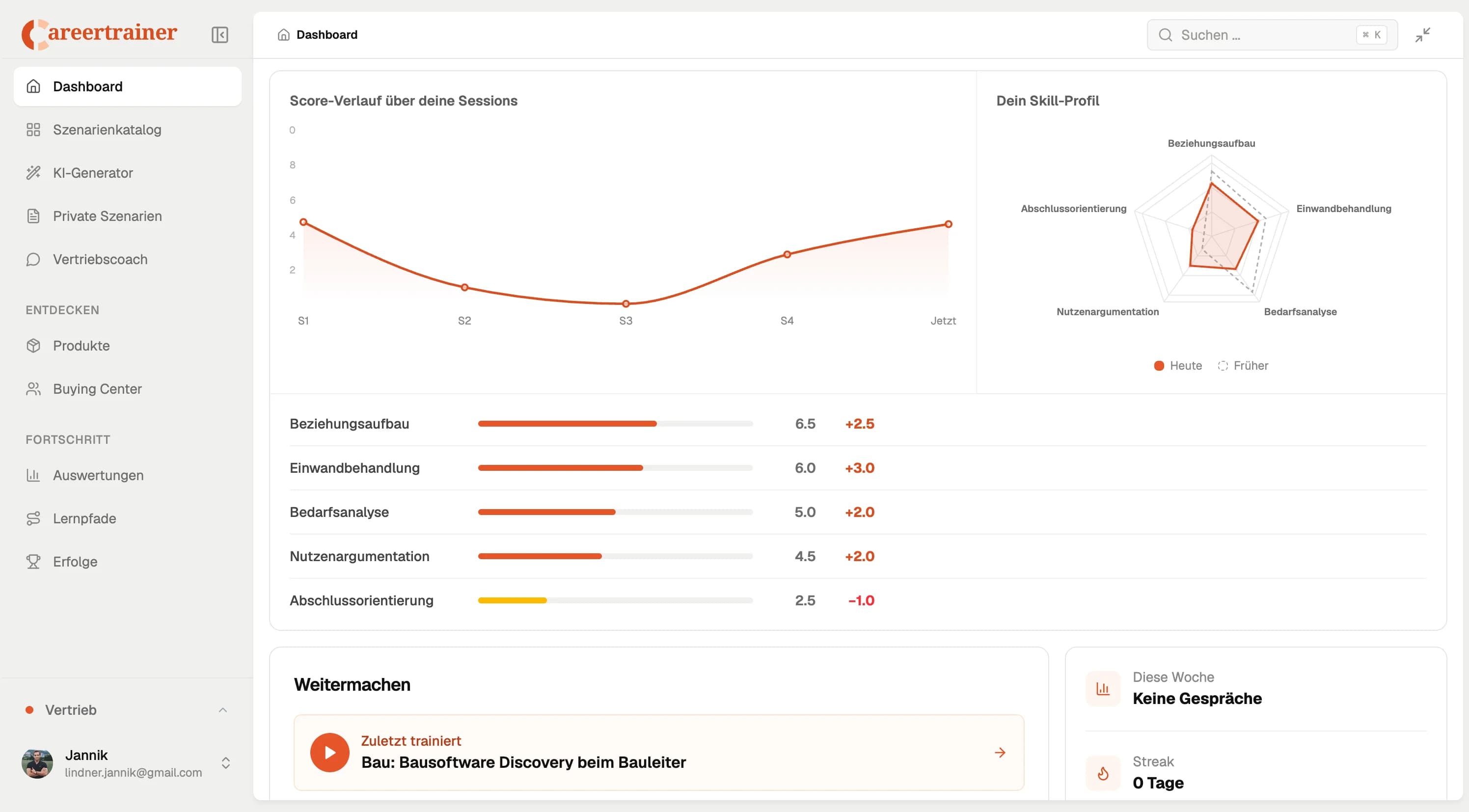
After the role-play, you get immediate feedback on how clear your structure was, how well you handled INTJ objections, and whether you moved the conversation toward openness, motivation, or commitment. You’ll see exactly where your tone, timing, or argumentation triggered resistance—so you can train that same leadership moment with precision right away.

Evaluation dashboard in Careertrainer.ai

Typical INTJ leadership conversations you shouldn’t have to improvise

When working with INTJ teammates, conversations often don’t stall because of overt emotion—but due to internal distance, strict logic checks, or quiet resistance. Here are concrete leadership moments you can train with Careertrainer.ai using realistic live audio role-play—before feedback, conflicts, or development get stuck in real conversations.

Feedback conversation

“Your point isn’t precise.”—critical feedback after a factual mistake

You’re speaking with an INTJ team member about an analysis error that has already led to follow-up costs. The conversation quickly turns sour if you criticize too broadly or broadly question their expertise. What helps most is a clear, fact-based opening: reference observable behavior, explain the impact, and set a precise expectation for the next step. In the AI role-play, you practice how to deliver feedback clearly—without triggering unnecessary defensiveness.

Practice the conversation with Lea
Conflict resolution

An INTJ Direct Report blocks new priorities with calm, counter-logical reasoning

A key employee challenges the new team priority in a fact-based conversation and signals that the plan doesn’t make operational sense. It gets harder when you frame the objection as resistance—turning it into a debate about logic, authority, and decision rights. A better approach is to clarify the thinking model behind their objection first, define decision options clearly, and then set the framework in a binding way. With Careertrainer.ai, you can practice this specific pressure point multiple times and see right away where you’re needlessly triggering pushback.

Practice the conversation with Markus
Motivational Interviewing

The results are strong, but your INTJ employee visibly withdraws from the team.

A previously strong employee is still delivering, but they’re increasingly disengaged: they participate less, avoid meetings, and seem emotionally distant already. Conversations often fail if you jump in too quickly with generic praise, team spirit, or motivation clichés. What works better is a clear, matter-of-fact start based on observable changes—then move into targeted questions about friction, decision-making autonomy, and whether the tasks still connect to their professional skills. With AI role-play training, you practice addressing hidden demotivation early—before attachment and performance start to break down.

Practice the conversation with Tobias
1:1 Development Conversation

“I need more responsibility, not more meetings” – discuss the development path with INTJ

An ambitious employee wants to develop—but rejects vague career paths and politically shaped role expectations. The conversation drags when you try to sell growth through job titles, motivation talk, or blurry future prospects. It’s better to make development concrete: responsibility, decision-making authority, the complexity of the work, and clear success criteria. In an AI role-play with immediate feedback, you practice how to drive substantial development for INTJ employees—not just symbolic changes.

Practice the conversation with Nora
Why Careertrainer.ai

Train INTJ conversations in everyday leadership situations—deliberately and effectively

When you’re preparing feedback, handling conflicts, or driving development with INTJ employees, you don’t need theory about personality types—you need realistic conversation dynamics. Careertrainer.ai combines live audio role-play, psychologically consistent AI characters, instant evaluation, and measurable skill tracking for real leadership moments in the DACH context.

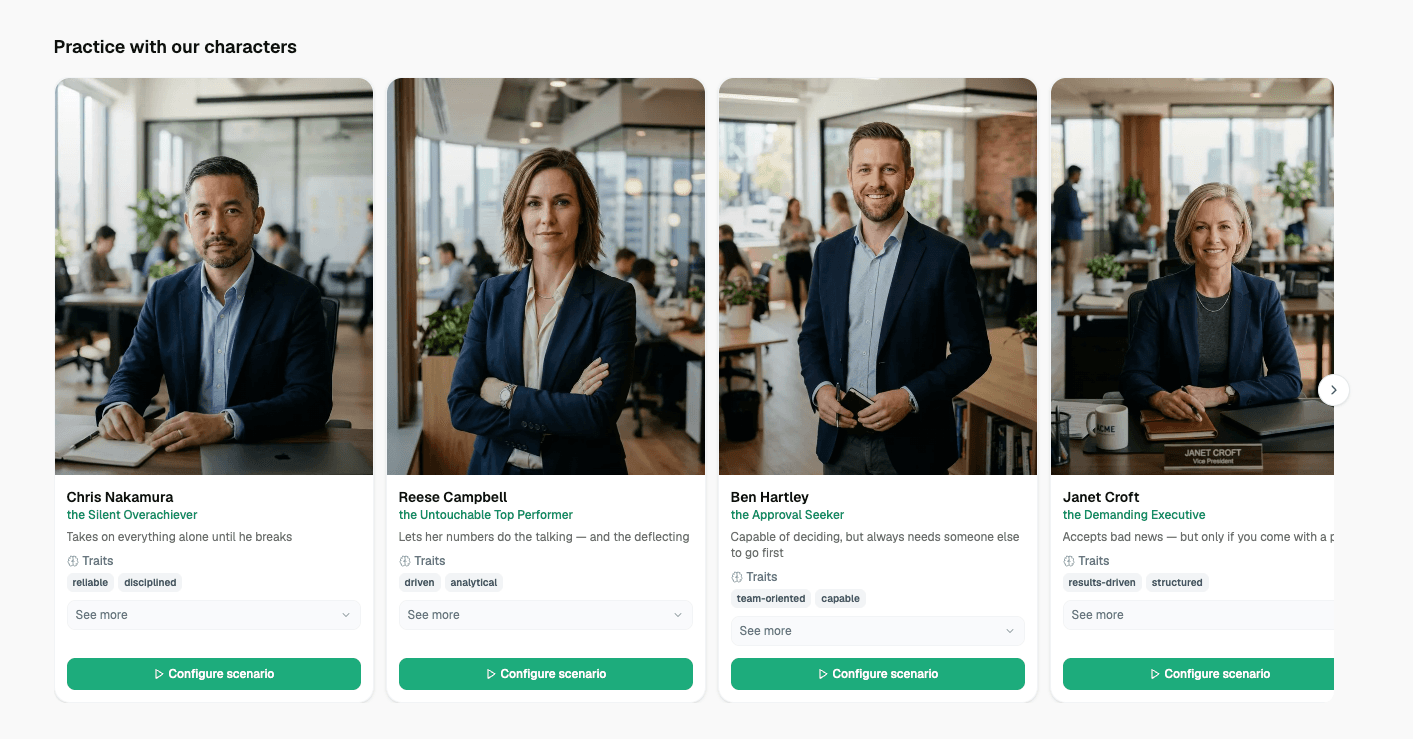
Character selection screen with AI training personas and scenario configuration buttons

1:1 coaching for feedback conversations and escalations

INTJ-Direct-Reports: Practice sensitive leadership conversations realistically

Train with INTJ team members on the exact conversations that fail in day-to-day work due to quiet resistance, hard logic checks, or withdrawal. Practice—through live audio role-play—how to lead feedback meetings, moderate conflicts, or run development conversations with precision, without triggering unnecessary pushback.

  • Practice critical feedback conversations with an INTJ—without getting stuck in a justification loop.
  • Practice 1:1 conversations on priorities, delegation, and conflicting goals
  • A risk-free space before performance reviews or escalations
  • Repeat it until your tone, timing, and clarity are right.
Learn more
Vertriebstraining mit KI-gestützten Szenarien zur Verbesserung von Verkaufs- und Beratungskompetenzen.

Psychologically realistic conversations

INTJ characters don’t respond generically—they react in a realistic, understandable way.

Careertrainer.ai maps INTJ patterns into realistic conversations with consistent behavioral logic: a calm communication style, probing follow-up questions, stepping back when leadership is unclear, or opening up when the reasoning is solid. That means you’re not training against a generic employee—you’re training against a counterpart with credible responses in day-to-day leadership situations.

  • INTJ Employees test logic, precision, and leadership structure
  • Stress shows up more as distance than as open emotion.
  • Great for feedback during probation and for coaching conversations
  • More everyday realism than rigid bots or seminar role-plays
Learn more
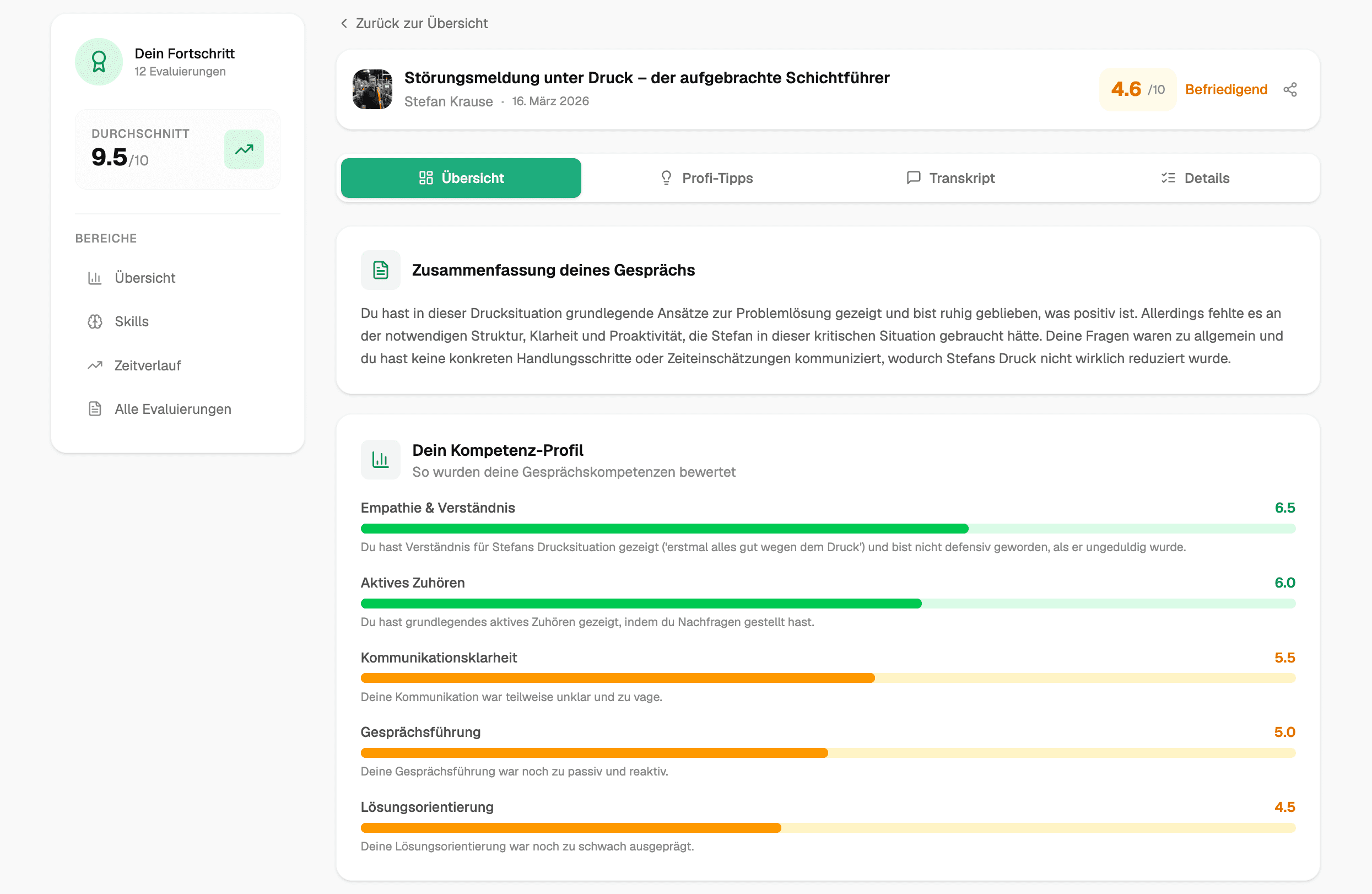
Evaluation summary and competency profile for leadership communication under pressure.

See instantly what works in the conversation

Your INTJ conversation leadership is evaluated directly after the role-play.

After every session, you’ll get an independent assessment of your conversation style—with clear scores, evidence, and concrete improvements. That way, you can quickly see whether, in an INTJ conversation, you were too vague, pushed too soon, or missed the mark on aligning goals, feedback, and next steps.

  • Scores for clarity, listening, empathy, and solution orientation
  • Evidence from real conversations—not gut feeling after a 1:1 session
  • Pro Tips for Better Phrasing When You Meet Matter-of-Fact Resistance
  • Helpful for staff meetings, OKR reviews, and conflict resolution
Learn more
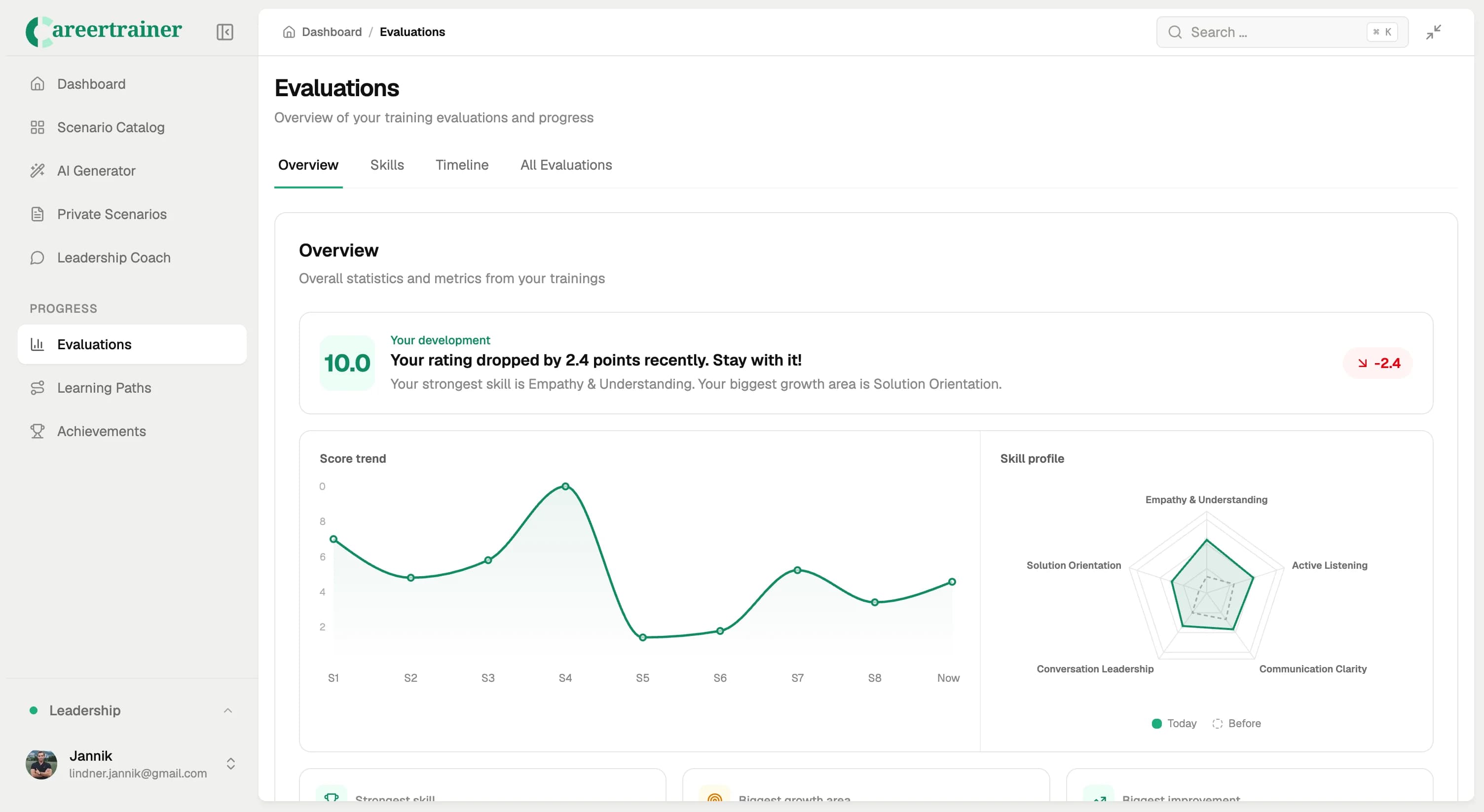
Training evaluation dashboard displaying progress, ratings, and performance metrics for leadership development.

Measurable progress instead of gut instinct

Make INTJ leadership conversations’ skill gaps visible over time

If you’re repeatedly training with demanding INTJ direct reports, Careertrainer.ai shows you where you’re actually improving. You’ll see whether your leadership KPIs rise in areas like clarity, conversation management, or de-escalation—and which competencies still lag behind in feedback, conflict, or development conversations.

  • Progress for each skill across multiple INTJ training sessions
  • Spot signs of stagnation early in conflict moderation or delegation
  • Useful for executives, team leads, and your leadership pipeline
  • A solid foundation for coaching instead of generic training plans
Learn more
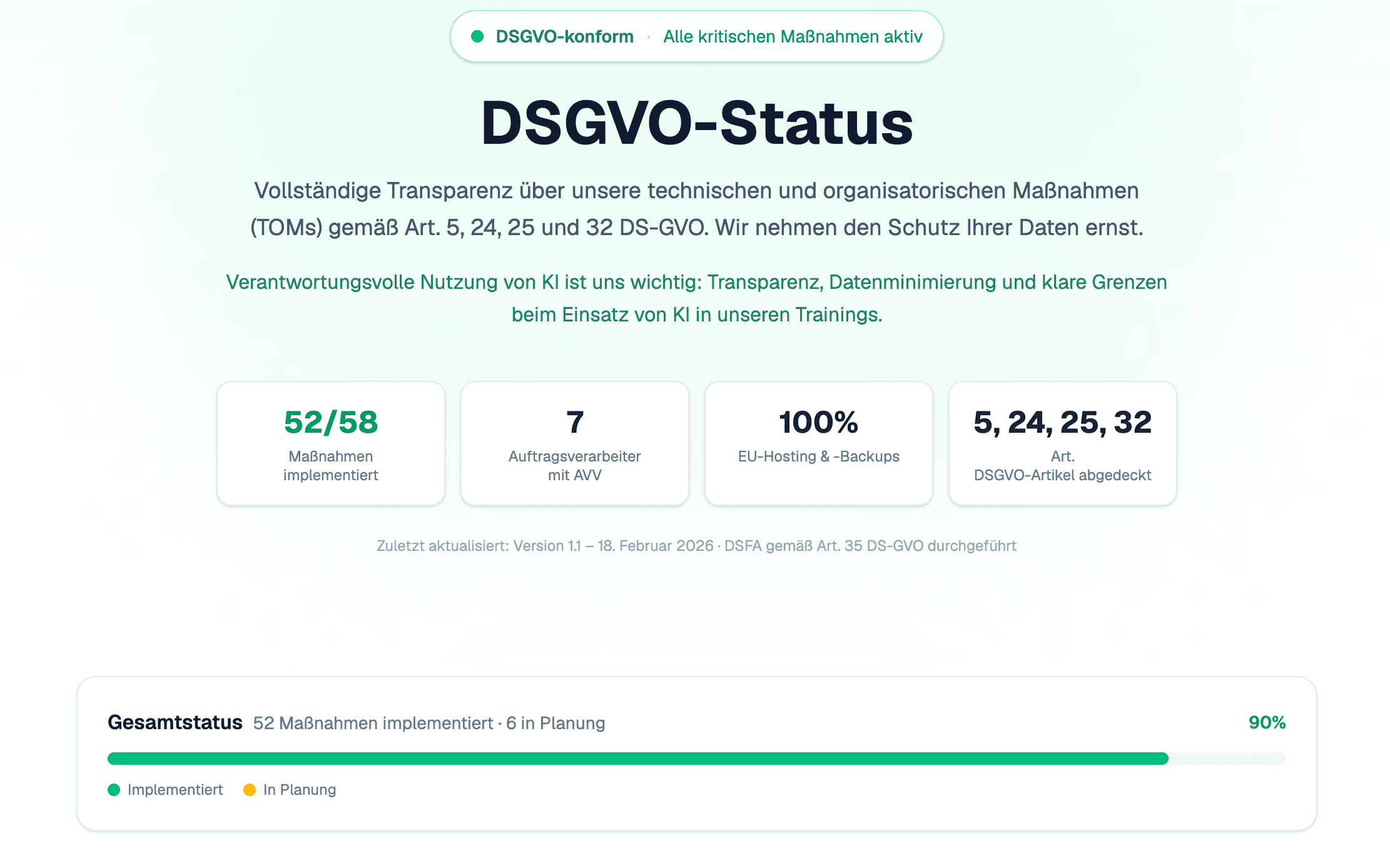
DSGVO compliance status overview for AI training, highlighting implemented measures and data protection commitment.

Train with AI—DACH-ready and GDPR-compliant

Even sensitive INTJ employee conversations stay GDPR-compliant and privacy-safe.

Especially in critical conversations—like feedback meetings, separation talks, or performance reviews—data protection isn’t a side issue. Careertrainer.ai was built for the DACH region, with EU hosting and GDPR-compliant processing, so you can implement even sensitive leadership training responsibly in your organization.

  • EU hosting for sensitive 1:1 and performance review training sessions
  • Ideal for HR, L&D, and regulated organizations across the DACH region
  • You don’t need a workaround with unclear third-country transfers.
  • Important for people-related leadership and conflict situations
Learn more

FAQ about INTJ leadership conversations and Careertrainer.ai

Practical, targeted preparation for executives who want to train specific feedback, conflict, motivation, and development conversations with INTJ employees.

What should you pay special attention to in feedback conversations with INTJ employees?

When giving feedback to INTJ team members, clarity matters most. If your point is imprecise, contradictory, or emotionally unclear, the likelihood of internal distance rises instead of an open discussion.

A helpful structure is observation, impact, and expectation: What exactly happened, why is it relevant, and what should change going forward. Avoid blanket judgments like “That seems unprofessional” without evidence. INTJ types often test statements for logic, consistency, and cause-and-effect. The more solid your example, the more likely the conversation stays objective and productive.

Tone is equally important. Direct doesn’t mean cold. If you only point out mistakes but don’t show a clear direction for development, it may come across as intellectually weak or operationally short-sighted. Strong leadership combines precision with respect—and a clear next step.

Why do conflicts with INTJ direct reports often escalate quietly instead of openly?

Conflicts with INTJ direct reports often don’t show up loudly—they stay quiet. This is often because, in conversations they see as illogical, politicized, or unclear, they tend to withdraw, build counterarguments internally, or only say what’s strictly necessary.

As a leader, that’s tricky, because the conversation can look calm on the surface even while cooperation is already taking damage. Typical warning signs include brief, restrained answers, a noticeable emotional distance, detail-oriented criticism focused on side issues, or a visible shift from relationship-building to handling tasks only.

If you want to address conflicts early, you need to name the tensions specifically: different priorities, unclear decision paths, perceived inconsistency, or frustration with inefficient processes. The more precisely you get to the core, the more likely you are to restore genuine collaboration instead of quiet resistance.

How do you motivate INTJ employees without triggering resistance with generic, stock phrases?

INTJ employees usually respond better to purpose, autonomy, and challenging problem-solving than to generic motivational rhetoric. If all you talk about is “more engagement” or a “positive mindset,” it can quickly feel superficial.

More effective is to connect motivation to concrete drivers: decision-making freedom, strategic relevance, intellectual challenge, clear responsibilities, and visible impact of the work. Be specific about how the task contributes to the bigger goal—and where independent thinking is explicitly expected.

At the same time, many INTJ types don’t need constant social approval, but they do value respect for their expertise. Motivation is more likely to come from a credible environment with a clear direction than from emotional appeals. When you articulate performance, thinking quality, and development opportunities precisely, you increase the likelihood of genuine commitment.

Which mistakes should you avoid in development conversations with INTJ?

A common mistake is being unclear. If you describe development with general statements like “You should communicate better” or “Show more leadership,” INTJ employees miss the operational translation into observable behavior.

Just as problematic are conversations that only collect deficits without offering a challenging perspective. Many INTJ types want to know which competency should be built, why it matters, and how progress can be recognized. Without this logic, development quickly starts to feel like a political ritual instead of a serious career path.

Also, avoid using analytical strength to undermine teamwork. It’s better to frame development as an expansion: for example, conveying complex content in a way that fits the audience, making decisions visible earlier, or moderating team resistance more productively. That way, the conversation stays respectful and future-oriented.

How do you prepare for a difficult conversation with an INTJ team member—concretely?

First, prepare the core conflict—not just your message. Clarify for yourself: What specific behavior are you addressing, what impact does it have, and what goal should the conversation achieve? For INTJ employees, it’s especially useful to translate ambiguous feelings into observable points.

Then check your reasoning for consistency. If there are contradictions, missing examples, or unclear expectations, the conversation can quickly turn into a debate about your logic rather than the actual topic. That’s why it helps to define just a few key points that you can back up—and set a clear next step.

Also plan how you’ll respond to common patterns: a factual counter-check, follow-up detail questions, distancing, or redirecting to system errors. This doesn’t mean you need to come across as harsher. It means you should stay calm, precise, and easy to build on. Good preparation reduces the risk of a conversation that’s formally correct but ultimately ineffective.

How does Careertrainer.ai help you with feedback and conflict conversations with INTJ employees?

Careertrainer.ai is a DACH-focused AI platform for hands-on conversation training through live audio role-play. For feedback and conflict conversations with INTJ employees, it means you don’t practice abstract communication—you train the exact leadership moments where precision, timing, and responding to factual resistance make the difference.

The AI counterpart doesn’t behave like a simple chatbot. Instead, it acts like a psychologically consistent conversational partner, using realistic patterns such as logic checking, internal withdrawal, or controlled counter-argumentation. This lets you practice how to respond to distance, detail-driven criticism, or cool, self-protective resistance—before the real conversation happens.

After each conversation, you get immediate feedback on your communication approach. You’ll see whether you’ve phrased things clearly, whether you escalated unnecessarily, or whether you got to the heart of the problem effectively. This is especially useful when you want to prepare sensitive leadership moments risk-free in the DACH work context.

What makes Careertrainer.ai different from seminars or e-learning for INTJ leadership conversations?

The biggest difference is the training mode. In seminars and e-learnings, you learn models, phrasing, and principles. With Careertrainer.ai, you practice the real conversation as a live audio role-play—including follow-up questions, resistance, and turning points.

Especially for INTJ leadership conversations, theory often isn’t enough. You need to stay precise in real time, respond to factual objections, and still manage the relationship. That’s exactly the gap between knowing and being able that Careertrainer.ai closes. You can practice the same situation multiple times, test different approaches, and immediately see which phrases work—and which trigger reactance.

It also scales easily: you don’t need a trainer calendar, an in-person format, or role-play partners. For individuals, it’s a fast, low-risk space to practice. For companies, it’s a measurable addition—or alternative—to classic training when you want to develop conversation quality systematically in everyday leadership.

Is Careertrainer.ai worth it even if you already have experience leading INTJ types?

Yes—especially then, Careertrainer.ai can make a real difference. Experience helps you with basic patterns, but challenging conversations remain context-dependent. Even an experienced team leader rarely fails due to missing knowledge—instead, it’s often the subtle things: unnecessary harshness, too much room for interpretation, or a moment when the conversation shifts from the matter at hand to power dynamics.

For INTJ types, those subtle points are exactly what matter, because they often respond sensitively to ambiguity, inconsistency, or overly quick simplifications. Careertrainer.ai gives you a risk-free space to test complex cases in advance: critical feedback after a logical error, loss of motivation despite high competence, or conflicts about priorities and decision quality.

Experienced leaders benefit most from immediate, criteria-based feedback. You don’t just get generic reassurance—you get clear guidance on where your conversation approach is already strong in difficult INTJ situations and where you can become even more precise.

How do you measure progress in INTJ leadership conversations with Careertrainer.ai?

With Careertrainer.ai, progress isn’t based on gut feeling—it’s made visible through repeatable conversation evaluations. After each live audio role-play, you get feedback tied to clearly defined scenario goals. For example, whether you structure sensitive feedback well, handle resistance productively, or guide a development conversation into concrete next steps.

This is especially helpful for INTJ leadership conversations, where success often depends on subtle factors: Was your reasoning consistent? Did you respond defensively to detail-based criticism—or keep it calm and grounded? Did you recognize distance and re-establish connection? These patterns can be tracked across multiple training runs.

In a company context, this turns training into measurable skill development instead of relying on one-off observations. Team leads and HR development teams can see where recurring skill gaps exist and which conversation types need more practice. That makes leadership training more planable than relying on purely one-time workshops.

Can training providers or consulting firms offer INTJ conversation training with Careertrainer.ai as a white-label solution?

Yes—Careertrainer.ai is also designed for partners who want to offer INTJ conversation training under their own brand. This is especially relevant for leadership trainers, consultancies, HR platforms, or enablement providers who want to integrate feedback, conflict, or development conversations with INTJ employees into their own offering.

The advantage of the white-label model is that you keep your existing customer relationships, your branding, and your positioning. Careertrainer.ai acts as a technical enabler—not a direct competitor to your training business. That means you can add AI role-play training for INTJ leadership moments to your portfolio without having to develop your own AI infrastructure.

If you work as a partner in the DACH region, the focus on German language, the GDPR context, and the ability to create tailored scenarios are also key. This makes the model particularly well-suited if you want to offer scalable, brand-ready conversation training to companies.

How quickly can you roll out Careertrainer.ai for INTJ leadership training with your team?

For many teams, getting started is fast—because Careertrainer.ai is designed for short, focused training moments. Instead of setting up a large on-site program, you begin with realistic live audio role-plays for the exact conversations that come up in everyday leadership: delivering critical feedback, addressing conflicts about priorities, motivating when someone pulls back or supports them in development conversations with INTJ employees.

For individuals, that means you can practice on short notice before a real conversation. For companies, it means leaders can train with consistent quality—without trainer bottlenecks or complicated scheduling. And if you want to enable multiple leaders, you can roll out training focus and scenarios in a structured way.

This is especially useful when you don’t want to plan a program for months—but need better conversation quality in concrete leadership moments. In that case, Careertrainer.ai is a practical solution to integrate training directly into day-to-day work instead of organizing it separately.