careertrainer.ai

Practice giving feedback, handling conflicts, motivating your team, and running development conversations with ESFJ employees—safely, securely, and with real-world practice.

Train ESFJ leadership in everyday work with AI role-play training

Careertrainer.ai lets you train difficult leadership conversations with ESFJ employees through realistic live audio role-play. You practice appreciative clarity under pressure and get instant feedback on your communication style and impact.

Live example · This is what training looks like

12 scenarios
Phone call

Practise with your situation

Hannah Reed

Hannah Reed

Leadership
The skeptical matrix team lead

Long-tenured high performer · 42 · ESTJ

Cross-IndustryKritikgespraechAbwehrhaltung FeedbackHigh Performer Langjaehrig

Phone feedback when Hannah stops engaging indirectly

Indirect frustration after your last check-in

In the Friday morning call window, Hannah sounds calm but distant. After the last steering committee, her updates kept missing key handovers.

Goal: Name the tension factually without blame and ask for her view. Then lock in a single concrete behavior for the next reporting cycle.

Learning goals

  • Anchor feedback in facts
  • Check her perspective briefly

What to expect

  • Uses indirect phrasing and short answers when tone feels evaluative
  • References steering committee context to soften personal responsibility
Practise with your situation

ESFJ conversations often veer off course—especially around appreciation, harmony, and clarity.

When you lead ESFJ employees, difficult conversations rarely fail because of the issue itself—they usually fail due to tone, timing, and emotional impact. Careertrainer.ai lets you train exactly these leadership moments as realistic live audio AI role-play—complete with instant feedback and measurable skill development.

AI character for industry-focused solutions

AI role-play focus

Confident communication without losing ESFJ trust

AI role-play training lets you handle sensitive leadership conversations with ESFJ employees realistically—before withdrawal, pressure to maintain harmony, or frustration turn into real performance issues.

Feedback with respectResolve conflicts—despite harmony
Challenge 01

Direct feedback often makes ESFJs quietly withdraw.

ESFJ employees often react sensitively in feedback conversations—especially to tone, a lack of appreciation, or abrupt criticism—even if they initially present as cooperative. The result is reduced openness, defensive agreement without real change, and delayed performance in day-to-day work. With Careertrainer.ai, you can practice these conversations as realistic AI role-plays, so you stay clear and appreciative—and get instant feedback on the impact, structure, and wording of what you say.

Book a free demo
Challenge 02

Conflicts often stay hidden beneath the ESFJ’s harmony-first surface.

When team harmony is especially important for ESFJ employees, tensions with colleagues or stakeholders are often smoothed over rather than addressed openly. That can create underlying friction, unclear responsibilities, and escalations that leaders usually notice only late. With Careertrainer.ai, you can train with AI conversation simulations designed for exactly this situation—so you practice bringing tensions up respectfully, without unnecessarily damaging relationship trust.

Book a free demo
Challenge 03

Lack of recognition can dampen ESFJ motivation faster than you might think.

ESFJs often draw energy from visible appreciation, clear belonging, and the feeling that their work truly matters to the team. If recognition is missing—or performance is handled only in a purely factual way—initiative, commitment, and the willingness to stay on board during challenging phases can drop. Careertrainer.ai helps you train motivation and development conversations with AI role-play, so you can express appreciation in a concrete, effective way while also setting expectations, responsibility, and next steps clearly and consistently.

Book a free demo
Challenge 04

Unclear development conversations leave ESFJs unsure instead of helping them grow.

ESFJs typically need guidance in development conversations—clear personal positioning and a transparent view of what growth looks like, without sacrificing social security. If goals stay vague or changes feel like veiled criticism, doubts set in, people start adjusting instead of acting, and your team experiences unnecessary friction. With Careertrainer.ai, you can turn these conversations into risk-free AI role-play training—so you connect perspective, recognition, and performance expectations through a solid, effective conversation approach.

Book a free demo

Train ESFJ leadership behavior in everyday practice: KI role-play training for difficult conversations—practice typical real-life scenarios with AI

Four real-world practice scenarios for training ESFJ leadership scenarios: AI role-play training for difficult conversations. Practice typical conversations with realistic AI characters in Careertrainer.ai.

Filter by company context, conversation type, challenge and employee persona. Every example leads directly into your own AI role-play.

12 of 12 scenarios

Company context

Conversation type

Challenge

Employee persona

Hannah Reed

Hannah Reed

Long-tenured high performer

Corporate matrix organisationCritical feedback conversationDefensive response to feedbackLong-tenured high performer

In the Friday morning call window, Hannah sounds calm but distant. After the last steering committee, her updates kept missing key handovers.

What you'll practise

  • Anchor feedback in facts
  • Check her perspective briefly
  • Agree one behavior commitment
I hear you. Still, the steering group changed priorities again.
James Carter

James Carter

Junior with high expectations

Family-led midmarket companyConflict conversationLoyalty conflictJunior with high expectations

Between two daily meetings, you pull James into a small meeting room. The family-run leadership changed the process, and James is stuck between team and new rules.

What you'll practise

  • State the role and mandate
  • Explore the loyalty conflict
  • Agree a first position
I don’t want to turn this into a personal fight.
Alex Taylor

Alex Taylor

Vocal critic

Tech scale-upCritical feedback conversationDefensive response to feedbackVocal critic

Right before the sprint planning call, Alex picks up and sounds irritated. He says the issue was reported, yet the escalation came back without clear timestamps.

What you'll practise

  • Separate observation from judgement
  • Name work impact clearly
  • Ask for his perspective once
Hold on. The incident log shows we flagged it.
Olivia Bennett

Olivia Bennett

Quiet talent

Public-sector organisationDelegation conversationFeeling micromanagedQuiet talent

On site at the municipal office, you catch Olivia at her desk. You need a decision soon, but her status updates keep sounding guarded after tighter follow-ups.

What you'll practise

  • Define outcome and success
  • Clarify decision scope boundaries
  • Set checkpoint logic together
I’ll deliver. I just need to know what decisions are truly mine.
Daniel Walker

Daniel Walker

Return after overload

Healthcare shift organisationReturn-to-work conversationOverload signalsReturn after overload

Daniel picks up the line during a tight staffing hour. You ask about his return plan, but he steers back to schedules only. The risk is that depleted reserves show up again, right when the next shift starts.

What you'll practise

  • Name strain without labeling
  • Ask capacity limits carefully
  • Agree relief and follow-up
I’m fine. The handover list is what matters now.
Jordan Blake

Jordan Blake

Informal leader

Skilled-trades businessMotivation conversationQuiet quittingInformal leader

Across from your desk in the workshop office, Jordan leans back as you request a quick meeting. He nods politely, but keeps it factual and short. If the team’s morale drops further, Jordan’s influence will pull others into the same quiet distance.

What you'll practise

  • Name withdrawal in concrete terms
  • Explore causes without pushing
  • Create one small binding step
I’ll do what’s agreed. More than that depends on the payoff.
Grace Cooper

Grace Cooper

New team member with leadership ambition

Retail branch operationConflict conversationFear of changeNew team member with leadership ambition

In a quick call before the store opens, Grace sounds tense on the line. You mention the new roll-out, and she cuts in about being used as a messenger. If this fails, the handover tone across shifts will sour and customer service will slip.

What you'll practise

  • Clarify what feels unsafe
  • Mirror concerns without arguing
  • Connect change to a personal upside
Another program means more talking for us on the shop floor.
Michael Brooks

Michael Brooks

Experienced senior close to exit

Remote and hybrid teamChange conversationAuthority challengeExperienced senior close to exit

Between two scheduled meetings, you find Michael at his desk on site. He smiles, but his answers keep pointing to other decision lines. If you cannot establish authority for the change, he will keep work-arounds and the handoff will break.

What you'll practise

  • Clarify your mandate boundary
  • Confirm the risk he protects
  • Get one observable next behavior
I’ve seen enough ‘new leaders’. Which line actually signs off?
Casey Hayes

Casey Hayes

Long-tenured high performer

Production shift operationDevelopment conversationFear of changeLong-tenured high performer

Casey calls right after the morning handover, tight on time and visibly tense. You mention the new role expectation and Casey challenges whether training will be enough. If this goes badly, the shift loses competence coverage and production risk rises fast.

What you'll practise

  • Name the real concern
  • Reassure with coverage clarity
  • Agree a next small step
So you want me on that system now. How does that keep quality stable?
Chloe Bailey

Chloe Bailey

Junior with high expectations

Corporate matrix organisationCritical feedback conversationDefensive response to feedbackJunior with high expectations

In the meeting room, Chloe sits forward and says you cut her off in the last status sync. You planned to address repeat misses on the internal SLA, and she interrupts with frustration. If nothing changes, Chloe’s trust drops and the team’s escalation risk grows with every deadline.

What you'll practise

  • Allow the vent first
  • Mirror the core message
  • Agree a recovery step
You said we were on track, but my ticket trail proves otherwise.
Owen Foster

Owen Foster

Vocal critic

Family-led midmarket companyConflict conversationAuthority challengeVocal critic

Owen calls first thing, saying he heard your proposal in the corridor before you told him. You planned to address duplicated work on a client delivery, but Owen attacks the decision path. If this fails, he will withdraw support and the handover to the next colleague slows down.

What you'll practise

  • Clarify role ownership precisely
  • Set a shared outcome together
  • Keep feedback off personal blame
So you want both of us to touch the client file? That is not how ownership works.
Riley Stone

Riley Stone

Quiet talent

Tech scale-upConflict conversationTeam splitQuiet talent

On site, Riley meets you across from her desk, phone face down, eyes cautious. The team has been split into two camps since the last sprint, and updates only travel one direction. If this continues, critical incidents get delayed and reliability drops in production deployments.

What you'll practise

  • Describe team split patterns
  • Make interfaces and standards clear
  • Agree collaboration commitment without blame
I am careful with what I share, because last time it came back as criticism.

How the AI evaluates your training conversation

After every role-play a separate AI analyses your full conversation transcript — with score, goal feedback and concrete quotes from your own dialogue.

Two layers feed the overall score: scenario-specific goals (70%) and five core competencies for your training type (30%).

SummaryRating: Solid

Hannah Reed · Phone feedback when Hannah stops engaging indirectly

Turn the facts into one next-cycle handover change

Name the tension factually without blame and ask for her view. Then lock in a single concrete behavior for the next reporting cycle.

Overall result
6.8/ 10

70% scenario goals + 30% core competencies

Scale 0–10 · backed by quotes from your conversation

Scenario goals · 70%Core competencies · 30%

Scenario goals

Scenario goals · 70%

Anchor feedback in facts

8.5 / 10

Name one specific observed behavior and its immediate impact on coordination. This prevents judgement tone and keeps the conversation usable.

Fully achieved

You anchored the issue in a concrete, time-bound steering committee-to-handover gap with neutral wording.

You missed the handovers after Friday’s steering committee; why?

Check her perspective briefly

6.5 / 10

Ask what she believes caused the issue, then reflect it once before continuing. This reduces defensiveness and improves buy-in.

Partially achieved

You asked for her view, but you did not reflect it back before moving toward the next-cycle behavior.

You missed the handovers after Friday’s steering committee; why?

Agree one behavior commitment

6.5 / 10

Close with a clear next-step behavior tied to the next reporting handover. Set it so it can be verified in the next cycle.

Partially achieved

You aimed for a concrete next-cycle tracking behavior, but it stayed as a question rather than a locked commitment.

For next cycle, what exact handover item should we track weekly?

Core competencies

Core competencies · 30%

Active listening

6.5

Follow-up questions, paraphrasing, targeted clarifiers

Empathy & understanding

7.0

Reading the counterpart's emotional state and perspective

Conversation control

6.8

Structured and goal-oriented without dominating

Solution focus

7.0

Developing constructive options together

Communication clarity

6.6

Clear, understandable, to the point

Details · Transcript excerpt

YouYou missed the handovers after Friday’s steering committee; why?
Hannah ReedI’m not against feedback, but this feels like a spotlight. My updates drift.
YouFor next cycle, what exact handover item should we track weekly?
Pro tip

Use a single, measurable handover item. Example: “Next cycle we track X in the weekly committee handover log.”

Only your wording is evaluated — not the AI counterpart's. The AI's opening of the conversation is not penalised.

Practise with your situation
Roles & Responsibilities

These leadership roles train ESFJ conversations with Careertrainer.ai particularly often.

When you lead ESFJ employees, you need different conversation simulations depending on the role. With Careertrainer.ai, you can train sensitive leadership moments as AI role-plays—starting with recognition and feedback, and covering conflicts, motivation, and development.

Operations Team Leader

You manage a tightly scheduled team in service, production, or back office—and you need to address performance without damaging team harmony. With Careertrainer.ai, you can train ESFJ conversations as a live-audio role-play exercise, especially when employees take criticism personally too quickly or—out of loyalty—end up absorbing too much.

Speak to performance clearly, and keep the relationship strong

  • Feedback When Reliability Drops
  • Clear misunderstandings caused by being overly helpful
  • Set fair boundaries within your team
  • Measure the impact of your word choices—directly and immediately.

Department Head & Area Manager

If you manage multiple teams, you need conversation training for ESFJ direct reports who value recognition and tend to avoid conflict. Careertrainer.ai provides AI role-play training for aligning goals, correcting behavior, and prioritizing—so you can lead clearly without losing trust or motivation.

Train clarity in your goals and priorities

  • Sharpen your goals after harmony conflicts
  • Demand accountability, not favors
  • Balancing praise and correction—done well
  • Compare competence scores across every conversation

HR Business Partner

You support leaders in sensitive HR conversations—and you want to rehearse realistic ESFJ reactions in advance. With the Careertrainer.ai conversation simulation, you train return-to-work discussions, team tensions, and development conversations with genuine appreciation, clear structure, and instant feedback.

Prepare sensible HR conversations with confidence—safely.

  • Lead a Return Conversation with Empathy
  • Resolve conflicts and restore team harmony
  • Start making progress despite uncertainty
  • Recognize anti-patterns in sensitive conversations
Popular

People Lead in Knowledge Work

In project and expert roles, ESFJ employees are often reliable—but they tend to say “yes” too often, and then find themselves under quiet pressure. Careertrainer.ai helps you with AI role-play training for 1:1s, so you can limit overcommitment, encourage healthy self-boundaries, and recognize performance—without triggering avoidance behaviors.

Address over-engagement and quiet burnout overload

  • 1:1 training when you feel hidden overload
  • Address how to say “no” effectively within your team context
  • Connect recognition with clear development goals
  • Measure progress through repetition

Branch and Site Manager

You lead teams close to day-to-day operations, where attitude, service, and reliability directly impact results. With Careertrainer.ai, you practice ESFJ leadership conversations as an AI role-play—especially during shift conflicts, when expectations are disappointed, or when standards are unclear—so you can de-escalate quickly while still staying firm and reliable.

Practice everyday conversations under real workplace pressure

  • Resolve shift conflicts with respect
  • Deliver standards without harshness
  • Turn disappointment about shift roster topics into a constructive conversation
  • Short 5–15 minute exercises before your shift starts

Learning & Development and Leadership Development

You’re developing leadership programs and need a measurable practice scenario for working with ESFJ employees. Careertrainer.ai makes conversation training scalable: leaders practice the same critical situations, get consistent evaluations, and you can identify typical skill gaps in feedback, motivation, and conflict resolution.

Make training quality measurable across teams

  • Roll out consistent ESFJ scenarios
  • Make skill gaps in leadership visible
  • Compare learning progress across teams
  • Realistic case scenarios, not generic role-play drills

So you can train difficult leadership conversations with ESFJ team members

With Careertrainer.ai, you practice real leadership scenarios with ESFJ direct reports through realistic live audio role-plays: from appreciative feedback and team harmony conflicts to motivation and development conversations. You don’t train by “acting” from scratch—you build skills through guided, repeatable scenarios with immediate feedback.

1

Choose the right ESFJ scenario for your leadership challenge

Choose an AI role-play that fits your exact conversation goal: critical feedback, team tensions, declining motivation, or a development talk with recognition and clear expectations. The scenarios reflect typical ESFJ patterns—such as a strong need for harmony, a heightened response to tone of voice, and withdrawal when emotional pressure builds.

Role-play Generator in Careertrainer.ai
2

Practice realistic conversations with Voice AI—out loud.

You’ll lead a 5 to 15 minute live audio conversation with an ESFJ employee in a realistic leadership scenario. In doing so, you’ll practice how to combine clarity, appreciation, and accountability—without triggering unnecessary harshness, distance, or loss of face.

Voice AI conversation simulation in Careertrainer.ai
3

ESFJ: Turn Feedback Into Measurable Leadership Progress

Right after the role-play, you get feedback on the exact behaviors that matter in ESFJ conversations: tone of voice, recognition, structure, clarity in conflict, and the impact on trust and openness. This way, you can see not only that you handled difficult conversations—but that you did it effectively and in a repeatable way with ESFJ team members.

Evaluation Dashboard in Careertrainer.ai

Typical leadership conversations with ESFJ employees

With ESFJ team members, sensitive leadership moments often become difficult when feedback feels like a personal attack—or when team harmony is put under pressure. With Careertrainer.ai, you train exactly these situations through realistic live role-play: concrete, risk-free, and closely aligned with everyday leadership practice.

Feedback session

Critical feedback for an ESFJ direct report who delivers great work—but repeatedly fails to follow through on commitments

An engaged ESFJ team member brings a lot to the group—but they may deliver tasks later than agreed and can feel visibly offended when you address it. The conversation can quickly turn sour if you jump straight into a list of mistakes or fail to acknowledge their loyalty to the team. What works better is starting with genuine appreciation, clearly naming the pattern, and setting a concrete expectation for the next few weeks. In AI role-play training, you practice how to provide clarity without damaging trust and motivation.

Practice the conversation with Lena
Conflict resolution

An ESFJ employee smooths over tensions within the team—until the conflict becomes visible in day-to-day collaboration.

For weeks, there’s tension in your team—but your ESFJ employee keeps downplaying the problems, takes on too much, and doesn’t speak up until frustration and misunderstandings have already started to affect performance. These conversations often fall apart if you push too hard on direct confrontation or frame their conflict-avoidance as dishonesty. The helpful approach: create psychological safety, reflect your observations clearly and specifically, and make the difference between “keeping harmony” and “working through things together” unmistakable. With Careertrainer.ai, you can practice this turning point again and again—and immediately see how your tone influences whether the conversation opens up.

Practice the conversation with Murat
Motivational Interviewing

Low energy despite strong commitment: “I’m trying hard, but no one sees it.”

An ESFJ direct report can still seem helpful in everyday situations, but internally they start to pull back: they reach out less often and only do what’s strictly necessary. The pressure builds because a lack of recognition and unclear priorities can quickly turn into quiet frustration rather than an open pushback. In the conversation, visible appreciation, precise examples, and a shared clarification of which contributions are expected—and how they’ll be recognized—make all the difference. In KI role-play training, you practice how to regain motivation without relying only on generic praise.

Practice the conversation with Sabrina
Development Review

Offer more responsibility—even if your ESFJ employee is afraid of letting the team down.

You want to develop a dependable ESFJ team member, but when it comes to the prospect of more responsibility, they hesitate—because they don’t want to let anyone down and they want to avoid risking social rejection. The conversation becomes harder if you focus only on career arguments and overlook what matters to them: their commitment to the team, stability, and recognition. It works better when you frame growth as a safe next step—backed by support, clear expectations, and visible trust. With Careertrainer.ai, you can practice how to develop their potential without triggering overwhelm or withdrawal.

Practice the conversation with Jonas
Why Careertrainer.ai

The Key Features for ESFJ Leadership Conversations

If you’re training feedback conversations, conflict moderation, motivation discussions, or development talks with ESFJ employees, you need more than generic communication tips. Careertrainer.ai combines realistic live audio role-plays, psychologically well-matched characters, instant evaluation, and measurable progress for your day-to-day leadership in the DACH context.

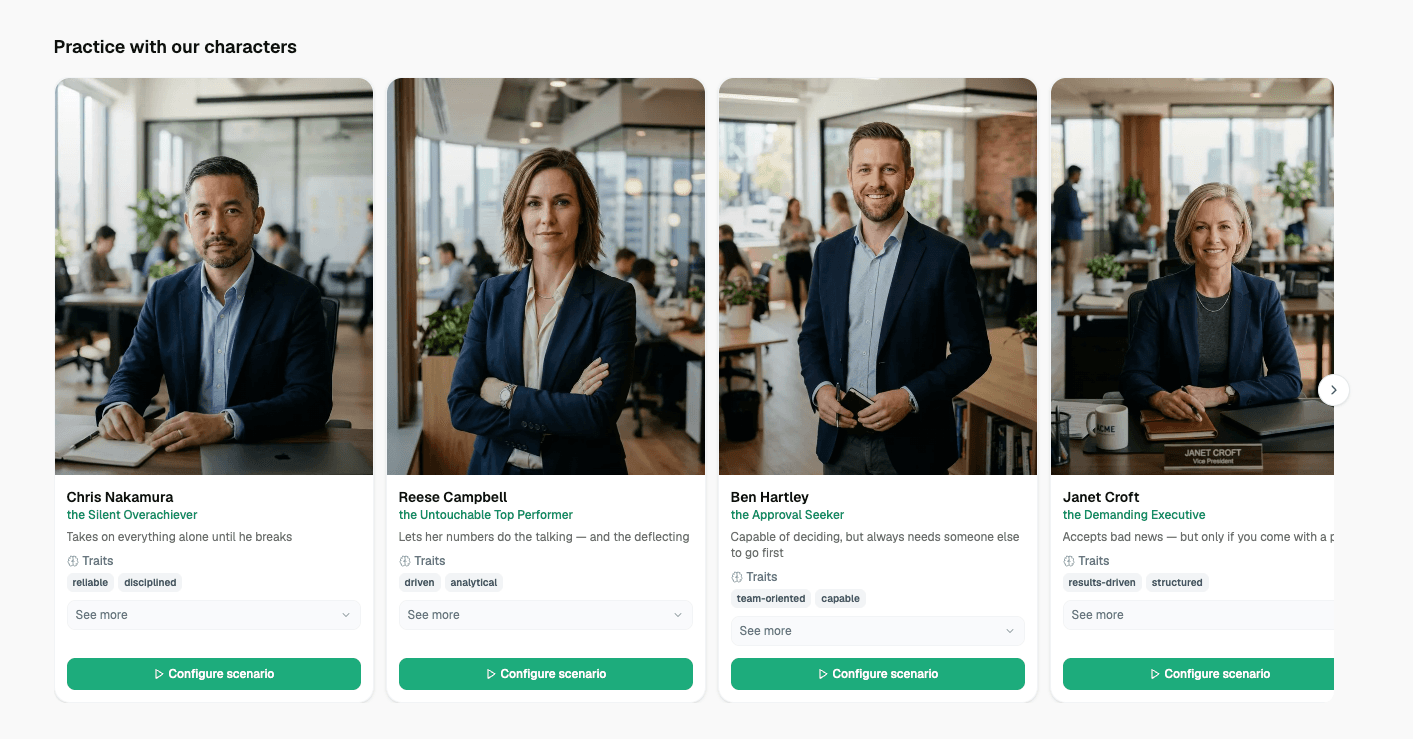
Character selection screen with AI training personas and scenario configuration buttons

For high-stakes 1:1s with ESFJ direct reports

Practice ESFJ conversations before your real employee conversation takes place.

With Careertrainer.ai, you train critical leadership moments as realistic live audio role-play—rather than theory. Especially with ESFJ employees, you can practice how to stay clear and constructive in feedback conversations without losing appreciation, and how to address conflict by aiming for harmony—without rewarding avoidance.

  • Run realistic feedback conversations with ESFJ team members
  • Practice conflict, motivation, and development in a protected space
  • Audio-first—no scripts or multiple-choice
  • Repeatable for 1:1 coaching, escalations, and performance reviews
Learn more
Vertriebstraining mit KI-gestützten Szenarien zur Verbesserung von Verkaufs- und Beratungskompetenzen.

ESFJ behavior instead of a standard role

Train with AI characters that respond audibly to tone, recognition, and pressure

ESFJ conversations often don’t fall apart because of the facts—but because of emotional impact, the social context, and a lack of recognition. With Careertrainer.ai, the AI characters respond in varying degrees to how you lead the conversation, so you can realistically train common ESFJ patterns like withdrawing under tough feedback, prioritizing harmony—or opening up through specific, meaningful appreciation.

  • ESFJ reactions to criticism, recognition, and social tension
  • Ready for feedback sessions and conflict mediation
  • Not generic bots—consistent behavior patterns you can count on.
  • Helpful for 1:1 conversations with direct reports, project leadership, or working students (Werkstudent)
Learn more
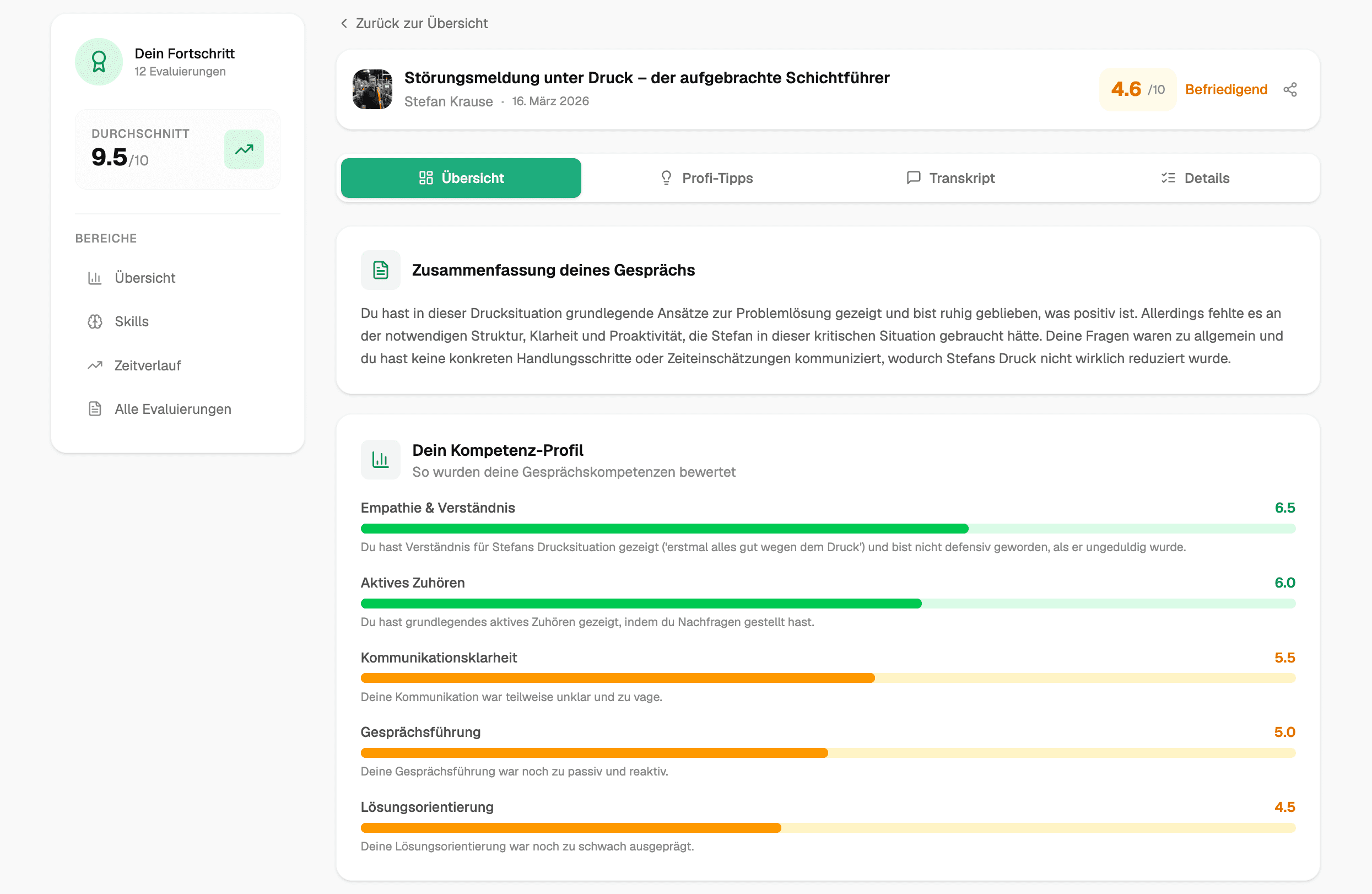
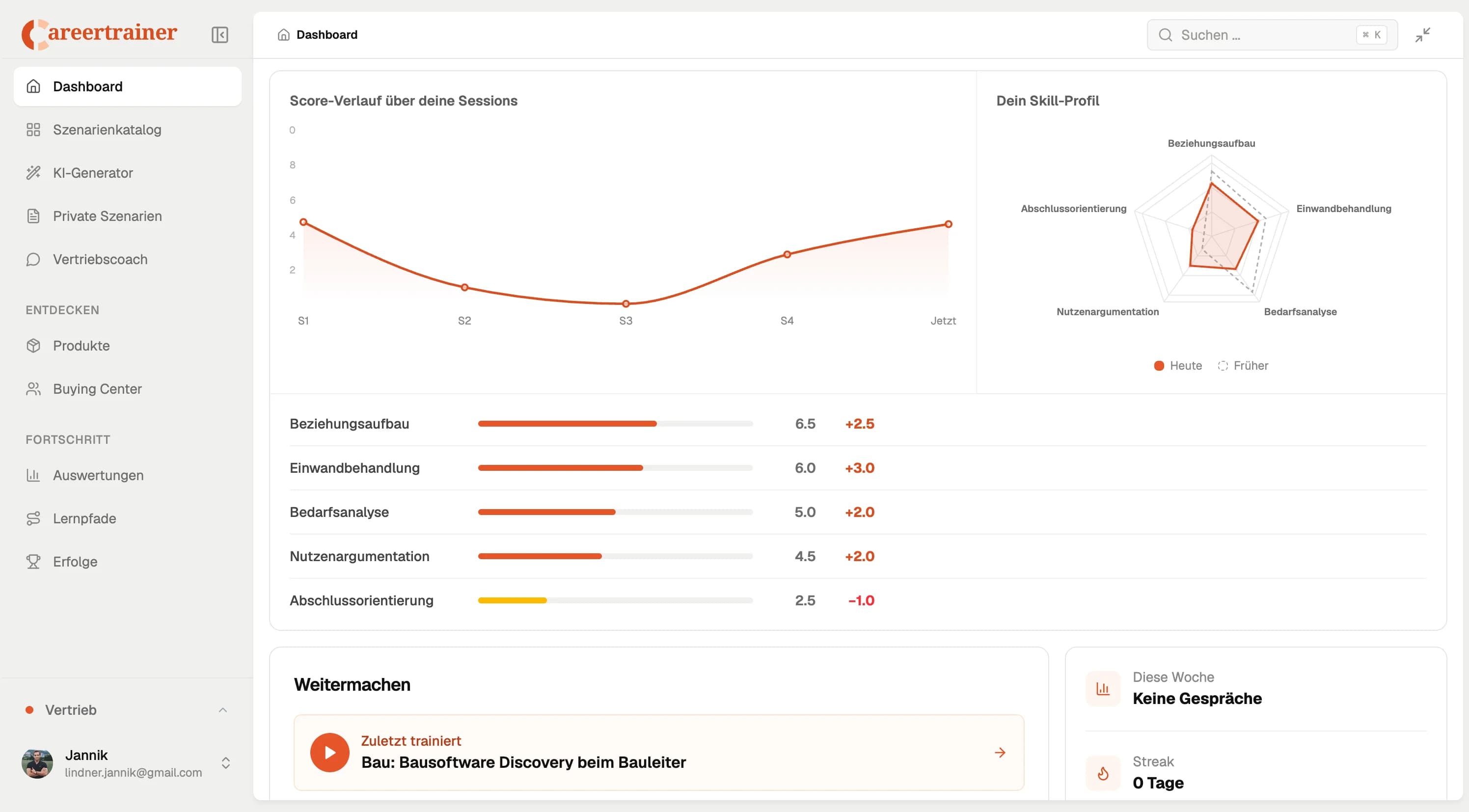
Evaluation summary and competency profile for leadership communication under pressure.

See instantly what’s working in your conversation

Wonder whether you’re truly balancing clarity and relationship in ESFJ conversations.

After every session, you’ll get a structured evaluation of your communication skills—not just a gut feeling. That way, you can see whether, in an ESFJ context, you came across too soft, whether you gave positive recognition too late, whether your expectations were too vague, or whether you triggered unnecessary defensiveness during a feedback or criticism conversation.

  • Scores for empathy, clarity, and 1:1 conversation management
  • Concrete evidence from real conversations—instead of generic tips
  • Professional alternatives for feedback, goal-setting, and coaching
  • Compare multiple runs for measurable progress
Learn more
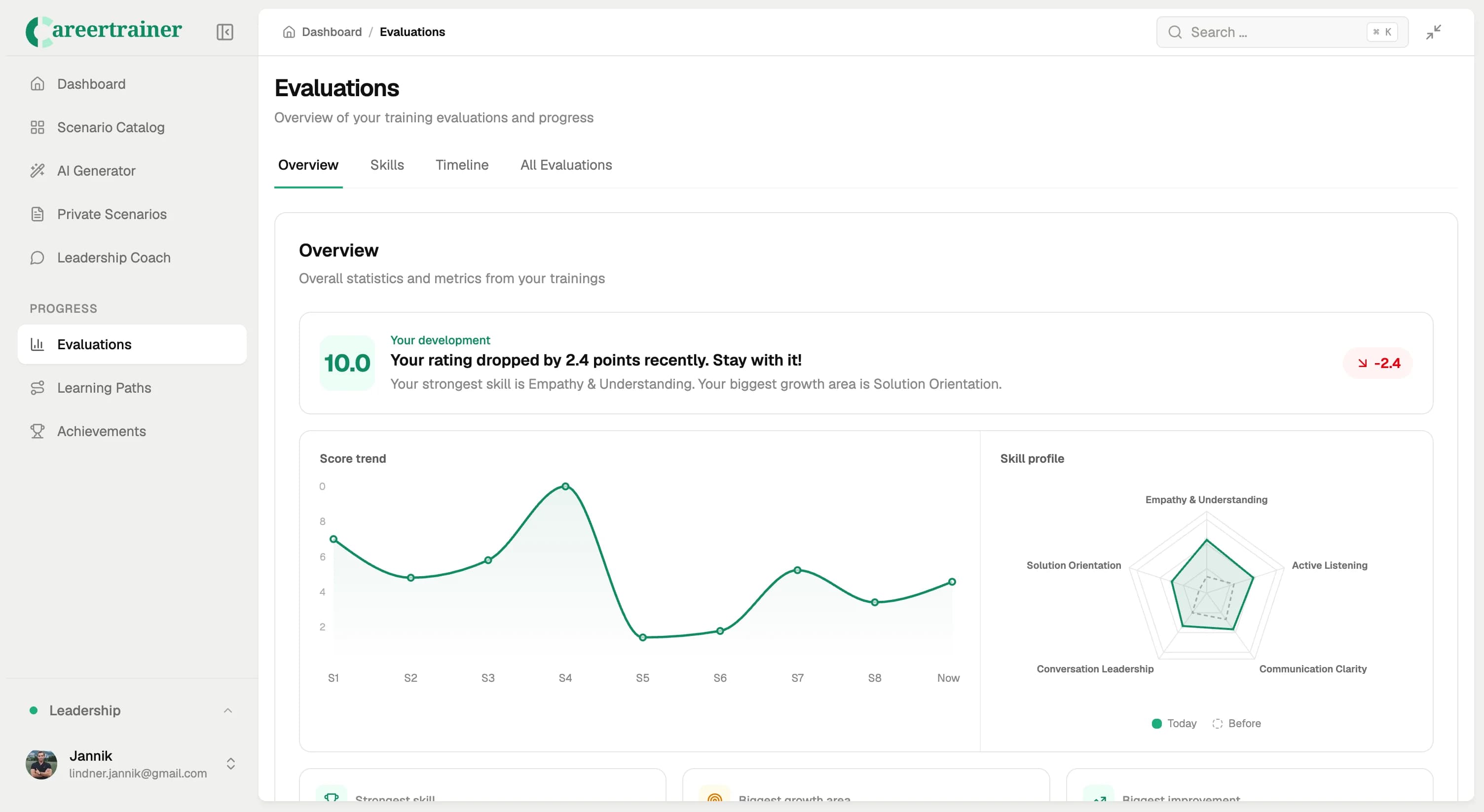
Training evaluation dashboard displaying progress, ratings, and performance metrics for leadership development.

Leadership KPI-based skill development

Identify your skill gaps in feedback, conflict, and development with ESFJ

If you regularly lead ESFJ team members, real progress only becomes visible through the course of ongoing training—not from one-off sessions. With Careertrainer.ai, you can see over multiple sessions whether you’re getting better at handling feedback conversations, aligning on OKRs, delegating effectively, or leading development discussions—and exactly where your communication is still costing you performance.

  • Make skill gaps in feedback, delegation, and conflict visible
  • Track your progress across multiple ESFJ sessions
  • Useful for your leadership pipeline and new team leads
  • Even for team dashboards in HR and people development
Learn more
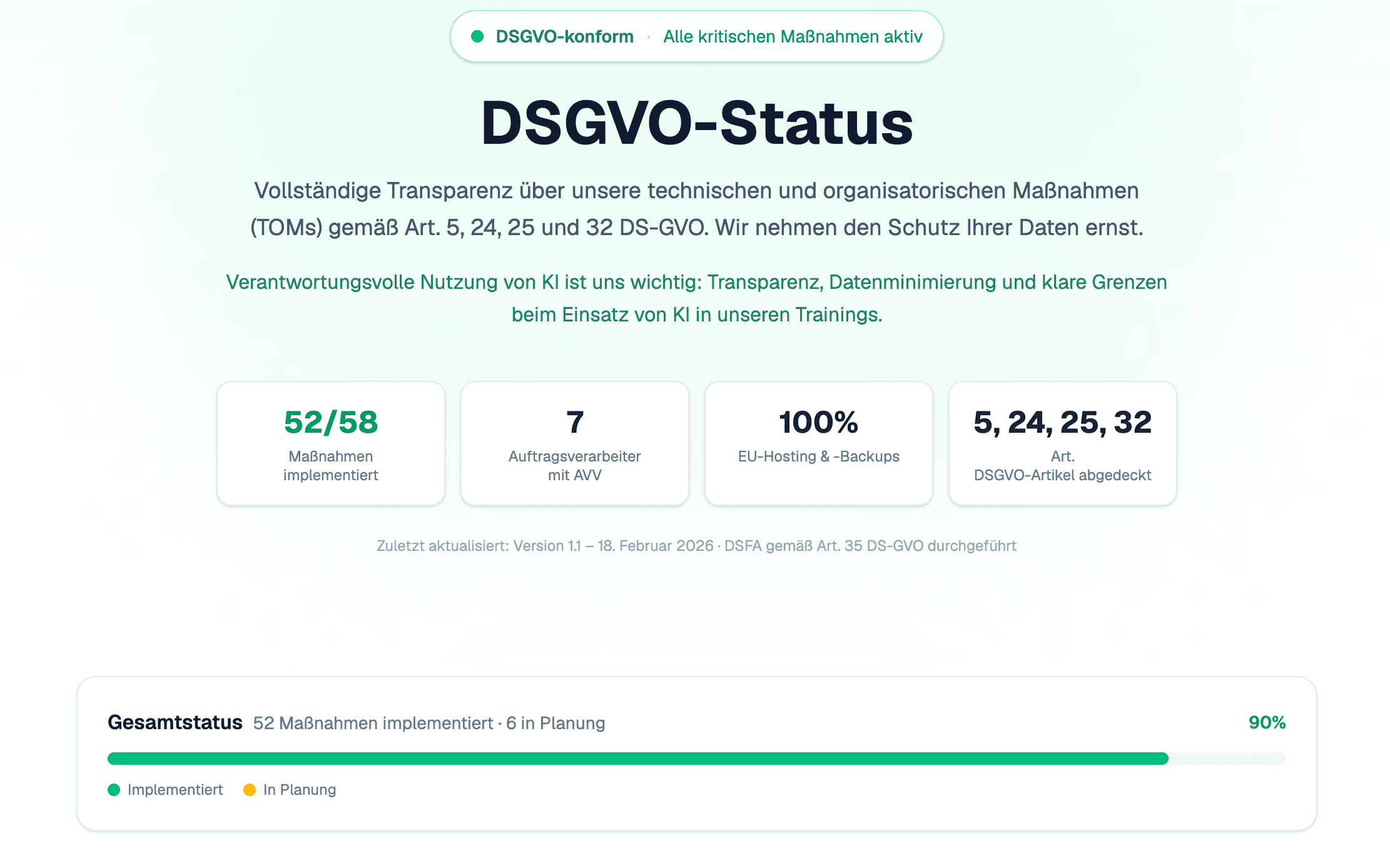
DSGVO compliance status overview for AI training, highlighting implemented measures and data protection commitment.

DACH-compliant for sensitive employee conversations

Train ESFJ employee conversations—DSGVO-compliant—on a DACH-focused platform

Especially in feedback conversations—probation review meetings, return-to-work check-ins, or termination conversations—data protection is not a side issue. Careertrainer.ai is built for the DACH region and supports companies that want to train sensitive leadership situations without resorting to generic US tools with unclear data processing.

  • EU hosting for sensitive 1:1 and employee conversations
  • Built for HR, L&D, and regulated industries across the DACH region
  • Train more safely without risking real team relationships
  • Enterprise options like SSO, audit logs, and deletion periods
Learn more

FAQ about ESFJ leadership conversations and Careertrainer.ai

Get ready for typical questions in tough leadership conversations with ESFJ team members—and learn how to train for these real-life situations with Careertrainer.ai using live audio role-play.

How do you give ESFJ employees critical feedback without losing trust?

For ESFJ employees, critical feedback works best when you keep appreciation and clarity clearly separate—instead of playing them off against each other. So don’t soften everything, but also don’t focus on mistakes head-on only.

Start with a specific observation rather than a personality judgment. Describe what happened, what impact it had on the team or on results, and what you expect next. For ESFJs, it’s important that the critique doesn’t feel like personal rejection. When you stay respectful, concrete, and calm, the risk drops that the conversation shifts into justification, withdrawal, or an excessive drive for harmony.

It also helps to phrase recognition in a credible, not blanket way: What went well, what can they rely on, and where is their contribution to the team? After that, you can clearly name what needs to change. End with a specific next step so the conversation doesn’t remain emotionally open-ended.

Why are conflicts with ESFJ employees often noticed later than with other personality types?

Conflicts with ESFJ team members often stay under the surface longer, because harmony, belonging, and social stability usually matter a lot in everyday work life. That doesn’t mean there’s no problem. It often just means that tensions are initially shown more indirectly.

Instead of confronting openly, ESFJs under stress are more likely to withdraw, overcomply, feel disappointed, or view the situation through a strongly relationship-focused lens. In day-to-day leadership, this can quickly look like agreement—even though frustration has already built up internally. That’s why superficial questions like “Everything okay?” are often not enough.

If you take early signals seriously, bring up specific observations, and create a conversation where feedback doesn’t feel like a breach of loyalty, you can address conflicts much earlier. The key is not only to clarify the issue itself, but also to name how it affects collaboration and the team climate.

How can you tell in a conversation when an ESFJ is under stress?

An ESFJ under stress rarely escalates openly right away. More often, you’ll notice tension through subtle patterns: more justification, a palpable sense of uncertainty, a strong drive for approval, defensive explanations of their intentions, or sudden emotional distance—despite still using a polite tone.

In a leadership conversation, this is a warning sign. When ESFJ employees feel that their performance or commitment to the team isn’t being recognized, the focus can quickly shift away from the actual issue toward the relationship side of things. They may still talk about tasks, but at that point the conversation is really about recognition, fairness, and belonging.

That’s why you should watch for changes during the discussion: shorter answers, cautious agreement without real commitment, repeated emphasis on good intentions, or a clearly hurt tone. If you notice these signs, additional pressure usually doesn’t help—instead, use more precise leadership: name what you’ve observed, explain the impact, clarify expectations, and make respect unmistakable at the same time.

How do you run a development conversation with ESFJ team members that motivates them—without it just sounding nice?

A great development conversation with ESFJ employees combines recognition with a clear picture of the next step. Pure praise can boost motivation in the short term, but it doesn’t yet create development. Pure performance pressure, on the other hand, can damage the relationship and trigger uncertainty.

The conversation becomes effective when you first make visible the contribution the employee makes today—especially in day-to-day collaboration, reliability, and support for the team. After that, you should clearly name which skill, responsibility, or impact should grow next. ESFJs usually respond well to development goals when they don’t stay abstract, but are linked to people, collaboration, and a clear benefit.

Helpful questions include: Which tasks give you energy? Where would you like to take on more responsibility? What do you need to take the next step with confidence? Close with concrete actions, specific feedback points, and a follow-up date. That way, the conversation stays both accountable and motivating.

What mistakes should you avoid in difficult conversations with ESFJ employees?

The most common mistake is unclear consideration. Many leaders want not to hurt ESFJ, so they phrase things too gently. The problem: then it stays unclear what actually needs to change. The second mistake is the opposite—communicating in a factual but emotionally blind way.

It’s also unhelpful to use public criticism, to raise sudden accusations without specific examples, to make blanket statements about personality, or to run conversations that focus only on deficits. With ESFJ, this can quickly feel like a personal put-down or like a withdrawal of belonging. As a result, they either defend themselves or outwardly say yes—without truly aligning internally.

Better is a clear structure: reason, observation, impact, expectation, support, and next step. So avoid both conflict avoidance and unnecessary harshness. Good leadership with ESFJ isn’t about keeping everything harmonious—it’s about staying respectfully clear even in sensitive moments.

How does Careertrainer.ai help you with leadership conversations with ESFJ employees?

Careertrainer.ai is a DACH-focused AI platform for hands-on conversation training through live audio role-play. For leadership conversations with ESFJ team members, that means you don’t just practice tricky situations in theory—you role-play a real, 5- to 15-minute conversation with an AI counterpart that responds realistically.

The benefit is the conversation dynamics. For example, you can train giving critical feedback, navigating conflict around team harmony, addressing declining motivation, or running a development conversation with genuine recognition. The AI doesn’t respond like a simple chatbot—it demonstrates coherent behavior patterns, such as heightened sensitivity to tone of voice, relationship signals, and perceived appreciation.

After the conversation, you get immediate feedback on your communication style: Where were you clear, where were you too soft, and where did you unintentionally create pressure or signal uncertainty? This helps you close the gap between communication knowledge and real behavior under pressure. That’s especially valuable in ESFJ conversations, where small wording choices can determine whether someone feels open—or withdraws.

What makes Careertrainer.ai’s ESFJ training different from seminars, e-learning, or team role-play exercises?

The biggest difference is the training focus. In a seminar or e-learning, you learn models, phrasing, and conversation logic. With Careertrainer.ai, you train the actual execution in a live conversation. That means you have to respond in real time, follow up, de-escalate, and still lead clearly.

That’s especially important in ESFJ conversations, because these situations often don’t fail due to a lack of knowledge—but because of timing, tone of voice, and the emotional impact. Internal role-plays within the team are only of limited use: they take up time, often feel artificial, and many leaders aren’t open enough in sensitive situations when speaking in front of colleagues.

Careertrainer.ai gives you a risk-free practice space—without a trainer bottleneck and without awkward observation by your own team. You also get immediate, criteria-based feedback instead of a purely subjective impression. If you want to train difficult ESFJ conversations regularly, it’s much closer to real leadership practice than pure theory training.

Which leadership roles is Careertrainer.ai especially valuable for when you work with ESFJ direct reports?

Careertrainer.ai is especially useful for team leads, department managers, store managers, shift managers, and People Managers who regularly need to hold challenging, relationship-focused conversations with employees. This applies across industries—for example in service, care, retail, operations, internal back office, or customer-facing support roles.

If you often work with employees who are reliable, helpful, and team-oriented—but react sensitively to feedback, tensions within the team, or a lack of recognition, this training fits well. With ESFJ Direct-Reports in particular, it’s important to manage performance, relationships, and expectations at the same time. That’s exactly what you can practice in targeted live-audio role-plays.

For individual leaders, it’s a fast way to prepare specific conversations. For companies, it becomes especially interesting when leadership quality needs to be trained consistently and measured across multiple locations or teams. Then, what used to be gut feeling turns into a structured development process.


How does the setup with Careertrainer.ai work if you want to practice ESFJ leadership conversations?

You start with a scenario that fits your real leadership situation—for example, delivering critical feedback, resolving conflict, motivating your team, or holding a development conversation with an ESFJ employee. Then you run a live audio role-play that typically takes 5 to 15 minutes and is designed for real conversation situations from everyday leadership.

After that, you get instant feedback with competency scores, specific strengths, improvement areas, and typical patterns in your communication style. This way you don’t just see whether the conversation felt good—you also see where you communicated clearly, with appreciation, and effectively.

For teams, getting started is also streamlined: scenarios can be tailored to typical leadership moments, and in a company context you can analyze training progress across the organization. If you want to move quickly from reading to practice, this direct flow is exactly the advantage.

Can you offer Careertrainer.ai as a partner for ESFJ training under your own brand?

Yes—Careertrainer.ai can also be used by partners as a white-label solution if you want to offer ESFJ training or other leadership training under your own brand. This is especially relevant for training providers, consultancies, HR platforms, and enablement partners who want to integrate AI role-play into their existing offering.

The advantage: you keep your brand, your customer relationship, and your pricing logic—without having to develop your own AI infrastructure for live role-plays. This is particularly interesting for specific topics like ESFJ leadership conversations, because you can deliver practical training on feedback, conflict, motivation, and development with conversation flows that are psychologically coherent.

In this setup, Careertrainer.ai positions itself as an enabler in the DACH region—not as a classic competitor to training providers. If you want to extend an existing offering with scalable, measurable conversation training, the white-label model is a straightforward option.

Why is Careertrainer.ai especially well-suited for ESFJ leadership training in the DACH context?

Careertrainer.ai is designed for the DACH market and combines German-language conversation coaching with practical, realistic live-audio AI role-plays. This is especially important for ESFJ leadership conversations, because impact often depends on subtle linguistic nuances: appreciation, clarity, boundary-setting, and emotional resonance need to sound natural in German.

It also takes into account the conditions companies care about: GDPR context, EU hosting, and a product approach that doesn’t rely on generic US scripts, but instead focuses on real leadership moments from everyday work in German-speaking environments. For HR, people development, and leaders, that means less friction when it comes to rollout, compliance, and acceptance.

If you want to learn how to lead ESFJ employees not through abstract personality tests, but through concrete conversation simulations, then this combination of DACH focus, realistic AI characters, and measurable feedback is a clear advantage over general communication tools.