
Station managers, nursing service leaders, and healthcare executives train for difficult conversations using AI role-play.
Leadership Training in Healthcare – AI-Powered Coaching for Nursing and Clinics
Leading in healthcare means managing shift work, emotional extremes, a shortage of skilled professionals, and teams under constant pressure. Ward managers, nursing service leaders, and hospital executives train with Careertrainer for the most challenging conversations they face daily—anytime, without a seminar day, and with immediate feedback.
Try for free

Practice scenario
Practice a realistic conversation with our AI employee. Improve your conversation skills in a safe environment.
The biggest leadership challenges in healthcare
Conducting employee discussions when the team is consistently under high emotional stress?
AI role-playing exercises train conversations with emotionally exhausted, overburdened, and burned-out caregivers. Leaders learn to recognize signs of stress early, address them without confrontation, and conduct discussions that signal genuine relief rather than additional demands.
Resolving conflicts within the care team – often between long-standing employees with entrenched patterns?
Conflicts in care teams often arise from prolonged stress, unequal distribution of work, or tensions between experienced and new caregivers. AI scenarios train mediation conversations that address team conflicts without risking escalation—featuring realistic characters that demonstrate typical conflict patterns.
Leading in Shift Work: How do you keep a team together that rarely sees each other?
Station managers train leadership under shift conditions: How do I communicate with a team that I only partially experience directly? How do I provide feedback to someone I rarely see? How do I ensure that team agreements are upheld during the night shift? AI scenarios make these specific leadership situations trainable.
Conduct leadership conversations even when there is hardly any time left for discussions beyond patient care?
Leadership training must fit into the daily routine of nursing leaders—not the other way around. AI role plays last 10 to 25 minutes and are conducted asynchronously. Ward managers can train during breaks, before shifts, or from home—without the need for seminar dates, days off, or burdening the team.
leadership training healthcare
Train realistic leadership situations with AI characters
Features for hospitals, nursing homes, and healthcare organizations
The essential tools for sustainable leadership competence in the healthcare sector.
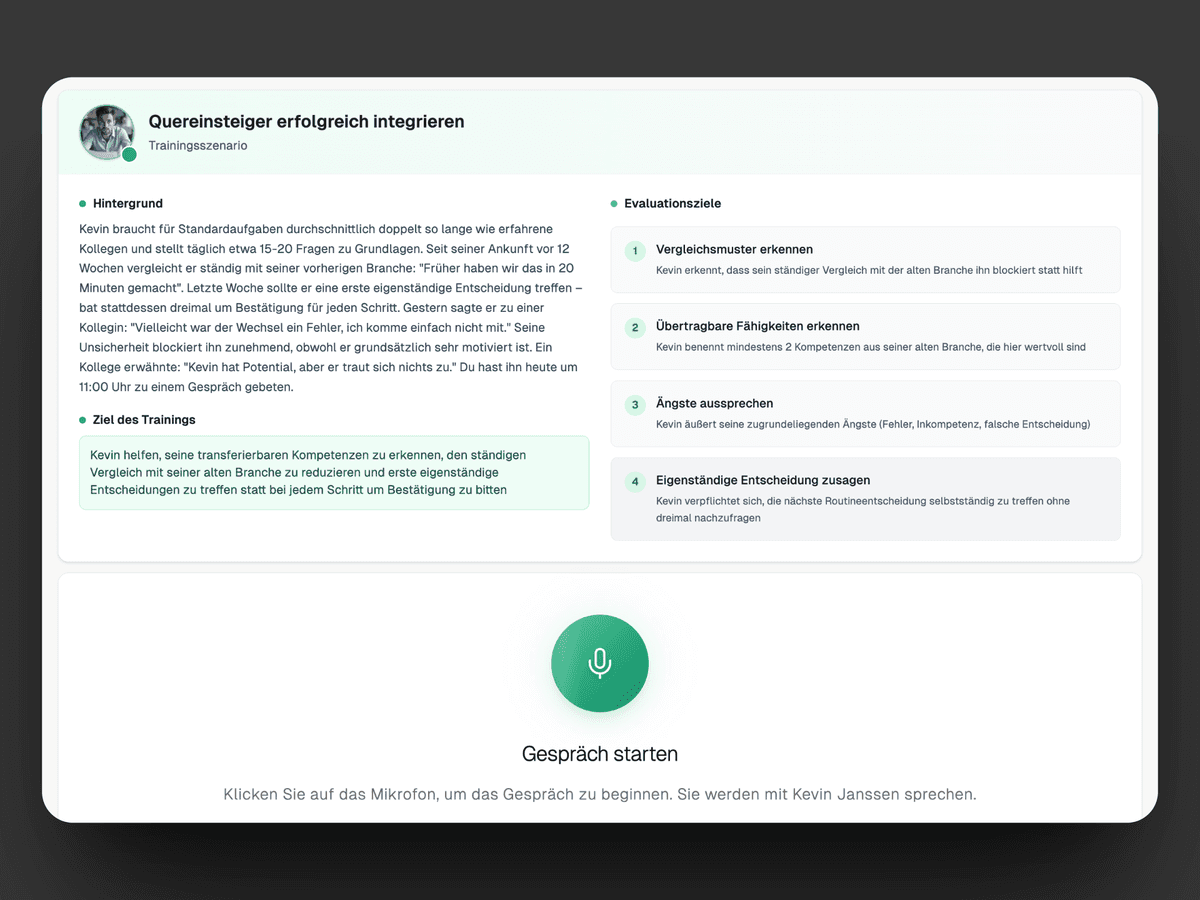
Realistic nursing team conversation simulations
Executives train audio conversations with AI caregivers—from the exhausted professional to the chronically overburdened shift leader. The AI responds to the quality of the conversation: genuine appreciation and empathy open the dialogue, while standard phrases lead to terse withdrawal.
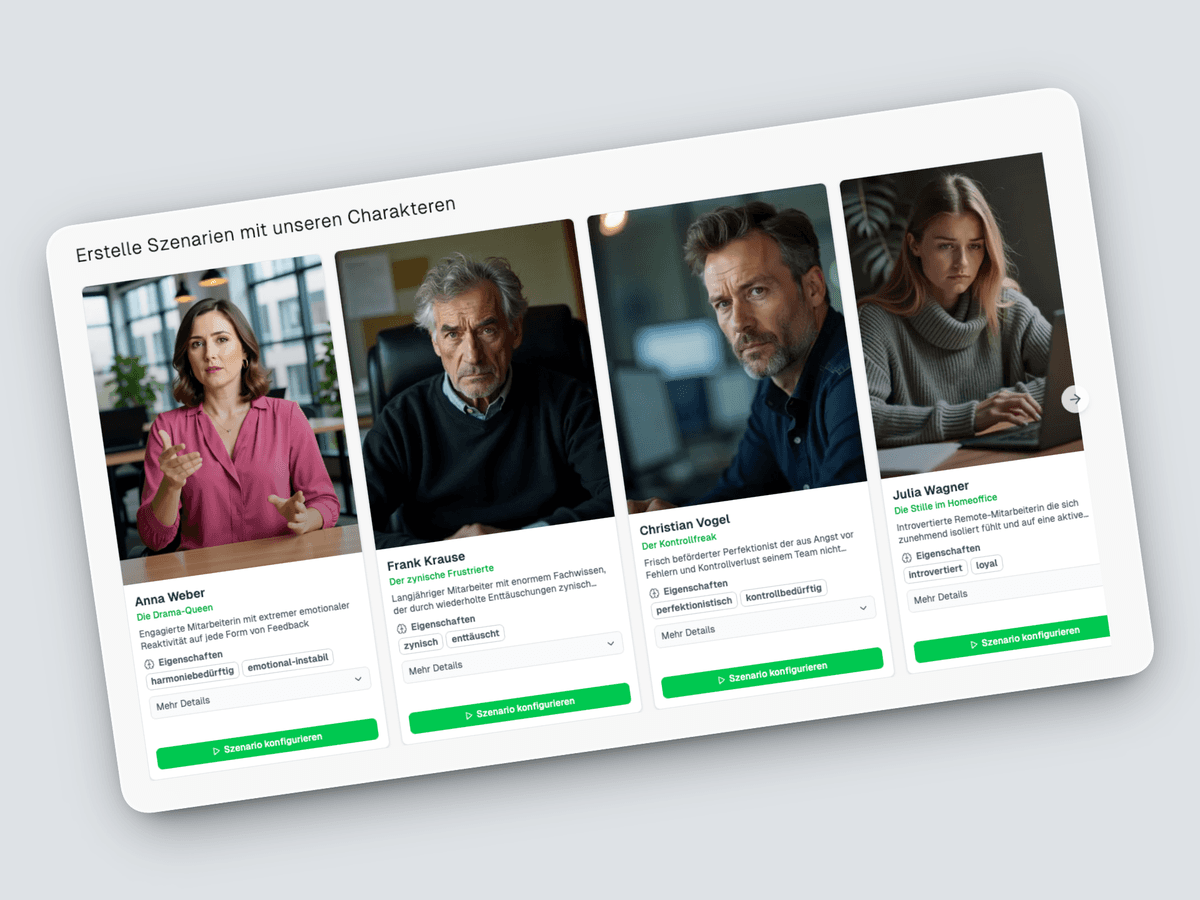
Care and clinic-specific employee profiles
Over 50 AI characters exhibiting typical behaviors from the healthcare sector: the experienced elderly caregiver on the brink of burnout, the new colleague from abroad struggling with integration, the nursing assistant refusing instructions, and the long-standing team member resisting change. Each character is psychologically consistent and realistic.
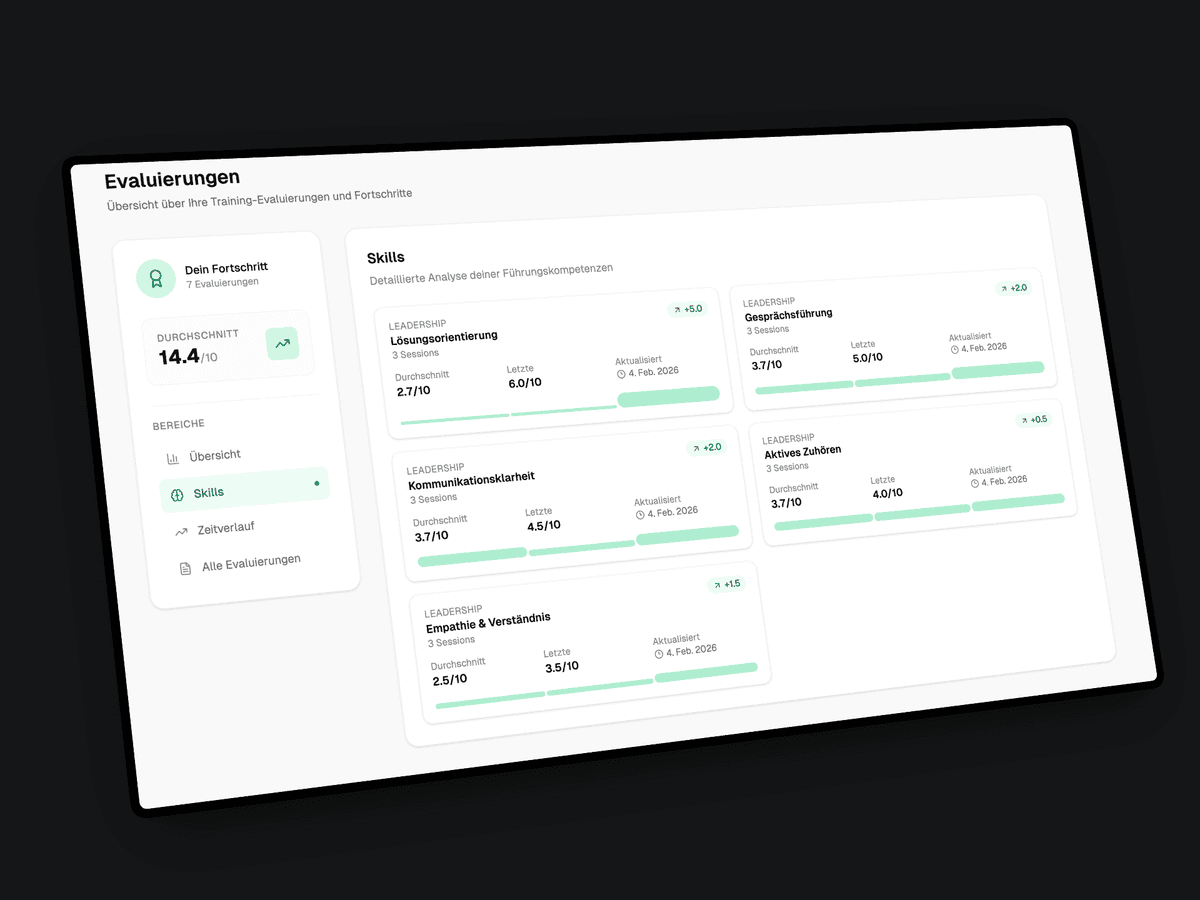
Skill Gap Analysis for Nursing Management and Hospital Leadership
Automatic analysis of leadership quality based on five core competencies: active listening, empathy, conversation management, solution orientation, and communication clarity. The dashboard displays development areas and strengths for each leader—over time and in comparison across the organization.
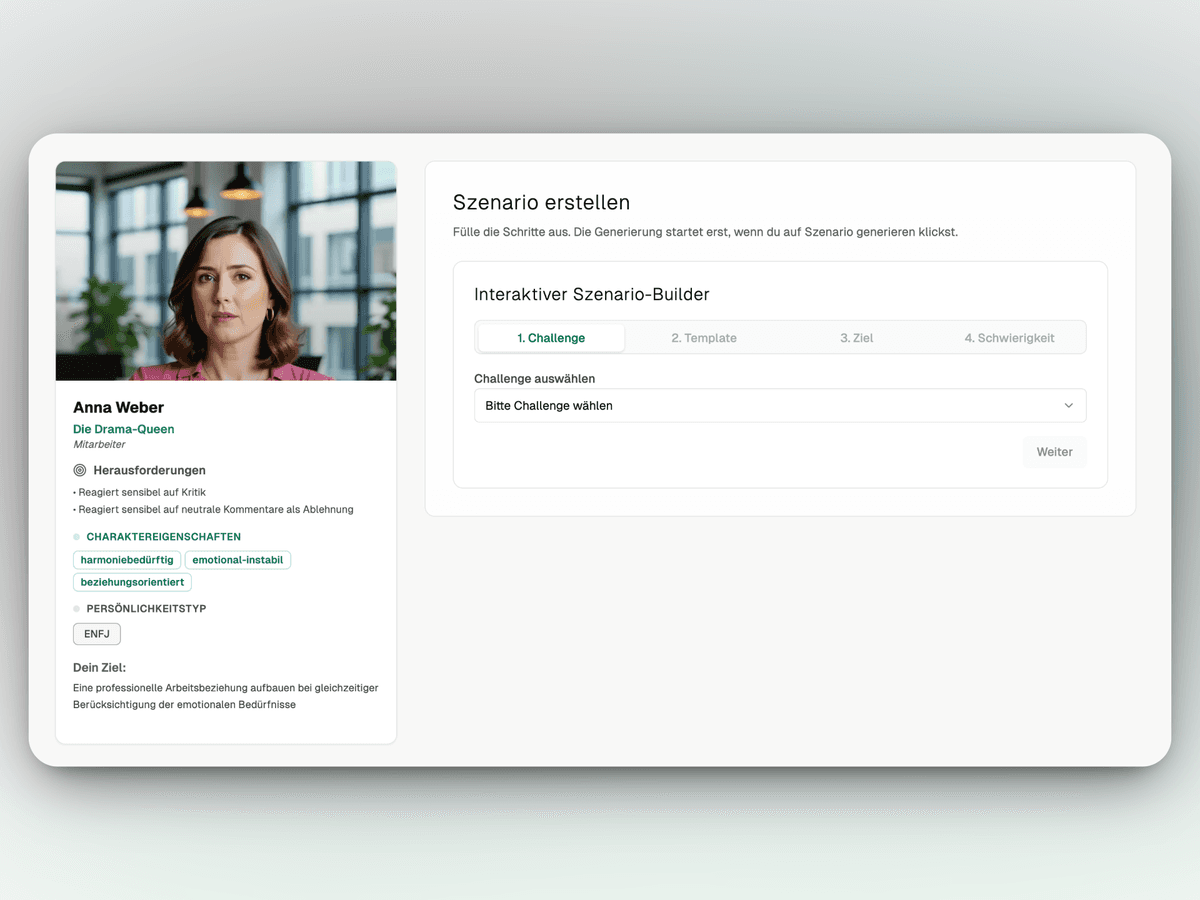
Scenario generator for facility-specific leadership situations
Care service managers and HR can create their own training scenarios in minutes based on real situations: a conversation with a caregiver who repeatedly arrives late, mediation between two conflicting team groups, or a discussion with someone who has mentally already resigned. No external trainer required.
Leadership in Healthcare by the Numbers
Why leadership skills in care and clinics determine quality of service and employee retention.
How AI Leadership Training Works for Healthcare
In four steps to measurable leadership competence for care and clinic teams.
Start immediately or create setup-specific scenarios.
Standard scenarios for typical leadership conversations in nursing and clinics are immediately available: stress discussions, conflict mediation within teams, feedback conversations, and motivational talks after challenging shifts. For facility-specific training, the scenario generator creates scenarios based on your specific leadership situations.
Training realistic care team conversations
Executives engage in audio conversations with AI employee characters from the healthcare sector – the exhausted elderly caregiver, the frustrated nurse after a challenging shift, the long-term employee resisting change, and the new colleague struggling to integrate. The AI responds authentically to the dialogue.
Immediate feedback on leadership behavior and conversation quality.
After each conversation, analysis of active listening, empathy, conversation management, solution orientation, and communication clarity. Specific formulation suggestions for more effective performance discussions, clearer feedback conversations, and de-escalating conflict moderation.
Measure and develop leadership skills over time.
The dashboard displays skill scores and development curves for each leader. Care service management and HR can identify who excels in empathy conversations and who needs support in conflict resolution or communication under pressure—based on data and without the need for extensive personal guidance.
Tailored for all leadership roles in healthcare.
Careertrainer supports station managers, nursing service leaders, medical executives, and HR teams.
Station management and residential area management
Conduct challenging care team conversations confidently and empathetically.
Leading through shifts, workload, and staff shortages
Station leaders engage in challenging conversations daily under difficult conditions: addressing criticism towards exhausted employees, resolving conflicts when there’s no time for lengthy discussions, and conveying appreciation even while the next emergency awaits. AI role-playing trains for these exact situations—precisely, repeatedly, and without burdening the real team.
New Leaders in Care
Build leadership fundamentals – immediately and without waiting for a seminar.
From Care Expert to Confident Leader
Excellent nursing professionals promoted to leadership positions need leadership tools immediately – not at the next seminar in three months. Structured learning paths systematically guide new nursing leaders through their initial conversations in their roles: clarifying expectations, delegation discussions, first feedback conversations, and employee development.
Nursing service management and departmental management
Measuring and developing leadership quality across the entire care sector.
Data-driven executive development for multiple stages.
Care service managers responsible for multiple stations or living areas gain an overview of the leadership status of all station managers through the dashboard. Skill gap analyses reveal who needs targeted support for specific types of conversations—without manual observation and without the need to coordinate seminar days during ongoing operations.
HR and personnel development in hospitals and care providers.
Scalable leadership development despite shift work and time pressure.
Leadership training that fits seamlessly into everyday care.
HR and personnel development in hospitals and care providers face the challenge of organizing leadership training for individuals who rarely have free time simultaneously. Careertrainer addresses this issue through asynchronous training: leaders can train whenever it suits them, while HR maintains an overview of progress and development needs in the dashboard.
When do companies use Careertrainer.ai?
Six typical scenarios for HR teams, leaders, and training providers
Onboarding for new leaders
Productivity from week 2 instead of month 6. New leaders practice their first difficult conversations before they have to lead them – from the first feedback conversation to taking over a team. No more learning by doing with real employees.
- Practice first leadership conversations risk-free
- Avoid typical beginner mistakes
- Faster effectiveness in the new role
- Structured onboarding program with progress tracking



Other Industries for Leadership Training
Discover industry-specific leadership development and leadership training for other industries.

Leadership Training in the IT Industry
Executives in IT companies train with AI role-playing to handle challenging employee conversations, remote leadership, conflict resolution within development teams, and communication between technology and business.

Leadership Training in Retail
Branch managers, team leaders, and retail executives train with AI role-playing to handle challenging employee conversations, shift management, performance reviews, and conflict resolution within the sales team.

AI Role-Playing Games for Educational Institutions
Leaders in educational institutions, training providers, and social organizations train difficult employee conversations, educational leadership, and team development using AI role-playing.

Leadership Training in Machinery and Plant Engineering
Executives in machinery and plant engineering train with AI role-playing to navigate challenging employee conversations, project management, communication between technical and sales teams, and temporary leadership in customer projects.
Leadership Training in Healthcare
Healthcare executives train with AI role-playing to handle difficult employee conversations, shift management, conflict resolution within nursing teams, and leadership under high emotional stress.

Leadership training in manufacturing
Masters, shift leaders, and executives in industrial companies train with AI role-playing to handle challenging employee conversations, shift management, performance reviews, and conflict resolution in production.
Frequently Asked Questions about Leadership Training in Healthcare
Everything clinics, care facilities, and HR teams need to know.
