
School leaders, department heads in training institutions, and educational leaders practice challenging conversations using AI role-playing.
AI Role-Playing for Educational Institutions – Leadership Training for Educational Managers
Leadership in educational institutions and training providers combines pedagogical responsibility with traditional management tasks: leading teams with high intrinsic motivation, conducting difficult conversations with stressed employees, moderating conflicts in educational teams, and supporting change processes. Careertrainer offers AI role-plays for precisely these leadership situations.
Try for free

Practice scenario
Practice a realistic conversation with our AI employee. Improve your conversation skills in a safe environment.
The biggest leadership challenges in educational institutions.
Educational professionals who often approach leadership with skepticism and demand autonomy?
Teachers, social educators, and trainers are highly intrinsically motivated and respond sensitively to leadership perceived as control. AI role-playing trains conversations that respect autonomy while setting clear expectations: How do I provide feedback that is received as collegial input? How do I establish binding standards without provoking resistance?
Leading and protecting employees in educational professions under high emotional stress?
Educational professionals face emotional challenges daily—difficult participants, clients in crisis situations, and parental conflicts. Leaders are trained to recognize signs of stress early, conduct supportive conversations, and communicate boundaries in a caring manner—without questioning the expertise of their staff.
Moderating conflicts between educational beliefs without positioning oneself as a referee?
When two experienced educators hold fundamentally different beliefs about the right approach, moderation at eye level is essential. AI scenarios train how to address value conflicts within the team without taking sides and how to develop common grounds for action from disagreements.
Leading change processes in educational institutions that are traditionally resistant to change?
New teaching formats, digital methods, regulatory requirements, or organizational realignments often encounter resistance in educational institutions. Leaders train in change conversations: How do I convincingly communicate the purpose of a change? How do I engage with employees who fundamentally reject changes? How do I keep the team united when not everyone is on board?
leadership training educational institutions
Train realistic leadership situations with AI characters
Features for educational institutions and pedagogical organizations
The essential tools for sustainable leadership competence in educational institutions.
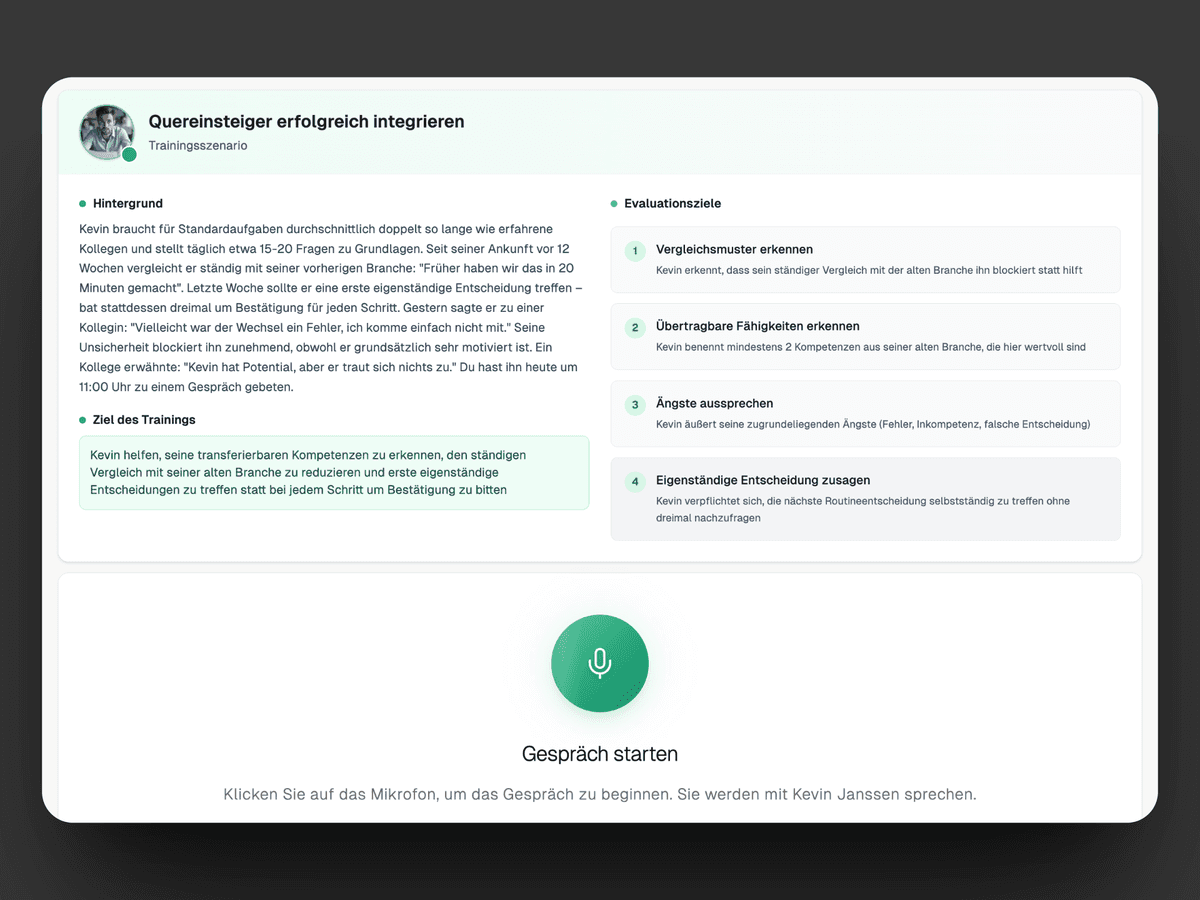
Realistic educational staff meeting simulations
Executives practice audio conversations with AI characters from the education sector – ranging from the overwhelmed teacher to the experienced educator who fundamentally resists change. The AI responds to the quality of the conversation: appreciation and genuine listening open up dialogue, while a commanding leadership style leads to resistance.

Educational Staff Profile - Library
Over 50 AI characters with typical profiles from educational institutions: the dedicated yet burnout-prone professional, the idealistic and mission-driven colleague who sees no boundaries, the experienced educator with a fixed mindset, and the new employee still developing their pedagogical approach. Each character is realistic and consistent.
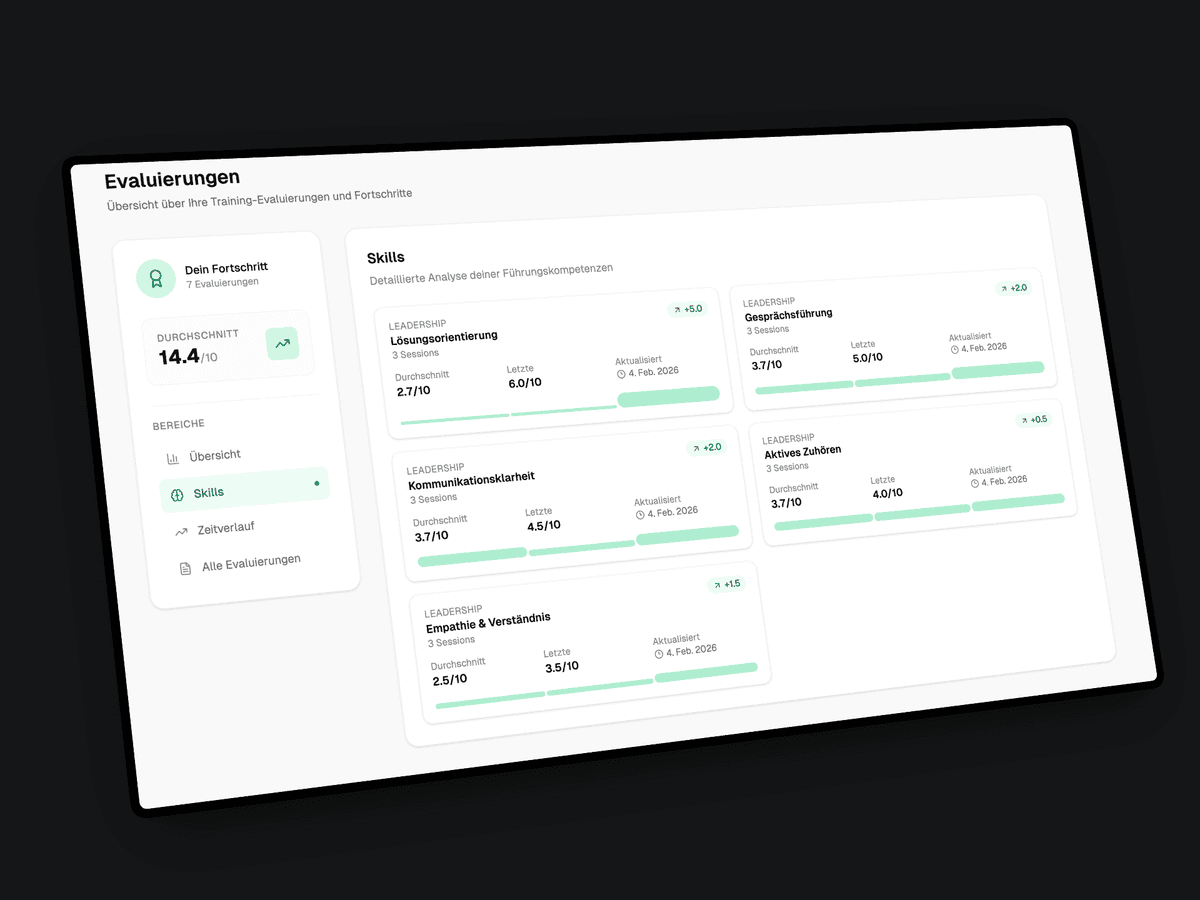
Skill gap analysis and progress tracking for educational institutions.
Automatic analysis of leadership quality based on five core competencies: active listening, empathy, conversation management, solution orientation, and communication clarity. Documented training records are exportable for reports to funding bodies, accreditation organizations, and quality assurance processes.
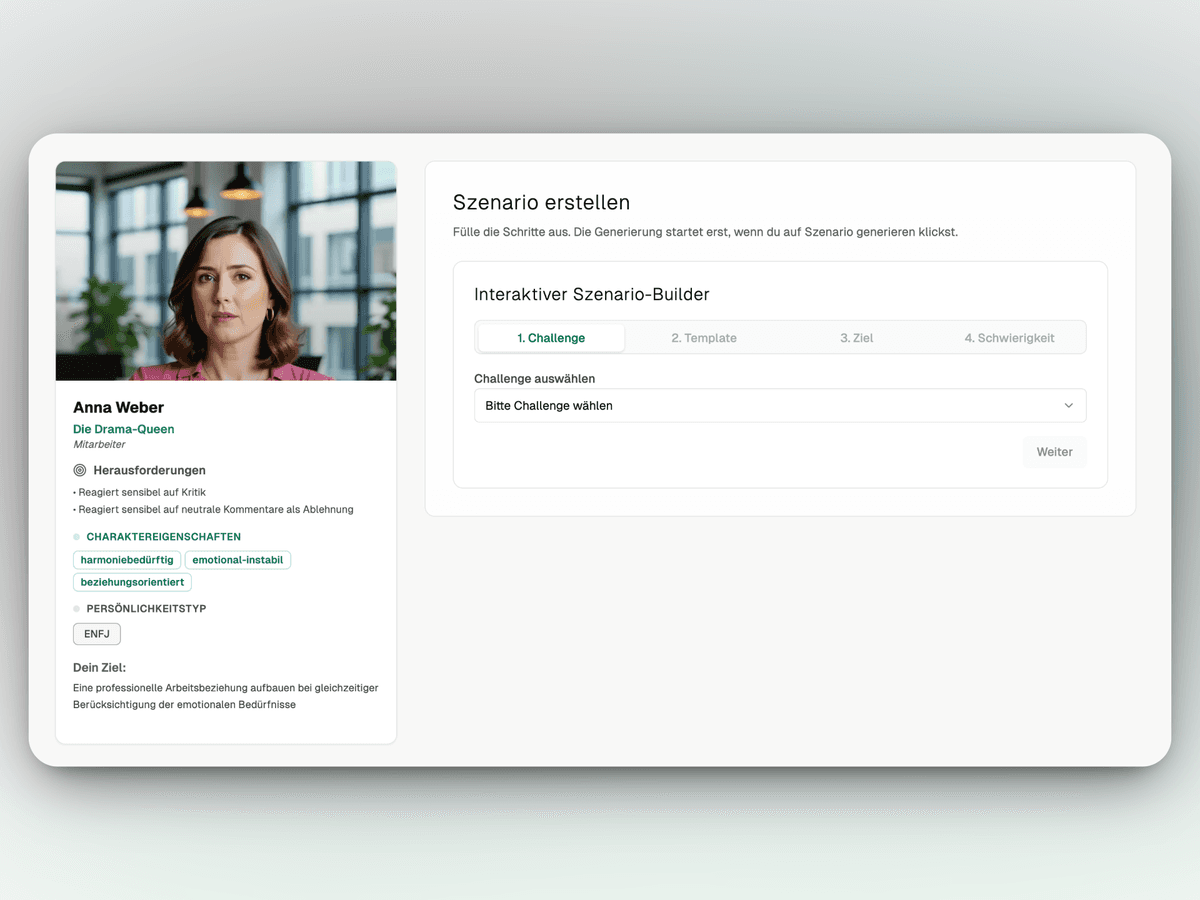
Scenario generator for carrier-specific leadership situations
Facility managers and quality officers can create their own training scenarios in minutes: a conversation with a professional who does not maintain boundaries with participants, moderating a values conflict within the teaching team, or discussing with someone who actively sabotages change processes. No external trainer required.
Leadership in Educational Institutions by the Numbers
Why leadership competence in educational institutions and social organizations determines team quality and impact.
How AI Leadership Training Works for Educational Institutions
In four steps to measurable leadership competence in educational organizations.
Start immediately or configure setup-specific scenarios.
Standard scenarios for typical leadership conversations in educational institutions are immediately available: feedback discussions with educational professionals, workload conversations, conflict moderation, and change discussions. For organization-specific training, the scenario generator creates scenarios based on your educational culture and leadership situations.
Train realistic educational staff conversations.
Executives engage in audio conversations with AI characters from the education sector – the dedicated yet overwhelmed teacher, the skeptical veteran resistant to change, the idealistic and mission-driven social educator who overlooks boundaries, and the new colleague who has yet to develop an educational stance. The AI responds authentically based on the quality of the conversation.
Immediate feedback on leadership behavior and conversation quality.
After each conversation, an analysis of active listening, empathy, conversation management, solution orientation, and communication clarity. Concrete formulation suggestions for more effective stress discussions, clearer feedback conversations, and improved conflict moderation within the teaching team.
Measure leadership competence over time and demonstrate impact.
The dashboard displays skill scores and development curves for each leader. Supporting organizations and quality managers receive documented evidence of leadership development, which can be exported for reports to funding bodies, accreditation agencies, and regulatory authorities.
Tailored for all leadership roles in educational institutions.
Careertrainer supports school leadership, departmental management, sponsoring organizations, and quality assurance teams.
School leadership and educational management personnel
Conduct difficult conversations with educational professionals confidently and respectfully.
Leading at the Intersection of Education and Management
School leaders and educational management staff engage in challenging conversations daily: providing feedback to an overwhelmed teacher who reacts defensively to criticism, mediating conflicts between two educators with fundamentally different beliefs, and communicating changes that face internal resistance. AI role-playing trains for these situations—without burdening the real team.
New Leadership in Educational Institutions
Build leadership fundamentals – immediately, without waiting for the next course.
From specialist educator to compelling leader
Experienced educators taking on leadership responsibilities for the first time face a role transition for which their pedagogical training has provided little preparation. Structured learning pathways train them for conversations in the initial leadership phase: clarifying expectations with the team, conducting the first feedback discussion with a former colleague, and managing the new dual role as both an expert and a leader.
Department management in training providers
Measure and develop leadership quality across multiple teams and locations.
Data-driven executive development for the entire organization.
Department heads responsible for multiple teams or locations of a training provider gain an overview of the leadership status of all managers through the dashboard. Skill gap analyses indicate who needs support with specific types of conversations—without the need for extensive personal observation. Progress reports provide evidence for quality assurance processes.
Carrier organizations and quality assurance
Implement leadership standards at scale and document their impact.
Consistent leadership quality across all facilities of the provider.
Organizations looking to implement leadership standards across multiple facilities utilize Careertrainer as a scalable training infrastructure. Standardized learning paths, documented progress records, and centralized reporting functions enable leadership development within the organization network—without the need for external trainers or coordinating seminar days.
When do companies use Careertrainer.ai?
Six typical scenarios for HR teams, leaders, and training providers
Onboarding for new leaders
Productivity from week 2 instead of month 6. New leaders practice their first difficult conversations before they have to lead them – from the first feedback conversation to taking over a team. No more learning by doing with real employees.
- Practice first leadership conversations risk-free
- Avoid typical beginner mistakes
- Faster effectiveness in the new role
- Structured onboarding program with progress tracking



Other Industries for Leadership Training
Discover industry-specific leadership development and leadership training for other industries.

Leadership Training in the IT Industry
Executives in IT companies train with AI role-playing to handle challenging employee conversations, remote leadership, conflict resolution within development teams, and communication between technology and business.

Leadership Training in Retail
Branch managers, team leaders, and retail executives train with AI role-playing to handle challenging employee conversations, shift management, performance reviews, and conflict resolution within the sales team.
AI Role-Playing Games for Educational Institutions
Leaders in educational institutions, training providers, and social organizations train difficult employee conversations, educational leadership, and team development using AI role-playing.

Leadership Training in Machinery and Plant Engineering
Executives in machinery and plant engineering train with AI role-playing to navigate challenging employee conversations, project management, communication between technical and sales teams, and temporary leadership in customer projects.

Leadership Training in Healthcare
Healthcare executives train with AI role-playing to handle difficult employee conversations, shift management, conflict resolution within nursing teams, and leadership under high emotional stress.

Leadership training in manufacturing
Masters, shift leaders, and executives in industrial companies train with AI role-playing to handle challenging employee conversations, shift management, performance reviews, and conflict resolution in production.
Frequently Asked Questions about Leadership Training for Educational Institutions
Everything educational institutions, sponsoring organizations, and quality assurance teams need to know.
