
AI role-plays for sales
Mastering Successful Sales Conversations
Losing deals despite having a great product? Learn in AI-driven role plays how to conduct sales conversations that persuade rather than pressure. Practice with various customer types, from skeptical buyers to urgent decision-makers.
Try for free

Thomas Weber
Head of IT
Sales Conversations
Practice scenario
Practice a realistic conversation with our AI employee. Improve your conversation skills in a safe environment.
The Challenges in
Sales Conversationsn
In the Sales context, conducting Sales Conversations confidently is one of the most demanding tasks. You should know these typical pitfalls to successfully master Sales Conversations.




MasterSales Conversationswith Careertrainer.ai
From scenario selection to detailed feedback – Careertrainer makes Sales Conversations training in the Sales context simple, effective, and measurable.
Select Scenario
Choose the appropriate scenario from various Sales Conversations or create your own individual training scenario.
.png&w=3840&q=75)
Conduct Conversation with AI
Conduct a realistic Sales Conversations with our AI. Train different situations and conversation flows in a safe environment.
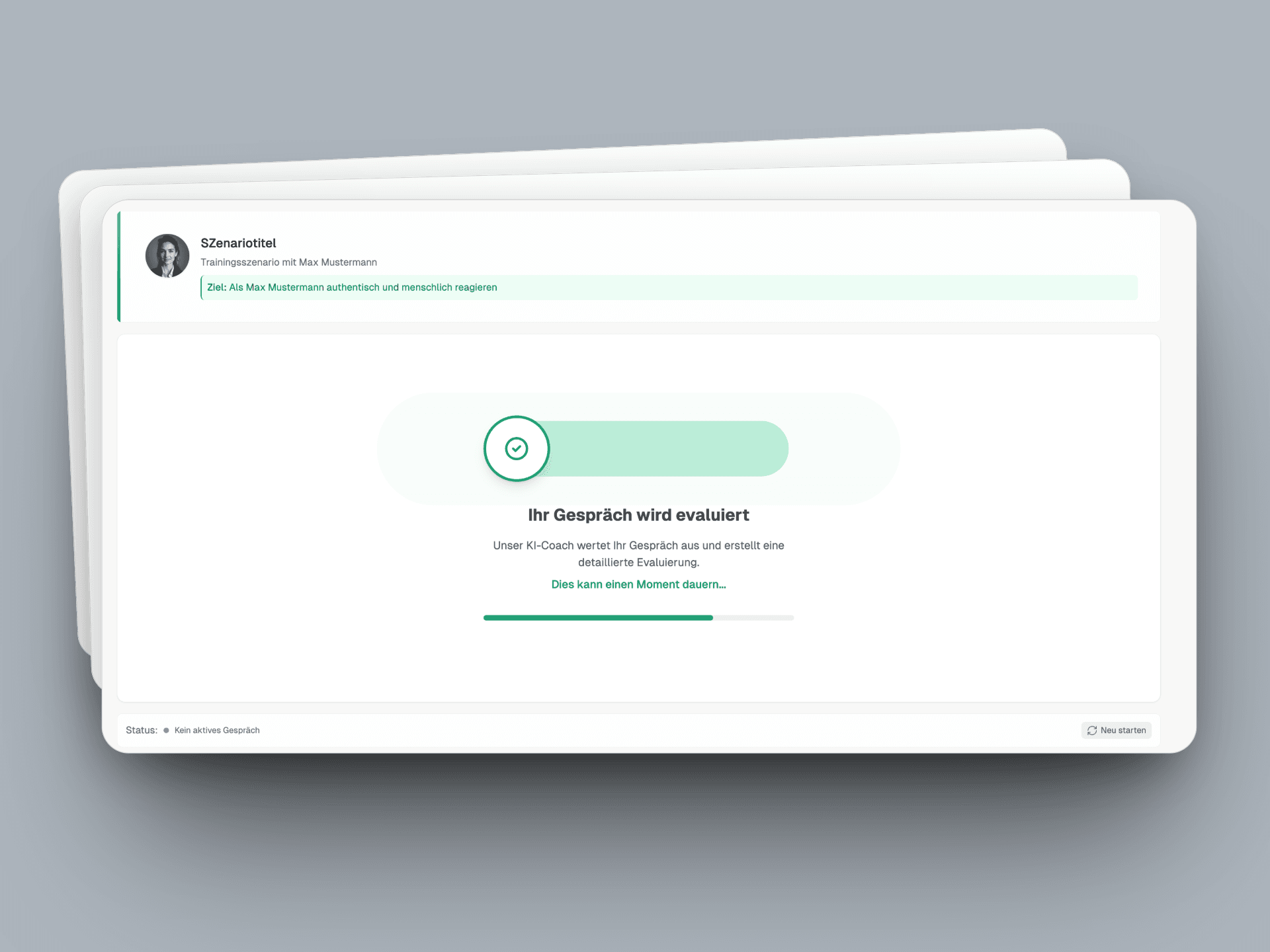
Receive Feedback
Receive detailed, constructive feedback on your Sales Conversations and concrete improvement suggestions for practice.
The 5 Phases for successful Sales Conversations
Follow this proven 5-phase structure for professional and successful Sales Conversations.
1Building Rapport
You start the conversation with a warm greeting, laying the groundwork for a relationship. This phase is crucial for establishing trust and creating an open atmosphere conducive to effective dialogue. By engaging in active listening and demonstrating genuine interest in your client’s needs and preferences, you can foster a connection that encourages more meaningful communication. It’s essential to be mindful of the tone and energy you bring to the conversation, as these elements can significantly impact the client’s comfort level. Additionally, recognizing cultural differences and adapting your approach accordingly can enhance rapport-building efforts, making the client feel understood and valued.
3-5 minutes
Building Rapport
You start the conversation with a warm greeting, laying the groundwork for a relationship. This phase is crucial for establishing trust and creating an open atmosphere conducive to effective dialogue. By engaging in active listening and demonstrating genuine interest in your client’s needs and preferences, you can foster a connection that encourages more meaningful communication. It’s essential to be mindful of the tone and energy you bring to the conversation, as these elements can significantly impact the client’s comfort level. Additionally, recognizing cultural differences and adapting your approach accordingly can enhance rapport-building efforts, making the client feel understood and valued.
About this Phase
You start the conversation with a warm greeting, laying the groundwork for a relationship. This phase is crucial for establishing trust and creating an open atmosphere conducive to effective dialogue. By engaging in active listening and demonstrating genuine interest in your client’s needs and preferences, you can foster a connection that encourages more meaningful communication. It’s essential to be mindful of the tone and energy you bring to the conversation, as these elements can significantly impact the client’s comfort level. Additionally, recognizing cultural differences and adapting your approach accordingly can enhance rapport-building efforts, making the client feel understood and valued.
Practical Tips
- Begin with a personal touch, such as a compliment or a reference to a shared experience, to create an immediate sense of connection. This could involve asking how their day is going or commenting on a recent event related to their industry.
Example Formulations
"Good day, Mr./Ms. Müller, this is Max Mustermann from XY. I’m calling because I read that you..."
"It's great that we can speak today. How are you?"
+2 more examples
Difficult Situations
"I understand that you're busy. Let's make this conversation efficient."
"I'm sorry to interrupt you. I'll keep it brief."
+2 more examples
2Needs Assessment
In this critical stage of the sales process, you will engage in a thorough needs assessment by asking targeted questions that help uncover the client’s requirements and identify their pain points. This phase is vital for establishing a deep understanding of the customer’s actual challenges and objectives. By effectively conducting a needs assessment, you lay the groundwork for presenting solutions that are tailored to the client’s specific needs, ultimately enhancing the likelihood of a successful sales outcome. Prior to the meeting, familiarize yourself with the client's industry and potential challenges they may face. This preparation allows you to ask informed questions and show genuine interest in their situation, which can help build rapport and trust.
10-15 minutes
Needs Assessment
In this critical stage of the sales process, you will engage in a thorough needs assessment by asking targeted questions that help uncover the client’s requirements and identify their pain points. This phase is vital for establishing a deep understanding of the customer’s actual challenges and objectives. By effectively conducting a needs assessment, you lay the groundwork for presenting solutions that are tailored to the client’s specific needs, ultimately enhancing the likelihood of a successful sales outcome. Prior to the meeting, familiarize yourself with the client's industry and potential challenges they may face. This preparation allows you to ask informed questions and show genuine interest in their situation, which can help build rapport and trust.
About this Phase
In this critical stage of the sales process, you will engage in a thorough needs assessment by asking targeted questions that help uncover the client’s requirements and identify their pain points. This phase is vital for establishing a deep understanding of the customer’s actual challenges and objectives. By effectively conducting a needs assessment, you lay the groundwork for presenting solutions that are tailored to the client’s specific needs, ultimately enhancing the likelihood of a successful sales outcome. Prior to the meeting, familiarize yourself with the client's industry and potential challenges they may face. This preparation allows you to ask informed questions and show genuine interest in their situation, which can help build rapport and trust.
Practical Tips
- Utilize open-ended questions to elicit comprehensive information from the client. For instance, instead of asking “Are you satisfied with your current solution?” you could ask, “What challenges are you facing with your current solution?” This encourages the client to share more about their experiences and needs.
Example Formulations
"What are your biggest challenges at the moment?"
"How are you currently addressing [topic area]?"
+2 more examples
Difficult Situations
"I understand that this is a sensitive topic. Could you help me gain a better understanding?"
"It seems that there are some challenges here. What do you see as the main issue?"
+2 more examples
3Presenting Solutions
In this phase, you present your solution while emphasizing the value it brings to the customer. This stage is crucial for convincing the customer of the relevance and benefits of your offering.
10-15 minutes
Presenting Solutions
In this phase, you present your solution while emphasizing the value it brings to the customer. This stage is crucial for convincing the customer of the relevance and benefits of your offering.
About this Phase
In this phase, you present your solution while emphasizing the value it brings to the customer. This stage is crucial for convincing the customer of the relevance and benefits of your offering.
Practical Tips
- Highlight the benefits for the customer rather than the product features.
Example Formulations
"Our solution offers you the advantage that..."
"A similar client was able to achieve XY through our solution."
+2 more examples
Difficult Situations
"I understand that you may have some reservations. Let me show you an example."
"There are often concerns about new solutions. What are your thoughts on this?"
+2 more examples
4Handling Objections
In this phase, you address the customer's objections and work to alleviate any doubts they may have. This step is crucial for convincing the customer and transforming objections into advantages.
10-15 minutes
Handling Objections
In this phase, you address the customer's objections and work to alleviate any doubts they may have. This step is crucial for convincing the customer and transforming objections into advantages.
About this Phase
In this phase, you address the customer's objections and work to alleviate any doubts they may have. This step is crucial for convincing the customer and transforming objections into advantages.
Practical Tips
- Listen attentively and identify the core of the objection.
Example Formulations
"I understand your concern. Many of our clients had similar reservations until..."
"That's a valid point. May I show you how other clients have addressed this?"
+2 more examples
Difficult Situations
"I understand that this poses a challenge for you. Shall we work together to find a solution?"
"It seems there are some concerns here. How can we address them?"
+2 more examples
5Securing the Close
In this crucial phase of the sales conversation, it is essential to summarize the discussion and propose specific next steps. This stage plays a pivotal role in finalizing the deal and establishing a clear path forward. A well-structured closing summary not only reinforces the value of your solution but also helps to address any lingering concerns the prospect may have. During this time, it’s important to reflect on the key points discussed, align them with the prospect's needs, and articulate how your product or service can meet those needs effectively. By clearly defining the next steps, you create a sense of urgency and momentum that encourages the prospect to move forward with the decision-making process.
5-10 minutes
Securing the Close
In this crucial phase of the sales conversation, it is essential to summarize the discussion and propose specific next steps. This stage plays a pivotal role in finalizing the deal and establishing a clear path forward. A well-structured closing summary not only reinforces the value of your solution but also helps to address any lingering concerns the prospect may have. During this time, it’s important to reflect on the key points discussed, align them with the prospect's needs, and articulate how your product or service can meet those needs effectively. By clearly defining the next steps, you create a sense of urgency and momentum that encourages the prospect to move forward with the decision-making process.
About this Phase
In this crucial phase of the sales conversation, it is essential to summarize the discussion and propose specific next steps. This stage plays a pivotal role in finalizing the deal and establishing a clear path forward. A well-structured closing summary not only reinforces the value of your solution but also helps to address any lingering concerns the prospect may have. During this time, it’s important to reflect on the key points discussed, align them with the prospect's needs, and articulate how your product or service can meet those needs effectively. By clearly defining the next steps, you create a sense of urgency and momentum that encourages the prospect to move forward with the decision-making process.
Practical Tips
- - Start by recapping the most critical points of the conversation. This not only reinforces the main benefits of your offering but also ensures that both you and the prospect are on the same page. Highlight any specific pain points the prospect mentioned and how your solution addresses them.
Example Formulations
"How about we schedule a meeting so I can show you this in detail?"
"Let’s discuss the next steps to ensure we’re on the right track."
+2 more examples
Difficult Situations
"I understand that you may still have some uncertainties. What can I do to help make your decision easier?"
"It seems there are still some outstanding questions. How can we address those?"
+2 more examples
Complete Sales Conversations Guide
Detailed instructions with more examples and checklists
Train Sales Conversations with AI characters
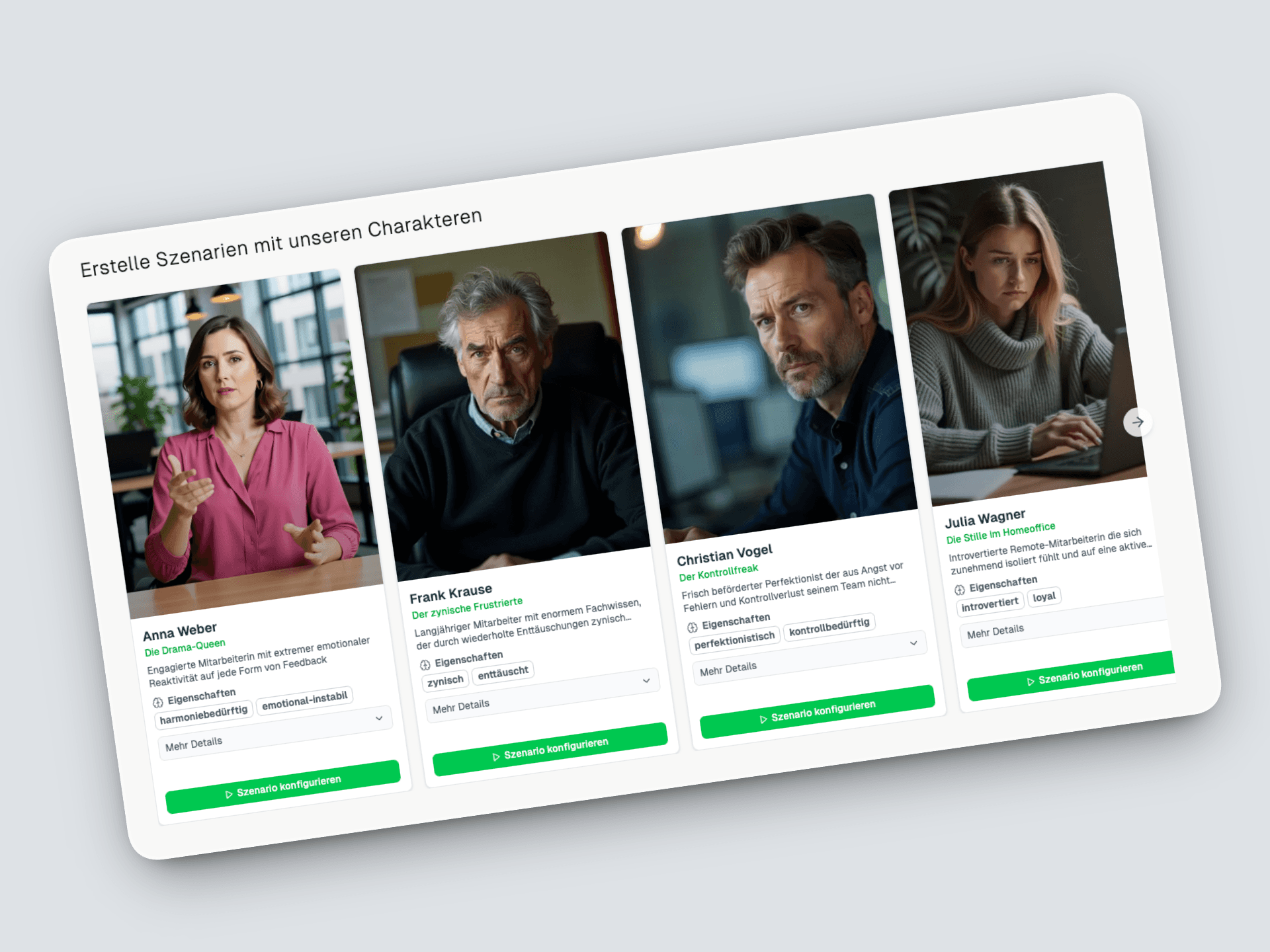
Every employee is different – and reacts differently to feedback. Our characters are built on scientifically validated personality models and simulate realistic conversation dynamics: from the insecure junior employee to the critical senior developer.
Lade Charaktere...
Prepared for everything
Practice with introverted, extroverted, defensive, or emotional characters – just like your real employees.→ No surprises in real conversations
Real reactions
The AI becomes emotional, blocks, or opens up – depending on how you conduct the conversation.→ Learn to respond to different reactions
Safe practice space
Test different approaches without consequences. Find out what works – before it matters.→ Making mistakes is allowed
More Sales Training with Careertrainer.ai
Train different conversation types and challenges in the Sales context with our AI role-plays.
Cold Calls
Do you hesitate to pick up the phone? Learn through AI role-plays how to conduct cold calls that open doors instead of shutting them. Practice with realistic gatekeepers and skeptical decision-makers until cold calling becomes second nature.
Price Negotiations
Are you too quick to offer discounts? Learn through AI role-playing how to conduct price negotiations that protect your margins instead of sacrificing them. Practice with professional buyers and gain confidence in defending your value.
Frequently Asked Questions
What is a sales conversation?
A sales conversation is a purpose-driven dialogue between a salesperson and a potential customer, aimed at initiating or deepening a business relationship. It encompasses various phases, from needs assessment to solution presentation and closing. Unlike a purely advisory discussion, a sales conversation has clearly defined commercial objectives. The art lies in aligning one's sales goals with genuine customer benefits.
Why do many sales conversations fail?
Most sales conversations fail due to a lack of needs analysis and premature solution presentation. Many salespeople talk more than they listen, thus missing the true buying motives of the customer. Additionally, the absence of closing techniques and the fear of asking for the order contribute to this issue. Without systematic training, these errors tend to repeat themselves in every conversation. With Careertrainer, you can identify your patterns and develop effective alternatives.
How does Careertrainer.ai assist me in sales conversations?
Careertrainer simulates various customer types with different buying motives, objections, and decision-making styles. You practice the complete conversation flow from the greeting to the closing, allowing you to test various techniques risk-free. The AI responds realistically to your word choice and timing, providing you with detailed feedback after each session. This way, you can improve your closing rate before risking real deals.
What distinguishes a sales conversation from a sales pitch?
The terms are often used interchangeably, though "sales conversation" is more commonly used in the B2B context and implies longer sales cycles. Sales conversations often involve multiple meetings with various stakeholders, while sales pitches tend to focus on individual transactions. In sales, there's a stronger emphasis on relationship-building and complex solutions, whereas traditional selling is geared towards quicker closures. With Careertrainer, you can train in both approaches.
Can I train complex B2B sales conversations with AI?
Complex B2B conversations are particularly well-suited for AI training. You can simulate various stakeholder perspectives, from technical decision-makers to procurement officers and executive management. The AI mimics realistic objections, buying center dynamics, and lengthy decision-making processes. Many sales professionals strategically use CareerTrainer to prepare for important client meetings or pitches.
How do I prepare for an important sales conversation?
A structured preparation includes researching the company, the industry, and the individuals involved. Define your primary conversation objective and potential fallback goals. Prepare questions that uncover needs, and anticipate common objections with suitable responses. Consider various closing scenarios. With Careertrainer, you can role-play the entire conversation, allowing you to identify gaps in your argumentation.
How do I handle price objections during a sales conversation?
Price objections are often a signal that the value has not been communicated clearly enough. Instead of immediately offering discounts, ask what exactly the customer perceives as too expensive and what they are comparing it to. Calculate the specific ROI and demonstrate the cost of inaction. It often helps to inquire about the budget the customer has allocated to make the discussion more objective. With Careertrainer, you can practice confident responses to price pressure.
How can I tell if my sales conversation was successful?
A successful sales conversation concludes with a clear next step that is actively supported by the customer. You have learned more than you have shared, and you understand the customer's true decision-making criteria. The customer has asked specific questions about implementation and timing, not just about features and pricing. Even if no immediate closing occurs, you have strengthened the relationship and advanced the sales process.
How do I conduct a sales conversation with multiple decision-makers?
When engaging with multiple participants, it is crucial to understand the roles and interests of each individual. Identify in advance or at the beginning who represents which perspective: economic, technical, or application-focused. Address each participant with arguments relevant to them and be attentive to non-verbal cues and group dynamics. Summarize at the end what is important for each stakeholder. With Careertrainer, you can specifically practice these multi-stakeholder situations.
How much time should I allocate for a sales conversation?
The optimal duration depends on the complexity of the offering and the stage in the sales process. An initial qualifying conversation typically takes 30 to 45 minutes, while a detailed needs analysis requires 60 to 90 minutes. For product demonstrations or pitches, you should plan for 45 to 60 minutes, plus additional time for questions. More important than the duration is having a clear structure with defined objectives for each phase.
What are the phases of a professional sales conversation?
A professional sales conversation typically follows five phases. It begins with the rapport-building phase to establish attention and initiate the conversation. This is followed by the needs analysis phase, where you ask targeted questions. In the presentation phase, you introduce your solution in a way that aligns with the identified needs. The objection handling phase addresses any remaining questions and concerns. Finally, the conversation concludes with the agreement on specific next steps. With Careertrainer, you can practice each of these phases and their transitions.
Does the training also work for technical sales?
Careertrainer is particularly well-suited for technical sales, as you can equip the AI customers with technical expertise and specific industry-related questions. You practice explaining complex technical concepts in an understandable way, without oversimplifying or overwhelming. The scenarios simulate typical challenges such as skeptical IT managers, detail-oriented engineers, or business-minded executives.
How can I transition from needs analysis to presentation?
The transition can be achieved by providing a brief summary of what you've heard and obtaining confirmation from the client. Summarize the key points and ask if you have understood the situation correctly. Only when the client confirms should you move on to the solution by using a sentence like, "Based on what we've discussed, I'd like to present an approach that addresses these points." This ensures that your presentation is relevant.
Can I also practice closing techniques with Careertrainer?
Yes, closing techniques are a core focus of the training. You will practice various types of closes, from alternative questions to summarization techniques and direct closing questions. The AI responds realistically to your attempts and shows you which technique works best in different situations. You will also learn to recognize buying signals and not miss the right moment to close the deal.
