
AI role-plays for leaders
Learning to Conduct Employee Conversations
From standard discussions to genuine dialogue. Engage in AI role-playing scenarios to master employee conversations that drive your team forward. Intelligent AI characters simulate various employee types, helping you communicate effectively and individually.
Try for free

Thomas Weber
Head of IT
Employee Conversation
Practice scenario
Practice a realistic conversation with our AI employee. Improve your conversation skills in a safe environment.
The Challenges in
Employee Conversationsn
In the Leadership context, conducting Employee Conversations confidently is one of the most demanding tasks. You should know these typical pitfalls to successfully master Employee Conversations.






MasterEmployee Conversationswith Careertrainer.ai
From scenario selection to detailed feedback – Careertrainer makes Employee Conversation training in the Leadership context simple, effective, and measurable.
Select Scenario
Choose the appropriate scenario from various Employee Conversations or create your own individual training scenario.
.png&w=3840&q=75)
Conduct Conversation with AI
Conduct a realistic Employee Conversation with our AI. Train different situations and conversation flows in a safe environment.
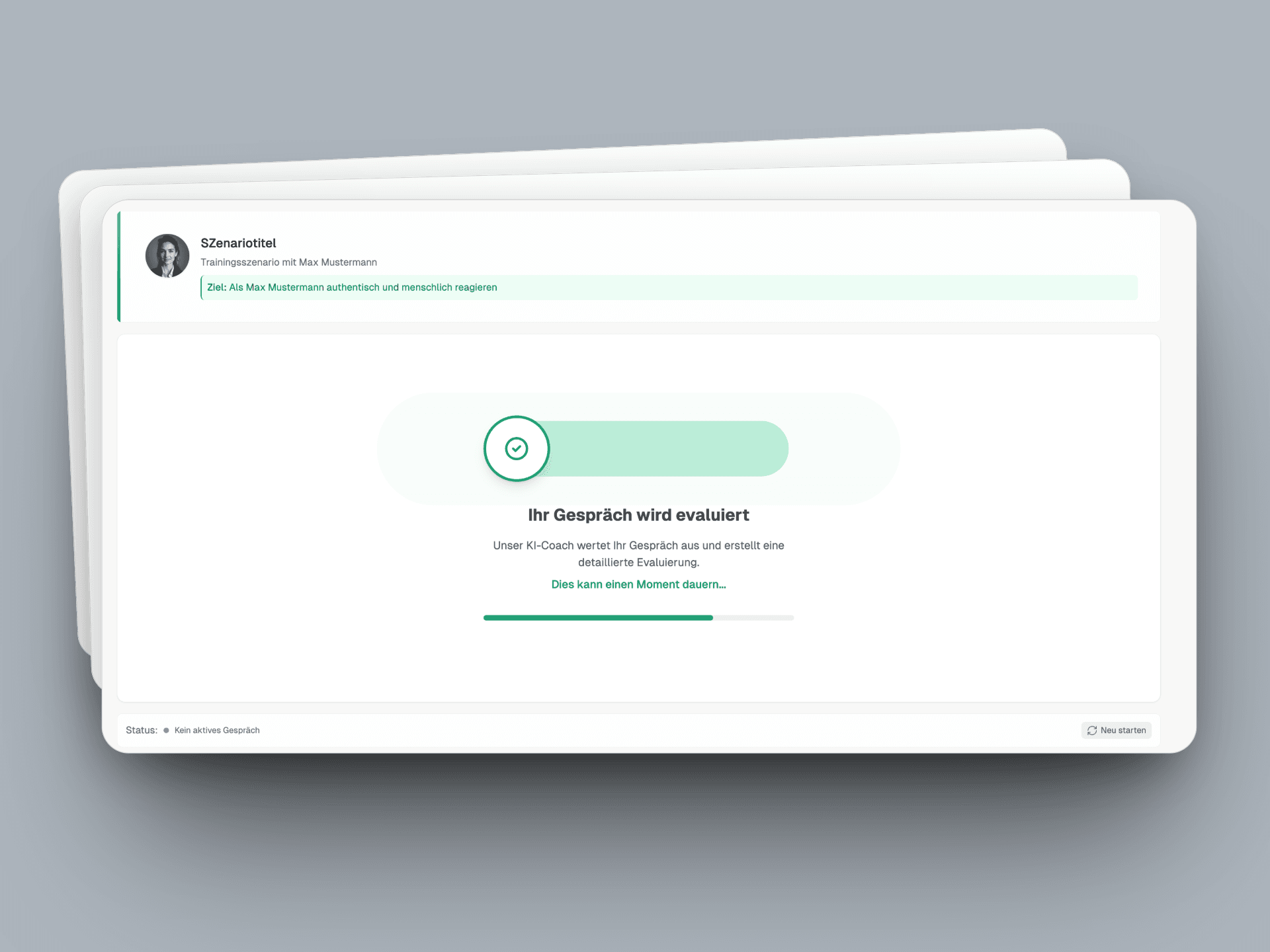
Receive Feedback
Receive detailed, constructive feedback on your Employee Conversation and concrete improvement suggestions for practice.
The 5 Phases for successful Employee Conversations
Follow this proven 5-phase structure for professional and successful Employee Conversations.
1Opening the Conversation
Begin the conversation with a warm greeting and create a pleasant atmosphere. Briefly explain the purpose of the discussion and the agenda so that both you and your employee know what to expect.
5-10 minutes
Opening the Conversation
Begin the conversation with a warm greeting and create a pleasant atmosphere. Briefly explain the purpose of the discussion and the agenda so that both you and your employee know what to expect.
About this Phase
Begin the conversation with a warm greeting and create a pleasant atmosphere. Briefly explain the purpose of the discussion and the agenda so that both you and your employee know what to expect.
Practical Tips
- Start with a positive statement. Ask how your employee is doing. Show genuine interest. Set the stage for an open and constructive conversation.
2Reflection & Analysis
Reflect together with your employee on the past period. Discuss successes, challenges, and learning experiences. Encourage them to share their perspective and provide constructive feedback.
15-20 minutes
Reflection & Analysis
Reflect together with your employee on the past period. Discuss successes, challenges, and learning experiences. Encourage them to share their perspective and provide constructive feedback.
About this Phase
Reflect together with your employee on the past period. Discuss successes, challenges, and learning experiences. Encourage them to share their perspective and provide constructive feedback.
Practical Tips
- Ask open-ended questions to prompt the employee to speak. Listen actively and summarize their statements. Provide specific and observable feedback, both positive and constructive.
3Discussion & Exchange
Delve deeper into current topics that concern the employee. Discuss developmental aspirations, potential obstacles, and ideas for the future. This segment should be a genuine dialogue, where you provide your employee with the space to express their thoughts.
15-20 minutes
Discussion & Exchange
Delve deeper into current topics that concern the employee. Discuss developmental aspirations, potential obstacles, and ideas for the future. This segment should be a genuine dialogue, where you provide your employee with the space to express their thoughts.
About this Phase
Delve deeper into current topics that concern the employee. Discuss developmental aspirations, potential obstacles, and ideas for the future. This segment should be a genuine dialogue, where you provide your employee with the space to express their thoughts.
Practical Tips
- Focus on the needs and desires of the employee. Ask about their ideas and suggestions. Stay solution-oriented and show understanding for their concerns.
4Goals & Next Steps
Collaboratively define specific and measurable goals for the upcoming period. Discuss the steps that need to be taken to achieve these goals and how you can support your employee in this process.
10-15 minutes
Goals & Next Steps
Collaboratively define specific and measurable goals for the upcoming period. Discuss the steps that need to be taken to achieve these goals and how you can support your employee in this process.
About this Phase
Collaboratively define specific and measurable goals for the upcoming period. Discuss the steps that need to be taken to achieve these goals and how you can support your employee in this process.
Practical Tips
- Set SMART goals (Specific, Measurable, Attractive, Relevant, Time-bound). Clarify responsibilities. Offer your support and consider what resources or training could be beneficial.
5Conclusion & Agreements
Summarize the key outcomes and agreements from the conversation. Thank the participant for the open discussion and schedule a follow-up appointment to review progress.
5-10 minutes
Conclusion & Agreements
Summarize the key outcomes and agreements from the conversation. Thank the participant for the open discussion and schedule a follow-up appointment to review progress.
About this Phase
Summarize the key outcomes and agreements from the conversation. Thank the participant for the open discussion and schedule a follow-up appointment to review progress.
Practical Tips
- Recap the core points and the agreed-upon actions. Confirm your enthusiasm for the implementation process. Express appreciation for your employee's time and contributions.
Our checklists for successful Employee Conversations
With a clear checklist, you prepare optimally for your Employee Conversation and avoid typical mistakes in a Leadership context.
Typical Use Cases
Discover all checklist examples and create your individual checklist with our generator on the detail page.
View all checklists for Employee ConversationsTrain Employee Conversations with AI characters
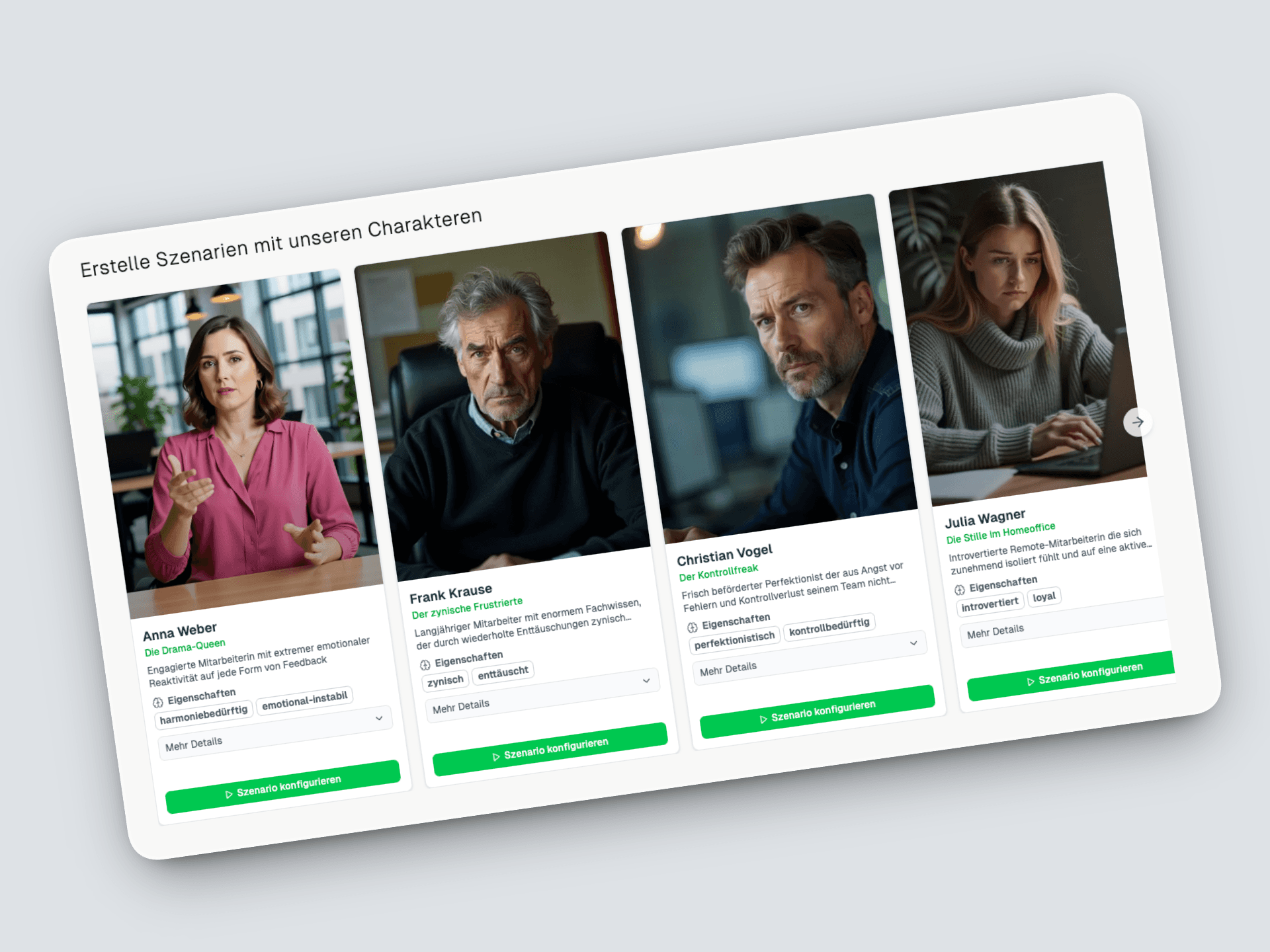
Every employee is different – and reacts differently to feedback. Our characters are built on scientifically validated personality models and simulate realistic conversation dynamics: from the insecure junior employee to the critical senior developer.
Lade Charaktere...
Prepared for everything
Practice with introverted, extroverted, defensive, or emotional characters – just like your real employees.→ No surprises in real conversations
Real reactions
The AI becomes emotional, blocks, or opens up – depending on how you conduct the conversation.→ Learn to respond to different reactions
Safe practice space
Test different approaches without consequences. Find out what works – before it matters.→ Making mistakes is allowed
More Leadership Training with Careertrainer.ai
Train different conversation types and challenges in the Leadership context with our AI role-plays.
Mediation Conversations
When team members block each other and positions harden, it's crucial to learn how to facilitate mediation conversations that transform adversaries back into colleagues. Engage in AI role-play scenarios where intelligent AI characters simulate emotional escalations and hidden power dynamics, allowing you to practice the mediator role without igniting real conflicts.
Salary Negotiations
Conquer salary negotiations without the stress. Learn to conduct salary discussions that are fair yet economically viable through AI role-playing scenarios. Various AI characters simulate different negotiation styles—from the reserved to the assertive employee.
Coaching Conversations
Does your team need development, but your advice falls flat? Learn to conduct coaching conversations that create real breakthroughs through AI role-playing. Realistic AI characters respond like actual employees—practice risk-free and become the coach who truly makes a difference.
Frequently Asked Questions
When is the right time for a performance review with an employee?
Performance reviews should take place regularly and not just when issues arise, ideally on a quarterly or semi-annual basis. Special occasions include the completion of significant projects, changes in team structure or roles, noticeable changes in performance, or when an employee actively seeks feedback. Important: Do not conduct reviews only when problems arise – especially high performers need regular appreciation and development opportunities; otherwise, they will seek these elsewhere. Avoid scheduling meetings right before vacations or during particularly stressful project phases, when neither you nor your employee will have the mental bandwidth for it.
How can I optimally prepare for an employee conversation?
Effective preparation begins with gathering specific observations—both successes and challenges—with concrete examples. Inform your employee in advance about the date and context so that they can prepare as well. Allocate sufficient uninterrupted time in a quiet room. Consider open-ended questions such as "What have been your greatest successes?" or "Where would you like more support?" instead of delivering feedback in a monologue. The proven five-phase structure helps you to approach the conversation in a structured manner, from a trusting introduction through reflection and discussion to goal setting.
What should I do if the employee responds defensively or is reticent during the conversation?
Defensive reactions often arise from uncertainty or fear of judgment. Instead of applying pressure, express your observation in a neutral way—such as, "I notice that you seem reserved. Is there something on your mind?" or "This is not a performance evaluation, but rather a conversation on equal footing." For introverted employees, concrete questions are more effective than abstract ones; for example, ask "How did you experience project X?" instead of "How are things going?" Give them time to think and be comfortable with pauses. Sometimes it takes several attempts for trust to be established.
How can I tell if the employee conversation was successful?
A successful conversation is characterized by an open atmosphere during the exchange and the employee contributing their own ideas. In the short term, both parties leave the conversation with clear agreements, and the employee appears motivated rather than frustrated. In the medium term, you will notice behavioral changes in the agreed-upon areas and active inquiries for support. In the long term, the conversation pays off with stronger commitment and higher engagement. Plan a follow-up after a few weeks to check if the measures are effective – this shows that you take the agreements seriously.
Why should we systematically train employee conversations within the company?
Employee conversations are the central lever for engagement and performance development; however, many leaders conduct them poorly or avoid them altogether. Common mistakes include poor timing when delivering critical feedback, neglecting emotional signals, and using the same communication style for all employee types. The consequences are measurable: higher turnover due to dissatisfied employees, decreasing motivation, and reduced team productivity. Systematic training empowers leaders to address different personality types and engage in meaningful development conversations instead of merely going through the motions. The return on investment from lower turnover and increased performance significantly outweighs the costs.
How do we implement employee conversation training for 50 to 100 leaders with varying levels of experience?
Careertrainer.ai enables personalized training without coordination efforts for different leadership levels simultaneously. The process begins with a demo and the setup of the admin dashboard within a few days. After that, you invite your leaders via a link and assign roles. The training starts immediately, and each leader selects relevant scenarios – from standard employee conversations to performance issues and high performer retention. The various AI characters simulate diverse employee types, ranging from introverted to confident. Each leader trains at their own pace, even in short sessions between meetings. The HR dashboard shows who is training on which scenarios and highlights where skill gaps exist.
How do we measure the success of employee conversation training in the company?
The HR dashboard provides comprehensive metrics to evaluate the effectiveness of the training. The completion rate indicates training activity, while the average score assesses conversation management based on specific criteria—open questions, active listening, and handling emotional moments. The skill gap analysis identifies challenges at the team level, such as the timing of critical feedback or managing introverted employees. Usage trends document whether leaders are engaging in continuous training or only participating once. The comparison between baseline skills and scenario performance distinguishes between generic conversation management and specific competencies. Unlike seminars with participation certificates, you receive data-driven insights for strategic personnel development.
How can I train employee conversations with AI role-playing?
Careertrainer.ai offers realistic employee conversation scenarios featuring AI characters based on the Myers-Briggs model, simulating different personality types. You engage in live audio conversations with AI employees like Sabine Fischer, a fatigued single parent, or Werner Lange, an experienced expert with a fear of technology. The AI responds authentically to your leadership style—opening up with open questions and empathy, while becoming defensive with premature critical feedback. After each conversation, you receive detailed feedback on your conversational skills, atmosphere, emotional handling, and goal setting. You train without social risk with unlimited repetitions. The platform is available 24/7 for short sessions between meetings. Test two scenarios for free without a credit card.
