
AI role-plays for leaders
Mastering Conflict Conversations
When tensions rise and emotions run high, learn to navigate conflict conversations as a confident mediator through AI role-playing scenarios. Realistic AI simulations prepare you for heated discussions and teach you effective de-escalation techniques.
Try for free

Thomas Weber
Head of IT
Conflict Conversation
Practice scenario
Practice a realistic conversation with our AI employee. Improve your conversation skills in a safe environment.
The Challenges in
Conflict Conversationsn
In the Leadership context, conducting Conflict Conversations confidently is one of the most demanding tasks. You should know these typical pitfalls to successfully master Conflict Conversations.






MasterConflict Conversationswith Careertrainer.ai
From scenario selection to detailed feedback – Careertrainer makes Conflict Conversation training in the Leadership context simple, effective, and measurable.
Select Scenario
Choose the appropriate scenario from various Conflict Conversations or create your own individual training scenario.
.png&w=3840&q=75)
Conduct Conversation with AI
Conduct a realistic Conflict Conversation with our AI. Train different situations and conversation flows in a safe environment.
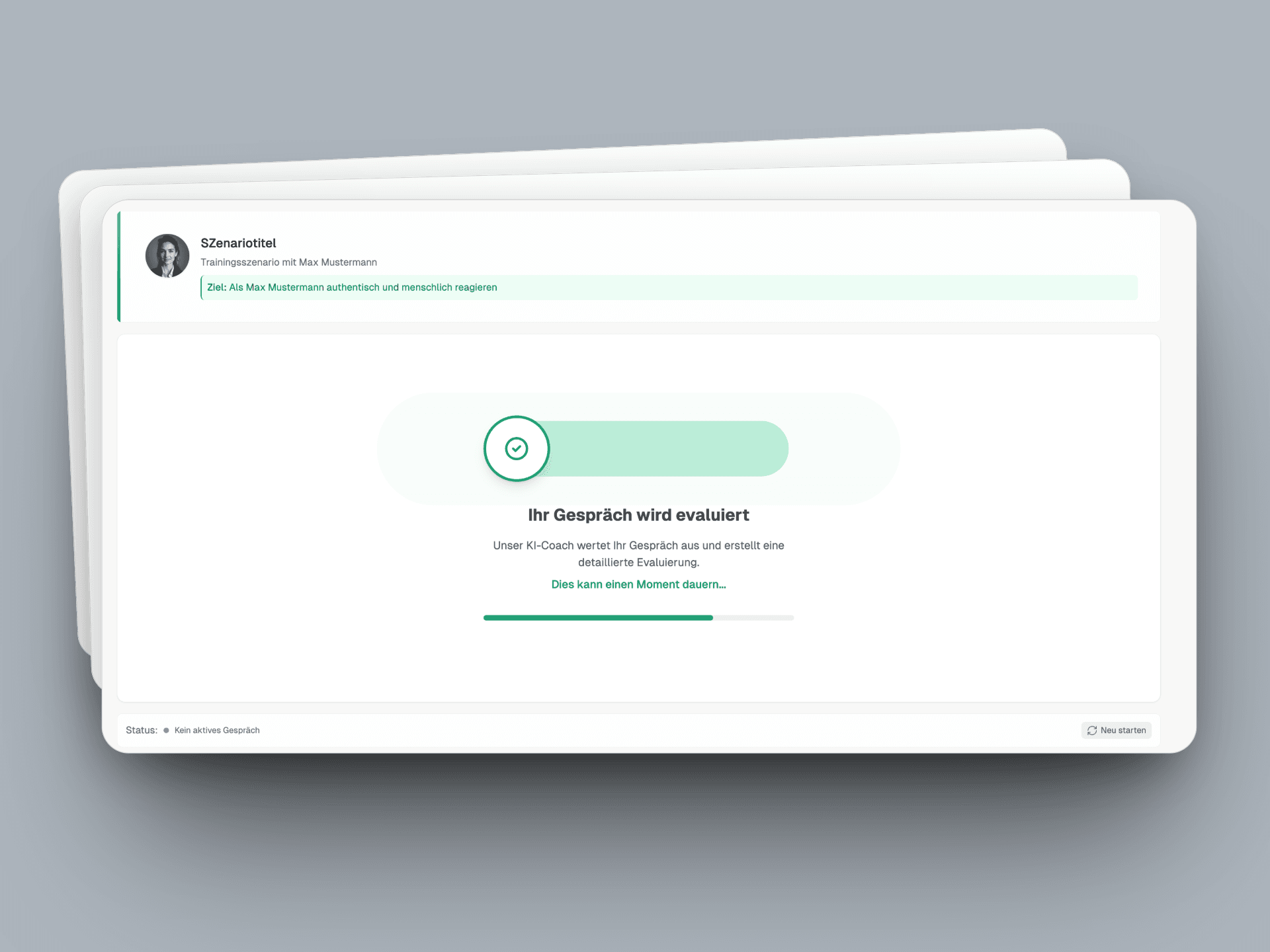
Receive Feedback
Receive detailed, constructive feedback on your Conflict Conversation and concrete improvement suggestions for practice.
The 5 Phases for successful Conflict Conversations
Follow this proven 5-phase structure for professional and successful Conflict Conversations.
1Preparation & Neutral Start
Prepare yourself by gathering all relevant information. Begin the conversation in a neutral and respectful manner to create an open atmosphere.
5-10 minutes
Preparation & Neutral Start
Prepare yourself by gathering all relevant information. Begin the conversation in a neutral and respectful manner to create an open atmosphere.
About this Phase
Prepare yourself by gathering all relevant information. Begin the conversation in a neutral and respectful manner to create an open atmosphere.
Practical Tips
- Make a note of the main points you want to address.
2Clarifying the Situation & Active Listening
Explain the situation that concerns you and practice active listening. Pay attention to the employee's perspective.
15-20 minutes
Clarifying the Situation & Active Listening
Explain the situation that concerns you and practice active listening. Pay attention to the employee's perspective.
About this Phase
Explain the situation that concerns you and practice active listening. Pay attention to the employee's perspective.
Practical Tips
- Clearly and concretely articulate your observations.
3Problem Analysis & Perspective Shift
Analyze the causes of the problem together with the employee. Try to understand the employee's point of view.
10-15 minutes
Problem Analysis & Perspective Shift
Analyze the causes of the problem together with the employee. Try to understand the employee's point of view.
About this Phase
Analyze the causes of the problem together with the employee. Try to understand the employee's point of view.
Practical Tips
- Encourage the employee to share their perspective.
4Solution Development & Agreements
Collaboratively develop solutions and agree on steps to improve the situation. Ensure that both parties contribute actively.
20-25 minutes
Solution Development & Agreements
Collaboratively develop solutions and agree on steps to improve the situation. Ensure that both parties contribute actively.
About this Phase
Collaboratively develop solutions and agree on steps to improve the situation. Ensure that both parties contribute actively.
Practical Tips
- Ask the employee for their suggestions regarding potential solutions.
5Conclusion & Follow-up
Conclude the conversation positively and summarize the key points discussed. Plan a follow-up to review progress.
5-10 minutes
Conclusion & Follow-up
Conclude the conversation positively and summarize the key points discussed. Plan a follow-up to review progress.
About this Phase
Conclude the conversation positively and summarize the key points discussed. Plan a follow-up to review progress.
Practical Tips
- Summarize the points discussed and the agreements made.
Complete Conflict Conversation Guide
Detailed instructions with more examples and checklists
Our checklists for successful Conflict Conversations
With a clear checklist, you prepare optimally for your Conflict Conversation and avoid typical mistakes in a Leadership context.
Typical Use Cases
Discover all checklist examples and create your individual checklist with our generator on the detail page.
View all checklists for Conflict ConversationsTrain Conflict Conversations with AI characters
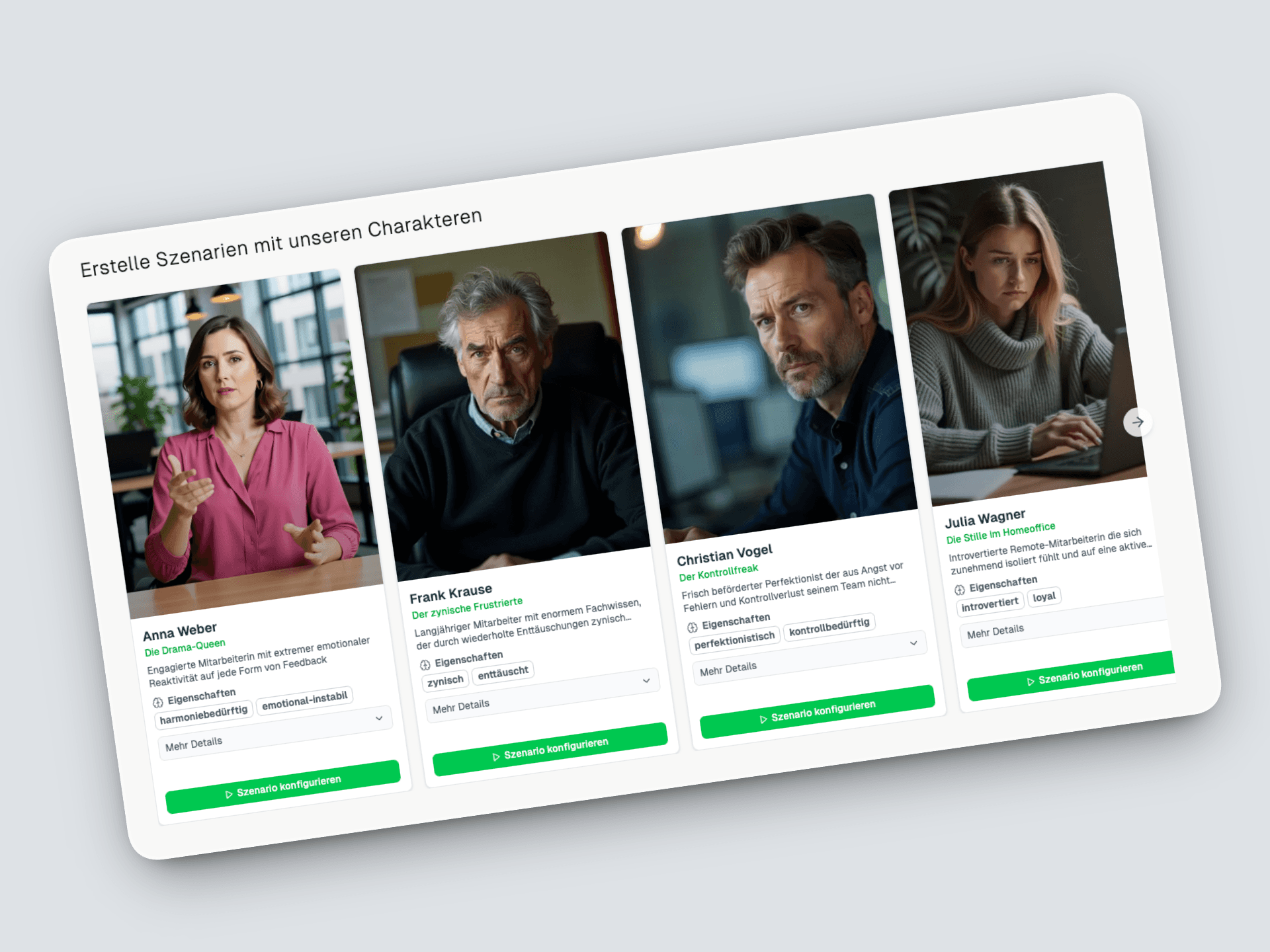
Every employee is different – and reacts differently to feedback. Our characters are built on scientifically validated personality models and simulate realistic conversation dynamics: from the insecure junior employee to the critical senior developer.
Lade Charaktere...
Prepared for everything
Practice with introverted, extroverted, defensive, or emotional characters – just like your real employees.→ No surprises in real conversations
Real reactions
The AI becomes emotional, blocks, or opens up – depending on how you conduct the conversation.→ Learn to respond to different reactions
Safe practice space
Test different approaches without consequences. Find out what works – before it matters.→ Making mistakes is allowed
More Leadership Training with Careertrainer.ai
Train different conversation types and challenges in the Leadership context with our AI role-plays.
Mediation Conversations
When team members block each other and positions harden, it's crucial to learn how to facilitate mediation conversations that transform adversaries back into colleagues. Engage in AI role-play scenarios where intelligent AI characters simulate emotional escalations and hidden power dynamics, allowing you to practice the mediator role without igniting real conflicts.
Salary Negotiations
Conquer salary negotiations without the stress. Learn to conduct salary discussions that are fair yet economically viable through AI role-playing scenarios. Various AI characters simulate different negotiation styles—from the reserved to the assertive employee.
Coaching Conversations
Does your team need development, but your advice falls flat? Learn to conduct coaching conversations that create real breakthroughs through AI role-playing. Realistic AI characters respond like actual employees—practice risk-free and become the coach who truly makes a difference.
Frequently Asked Questions
When is the right time for a conflict conversation?
Conflict conversations should take place as soon as a conflict begins to affect collaboration, but before it fully escalates. Ideal occasions include ongoing tensions between team members that impact productivity, open or hidden conflicts that strain the work environment, situations where you, as a leader, need to intervene because the parties involved cannot resolve the conflict on their own, or when colleagues actively avoid each other. Important: Do not wait until the conflict escalates and entrenched positions develop – the earlier you mediate, the greater the chance of success. However, avoid barging into the acute conflict situation. Invite the parties involved to a separate, scheduled conversation in a neutral setting.
How can I optimally prepare for a conflict conversation?
Effective preparation begins with individual discussions with both parties involved in the conflict to understand their perspectives without immediately passing judgment. Gather information about the conflict without taking sides. Choose a neutral space and allocate sufficient time without the pressure of a deadline. The proven five-phase structure can assist you: Start with a neutral, respectful introduction and clear conversation rules, clarify the facts through active listening from both sides, collaboratively analyze the causes and encourage perspective shifts, develop solutions together instead of dictating them, and agree on concrete steps with follow-up. Importantly, your role is that of a mediator, not a judge – remain neutral and help both sides find their own resolution.
How do I remain neutral in a conflict conversation when I know one of the parties better?
Neutrality is one of the greatest challenges, especially when you have a history with those involved. Honestly reflect on your own assumptions before the conversation and acknowledge them to yourself. During the discussion, ensure that both sides receive equal speaking time and that you ask questions of both parties equally. Avoid subtle signals such as nodding more at one side or interrupting gestures towards the other. If you notice that you are internally taking a position, pause briefly and take a breath. Summarize the perspectives of both sides to demonstrate that you have heard them both. If you find that you cannot remain neutral, consider bringing in a third person as a mediator – this is not a weakness but a professional approach.
What should I do if the conflict conversation escalates and becomes emotional?
When voices get louder or personal attacks begin, intervene immediately. Calmly but firmly say, "Stop, let's take a short break," or "I can see that emotions are running high. Let's take a moment to breathe." Remind everyone of the agreed-upon conversation rules: "We agreed that everyone can speak without being interrupted." Give both sides structured speaking time without interruptions. Label the emotion neutrally: "I can see that this is very upsetting for you," instead of saying, "Don't get upset." Shift the focus from accusations to needs: "What exactly do you need for the collaboration to work?" If the escalation cannot be stopped, end the conversation and schedule a new appointment—sometimes the participants need time to calm down.
Why should we systematically train conflict conversations in the company?
Conflict conversations are crucial for team dynamics and productivity; however, many leaders either avoid them or unintentionally escalate the situations. Common mistakes include starting with accusations instead of objective observations, which causes employees to become defensive immediately, unconscious bias that undermines credibility as a mediator, dictating solutions instead of collaboratively developing them, which leads to a lack of ownership, and emotional contagion, where the leader themselves gets caught in the conflict spiral. The consequences are measurable: unresolved conflicts cost an average of 15 percent of the working time of all involved, escalated conflicts lead to resignations with high recruitment costs, and a poor conflict culture poisons the entire work environment. Systematic training empowers leaders to facilitate neutrally, de-escalate situations, and develop sustainable solutions. The return on investment through improved team dynamics and reduced turnover is significant.
How do we implement conflict conversation training for larger leadership teams?
Careertrainer.ai enables personalized training without coordination efforts for various leadership levels. After setting up the admin dashboard, you invite leaders via a link, and the training starts immediately. Each leader selects relevant scenarios – from team conflicts to performance issues and personality clashes. The different AI characters simulate various conflict reactions, ranging from aggressive and defensive to closed-off and emotionally distressed. Each leader trains independently in short sessions between meetings, available 24/7. The HR dashboard displays who is training on which scenarios and where challenges arise, such as maintaining neutrality, handling escalations, or developing collaborative solutions instead of dictated measures.
How do we measure the success of conflict management training within the company?
The HR dashboard provides detailed metrics on training effectiveness. The completion rate indicates the training activity of leaders. The average score assesses mediation skills based on specific criteria such as starting neutrally without accusations, actively listening to both parties in conflict, maintaining neutrality without taking sides, successfully de-escalating emotional moments, and developing collaborative rather than dictated solutions. The skill gap analysis identifies challenges at the team level, for example, when many leaders struggle to remain emotionally neutral or when they present their own solutions too quickly. Usage trends document continuous versus one-time training. Unlike external seminars that only provide participation certificates, you receive data-driven insights for targeted adjustments.
How can I train conflict conversations with AI role-playing?
Careertrainer.ai offers realistic conflict conversation scenarios featuring multiple AI characters in conflict, based on the Myers-Briggs model. You engage in live audio conversations and practice the role of a mediator while the AI characters react emotionally, interrupt each other, or display power dynamics. The AI adjusts its responses to your moderation style – with neutral, structured moderation, the characters open up and work towards solutions, whereas bias or accusations lead to further escalation of the conflict. After each conversation, you receive detailed feedback: Were you neutral? Did you listen to both sides equally? Were you able to de-escalate? Were common solutions developed? You train without social risk with unlimited repetitions. The platform is available 24/7 for sessions lasting between 15 and 30 minutes. Try two scenarios for free without a credit card.
