
AI role-plays for leaders
Learning to Conduct Feedback Conversations
Provide feedback without causing harm, and be constructive without being overly soft. Learn to conduct feedback conversations that truly make a difference through AI role-playing scenarios. Various AI characters will demonstrate how different personalities respond to criticism.
Try for free

Thomas Weber
Head of IT
Feedback Conversation
Practice scenario
Practice a realistic conversation with our AI employee. Improve your conversation skills in a safe environment.
The Challenges in
Feedback Conversationsn
In the Leadership context, conducting Feedback Conversations confidently is one of the most demanding tasks. You should know these typical pitfalls to successfully master Feedback Conversations.





MasterFeedback Conversationswith Careertrainer.ai
From scenario selection to detailed feedback – Careertrainer makes Feedback Conversation training in the Leadership context simple, effective, and measurable.
Select Scenario
Choose the appropriate scenario from various Feedback Conversations or create your own individual training scenario.
.png&w=3840&q=75)
Conduct Conversation with AI
Conduct a realistic Feedback Conversation with our AI. Train different situations and conversation flows in a safe environment.
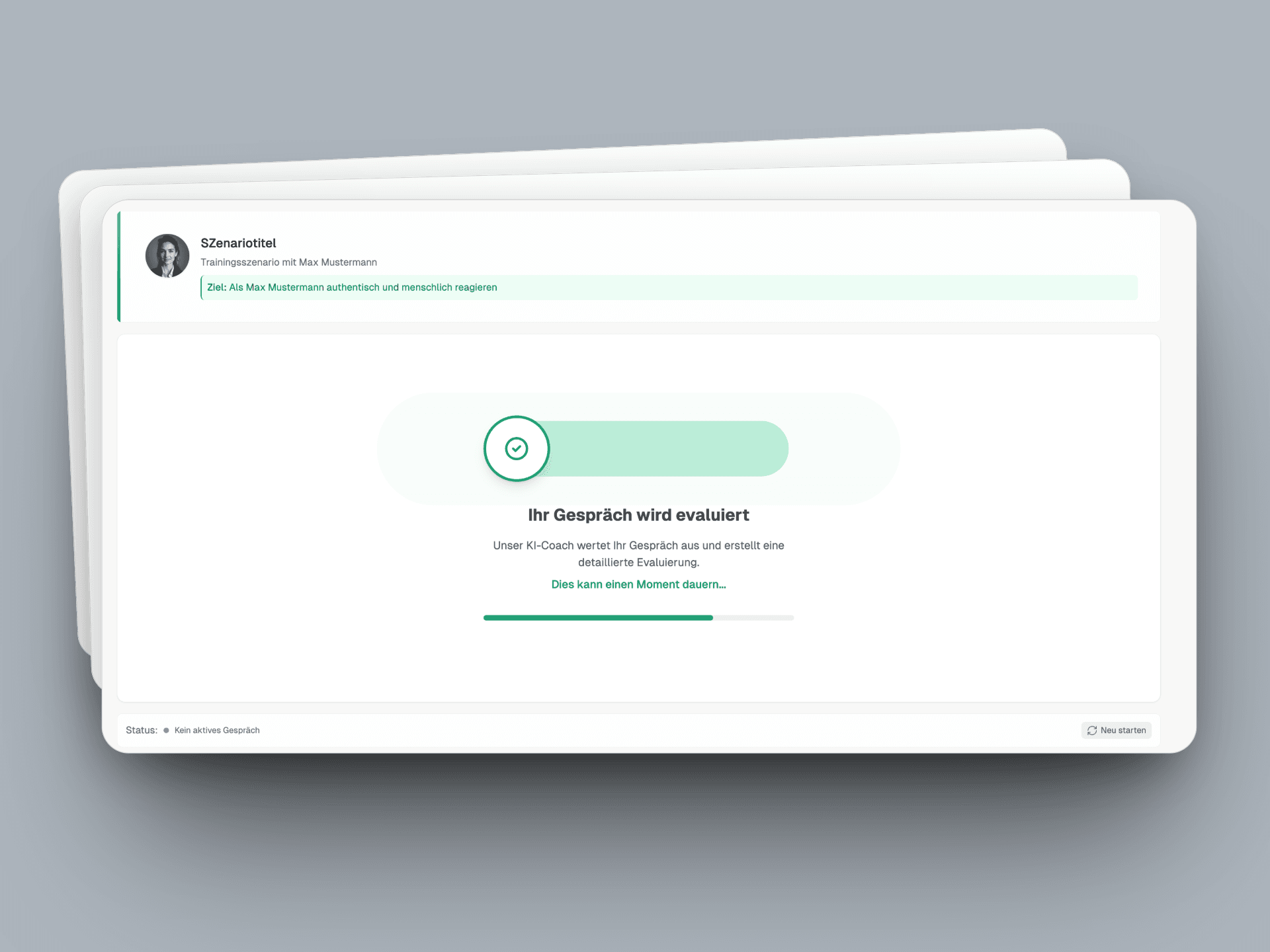
Receive Feedback
Receive detailed, constructive feedback on your Feedback Conversation and concrete improvement suggestions for practice.
The 5 Phases for successful Feedback Conversations
Follow this proven 5-phase structure for professional and successful Feedback Conversations.
1Structured Introduction
Begin the conversation with a clear agenda and a positive greeting. Ensure that the employee feels comfortable and is ready to speak openly.
5-10 minutes
Structured Introduction
Begin the conversation with a clear agenda and a positive greeting. Ensure that the employee feels comfortable and is ready to speak openly.
About this Phase
Begin the conversation with a clear agenda and a positive greeting. Ensure that the employee feels comfortable and is ready to speak openly.
Practical Tips
- Clearly and transparently explain the purpose of the conversation.
Example Formulations
"I would like to discuss the next steps with you. "
"How do you assess the current situation? "
+1 more examples
2Performance Review & Evaluation
Provide objective feedback on the employee's performance. Use specific data and examples to illustrate your points clearly.
20-25 minutes
Performance Review & Evaluation
Provide objective feedback on the employee's performance. Use specific data and examples to illustrate your points clearly.
About this Phase
Provide objective feedback on the employee's performance. Use specific data and examples to illustrate your points clearly.
Practical Tips
- Utilize concrete numbers and facts to support your evaluation.
Example Formulations
"The teamwork has improved. "
"You have achieved the project goals and met the deadlines. "
+1 more examples
Difficult Situations
"I have noticed that there are interruptions during meetings. How do you explain this? "
"The feedback on your last project was not entirely positive. What could we do differently? "
+1 more examples
3Strengths-Weaknesses Analysis
Collaborate with the employee to analyze their strengths and weaknesses. Emphasize how learning can be derived from weaknesses.
15-20 minutes
Strengths-Weaknesses Analysis
Collaborate with the employee to analyze their strengths and weaknesses. Emphasize how learning can be derived from weaknesses.
About this Phase
Collaborate with the employee to analyze their strengths and weaknesses. Emphasize how learning can be derived from weaknesses.
Practical Tips
- Focus on specific examples of strengths and weaknesses.
Example Formulations
"Your ability to convey complex information is one of your greatest strengths. "
"You have fostered a great team dynamic, which is very positive. "
+1 more examples
Difficult Situations
"I have noticed that difficulties with time management are affecting your performance. What do you think about that? "
"There is feedback that your decisions sometimes come across as impulsive. How can we work on that? "
+1 more examples
4Goal Setting & Development
Collaborate with the employee to establish clear objectives for the future and discuss development measures.
15-20 minutes
Goal Setting & Development
Collaborate with the employee to establish clear objectives for the future and discuss development measures.
About this Phase
Collaborate with the employee to establish clear objectives for the future and discuss development measures.
Practical Tips
- Formulate SMART goals (specific, measurable, achievable, relevant, time-bound).
Example Formulations
"We should create a clear plan for the upcoming months. "
"I suggest we schedule regular check-ins to discuss progress. "
+1 more examples
Difficult Situations
"It is important that we agree on realistic goals to avoid further disappointments. "
"If you are not willing to work on your weaknesses, it will be difficult to make progress. "
+1 more examples
5Documentation & Outlook
Document the discussed points and agreed-upon goals. Provide an outlook for the next feedback conversation.
5-10 minutes
Documentation & Outlook
Document the discussed points and agreed-upon goals. Provide an outlook for the next feedback conversation.
About this Phase
Document the discussed points and agreed-upon goals. Provide an outlook for the next feedback conversation.
Practical Tips
- Summarize the key points of the conversation.
Example Formulations
"I will document all the discussed points in writing. "
"We should schedule a date for our next conversation in a month. "
+1 more examples
Difficult Situations
"It's important that we document the goals in writing to avoid misunderstandings. "
"If there are any issues, we need to address them openly in our next conversation. "
+1 more examples
Complete Feedback Conversation Guide
Detailed instructions with more examples and checklists
Our checklists for successful Feedback Conversations
With a clear checklist, you prepare optimally for your Feedback Conversation and avoid typical mistakes in a Leadership context.
Typical Use Cases
Discover all checklist examples and create your individual checklist with our generator on the detail page.
View all checklists for Feedback ConversationsTrain Feedback Conversations with AI characters
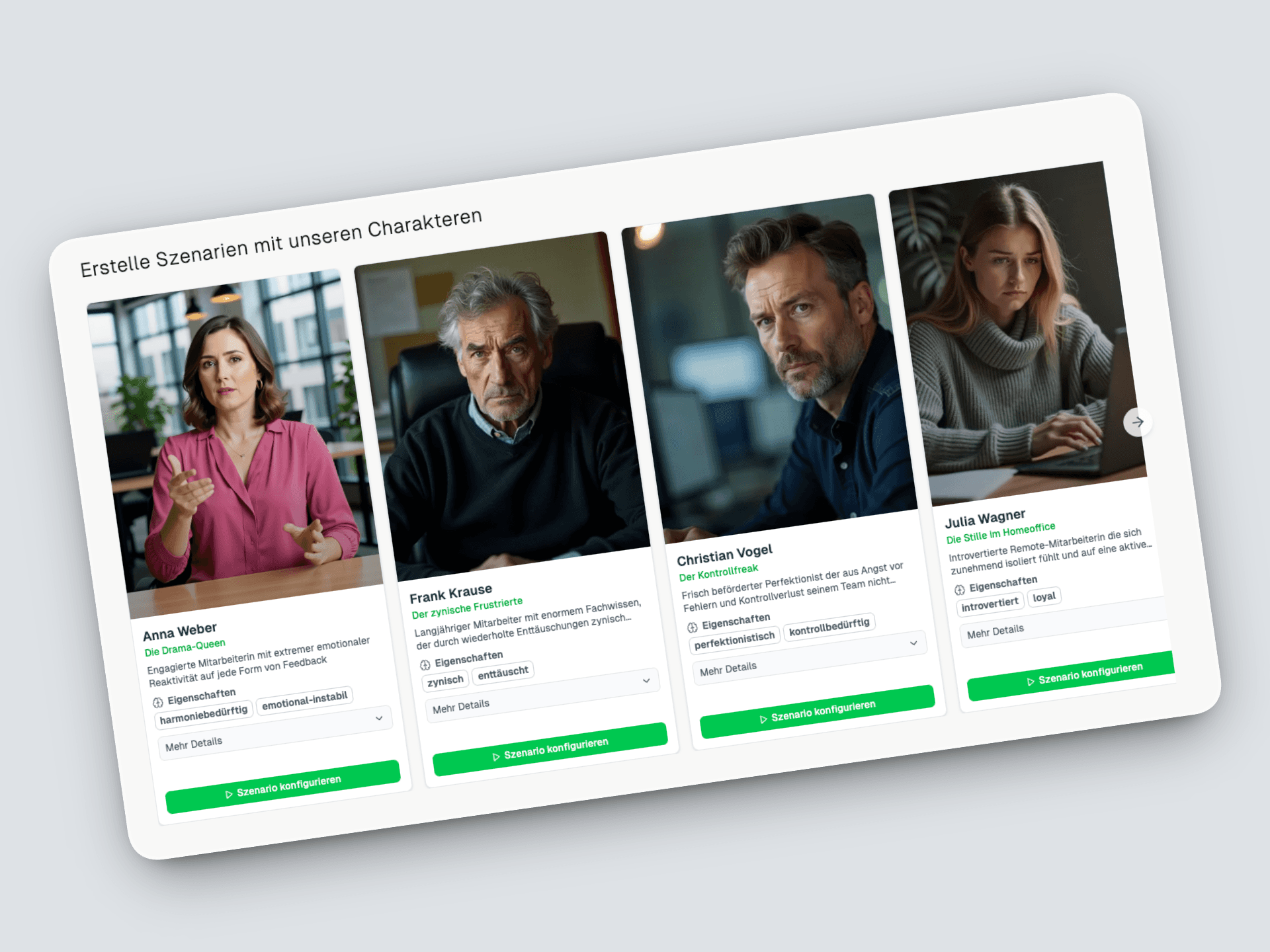
Every employee is different – and reacts differently to feedback. Our characters are built on scientifically validated personality models and simulate realistic conversation dynamics: from the insecure junior employee to the critical senior developer.
Lade Charaktere...
Prepared for everything
Practice with introverted, extroverted, defensive, or emotional characters – just like your real employees.→ No surprises in real conversations
Real reactions
The AI becomes emotional, blocks, or opens up – depending on how you conduct the conversation.→ Learn to respond to different reactions
Safe practice space
Test different approaches without consequences. Find out what works – before it matters.→ Making mistakes is allowed
More Leadership Training with Careertrainer.ai
Train different conversation types and challenges in the Leadership context with our AI role-plays.
Mediation Conversations
When team members block each other and positions harden, it's crucial to learn how to facilitate mediation conversations that transform adversaries back into colleagues. Engage in AI role-play scenarios where intelligent AI characters simulate emotional escalations and hidden power dynamics, allowing you to practice the mediator role without igniting real conflicts.
Salary Negotiations
Conquer salary negotiations without the stress. Learn to conduct salary discussions that are fair yet economically viable through AI role-playing scenarios. Various AI characters simulate different negotiation styles—from the reserved to the assertive employee.
Coaching Conversations
Does your team need development, but your advice falls flat? Learn to conduct coaching conversations that create real breakthroughs through AI role-playing. Realistic AI characters respond like actual employees—practice risk-free and become the coach who truly makes a difference.
Frequently Asked Questions
When is the right time for a feedback conversation?
Feedback conversations should take place regularly and promptly, not just during formal occasions. Ideal moments include after project completions for reflecting on collaborative work, during visible performance changes in either direction, when you identify specific areas for improvement, or when an employee actively seeks feedback. It's important to note that feedback loses its effectiveness if it comes too late—if you observe a behavior in January and only address it during the annual review in December, the employee can hardly learn from it. Avoid giving feedback in emotionally charged moments immediately after mistakes; take the time for a structured conversation.
How can I optimally prepare for a feedback conversation?
Effective preparation starts with gathering specific examples rather than vague impressions – note down particular situations that support your feedback. Consider both positive aspects and areas for improvement to provide balanced feedback. Allocate sufficient time in a quiet room free from interruptions. A proven structure can help you: Begin with a structured introduction, provide an objective performance review with concrete examples, collaboratively analyze strengths and development areas, set clear goals, and document the next steps. Focus on two to three key points instead of overwhelming the employee with a long list.
How do I find the right balance between positive and critical feedback?
Balanced feedback does not mean wrapping every criticism in praise; rather, it involves providing a complete picture. Start with specific positive observations – "Your expertise is excellent, and your analyses are precise" – and then address areas for development factually: "I see potential in your communication with clients." Avoid the sandwich approach, where criticism is hidden between two layers of praise, as this can come across as insincere. What's more important is the mindset: feedback should foster development, not diminish it. If you only focus on the negatives, the employee may lose motivation and a sense of their strengths. True balance means appreciating successes and framing areas for improvement as opportunities for growth.
What should I do if my employee reacts defensively during a feedback conversation?
Defensive reactions often occur when feedback is perceived as a personal attack rather than constructive criticism. Instead of responding to justifications, first listen: "I can see that this surprises you. Please share your perspective." Often, the employee has reasons or contexts that you may not be aware of. Focus on specific observations rather than evaluations—say, "In the last three meetings, you didn't prepare the results," instead of "You're unreliable." Make it clear that the discussion is about behavior, not the person. Ask for their perspective: "How do you see your own development in this area?" Sometimes, the employee may need time to process the feedback—plan a follow-up.
Why should we systematically train feedback conversations in the company?
Feedback conversations are crucial for performance development and employee motivation, yet many leaders conduct them ineffectively. Common mistakes include providing one-sided feedback focused only on negatives, which demotivates rather than fosters growth; engaging in monologues instead of dialogues, leaving the employee passive; addressing too many points at once, overwhelming the employee; and lacking follow-up, which causes even good feedback to fade into the background of daily routines. The consequences are measurable: employees without regular feedback show lower engagement, performance issues remain unresolved and escalate, and talented employees leave the company because they do not receive developmental support. Systematic training empowers leaders to give balanced feedback, engage in meaningful dialogues, and agree on specific development steps. The return on investment through increased performance and improved retention is clearly measurable.
How do we implement feedback training for larger leadership teams?
Careertrainer.ai enables personalized training for various leadership levels without the need for coordination. After setting up the admin dashboard, you can invite leaders via a link, and the training starts immediately. Each leader selects relevant scenarios, ranging from standard feedback to difficult conversations and defensive employee reactions. The different AI characters simulate various feedback recipients, from grateful and open-minded to surprised or uncertain when receiving criticism. Each leader trains independently in short sessions between meetings, available around the clock. The HR dashboard shows who is training on which scenarios and where challenges arise, such as in formulating constructive criticism or handling defensive reactions.
How do we measure the success of feedback conversation training within the company?
The HR dashboard provides detailed metrics on training effectiveness. The completion rate indicates the training activity of leaders. The average score assesses the quality of feedback based on specific criteria such as balanced feedback between praise and criticism, dialog-oriented rather than monological conversation management, focus on a few key points, and the agreement on concrete follow-up dates. The skill gap analysis identifies challenges at the team level, for instance, when many leaders struggle to formulate critical feedback constructively or manage defensive reactions. Usage trends document ongoing versus one-time training. Unlike external seminars that only provide certificates of attendance, you receive data-driven insights and can specifically adjust where leaders need additional support.
How can I train for feedback conversations using AI role-playing?
Careertrainer.ai offers realistic feedback conversation scenarios with AI characters based on the Myers-Briggs model, simulating various reactions to feedback. You engage in live audio conversations with AI employees who respond anywhere from grateful and development-oriented to defensive or surprised. The AI adapts its reactions to your feedback style – with constructive, balanced feedback, it opens up and generates its own improvement ideas; with one-sided negative or vague feedback, it becomes defensive or frustrated. After each conversation, you receive detailed feedback: Was your feedback balanced? Did you provide concrete examples? Did you engage in a dialogue or monologue? Were clear development steps agreed upon? You train without social risk with unlimited repetitions. The platform is available 24/7 for sessions lasting between 15 and 30 minutes. Test two scenarios for free without a credit card.
