careertrainer.ai

Intercultural training with AI role-playing games.

"Understanding Cultural Differences – Through Practical Conversations Instead of Theory"

Modern intercultural training for global teams: Your leaders practice conversations with AI characters from various cultures and countries – in German or English. From direct German to indirect Asian communication – practical and risk-free.

Product Demo

Try for free

Thomas Weber

Thomas Weber

Head of IT

Practice scenario

Practice a realistic conversation with our AI employee. Improve your conversation skills in a safe environment.

Develop cultural competence through realistic conversation simulations.

Intercultural training for effective global leadership.

Our intercultural training goes beyond theory: Your leaders engage in real conversations with AI characters from various cultures and experience how differently people respond to the same leadership, depending on their cultural background and communication style.

Intercultural training featuring AI characters from various countries and cultures.

Our intercultural training features over 50 AI characters representing diverse cultural backgrounds: direct Northern European communication versus indirect Asian politeness, hierarchy-sensitive Eastern European employees versus egalitarian Scandinavian teams, expressive Southern European personalities versus reserved, fact-oriented characters. Each character responds authentically based on cultural norms.

Diverse cultural backgrounds: German, British, French, Spanish, Indian, Chinese, Japanese, American.

Different Communication Styles: Direct vs. Indirect, Low Context vs. High Context, Emotional vs. Factual

Cultural-specific response patterns: What is considered respectful? When does someone feel overlooked? How is criticism received?

Understanding Hierarchy: Authority-oriented (India, China) vs. Egalitarian (Scandinavia, Netherlands)

Intercultural training featuring AI characters from various countries and cultures.

Intercultural training available in multiple languages – German and English offered.

Our intercultural training programs are available in both German and English. German leaders can practice critical conversations in English before managing international teams. The AI characters are fluent in both languages and adjust their expressions to align with the cultural norms of each language—British English sounds different from American English.

Integrated language training: Practice leadership conversations in English without the fear of language barriers.

Cultural Expression: British Understatement vs. American Directness

Accent Variety: Indian English, Chinese English, European English – realistic and authentic.

Train Code-Switching: Switch between formal and informal language depending on the cultural context.

Intercultural training available in multiple languages – German and English offered.

Intercultural conflict resolution with culturally sensitive AI characters.

In our intercultural training programs, your leaders will experience how cultural misunderstandings arise and how to resolve them professionally. A German manager gives direct feedback, while an Indian employee feels embarrassed. An American colleague frequently interrupts, leaving a Japanese colleague resignedly silent. Our AI realistically simulates these dynamics.

Typical intercultural conflicts: Direct criticism vs. saving face, punctuality vs. flexible perception of time.

Recognizing Cultural Triggers: What escalates in which culture? Where are people particularly sensitive?

Adaptive Leadership: Learning to Communicate the Same Content in Culturally Appropriate Ways

Mediation Between Cultures: Facilitating Conflicts Among Team Members from Different Countries

Intercultural conflict resolution with culturally sensitive AI characters.

Measurable intercultural competence through detailed performance analysis.

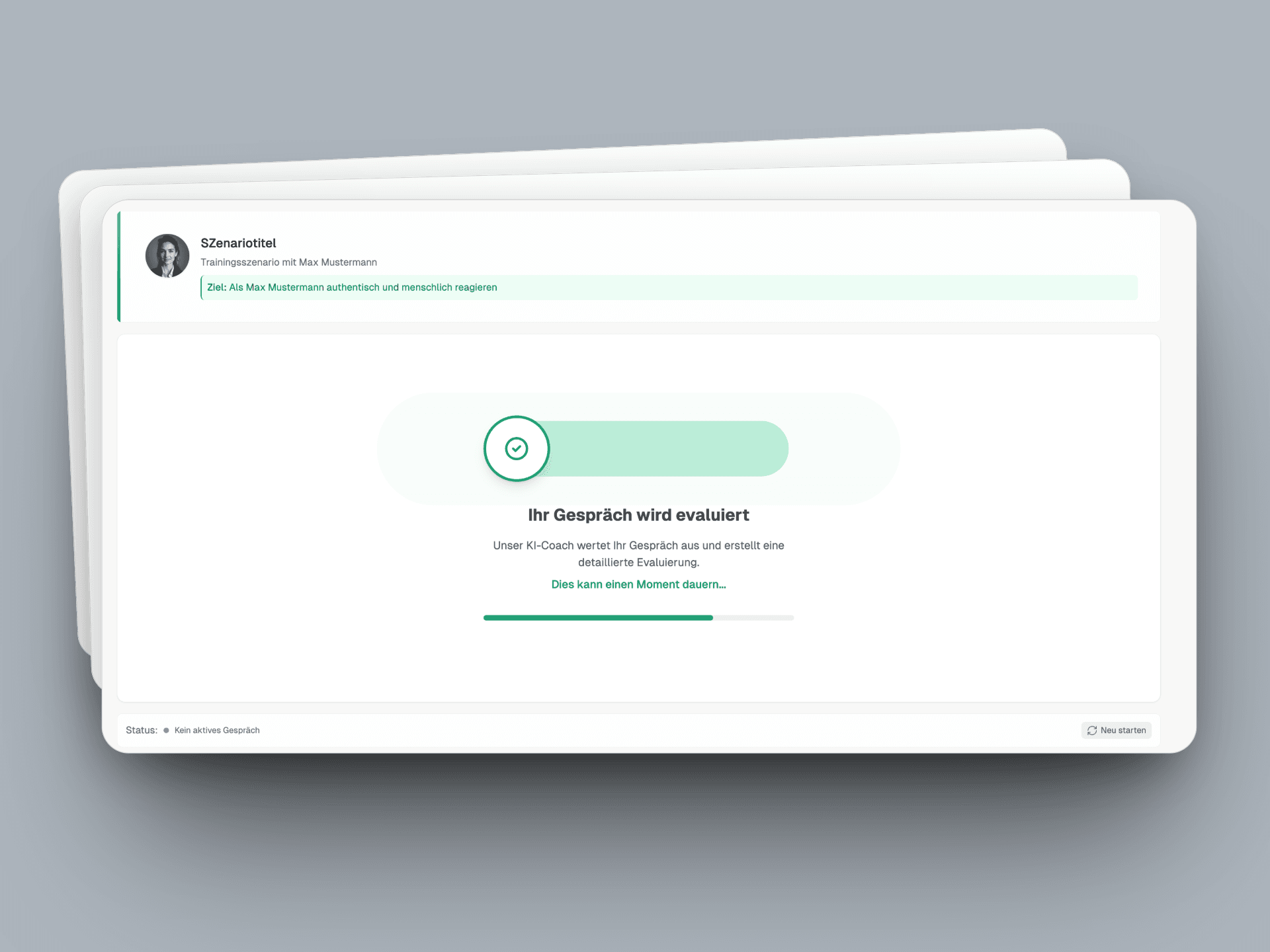
After each conversation in our intercultural training sessions, you will receive feedback on your cultural sensitivity: Did you recognize cultural signals? Was the communication adapted to the cultural context? Did you avoid stereotypical assumptions? The AI evaluates your intercultural leadership skills and highlights specific areas for improvement.

Cultural Sensitivity: Were cultural norms respected? Were non-verbal cues taken into account?

Adaptability: Has the communication style been tailored to the culture, or has it remained rigid?

Avoiding stereotypes: Did the leader recognize individual personality rather than just nationality?

Specific improvement suggestions: "In Asian cultures, indirect criticism is more effective – try SBI feedback."

Measurable intercultural competence through detailed performance analysis.
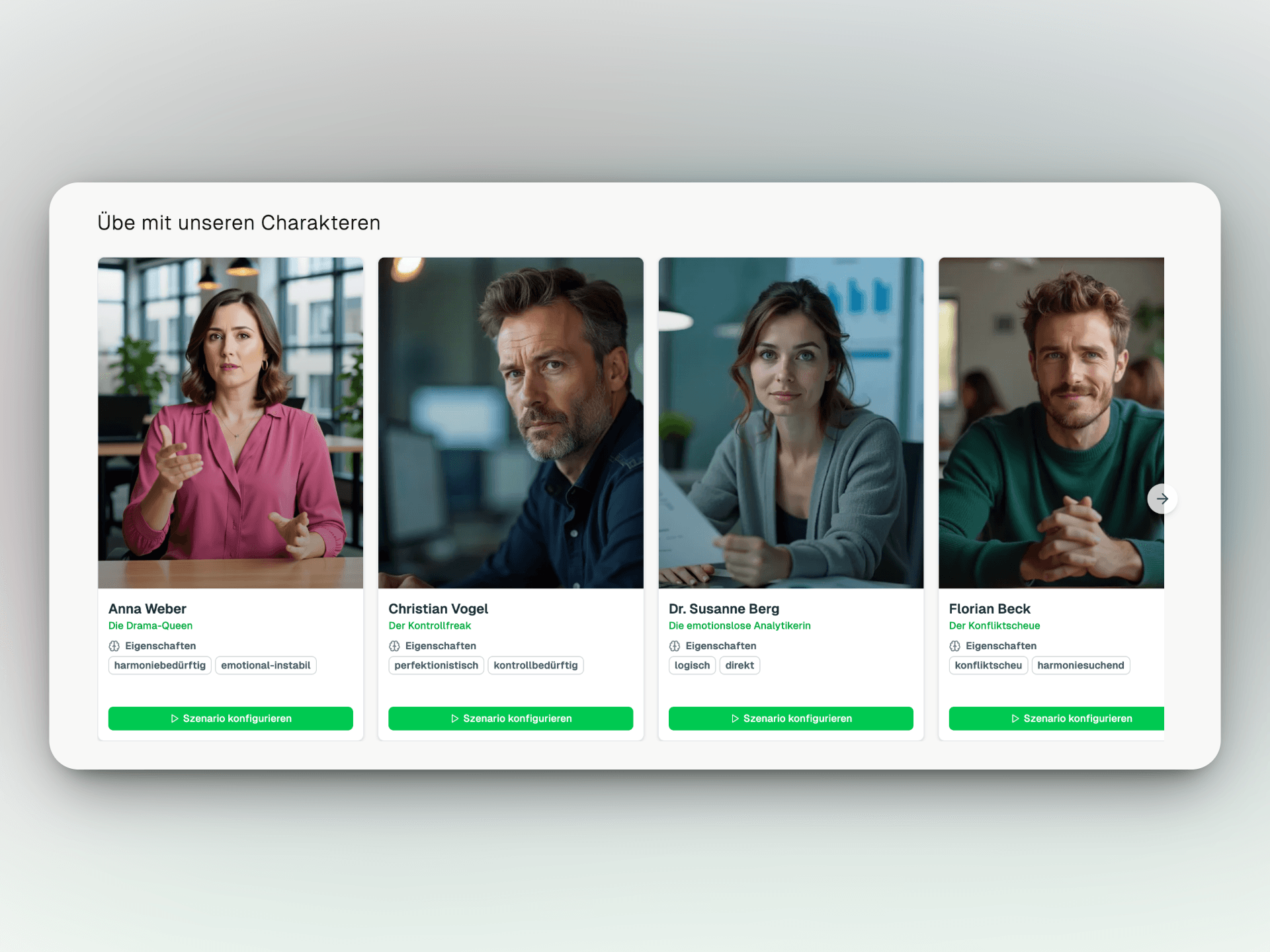
AI Character Library

Practice with realistic personalities

Every employee is different – and reacts differently to feedback. Our characters are built on scientifically validated personality models and simulate realistic conversation dynamics: from the insecure junior employee to the critical senior developer.

Every character reacts differently

Thomas Weber

Thomas Weber

The skeptical IT decision-maker

IT & Cybersecurity

Analytical and slightly defensive – defends his team even though he knows NIS2 can't be managed alone.

references internal know-howblocks external solutionswants complement not replacement
Introverted
Extroverted
Detail-oriented
Conceptual
Analytical
Emotional
Structured
Flexible
Andreas Kaufmann

Andreas Kaufmann

The cautious administrator

Real Estate Management

Manages commercial properties, sees the topic as 'a few years away'. Only recommends, never decides himself.

refers to owner's decisiondefers urgencywants to see concrete impact
Introverted
Extroverted
Detail-oriented
Conceptual
Analytical
Emotional
Structured
Flexible
Dr. Anna Berger

Dr. Anna Berger

The ambitious part-time returner

Healthcare

Excellent senior doctor returning with a part-time request. Fears part-time will be seen as a career brake.

emphasizes capabilityimmediately sets perception boundariesseeks creative solutions when understood
Introverted
Extroverted
Detail-oriented
Conceptual
Analytical
Emotional
Structured
Flexible
Timo Lindner

Timo Lindner

The charming facade carrier

Corporate Management

Charming, clever, talks his way out of everything. Beneath the facade: growing exhaustion and inability to ask for help.

deflects with charmbecomes irritated when confrontedcan't ask for help
Introverted
Extroverted
Detail-oriented
Conceptual
Analytical
Emotional
Structured
Flexible
16+
Different Personality Types
50+
Realistic scenarios
24/7
Available for training anytime
Use Cases

What do others use Careertrainer.ai for?

Typical scenarios for leaders, team managers, and anyone who wants to have better conversations

Onboarding for new leaders

Productivity from week 2 instead of month 6. New leaders practice their first difficult conversations before they have to lead them – from the first feedback conversation to taking over a team. No more learning by doing with real employees.

  • Practice first leadership conversations risk-free
  • Avoid typical beginner mistakes
  • Faster effectiveness in the new role
  • Structured onboarding program with progress tracking
Thomas Weber
Frank Zimmermann
Karl-Friedrich Moser
Total ProgressWeek 1
First feedback conversation practicedTeam meeting simulated
Discover onboarding solution

Choose your plan

Every plan gives you access to leadership and sales training – the difference is volume and feature set.

Free

0
3 conversations total

Start immediately – no credit card. 3 real role-plays for leadership or sales.

  • 3 training conversations (no expiry)
  • Leadership & sales scenarios to try
  • Detailed AI feedback after each conversation
Start for free

Basic

14,99/month
15 conversations per month

For regular leadership and sales training – flexible, no scheduling needed.

  • 15 conversations per month
  • All standard scenarios: leadership & sales
  • AI Role-play Generator – create your own scenarios
  • Detailed performance evaluation with score
  • Progress tracking
  • Email support
Choose Basic
Popular

Pro

29,99/month
40 conversations per month

The most popular choice for ambitious leaders and sales professionals.

  • 40 conversations per month
  • All premium scenarios: leadership & sales
  • AI Role-play Generator – create your own scenarios
  • Detailed performance evaluation with score
  • Progress tracking over time
  • Personalized learning recommendations
  • Priority support
Choose Pro

Unlimited

59,99/month
Unbegrenzte Gespräche

No quota, no waiting – train as often as you want, whenever you want.

  • Unlimited conversations
  • All premium scenarios: leadership & sales
  • AI Role-play Generator – create your own scenarios
  • Detailed performance evaluation with score
  • Progress tracking over time
  • Personalized learning recommendations
  • Priority support
Choose Unlimited

Still have questions? We're happy to advise you.

Contact Us

FAQs

What distinguishes your intercultural training from traditional cultural workshops?
Classic intercultural training programs focus on theories of cultural dimensions (Hofstede, Lewis Model, GLOBE) and provide Dos and Don'ts for various countries. Our intercultural training allows leaders to experience these differences firsthand: they engage in real conversations with AI characters from diverse cultures and immediately feel how the same leadership approach can have varying effects. Direct feedback may frustrate an Indian employee, while it motivates a German one. This practical experience leaves a lasting impression—far more impactful than theoretical country lists.
Which cultures and countries are covered in the intercultural training sessions?
Currently available are characters with the following cultural backgrounds: Western Europe (Germany, UK, France, Spain, Netherlands, Scandinavia), North America (USA, Canada with varying communication styles), Asia (India, China, Japan with hierarchy-oriented patterns), and Eastern Europe (Poland, Czech Republic with respect-based structures). Each character is uniquely crafted—non-stereotypical and featuring realistic personality traits influenced by cultural norms.
Can I also improve my business English through the intercultural training?
Yes, the intercultural training sessions are ideal for practical Business English training. German executives can practice critical employee conversations in English: providing feedback, resolving conflicts, and conducting development discussions—all in a natural language environment. The AI characters speak fluent English with various accents (British, American, Indian, Chinese), allowing you to become accustomed to different pronunciations. You will not only train grammar but also culturally appropriate communication in English.
How realistic are the cultural differences in the AI characters?
Very realistic due to three factors: Culture-specific behavior patterns (e.g., a Japanese character avoids saying "no" directly, while an Indian character shows respect for hierarchy even in disagreements), authentic reactions (Asian characters feel embarrassed by public criticism, while Northern Europeans appreciate direct communication), and individual personalities within cultural norms (not every German is ultra-direct, and not every Indian is hierarchical). We avoid stereotypes and portray realistic individuals shaped by their culture.
Are the intercultural training sessions suitable for expatriates prior to international assignments?
Perfect for Expat Preparation. Before German managers head to China, India, or the USA, they can practice with our intercultural training: How do I lead hierarchy-oriented Chinese teams? How do I give indirect feedback in Japan? How do I navigate the informal US corporate culture? The AI characters prepare them for cultural realities, ensuring expatriates arrive ready and informed, rather than learning through awkward mistakes.
Can we customize the intercultural training to our specific target countries?
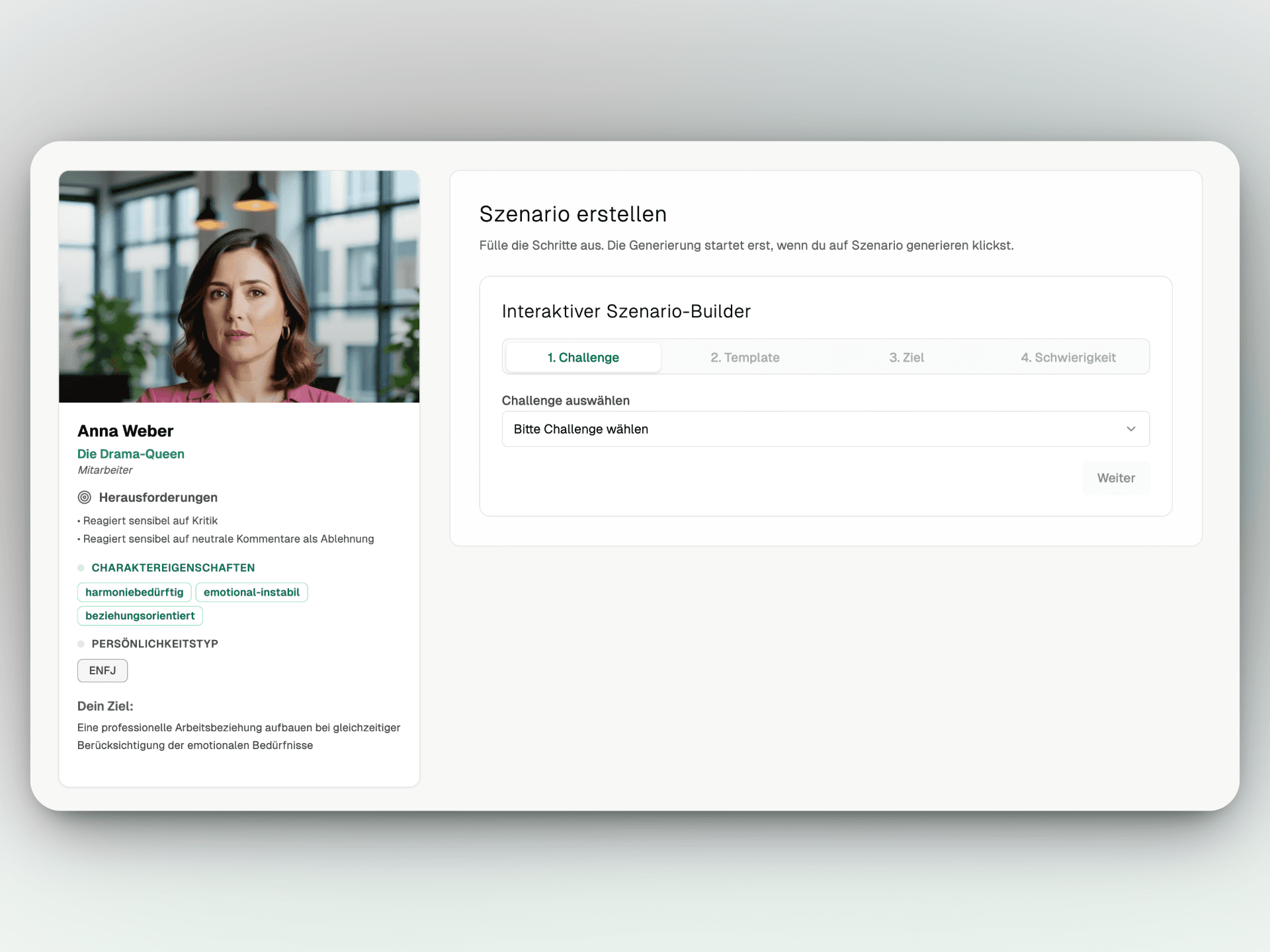
Yes, with the Scenario Builder, you can create custom scenarios tailored to your specific markets and cultures. If your leaders primarily work with Indian development teams, we will design characters and scenarios specifically for that context. When expanding into the Chinese market, we focus on hierarchical communication and face-saving strategies. Our intercultural training adapts to your global business realities.
How do the intercultural trainings avoid cultural stereotypes?
We differentiate between cultural tendencies and stereotypes: Cultural tendencies are statistically supported preferences (e.g., indirect communication in Japan), while stereotypes are broad generalizations (e.g., all Japanese people are polite and submissive). Our AI characters possess unique personalities influenced by cultural norms—but not determined by them. For instance, you might encounter a German character who reacts emotionally or a Japanese character who is surprisingly direct. This helps leaders understand that culture influences behavior but does not define it.
Do intercultural training programs also work for virtual international teams?
Absolutely, we have tailored scenarios for remote leadership in multicultural teams: motivating without physical presence across cultural boundaries, moderating conflicts in video calls between team members from different countries, facilitating culturally appropriate asynchronous communication (via Slack, email), and coordinating time zone differences and flexible working hours. Remote work often amplifies cultural misunderstandings—our intercultural training prepares you for this.
How long do the intercultural trainings last?
An individual intercultural conversation simulation lasts 15-25 minutes—short enough to fit between meetings, yet long enough for genuine learning. For systematic development of intercultural competence, we recommend the following schedule: Weeks 1-2: Foundations (5-6 scenarios featuring different cultures); Weeks 3-4: Deepening (specific conflict situations); Weeks 5-6: Application (complex team configurations). This totals 6-8 weeks with 2-3 sessions per week for sustainable intercultural leadership skills.
Can non-German-speaking employees also benefit from the intercultural training?
Yes, the intercultural training sessions are fully available in English. International teams can train in English, while German teams can practice in German. This is perfect for multinational corporations: a unified training platform for all locations, allowing everyone to work in their preferred language. The AI characters are authentically designed in both languages and adapt their communication to the respective cultural context.
How do we measure the effectiveness of our intercultural training programs?
Measurable outcomes on multiple levels: Quantitative metrics in the HR dashboard (Completion Rates, Performance Scores, improvement over time), qualitative feedback analyses (reduced cultural misunderstandings, increased cultural sensitivity in scores), and business impact (fewer conflicts in international teams, higher employee satisfaction among foreign colleagues, successful expatriate assignments without early returns). Additionally, we recommend 360° feedback before and after intercultural training specifically focused on intercultural competence.
More Solutions

More Careertrainer.ai Solutions

Discover more professional solutions for your leadership development.